


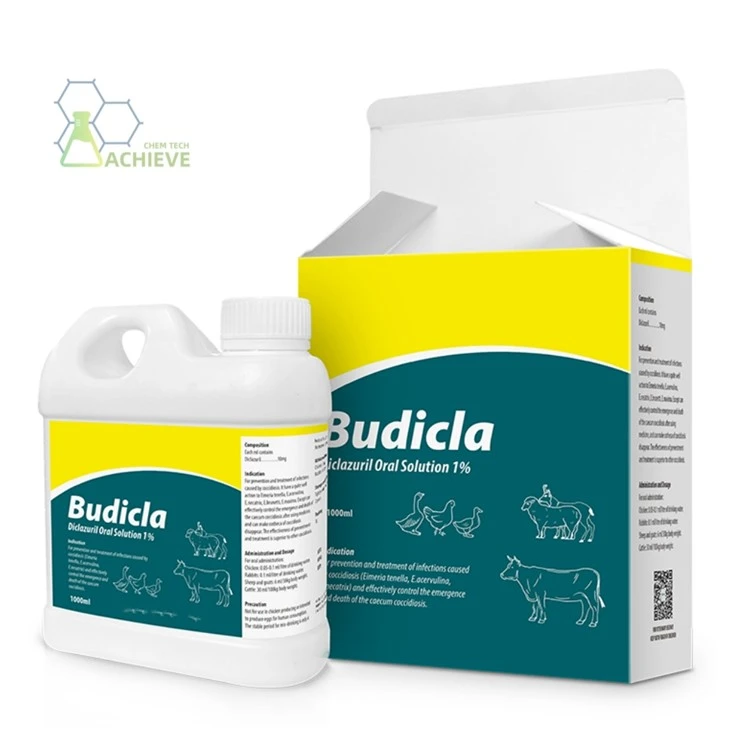


Shaanxi BLOOM Tech Co., Ltd. is one of the most experienced manufacturers and suppliers of diclazuril solution in China. Welcome to wholesale bulk high quality diclazuril solution for sale here from our factory. Good service and reasonable price are available.
The core component of Diclazuril solution is Diclazuril, with the chemical name:
2,6‑dichloro‑α‑(4‑chlorophenyl)‑4‑(4,5‑dihydro‑3,5‑dioxo‑1,2,4‑triazin‑6(2H)‑yl)‑benzonitrile, belonging to the triazine phenylacetonitrile class of compounds. Its molecular formula isC₁₇H₉Cl₃N₄O₂, and its molecular weight is approximately 407.64.
This drug is a broad‑spectrum, highly effective, and low‑toxicity anticoccidial agent that exerts its potent killing effect by interfering with the nucleic acid synthesis and normal cellular metabolism of coccidia. It acts on multiple developmental stages of coccidia, including the schizogony and gametogony phases, inhibiting parasite proliferation and preventing further infection in the host.
Our products




Diclazuril +. COA
 |
||
Certificate of Analysis |
||
|
Compound name |
Diclazuril | |
|
CAS No. |
101831-37-2 | |
|
Grade |
Pharmaceutical grade | |
|
Quantity |
Customized | |
|
Packaging standard |
Customized | |
| Manufacturer | Shaanxi BLOOM TECH Co., Ltd | |
|
Lot No. |
202601090069 | |
|
MFG |
Jan 9th 2026 | |
|
EXP |
Jan 8th 2029 | |
|
Structure |
|
|
| TEST STANDARD | GB/T24768-2009 Industry. Stnndard | |
|
Item |
Enterprise standard |
Analysis result |
|
Appearance |
White or almost white powder |
Conformed |
|
Water content |
≤4.5% |
0.30% |
| Loss on drying |
≤1.0% |
0.15% |
|
Heavy Metals |
Pb≤0.5ppm |
N.D. |
|
As≤0.5ppm |
N.D. | |
|
Hg≤0.5ppm |
N.D. | |
|
Cd≤0.5ppm |
N.D. | |
|
Purity (HPLC) |
≥99.0% |
99.5% |
|
Single impurity |
<0.8% |
0.48% |
|
Residue on ignition |
<0.20% |
0.064% |
|
Total microbial count |
≤750cfu/g |
80 |
|
E. Coli |
≤2MPN/g |
N.D. |
|
Salmonella |
N.D. | N.D. |
|
Ethanol (by GC) |
≤5000ppm |
400ppm |
|
Storage |
Store in a sealed, dark and dry place at-20 degrees |
|
|
|
||


Diclazuril solution is a triazine broad-spectrum anti coccidiosis drug with Dicrazuril as the core ingredient. With its high efficiency, low toxicity, and broad-spectrum characteristics, it has become an important choice for the prevention and control of coccidiosis in poultry, livestock, and special economic animals. This article will systematically analyze the scope of indications and scientific medication strategies from four dimensions: drug mechanism of action, core indications, clinical application scenarios, and medication precautions.
Formulation specifications and characteristics
Dikezhuli solution is usually an almost colorless to pale yellow clear liquid, with common specifications including:
0.5% solution: Each 100ml contains 0.5g of Dikezhuli, and the packaging is usually 100ml/bottle x 60 bottles/box or 100ml x 32 bottles, etc.
Compound formulation: Some products are added with tocilizumab (such as 0.5% dicozumab+2.5% tocilizumab) to expand the spectrum of anti coccidiosis.
Solubility and stability
Dikezhuli raw material is almost insoluble in water and ethanol, but soluble in alkaline water, slightly soluble in dimethylformamide (DMF), and slightly soluble in tetrahydrofuran (THF). The stability of the solution is poor, and the stability period of the drinking water solution is only 4 hours. It needs to be prepared and used immediately, otherwise the efficacy will significantly decrease.
Dikezhuli belongs to the triazine phenylacetonitrile class of compounds, and its anti coccidial effect has the following characteristics:
Full stage inhibition: It has inhibitory effects on the development of conidia, first generation schizonts, second generation schizonts, and gametophytes of nematodes, but the peak period of action is concentrated in the early stages of conidia and first generation schizonts.
Dual action mechanism:
Nucleic acid synthesis blockade: interferes with cell division by inhibiting coccidian DNA replication and RNA transcription.
Metabolic disorder induction: disrupts mitochondrial energy metabolism, leading to the death of coccidiosis.

Core indications: covering various animal coccidiosis

(I)Prevention and control of poultry coccidiosis
Pathogen spectrum: It has a highly effective killing effect on five major pathogenic nematodes, including E. tenella, E. acervulina, E. necrotrix, E. brunetti, and E. maxima.
Clinical features:
Cecal coccidiosis: bloody stool, pale coronal hair, loose feathers, and swelling of the cecum and bleeding of the intestinal wall can be seen on autopsy.
Small intestinal coccidiosis: diarrhea, decreased feed conversion rate, and spotting of intestinal bleeding and tomato sauce like contents can be seen on autopsy.
Medication plan:
Prevention: Broiler chickens should be used continuously for 3 days each at 9-11 days and 24-26 days of age; Commercial laying hens are used continuously for 3 days at 9-11 days old, 24-26 days old, 65-67 days old, and 110-112 days old.
Treatment: Mix 300 pounds of water per 100ml solution of cecal coccidiosis, drink water for 4 hours, and continue using for 3-4 days; Mix 300 pounds of water per 100ml solution of small intestinal coccidiosis, drink water for 6-9 hours, and use continuously for 3-5 days.
Duck coccidiosis:
Pathogen spectrum: Effective against duck derived nematodes such as T. tsutsumi and W. filipoi.


(2) Prevention and control of livestock coccidiosis
Piglet coccidiosis:
Pathogen spectrum: Effective against coccidiosis caused by Isospora suis in 7-21 day old piglets.
Clinical features: Yellow watery diarrhea, dehydration, weight loss, with a mortality rate of up to 30%.
Medication plan:
Prevention: Take 1ml/head orally 3-7 days after birth, for 2 consecutive days.
Rabbit coccidiosis:
Pathogen spectrum: Effective against 11 rabbit derived coccidia, including E. stiedai and E. intestinalis.
Clinical features: emaciation, diarrhea, neurological symptoms (such as head tilt back), liver enlargement and intestinal bleeding visible on autopsy.
Medication plan: Take 0.05ml orally per 1kg body weight, once.
Calve and lamb coccidiosis:
Pathogen spectrum: Effective against E. zuernii and E. bovis, among others.
Clinical features: bloody stool, abdominal pain, dehydration, and in severe cases, death may occur due to intestinal perforation.

Expansion of clinical application scenarios

Treatment of refractory enterotoxic syndrome:
Mechanism: Diclazuril solution often leads to secondary bacterial infection (such as Clostridium perfringens), resulting in enterotoxic syndrome. Dikezhuli kills coccidiosis and blocks the secondary chain of infection.
Solution: Use in combination with antibiotics such as amoxicillin and neomycin sulfate for 5-7 days.
Poultry purification program:
Objective: To reduce the amount of egg sacs released by avian coccidiosis and minimize the risk of vertical transmission.
Plan: One month before the start of the experiment, add 0.1ml of Dikezhuli to every 1L of water for 7 consecutive days, and repeat for another 7 days after a 14 day interval.
Typical Case Analysis
Case 1: Outbreak of cecal coccidiosis in broiler chickens
Background: In a large-scale broiler farm, a 21 day old flock of chickens suddenly had bloody stools, with a mortality rate of 5%.
Diagnosis: Upon autopsy, swelling of the cecum and bleeding of the intestinal wall were observed. Microscopic examination revealed a large number of soft and tender Eimeria granulosa cysts.
Solution: Mix 100ml of Dikezhuli solution with 300 pounds of water, concentrate on drinking water for 4 hours, and use continuously for 4 days. At the same time, supplement vitamin K to stop bleeding.
Result: Blood and stool stopped after 2 days of medication, and the mortality rate decreased to 0.2% after 4 days. Food intake returned to normal.


Case 2: Prevention of piglet coccidiosis
Background: 7-day-old piglets in a pig farm experienced yellow watery diarrhea, with a mortality rate of 15%.
Diagnosis: Microscopic examination of feces revealed the presence of equisporous coccidiosis cysts.
Plan: Take 1ml/head of Dikezhuli solution orally 3-7 days after birth for 2 consecutive days.
Result: The piglets in the prevention group did not experience diarrhea, and the mortality rate in the control group decreased to 8%.
Release and Controlled Release Technology Test
The diclazuril solution itself is not a traditional sustained-release or controlled-release formulation. However, through technological improvements in the formulation (such as adding high-molecular-weight additives and adjusting the solvent system), a sustained-release effect can be achieved. Its core advantage lies in prolonging the drug's action time and reducing the frequency of administration, but the prescription process must be strictly optimized to ensure stability and controlled release.
Diclazuril is a triazine-type broad-spectrum anti-coccidial drug. It has a strong killing effect on multiple stages of coccidia development (especially the sporozoites and the early stages of the first generation of trophozoites), and is commonly used for the prevention of coccidiosis in poultry and livestock such as chickens, ducks, and rabbits. The conventional solution formulation of Diclazuril has the following issues:
Insufficient stability: The solution is prone to decomposition under light exposure, high temperature or alkaline conditions. It needs to be stored in a dark place and at low temperatures.
Short duration of efficacy: When given orally as an ordinary solution, the efficacy of Diclazuril only lasts for a few hours and requires multiple administrations daily.
Risk of drug resistance: Long-term use of a single drug can induce resistance in coccidia, so rotation or alternating administration is necessary.


Improvement directions of Diclazuril through sustained-release and controlled-release technology
Through sustained-release and controlled-release technology, the release behavior of Diclazuril can be optimized, solving the above problems. Specific improvement directions include:
Extended action time: By using sustained-release formulations, the drug is released slowly in the body, maintaining an effective blood drug concentration and reducing the frequency of administration (for example, from twice a day to once a day).
Enhanced stability: Utilizing solid dispersion technology, cyclodextrin inclusion technology, or liposome encapsulation, the drug's tolerance to light, heat, and pH is enhanced.
Preparation methods and effects of Diclazuril sustained-release formulations
1. Solid dispersion technology: Diclazuril is melted with a high-molecular carrier (such as polyethylene glycol PEG or polyvinylpyrrolidone PVP) and then cooled and solidified to form a uniform dispersion system. This technology significantly improves the drug's solubility and dissolution rate, achieving a balance between rapid onset and sustained release.
2. Cyclodextrin inclusion technology: The Diclazuril molecule is encapsulated by the cavity structure of β-cyclodextrin to form an inclusion compound. This technology can mask the unpleasant odor of the drug, improve stability, and control the release rate by adjusting the amount of cyclodextrin.
3. Liposome encapsulation technology: Diclazuril is encapsulated in a lipid membrane formed by phospholipids. By changing the particle size and surface charge of the liposome, targeted release and long-term circulation are achieved.
Effect verification
Extracellular Release Experiment: In simulated gastric and intestinal fluids, the optimized Diclazuril sustained-release formulation can achieve continuous release for 12 hours, with a cumulative release rate of over 90%, significantly superior to the 4-hour release cycle of the ordinary solution.
In Vivo Efficacy Experiment: In the chicken coccidiosis model, the chickens in the sustained-release formulation group had significantly higher weight gain rate and survival rate than those in the ordinary solution group, and the egg sac excretion volume was reduced by more than 80%, indicating that it can effectively inhibit coccidial reproduction and alleviate intestinal damage.
Challenges and Optimization Directions of Sustained-Release Technology

Complexity of Prescription Process
Sustained-release formulations require precise control of the ratio of excipients and preparation conditions (such as temperature, stirring speed), otherwise, the release behavior is prone to fluctuation. Orthogonal design should be used to optimize the prescription to ensure batch-to-batch consistency.
Stability Issues
Although the sustained-release technology can improve the stability of Diclazuril, long-term storage still requires attention to the interaction between excipients and the drug (such as oxidation, hydrolysis). Accelerated stability tests (such as at 60°C and 75% humidity conditions) should be conducted to screen the optimal prescription.


Cost and Large-scale Production
The cost of excipients for sustained-release formulations (such as polymer carriers, lipid material) is significantly higher than that of ordinary formulations. Process optimization (such as continuous production, excipient recycling) is needed to reduce costs and promote industrial application..
Diclazuril shows strong activity against a variety of coccidian species that commonly infect livestock and poultry, with high efficacy at low concentrations and good safety for target animals. Due to its stable properties and favorable pharmacokinetic characteristics, it is widely used in veterinary clinics for the prevention and control of coccidiosis in chickens, ducks, rabbits and other animals, effectively reducing mortality and improving production performance.
Hot Tags: diclazuril solution, suppliers, manufacturers, factory, wholesale, buy, price, bulk, for sale, colchicine powder, DL Sulforaphane CAS 4478 93 7, 4 4 Diaminodiphenylsulfone CAS 80 08 0, 3 4 5 Trimethoxy trans stilbene, isoflurane powder, tofacitinib powder