






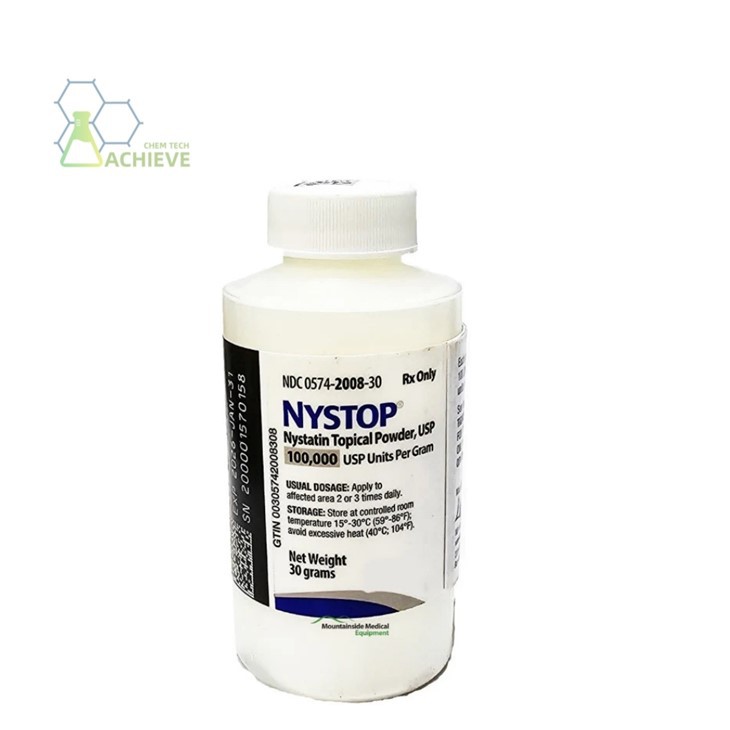

Shaanxi BLOOM Tech Co., Ltd. is one of the most experienced manufacturers and suppliers of nystatin cas 1400-61-9 in China. Welcome to wholesale bulk high quality nystatin cas 1400-61-9 for sale here from our factory. Good service and reasonable price are available.
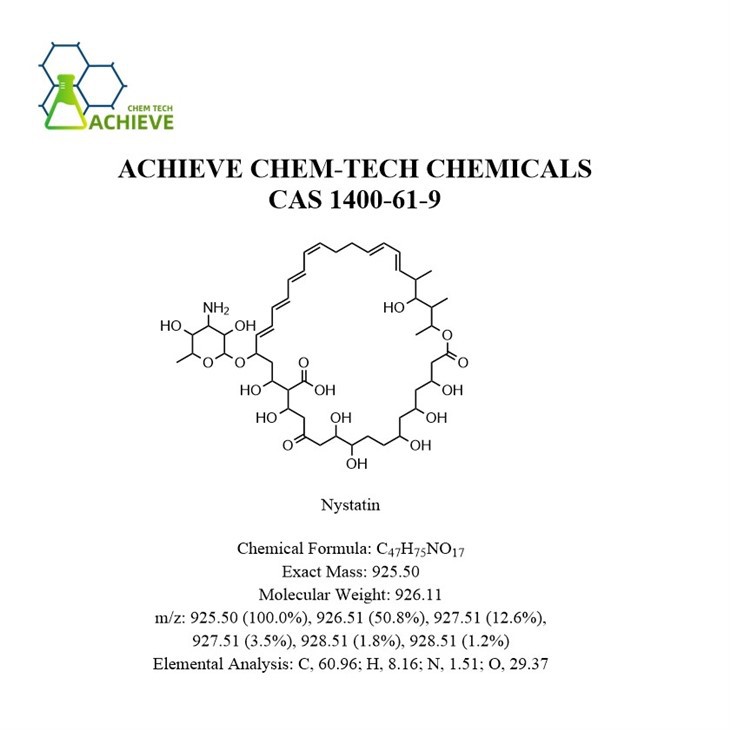
Nystatin, CAS1400-61-9, molecular formula C47H75NO17, is a polyene antibiotic. Pale yellow or light brown powder; It has moisture wicking properties and a grain aroma. Unstable in nature, extremely slightly soluble in water, slightly soluble in ethanol and methanol, relatively soluble in lipid matrix. Exposure to heat, light, air, or moisture can cause deterioration. Stable in slightly alkaline media, unstable at pH 9-12. Polyaldehyde nysttin sodium salt is soluble in water. In 1950, it was discovered that soil microorganisms Streptomyces noursei could secrete a substance that was resistant to mold, thus discovering the first antibiotic against mold. Nysttin has a conjugated polyene macrocyclic lactone structure, which can inhibit the activity of fungi and mosses, but has no inhibitory effect on bacteria.


Our product


Nystatin COA


|
|
|

|
Chemical Formula |
C47H75NO17 |
|
Exact Mass |
925.50 |
|
Molecular Weight |
926.11 |
|
m/z |
25.50 (100.0%), 926.51 (50.8%), 927.51 (12.6%), 927.51 (3.5%), 928.51 (1.8%), 928.51 (1.2%) |
|
Elemental Analysis |
C, 60.96; H, 8.16; N, 1.51; O, 29.37 |

As a polyene antibiotic, nystatin has unique antifungal activity. In the medical field, it is mainly used to treat fungal infections in the digestive tract and skin, and has a wide range of application prospects. However, its use also faces some challenges, including side effects and resistance issues. By continuously optimizing dosage forms and medication methods, strengthening the monitoring and management of drug resistance, we can better leverage the role of nysttin in antifungal therapy and make greater contributions to human health.
Medical application of nysttin
Penicillin has a wide range of applications in the medical field, mainly used to treat fungal infections in the digestive tract and skin.
(1) Gastrointestinal fungal infections:
Oral administration of nysttin can be used to treat gastrointestinal fungal infections, such as fungal gastritis in cattle, and fungal diseases in chicken and turkey feeding sacs. In addition, milk duct perfusion is also effective for mastitis caused by Aspergillus and Trichoderma.
(2) Skin fungal infections:
External application of antifungal agents can be used to treat skin fungal infections, such as candidiasis, tinea pedis, tinea manus, tinea corporis, etc. Spray inhalation is also effective for chicken pneumonia caused by Aspergillus fumigatus.
(3) Double infection:
Long term use of broad-spectrum antibiotics may lead to fungal double infection, and antifungal agents also have therapeutic effects on such infections.
Research and Application of Nano Fungicide
The application of nanotechnology in the field of antifungal agents provides new possibilities for antifungal therapy. Nano mycotoxin exerts antibacterial effects by disrupting bacterial cell walls, interfering with cell membrane function, and inhibiting protein synthesis.
1. Antibacterial mechanism:
Nanomycin can penetrate the cell membrane and form pores, causing leakage of intracellular substances, disrupting osmotic pressure balance and ion concentration gradient, causing bacteria to lose the ability to maintain cellular homeostasis, ultimately leading to cell death. In addition, nano mycotoxin can also enter bacterial cells and bind to DNA, inhibiting DNA transcription and replication, resulting in bacterial cells being unable to synthesize essential proteins, thereby inhibiting cell division and growth.
2. The selection and design of nanocarriers:
The selection and design of nanocarriers are crucial for improving the solubility, stability, targeting, and sustained release performance of antifungal agents. Common types of nanocarriers include liposomes, polymer nanoparticles, metal nanoparticles, carbon nanotubes, and inorganic nanoparticles. By selecting and designing nanocarriers reasonably, the antibacterial activity of nysttin can be significantly improved.
3. Targeted delivery:
Nanotechnology encapsulates nysttin in nanocarriers, improving stability and reducing non targeted toxicity. The targeted delivery system improves efficacy and reduces systemic toxicity by directly delivering nysttin to the infected site. Surface modification and active targeting strategies can enhance the affinity of nanomaterials for specific cells or pathogens.
The production process of nystatin is a complex and delicate process, covering a series of key steps from strain selection to final product packaging, each of which is crucial to ensure the quality and yield of the final product.
Researchers carefully select high-yielding and genetically stable Streptomyces noursei strains from microbial libraries. These strains have undergone multiple rounds of breeding and purification to ensure their high-yield characteristics and genetic stability. This step is the foundation of fungal production, and only by selecting excellent strains can a solid foundation be laid for the subsequent production process.
In a sterile environment, researchers will inoculate dormant spores onto sterilized slant culture medium. By appropriate cultivation conditions such as temperature, humidity, and light, spores can germinate and grow sufficient mycelium. The purpose of this step is to obtain a sufficient number of active hyphae to provide sufficient inoculum material for subsequent seed cultivation.
Transfer the culture medium that has been activated and grown enough mycelium into the seed tank, and promote microbial proliferation through a step-by-step expansion cultivation method. During the seed cultivation process, it is necessary to strictly control the cultivation conditions, such as temperature, pH value, dissolved oxygen, etc., to ensure that microorganisms can grow normally and accumulate sufficient biomass. The purpose of this step is to obtain a sufficient number of active microbial cells to provide sufficient inoculum for subsequent large-scale fermentation.
This step is the core step in the production of nystatin. Inoculate the culture medium that has undergone seed cultivation and accumulated sufficient biomass into the fermentation tank. By controlling the fermentation conditions such as temperature, pH value, dissolved oxygen, stirring speed, etc., promote the growth of the strain and the synthesis of nysttin. The fermentation cycle is usually around 360-380 hours, during which regular sampling and testing of indicators such as the content and biomass of nysttin in the fermentation broth are required to monitor the fermentation process and make necessary adjustments.
The fermentation broth needs to be treated. Firstly, adjust the pH value of the fermentation broth to adapt to the subsequent extraction process. Then, impurities and microbial cells in the fermentation broth are removed through filtration, centrifugation, and other methods to obtain a relatively pure fermentation broth. The purpose of this step is to remove impurities that affect the subsequent extraction and refining processes, and improve the purity of the product.
Extraction and refining is one of the key steps in the production of antifungal agents. Solvent extraction and other methods are used to extract the fungal extract from the fermentation broth, and then high-purity fungal extract products are obtained through refining steps such as crystallization and drying. The purpose of this step is to remove residual impurities and solvents from the fermentation broth, and improve the purity and quality of the product.
Strict quality testing is conducted on the extracted and refined fungal extract products, including purity, potency, microbial limits, and other indicators. Only products that meet quality standards are allowed to be packaged and stored. During the packaging process, it is necessary to ensure the sealing and stability of the product to extend its shelf life and ensure its safety and effectiveness during use.
The production process of nystatin is a complex and delicate process that requires strict control of the conditions and operating standards of each link. Only by ensuring the quality and efficiency of each step can high-quality antifungal products be produced to meet the needs of the medical field.
Nystatin is a polyene antibiotic with strong antifungal activity. Its discovery and application history can be traced back to 1950, when scientists discovered that soil microorganisms Streptomyces noursei could secrete an antifungal substance, marking the birth of the first antifungal antibiotic. Penicillin, with its unique conjugated polyene macrocyclic lactone structure, exhibits strong inhibitory effects on fungi and fungi, but has no significant effect on bacteria.
1. Basic characteristics of nysttin
It is a polyene antibiotic with a conjugated polyene macrocyclic lactone structure. This structure enables it to bind with sterols on the fungal cell membrane, leading to changes in membrane permeability and loss of important cellular contents, thereby exerting antifungal effects. Penicillin has particularly high antibacterial activity against Candida species, including Cryptococcus neoformans, Aspergillus, Trichoderma, Microsporomonas, Histoplasma perfringens, Aspergillus nidulans, and Trichophyton.
The characteristics of nysttin are light yellow or light brown powder, with hygroscopicity and a grain aroma. However, its properties are not stable, slightly soluble in water, slightly soluble in ethanol and methanol, and relatively soluble in lipid matrices. Exposure to heat, light, air, or moisture can cause deterioration. Stable in slightly alkaline media, but unstable at pH 9-12.
2. Market and Consumption of Penicillin
The market size of nysttin is constantly expanding, and with the emergence of drug-resistant fungi and advances in medical technology, its application demand is also increasing.
1. Market size:
In 2021, the global market size for mycotoxins was approximately 2.9 billion US dollars, and it is expected to reach 4.8 billion US dollars by 2028, with a compound annual growth rate (CAGR) of 6.5%. In 2021, North America accounted for the largest share of the global mycotoxin market (45%), followed by Europe (30%) and the Asia Pacific region (20%).
2. Market competition:
The main participants in the nystati market include Gilead Sciences, among others, which engage in fierce competition in the research, development, production, and marketing of nystati by launching new formulations, combination therapies, and improved drug forms to gain market share.
3. Consumer Trends:
The consumption trend of nystati is influenced by various factors, including socioeconomic status, lifestyle, population distribution, and age structure. Countries with a larger population of young people have higher consumption of nystati because young people prefer to consume processed foods and fast food, which contain nystati. Countries with a larger elderly population have lower consumption of mycotoxins because older people are more concerned about healthy eating and reducing their intake of processed foods.
Hot Tags: nystatin cas 1400-61-9, suppliers, manufacturers, factory, wholesale, buy, price, bulk, for sale, tetracaine hcl, Pramipexole Powder CAS 104632 26 0, eriodictyol powder, tetrahydrobiopterin synthesis, 3-Dimethylaminophenol, Atropine Sulfate Monohydrate CAS 5908 99 6