




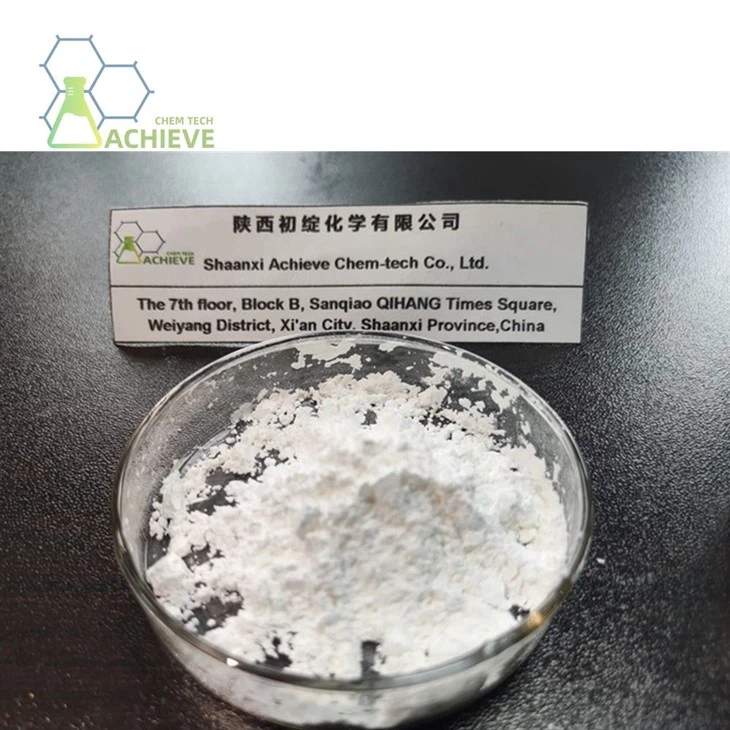


Shaanxi BLOOM Tech Co., Ltd. is one of the most experienced manufacturers and suppliers of posaconazole powder in China. Welcome to wholesale bulk high quality posaconazole powder for sale here from our factory. Good service and reasonable price are available.
Posaconazole powder, chemical name 4- [4- [4- [4- [4- [[(3R, 5R) -5- (2,4-difluorophenyl) -5- (1,2,4-triazol-1-ylmethyl) oxazol-3-yl] methoxy] phenyl] piperazin-1-yl] phenyl] -2- [(2S, 3S) -2-hydroxypent-3-yl] 1,2,4-triazol-3-one, molecular formula C37H42F2N8O4, CAS 171228-49-2, precise molecular weight 700.77700. Its molecular structure contains a triazole ring core, which introduces fluorine atoms to replace chlorine atoms through side chain extension, and introduces hydroxylated side chains. This structural modification significantly enhances the affinity between the drug and the 14 α - demethylase (CYP51) dependent on fungal cytochrome P450, while reducing its impact on human cytochrome P450 enzymes, manifested only as CYP3A4 inhibitors. In addition, the long side chain structure reduces the binding of drugs to transmembrane transporters (efflux pumps) and lowers the risk of drug resistance.

Triazole ring core: As a common structure of triazole antifungal drugs, the triazole ring binds to the fungal cytochrome P450 dependent 14 α - demethylase (CYP51) through a nitrogen atom, inhibiting the synthesis of ergosterol.
Fluorine atom substitution: The chlorine atom in the benzene ring is replaced by a fluorine atom, enhancing the affinity between the drug and fungal CYP51, while reducing the impact on human cytochrome P450 enzymes.
Hydroxylated side chains: Introducing (2S, 3S) -2-hydroxypent-3-yl side chains increases drug polarity, improves water solubility, and reduces binding to transmembrane transporters (efflux pumps), thereby reducing the risk of drug resistance.


Additional information of chemical compound:

Our Product


Posaconazole Powder COA


Solubility and pH dependence
The solubility exhibits significant pH dependence, which is the core basis for the design of its enteric coating:
Acidic environment (gastric acid, pH 1-3):
The solubility in gastric acid is extremely low, but enteric coating can fully protect the drug core and avoid degradation by gastric acid.
Alkaline environment (gut, pH 6-8):
The coating dissolves under alkaline conditions in the gut, releasing the drug core. The solubility in dimethyl sulfoxide (DMSO) is 50mg/mL, but the solubility in water is extremely low (<0.1mg/mL). This characteristic requires clinical medication to be taken together with a high-fat diet or acidic carbonated beverages to promote emulsification and absorption of the drug in the intestine. Research has shown that co administration with high-fat foods can increase the systemic exposure (AUC) of posaconazole by 4 times, while co administration with skimmed foods increases it by 2.6 times.

Chemical Overview and Basic Information
Posaconazole Powder is a triazole-based broad-spectrum antifungal drug. Its chemical name is 4-[4-[4-[4-[[(3R,5R)-5-(2,4-difluorophenyl)-5-(1,2,4-triazole-1-ylmethyl)oxazepane-3-yl]methoxy)phenyl]piperazine-1-yl]phenyl]-2-[(2S,3S)-2-hydroxypent-3-yl]-1,2,4-triazole-3-one. The molecular formula is C₃₇H₄₂F₂N₈O₄, and the molecular weight is 700.78. It appears as a white or off-white crystalline powder, with a melting point range of 170-172℃. It is almost insoluble in water, but soluble in organic solvents such as chloroform and methanol.
Posaconazole exerts its antifungal effect by inhibiting the biosynthesis of ergosterol on the fungal cell membrane, thereby damaging the integrity of the cell membrane. It has strong inhibitory activity against various difficult-to-treat fungi such as Candida species, Cryptococcus species, and Aspergillus species. It is particularly suitable for the treatment of invasive fungal infections that are resistant to other antifungal drugs.
Manufacturing Process and Synthesis Route
The production of posaconazole involves multiple organic synthesis reactions and requires precise control of reaction conditions to obtain high-purity products. The following is an overview of the typical synthesis route:

Selection of starting materials
Common starting materials include 2'-chloro-2,4-difluorobenzoic acid or meta-difluorobenzene. The former uses a prepared format reagent to replace the Wittig reaction, with a shorter process but higher isomer content, requiring multiple purifications; the latter is synthesized through steps such as Friedel-Crafts acylation, Wittig reaction, and condensation amide, but is prone to generating intramolecular ring-forming impurities, which affect the yield.
Synthesis of key intermediates
Threeazole rings and oxacyclopentane structures are constructed through multiple reactions. For example:
Using 2,4-difluorobenzene as the raw material, a carbonyl group is introduced through Friedel-Crafts acylation, and then a double bond is formed through Wittig reaction. Subsequently, an epoxidation reaction is carried out to generate an oxazepane ring.
When introducing the 1,2,4-triazole group, the reaction conditions need to be controlled to avoid the formation of by-products. Usually, nucleophilic substitution or metal-catalyzed coupling reactions are adopted.


Side chain modification and coupling
The hydroxyl pentyl side chain is connected to the triazole ring through alkylation or acylation reactions to form the final molecular framework. This step requires precise control of reaction temperature and solvent selection to ensure accurate positioning of the side chain.
Purification and crystallization
The synthetic product needs to be purified by column chromatography, recrystallization, or preparative high-performance liquid chromatography (HPLC) to remove isomers and impurities. The crystallization conditions (such as solvent, temperature, and pH value) have a significant impact on the purity and crystal form of the product, and need to be optimized to obtain crystalline powder that meets the standards of the pharmacopoeia.

Quality Control and Standards
The quality of posaconazole powder should meet the following key indicators:
Purity
Through HPLC testing, the total impurity content should be ≤ 1.0%, and each individual impurity should be ≤ 0.2%. For high-purity products (≥ 99.5%), more stringent purification processes such as multiple recrystallizations or chromatographic separation are required.
Physical properties
Melting point: 170 - 172℃, verified by differential scanning calorimetry (DSC).
Specific rotation: -28.0° to -34.0°, reflecting the purity of the chiral center.
Water content: ≤ 2.0%, determined by Karl Fischer method.
Residual solvents and heavy metals
According to ICH guidelines, residual solvents (such as methanol, ethanol, dichloromethane) should be controlled within safe limits; the content of heavy metals (such as lead, arsenic) should be ≤ 10 ppm.
Microbial limits
Complies with the microbial contamination control requirements of the pharmacopoeia for non-sterile raw materials, such as total aerobic bacteria count ≤ 1000 CFU/g, mold and yeast count ≤ 100 CFU/g..
Process Optimization and Innovation
In recent years, the manufacturing process of posaconazole has been continuously optimized to reduce costs and improve environmental friendliness:

Green Chemistry Application
Use water as the solvent or low-toxic organic solvents (such as ethyl acetate), reducing the use of highly polluting reagents like petroleum ether. Some reaction steps are replaced by catalytic hydrogenation instead of traditional reducing agents (such as sodium borohydride), thereby reducing waste generation.
Continuous Flow Reaction Technology
Introduce microreactors or continuous flow devices to achieve precise control of reaction conditions, improve reaction selectivity and yield, and shorten the production cycle.


Chiral Synthesis Technology
Develop new chiral catalysts or asymmetric synthesis routes to directly obtain optically pure intermediates, reducing the steps of isomer separation and lowering production costs.
Process Scaling and Stability Studies
Verify the feasibility of the process through pilot-scale experiments and conduct long-term stability studies (such as accelerated tests and long-term tests) to ensure stable product quality during storage.

Packaging and Storage
Posaconazole powder should be stored in a dry and dark place, sealed, to prevent moisture absorption and degradation. Recommended packaging materials are aluminum foil bags or high-density polyethylene (HDPE) bottles, lined with desiccants. The recommended storage temperature is 2-8℃. Some products can be stored at room temperature (≤25℃) for a short period. During transportation, avoid severe vibrations and high-temperature environments.
Application and Market Prospects
Posaconazole powder is mainly used for the preparation of oral suspensions, tablets or injections. It is clinically used for the prevention and treatment of invasive fungal infections in patients with immune deficiencies. With the growth of the antifungal drug market, the demand for posaconazole continues to rise. Manufacturers need to pay attention to the following trends:
Generic drug development
After the patent expires, generic drug companies will enter the market, driving down prices and increasing accessibility.
New formulation research
New delivery systems such as nanocrystals and liposomes can improve bioavailability and reduce side effects.
Global market expansion
The demand for high-end antifungal drugs in emerging markets (such as Asia-Pacific and Latin America) is growing, providing opportunities for manufacturers.

Drug interactions and contraindications
CYP3A4 substrate:
Powerful inhibitor: Posaconazole powder is a potent CYP3A4 inhibitor. When used in combination with sirolimus and tacrolimus, the latter's blood concentration can increase by 9 times, and the dosage needs to be adjusted and closely monitored.
Substrate contraindications: Do not use in combination with ergot alkaloids (such as ergotamine), pimozide, and quinidine, as it may cause severe arrhythmia or ergot poisoning.
Other interactions
Cyclosporine: When used in combination, the dosage of cyclosporine needs to be adjusted and the trough concentration of whole blood should be monitored to avoid nephrotoxicity and white matter lesions.
Changchun alkaloids: Combination use may enhance neurotoxicity, and the risk return ratio needs to be carefully evaluated.
HMG CoA reductase inhibitors
When combined with atorvastatin, lovastatin, and simvastatin, an increase in blood concentration of the latter may lead to rhabdomyolysis, and should be avoided or replaced with statins that are less dependent on CYP3A4 (such as pravastatin).
Contraindication
It is contraindicated for individuals allergic to posaconazole or other triazole drugs.
Patients with severe arrhythmia or congenital QT interval prolongation syndrome are contraindicated.
FAQ
1. Solubility of Powder and Storage Recommendations
Posaconazole powder is soluble in dimethyl sulfoxide (DMSO) in in vitro experiments. It can dissolve at concentrations of 100 mg/mL or 140 mg/mL, but is insoluble in water and ethanol. To maintain its stability, the powder should be stored at low temperatures: it is recommended to store it in a light-proof, sealed container at 2-8°C, or at -20°C, where it can be stable for up to 3 years.
2. What are the uses of the powder?
Posaconazole is a broad-spectrum triazole antifungal drug. In the field of research, it is often used as a therapeutic agent, mainly as a sterol C14α demethylase inhibitor, by inhibiting the synthesis of ergosterol in fungi to damage the fungal cell membrane and exert antifungal effects. It is commonly used to study its inhibitory activity against various fungi (such as Candida, Aspergillus).
3. How to prepare in vivo formulations for animal experiments?
When conducting in vivo animal experiments, posaconazole is typically administered as a uniform suspension. A common method is to disperse the powder in a sodium carboxymethyl cellulose (CMC-Na) solution, for example, preparing a uniform suspension of 5 mg/mL for oral use. It should be noted that the presence of food (especially high-fat meals) significantly increases the bioavailability of posaconazole in the body.
Hot Tags: posaconazole powder, suppliers, manufacturers, factory, wholesale, buy, price, bulk, for sale, 3 Dimethylaminophenol, 4 Fluorotropacocaine, isoflurane powder, lidocaine hydrochloride powder, Pure Tetracaine, tetramisole hcl powder