




Shaanxi BLOOM Tech Co., Ltd. is one of the most experienced manufacturers and suppliers of trifluoperazine dihydrochloride cas 440-17-5 in China. Welcome to wholesale bulk high quality trifluoperazine dihydrochloride cas 440-17-5 for sale here from our factory. Good service and reasonable price are available.
Trifluoperazine Dihydrochloride, CAS 440-17-5, molecular formula C21H26Cl2F3N3S, containing two molecules of hydrochloric acid. Its molecular weight is 480.82 grams/mole. Usually present in the form of white or similar white crystalline powder. It may have hygroscopicity. In water, the solubility of trifluoperazine hydrochloride is relatively high, forming a solution. It can also be dissolved in various organic solvents, such as methanol, ethanol, and dimethylformamide.
It is easily soluble in water, soluble in ethanol, slightly soluble in chloroform, and insoluble in ether. Relatively stable at room temperature, but contact with strong oxidizing agents should be avoided. It is a drug with multiple clinical and laboratory applications. It is a dopamine D2 receptor inhibitor with antipsychotic and antiemetic effects. It is also widely used as a reagent in laboratory research. In scientific research, trifluoperazine hydrochloride is often used as a tool and reagent in laboratory research. It can be used to study the functions and interactions of neurotransmitters, such as dopamine and serotonin.

| Chemical Formula | C21H26Cl2F3N3S |
| Exact Mass | 479 |
| Molecular Weight | 480 |
| m/z | 479 (100.0%), 481 (63.9%), 480 (22.7%), 483 (10.2%), 482 (7.3%), 482 (7.3%), 481 (4.5%), 483 (2.9%), 481 (2.5%), 484 (2.3%), 483 (1.6%), 480 (1.1%), 482 (1.0%) |
| Elemental Analysis | C, 52.50; H, 5.46; Cl, 14.76; F, 11.86; N, 8.75; S, 6.67 |
|
|
|

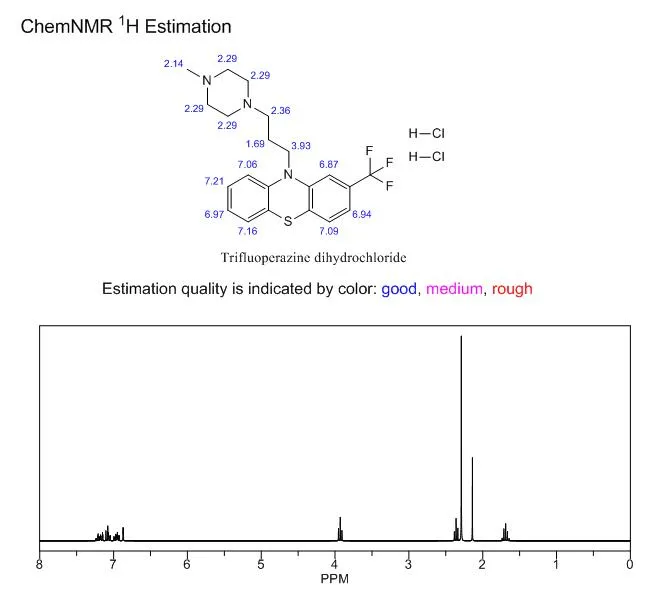
Melting point 243 °C ( dec. ) ( lit. ) , Flash point 9 °C , Storage condition -20 ° C , Solubility of ethanol : soluble 5mg / mL . morphological powder , Acidity coefficient ( pKa ) pK13.9, pK28.1 ( at 25 °C ) , Color white to off-white , Maximum wavelength ( λmax ) 312nm ( MeOH ) ( lit. ) , BRN 3820024 , Stability Hygroscopic , Hazard Signs ( GHS ) , GHS02, GHS06, GHS08, GHS07 , warning word Danger , Hazard description H302-H225-H301 + H311 + H331-H370 , Prevention instructions P210 - P280 - P302 + P352 + P312 - P304 + P340 + P312 - P370 + P378 - P403 + P235 - P301 + P312 + P330 , Hazardous Mark Xn , Hazard Category Code 22 , Safety statement 36 , Transport number of dangerous goods, UN1230 - class 3 - PG 2 - Methanol, solution , WGK Germany 3 , RTECS SP1750000 , F 3-10.

Trifluoperazine Dihydrochloride is a phenothiazine antipsychotic drug. Its mechanism of action revolves around the neurotransmitter system of dopamine, serotonin, adrenaline, etc., and achieves comprehensive therapeutic effects such as antipsychotic, sedative, and anti anxiety through multi-target regulation.
The core mechanism is to selectively block dopamine D2 receptors in the central nervous system, by competitively occupying receptor binding sites and inhibiting dopamine overactivation. Dopamine plays a key role in the pathogenesis of schizophrenia: excessive release of dopamine from the midbrain limbic pathway leads to positive symptoms such as hallucinations and delusions, while hyperfunction of dopamine in the substantia nigra striata pathway triggers extrapyramidal reactions such as tremors and muscle tone disorders.


Trifluorouracil hydrochloride precisely regulates these two pathways:
Midbrain limbic pathway: blocks D2 receptors, reduces dopamine overstimulation of the prefrontal cortex, and directly alleviates positive symptoms.
The substantia nigra striata pathway: partially blocks D2 receptors, restores the balance between dopamine and acetylcholine, and reduces the risk of motor disorders (although long-term use may still cause late-onset motor disorders).
In addition to dopamine D2 receptors, it also enhances therapeutic efficacy and reduces side effects by acting on other receptor systems:1. 5-hydroxytryptamine (5-HT) receptor antagonist
Mild blockade of 5-HT2A receptors improves negative symptoms of schizophrenia, such as emotional apathy and social withdrawal, while enhancing antidepressant effects.


When used in combination with selective 5-HT reuptake inhibitors (such as fluoxetine), it can synergistically regulate emotions, but caution should be exercised regarding the risk of 5-HT syndrome.
2. Adrenergic receptor blockade
Alpha 1-adrenergic receptor blockade: causes vasodilation, leading to orthostatic hypotension, requiring monitoring of blood pressure changes and adjustment of dosage.
Blocking of β - adrenergic receptor: slow down the heart rate, which may cover the symptoms of hypoglycemia. Patients with diabetes should use it cautiously.
3. Histamine H1 receptor blockade
Inhibit histamine release, alleviate allergic reactions (such as itching and redness), but at the same time cause drowsiness and fatigue, and avoid driving or operating machinery.


4. Cholinergic M1 receptor antagonism
It can reduce the acetylcholine effect and the risk of extrapyramidal system reaction, but it may cause anticholinergic side effects such as dry mouth, constipation and urinary retention.
The mechanism of action extends its application beyond schizophrenia to multiple clinical fields:
1. Mania treatment
By stabilizing the dopamine and serotonin systems and suppressing excessive excitement during manic episodes, trifluoperazine Dihydrochloride is often used in combination with mood stabilizers such as lithium carbonate.


2. Adjuvant therapy for anxiety and depression
The antagonistic effect of 5-HT2A receptor can alleviate anxiety, especially for patients with comorbid anxiety in schizophrenia.
It has auxiliary therapeutic effects on neurasthenia syndrome (such as tension headaches and sleep disorders) by regulating the excitability of the central nervous system to improve symptoms.
3. Adjuvant therapy for status epilepticus
Although it cannot directly terminate epileptic seizures, it can stabilize neuronal membrane potential and reduce seizure frequency. It needs to be used in combination with antiepileptic drugs (such as phenytoin sodium).


4. Functional dyspepsia and antiemetic symptoms
Blocking the D2 receptor in the chemosensory area of the brain to induce vomiting and suppress nausea and vomiting is commonly used for antiemetic treatment after chemotherapy or surgery.
By regulating gastrointestinal peristalsis, functional dyspepsia symptoms such as bloating and early satiety can be alleviated.

We are the factory of STELAZINE.
Remark: BLOOM TECH(Since 2008), ACHIEVE CHEM-TECH is the subsidiary of us.
A synthesis method of triflurazine hydrochloride including:
(1) condensation reaction: 2-trifluoromethyl phenothiazine and 4-methyl-1-chloropropyl piperazine in an organic solvent, catalyst, pH 9 ~ 12, temperature 80 °C ~ 120 °C condensation reaction, triflurazine crude products.
(2) Purification of crude triflurazine : the crude triflurazine was first converted into triflurazine dioxalate, and then the triflurazine dioxalate was converted into triflurazine by adding alkali.
(3)The triflurazine obtained in step(2)reacts with hydrochloric acid to form triflurazine hydrochloride. The preparation method of triflurazine hydrochloride provided by the invention is simple, low cost, and high yield, which is suitable for industrial production of triflurazine hydrochloride.
In vitro studies, trifluoroperazine binds to α 1A - and α 1B adrenal receptor, Ki values were 27.6 nm and 19.2 nm, respectively, α 1B/ α 1A ratio is 0.7. Trifluoroperazine inhibited Mycobacterium tuberculosis (MTB) with MICs of 7.6 μ g/mL.
Trifluoroperazine (< 14. Chemicalbook78mm) inhibited NK cytotoxic activity and effector target cell junction in mouse spleen in a dose-dependent manner. Trifluoroperazine inhibits interferon- α Or the increase of NK cytotoxic activity induced by interleukin-2. Trifluoroperazine inhibits voltage-dependent potassium channel Kv2 1 gene expression from the human brain (hKv2.1).

The preparation method of trifluoperazine Dihydrochloride includes the following detailed steps:
C13H8F3NS+4-methyl-1-chloropropylpiperazine → crude trifluoperazine
Add 2-trifluoromethylphenothiazine and 4-methyl-1-chloropropylpiperazine in a proportional manner to an organic solvent, such as dimethylformamide (DMF) or dichloromethane (DCM). Adding an appropriate amount of catalyst can use alkaline catalysts such as triethylamine (TEA) or zinc powder. Control the reaction pH between 9 and 12, and maintain the temperature within the range of 80 ℃ to 120 ℃ for a certain period of time.
Crude trifluoperazine+C2H2O4 → trifluoperazine oxalate
Trifluoperazine oxalate+base → C21H24F3N3S
Convert the crude trifluoperazine obtained in step 1 into trifluoperazine oxalate. This reaction can be carried out by reacting with excess oxalic acid, usually in an alcohol solvent. After obtaining trifluoperazine dioxalate, an appropriate amount of alkali, such as sodium hydroxide (NaOH), is added to convert trifluoperazine dioxalate into trifluoperazine.
C21H24F3N3S+ClH → C21H26Cl2F3N3S
React the purified trifluoperazine obtained in step 2 with hydrochloric acid to generate trifluoperazine hydrochloride. Under appropriate temperature and reaction time, the reaction is usually carried out between room temperature and 60 ℃. Anhydrous hydrochloric acid (HCl) can be used as a reaction solvent or catalyst. Finally, pure trifluoperazine hydrochloride product is obtained through filtration or crystallization.
This method has simple process route, low cost, high yield, and is suitable for industrial production of trifluoperazine hydrochloride.

I. R&D Background: The Boom in Phenothiazine Drugs
Following the launch of chlorpromazine in 1952, a new era of chemotherapy for psychiatric disorders began. However, chlorpromazine required high doses, produced strong sedation, and had significant side effects. Pharmaceutical companies therefore launched structural modification programs aimed at developing a new generation of antipsychotics with high efficacy, low toxicity, and long action duration.
II. Drug Synthesis and Structural Optimization (Mid‑1950s)
The drug was developed by Smith Kline & French (research code: SKF 5019). Using prochlorperazine as the parent scaffold, the chlorine atom at the 2‑position was replaced by a trifluoromethyl group (‑CF₃), and an N-methylpiperazine side chain was introduced. These modifications significantly enhanced antipsychotic potency and reduced sedative side effects.The compound was synthesized and structurally confirmed in 1957, and its dihydrochloride salt was prepared to improve water solubility and stability.
III. Clinical Evaluation and Launch (1957–1959)
Clinical trials began in late 1957 and demonstrated remarkable efficacy against delusions and hallucinations in paranoid schizophrenia. Its potency was 9–10 times that of chlorpromazine and 4 times that of prochlorperazine.Global multicenter validation was completed in 1958, and the drug was approved by the U.S. FDA in 1959 under the brand name Stelazine.
IV. Historical Status and Impact
Trifluoperazine represents a benchmark first‑generation antipsychotic. It became a first‑line psychiatric agent due to its high efficacy, mild sedation, and convenient oral administration.Its structural optimization strategy established a paradigm for fluphenazine, pipotiazine, and other derivatives, driving the refined development of phenothiazine drugs. To this day, it remains used in the management of schizophrenia, acute agitation, and emesis control.
FAQ
Why was trifluoperazine discontinued?
+
-
Why is Stelazine discontinued? "Trifluoperazine can cause extrapyramidal side effects, which are abnormal muscle contractions, difficulty breathing and swallowing, and neck spasms."
Is trifluoperazine an antidepressant?
+
-
Trifluoperazine is a phenothiazine used to treat depression, anxiety, and agitation. A phenothiazine with actions similar to chlorpromazine. It is used as an antipsychotic and an antiemetic.
Hot Tags: trifluoperazine dihydrochloride cas 440-17-5, suppliers, manufacturers, factory, wholesale, buy, price, bulk, for sale, Paliperidone powder, tetravisc, sapropterin dihydrochloride powder, Pyrantel Pamoate Powder CAS 22204 24 6, Uracil Powder CAS 66 22 8, procaine powder