



Shaanxi BLOOM Tech Co., Ltd. is one of the most experienced manufacturers and suppliers of triethylsilane cas 617-86-7 in China. Welcome to wholesale bulk high quality triethylsilane cas 617-86-7 for sale here from our factory. Good service and reasonable price are available.
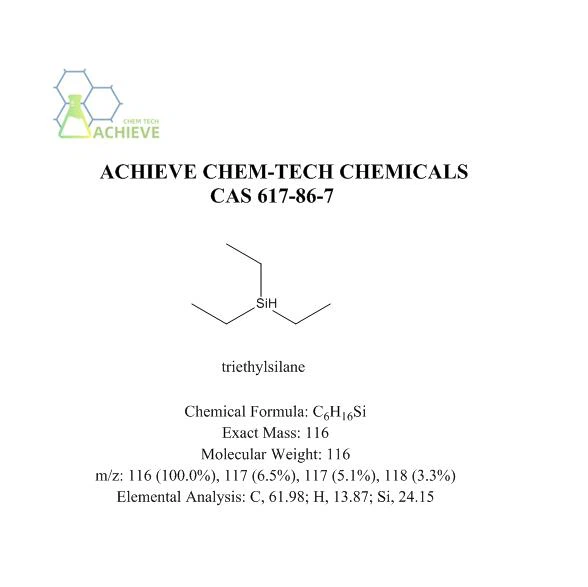
Triethylsilane is an organosilicon compound with the chemical formula (C₂H₅)₃SiH. It belongs to the class of silanes, which are compounds featuring a silicon-hydrogen bond along with organic substituents attached to the silicon atom. Three ethyl groups (C₂H₅) are bonded to the silicon atom, leaving one hydrogen atom directly attached, making it a useful reagent in various chemical reactions.
One of the primary applications is as a reducing agent in organic synthesis. It can selectively reduce functional groups such as carbonyl compounds (aldehydes and ketones) to their corresponding alcohols. This reduction is often carried out under mild conditions, making it a valuable tool in the synthesis of complex organic molecules.

|
|
|


|
Chemical Formula |
C6H16Si |
|
Exact Mass |
296 |
|
Molecular Weight |
296 |
|
m/z |
116 (100.0%), 117 (6.5%), 117 (5.1%), 118 (3.3%) |
|
Elemental Analysis |
C, 61.98; H, 13.87; Si, 24.15 |
Moreover, it is known for its relatively low toxicity and ease of handling compared to some other reducing agents. It is also used in the formation of silicon-carbon bonds through hydrosilylation reactions, where the Si-H bond reacts with unsaturated organic compounds.
Overall, it plays a significant role in organic chemistry, offering versatility and efficiency in synthetic transformations.

Triethylsilane (chemical formula: (C2H5)3SiH), as an important organic silicon intermediate, has shown wide application value in various fields such as chemical synthesis, materialise science, pharmaceutical research and development, and semiconductor industry due to its unique silicon hydrogen bond structure.
Core reducing agents in the field of organic synthesis

1. Selective reduction of carbonyl compounds
It is an efficient reagent for reducing carbonyl compounds such as aldehydes and ketones to alcohols. Under acidic conditions (such as TFA of trifluoroacetic acid or BF3 of boron trifluoride catalysis), its reducibility is significantly enhanced, enabling selective reactions under mild conditions. For example, in the Fukuyama reduction reaction, thioesters can be reduced to aldehydes at room temperature, avoiding the problem of excessive reduction by strong reducing agents (such as DIBAL-H) in traditional methods. In addition, it can also reduce tertiary alcohols, benzyl alcohols, or aromatic aldehydes to alkanes, which is particularly important in the synthesis of complex molecules such as natural products and pharmaceutical intermediates, as it can avoid the damage of traditional reducing agents (such as sodium borohydride) to other sensory groups.
3. Conversion of special functional groups
It also performs well in the conversion of special functional groups. For example, under the catalysis of B (C ₆ F ₅) ∝, carboxylic acids and acyl chlorides can be directly reduced to alkanes, breaking the limitation of traditional methods that require multi-step conversion. In addition, it can also participate in C-H functionalization reactions, such as activating benzyl C-H bonds to generate silicon substituted products, providing new strategies for the synthesis of natural products.


2. Hydrosilanization reaction
It can undergo addition reactions with unsaturated bonds (such as olefins and alkynes) to produce organosilicon compounds. This reaction is regulated by metal catalysts such as platinum and palladium, and exhibits high regioselectivity and stereoselectivity. For example, in the hydrogenation silicification reaction of terminal alkynes, different catalysts can be selected to obtain Markovian addition or anti Markovian addition products, and even control the cis/trans configuration. This reaction has wide applications in the synthesis of functional organosilicon materialise, pharmaceutical intermediates, and polymer compounds.
Key tools for the synthesis of pharmaceutical intermediates
1. Anti influenza drug oseltamivir (Tamiflu)
It is a key intermediate of the anti influenza drug oseltamivir (Tamiflu). In the synthesis process of Tamiflu, as a reducing agent, the carbonyl group is reduced to a methylene group in the presence of Lewis acid, which has a direct impact on the cost and quality of the drug. Its high selectivity and mild reaction conditions make the synthesis of Tamiflu more efficient and controllable.


2. Construction of complex molecular frameworks
It also plays an important role in the construction of complex molecular skeletons. For example, when synthesizing Nav1.7 spiroindole inhibitors for pain treatment, they participate in the reduction reaction of key steps, enhancing the metabolic stability of the drug. In addition, in the synthesis of natural products such as paclitaxel or drug analogues, specific functional groups can be selectively reduced to avoid damage to other sensitive structures.
3. Drug protection and modification
It can also be used for drug protection and modification. For example, in the synthesis of some drugs that are sensitive to air and moisture, triethylsilane can serve as a protective group to prevent the drug from being oxidized or hydrolyzed during the synthesis process. Meanwhile, by chemically modifying it, the physical and chemical properties of the drug can be altered, improving its stability and bioavailability.

Innovative applications in the field of materialise science

Organic inorganic hybrid materialise
The organic-inorganic hybrid materialise can be prepared by the sol gel method. Combined with the flexibility of organic components and the rigidity of inorganic components, they can be used in optical materialise, biomedical materialise and other fields. For example, in optical materialise, the hybrid materialise involved in the preparation have high refractive index, anti reflection and other characteristics; In biomedical materialise, bone repair scaffolds, drug delivery carriers, and other materialise exhibit excellent biocompatibility and functional potential.
Preparation of microfluidic chips
After treatment, polydimethylsiloxane (PDMS) forms a porous molecular network structure on its surface, which can reduce the diffusion rate of small molecules and improve the detection sensitivity of microfluidic chips. This characteristic has broad application prospects in fields such as biomedical testing and chemical analysis.

Key roles in the semiconductor industry

1. Chemical vapor deposition (CVD) precursor
High purity triethylsilane (purity ≥ 99%) is an important precursor gas for chemical vapor deposition processes in the semiconductor industry. In CVD process, silicon thin films are deposited for manufacturing integrated circuits, solar cells, etc. Its high purity and controllable deposition rate endow silicon thin films with excellent electrical properties and surface morphology.
2. n-type doping source
In the growth of III-V semiconductors (such as GaAs), as an n-type dopant, it regulates the electrical properties of the material. By precisely controlling the doping concentration and distribution, the carrier concentration and mobility of semiconductors can be optimized, improving the performance and reliability of devices.


3. Silane gas preparation
High purity silane gas (SiH ₄) can also be prepared through disproportionation reaction for epitaxial growth processes in semiconductor manufacturing. Silane gas is an important raw material for the preparation of key materialise such as monocrystalline silicon and polycrystalline silicon, and its purity and quality have a decisive impact on the performance of semiconductor devices.
Expanded applications in other fields
1. Preparation of silane gas by disproportionation reaction
Under the action of a catalyst, a disproportionation reaction occurs, producing high-purity silane gas (SiH ₄) and higher grade silane (such as Si ₂ H ₆). This reaction provides an important silicon source gas for the semiconductor industry, while expanding its application potential in fields such as energy and materialise.

2. Modification of Metal Organic Frameworks (MOFs)
By using vapor deposition technology to modify the surface of MOFs, a hydrophobic coating is formed to enhance their chemical stability and adsorption performance. This characteristic has broad application prospects in fields such as gas adsorption and catalysis. For example, in gas adsorption, MOFs modified with it can efficiently capture greenhouse gases such as CO ₂; In catalysis, modified MOFs can enhance the selectivity and activity of the catalyst.
3. Lubricants and anti adhesives
Triethylsilane can be used as a lubricant on metal surfaces, providing lower friction coefficients and better wear resistance. In addition, it can also serve as an anti adhesive to prevent materialise from sticking during processing, improving production efficiency and product quality.

FAQ
What is triethyl silane used for?
Triethylsilane is often used in conjunction with transition metal catalysts, such as platinum or rhodium complexes, to carry out hydrosilylation. These catalytic reactions are crucial in producing silicon-based polymers and materials, which are essential for various industries, including: Semiconductor manufacturing.
What is the use of Trimethylsilane?
Trimethylsilane (TMS) is a high-purity silicon-based precursor widely used in the semiconductor industry, particularly in the fabrication of advanced memory and microprocessor chips. Its unique chemical properties make it an essential material for a range of front-end-of-line (FEOL) processes.
What are the hazards of Triethylsilane?
Hazard statements (CLP) : H225 - Highly flammable liquid and vapour. H412 - Harmful to aquatic life with long lasting effects. Precautionary statements (CLP) : P210 - Keep away from heat, hot surfaces, sparks, open flames and other ignition sources.
What are the byproducts of Triethylsilane?
Using a one-pot method; firstly, sodium hydride is used for reacting with trimethyl borate to prepare trimethoxy boron sodium hydride; and then adding triethylchlorosilane dropwise to react to obtain triethylsilane. The byproducts are sodium chloride and trimethyl borate.
Hot Tags: triethylsilane cas 617-86-7, suppliers, manufacturers, factory, wholesale, buy, price, bulk, for sale, 1-Bromododecane, 2 Chloro 5 Chloromethylpyridine CCMP , 4,4'-Dimethylbiphenyl CAS 613-33-2, 3 5 Di tert butylbromobenzene, Acetohydroxamic Acid CAS 546 88 3, Chlorocyclohexane CAS 542 18 7