




Shaanxi BLOOM Tech Co., Ltd. is one of the most experienced manufacturers and suppliers of ethyl hydrogen malonate cas 1071-46-1 in China. Welcome to wholesale bulk high quality ethyl hydrogen malonate cas 1071-46-1 for sale here from our factory. Good service and reasonable price are available.
Ethyl Hydrogen Malonate, also known as succinic monobutyl ester, ingeniously integrates both carboxylic acid and ester functional groups in its molecular structure. This "amphiphilic" property makes it far more than just a simple chemical intermediate. In the cutting-edge fields of supramolecular chemistry and materials science, it serves as an elegant dynamic assembly unit: its carboxyl group can act as a strong hydrogen bond donor, forming stable two-dimensional networks with various nitrogen-containing heterocycles (such as pyridines, triazines).
While the ester group acts as a flexible hinge, and its carbamido units can enhance interlayer stacking through weak van der Waals forces. This multi-level molecular recognition ability enables it to induce the self-assembly of organic small molecules at room temperature to form crystalline materials with regular nanopores. These materials demonstrate unique potential for selective adsorption of guest molecules or as non-metallic organic catalyst carriers, providing a new paradigm beyond traditional metal-organic frameworks for the construction of "green" porous materials.

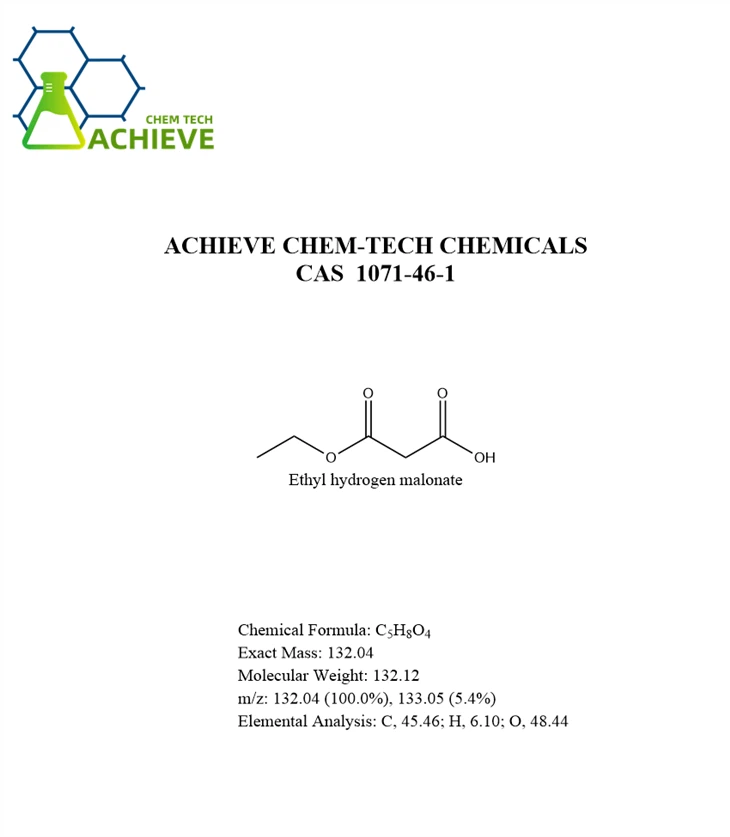
Additional information of chemical compound:
|
Chemical Formula |
C5H8O4 |
|
Exact Mass |
132.04 |
|
Molecular Weight |
132.12 |
|
m/z |
132.04 (100.0%), 133.05 (5.4%) |
|
Elemental Analysis |
C, 45.46; H, 6.10; O, 48.44 |
|
Melting point |
-13℃(lit.) |
|
Boiling point |
106.5℃/3 mmHg (lit.) |
|
Density |
1.119 g/mL at 25℃(lit.) |
|
|
|
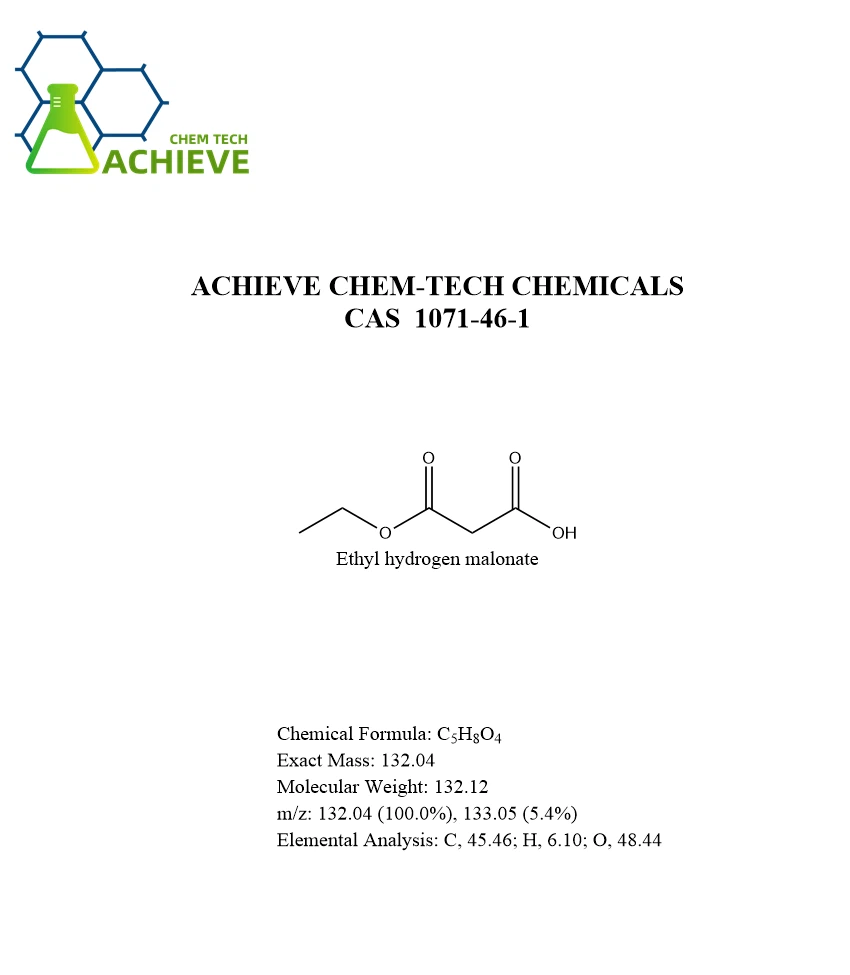

Ethyl hydrogen malonate is an important organic compound with the chemical formula C5H8O4 and CAS number 1071-46-1. It has a certain acidity and is difficult to dissolve in water, but can be miscible with common organic solvents. Due to its unique chemical structure and properties, it has a wide range of applications in multiple fields. The following is a detailed explanation of its purpose:
Monoethyl malonate is a derivative of malonic acid esters, which contains an ester unit and a carboxyl structure in its structure, giving it diverse chemical conversion properties. In organic synthesis, monoethyl malonate is often used as an important intermediate and participates in various chemical reactions. Monoethyl malonate can continue to undergo esterification reaction with ethanol under the action of acid or base, producing diethyl malonate. This reaction is of great significance in organic synthesis, as diethyl malonate is also an important organic compound widely used in fields such as medicine, pesticides, dyes, etc.


The carboxyl units in the Monoethyl malonate structure can be transformed into corresponding carboxylic acid anions under alkaline conditions such as potassium hydroxide. This negative ion has strong nucleophilicity and can participate in various nucleophilic substitution reactions, thereby expanding the chemical reaction pathway of monoethyl malonate. For example, it can undergo substitution reactions with halogenated hydrocarbons, alcohols, and other compounds to generate organic compounds with different structures and functions. Monoethyl malonate can also undergo reduction reactions under the action of certain reducing agents, generating corresponding alcohol compounds. This reaction also has certain applications in organic synthesis.
The application of Monoethyl Malonate in the pharmaceutical field is mainly reflected in its use as a chemical raw material for synthesizing various biologically active compounds. Monoethyl malate can be converted into drug molecules with specific pharmacological activities through a series of chemical reactions. For example, it can combine with drug intermediates containing amino or hydroxyl groups through esterification, amidation, and other reactions to generate drugs with specific pharmacological effects. These drugs play an important role in treating various diseases. Monoethyl malate can also be used as a pharmaceutical intermediate to participate in the synthesis of complex drug molecules.


In the process of drug development, researchers often need to use organic compounds such as Monoethyl Malonate to construct drug molecules with specific structures and functions through multi-step reactions.
Monoethyl malate also has certain applications in the synthesis of surfactants. Surfactants are a type of compound with special surface activity that can form a thin film on the surface or interface of a solution, thereby altering the physical and chemical properties of the solution. Monoethyl malate can react with other compounds to generate surface active compounds, which have a wide range of applications in detergents, emulsifiers, dispersants, and other fields.
In recent years, monoethyl malonate has been shown to promote plant growth, enhance soil nitrogen metabolism, increase soil available nitrogen content, improve plant fruit quality, promote plant absorption of nitrogen, phosphorus, and potassium, and optimize plant physiological and biochemical enzyme systems. These findings provide new ideas for the application of monoethyl malonate in the agricultural field. Monoethyl malonate can promote plant growth and development by regulating physiological and biochemical processes within the plant body.


For example, it can improve the efficiency of photosynthesis in plants, increase the content of chlorophyll, and thus promote the growth rate of plants. Monoethyl malonate can also promote the nitrogen metabolism process in soil and increase the available nitrogen content in the soil. This helps improve the soil environment, enhance soil fertility, and increase crop yields. Research has shown that monoethyl malonate can also improve the quality of plant fruits. For example, it can increase the sugar content, color, and taste of the fruit, making it more delicious and tasty.

Ethyl Hydrogen Malonate, as an important organic synthesis intermediate and medicinal chemical raw material, has shown broad application prospects in the chemical industry, pharmaceutical manufacturing and other fields in recent years. The following is a detailed explanation of its development prospects:
Market demand analysis
Global market demand growth
With the continuous development of the global chemical and pharmaceutical industries, the demand for organic synthesis intermediates and pharmaceutical chemical raw materials is constantly increasing. As an important organic synthesis intermediate and pharmaceutical chemical raw material, the market demand for monoethyl malonate will continue to grow. Especially in emerging market countries, with the acceleration of industrialization and the improvement of people's living standards, the demand for high-end chemicals such as monoethyl malonate will become more vigorous.

The domestic market has enormous potential

As one of the world's largest consumers of chemicals, China has enormous potential for demand for high-end chemicals such as monoethyl malonate. In recent years, the Chinese government has attached great importance to the development of the chemical and pharmaceutical industries, and has introduced a series of policy measures to support the innovative development of related industries. This will provide strong support for the market demand of high-end chemicals such as monoethyl malonate.
Expansion of downstream application areas
With the advancement of technology and the development of industries, the downstream application fields of monoethyl malonate are constantly expanding. For example, in the fields of new energy, new materials, and environmental protection, monoethyl malonate can be used as an important raw material or additive. This will bring new growth points to the market demand for monoethyl malonate.

Technology Trend Analysis
Production process improvement

At present, the production process of monoethyl malonate mainly includes the selective hydrolysis reaction of diethyl malonate and the esterification reaction of malonic acid with ethanol. In order to improve production efficiency and product quality, relevant enterprises and research institutions are constantly exploring new production processes and catalyst systems. For example, by improving reaction conditions and optimizing catalyst performance, the yield and purity of monoethyl malonate can be increased, and production costs can be reduced.
Environmental Protection and Sustainable Development
With the increasing global awareness of environmental protection, the production and use of monoethyl malonate will also pay more attention to environmental protection and sustainable development. Related enterprises and research institutions are actively developing green and environmentally friendly production processes and technologies to reduce pollution and damage to the environment. At the same time, they are also working hard to promote the environmentally friendly applications of monoethyl malonate, such as its use as a plant growth regulator, biodegradable material, and other fields.

Intelligence and automation

With the continuous development of intelligence and automation technology, the production process of monoethyl malonate will gradually achieve intelligence and automation. By introducing advanced control systems and automation equipment, production efficiency and product quality can be improved, while production costs and labor intensity can be reduced. This will provide strong support for the industrial development of monoethyl malonate.

I. The Rise of Malonic Ester Research
In the mid-to-late 19th century, organic chemistry entered a period of rapid development, and research into the synthesis and properties of ester compounds became a major focus. Diethyl malonate, as an important organic synthetic intermediate, had already attracted widespread attention. At that time, chemists focused on exploring derivative reactions of malonic esters, attempting to prepare new derivatives through hydrolysis, substitution, and other reactions to provide more tools for organic synthesis. This research context laid the foundation for the discovery of Ethyl Hydrogen Malonate (EHM, CAS No. 1071-46-1). As a monoethyl derivative of malonic acid, it was serendipitously discovered during in-depth investigations into reactions related to diethyl malonate.
II. A New Substance from Impurities (Late 19th Century)
The first discovery of EHM dates back to the 1890s and is closely linked to the work of the German chemist Laubenheimer. Around 1891, while studying the reaction between fumaric acid and ethanol, Laubenheimer heated the mixture in a sealed tube at 120 °C until the acid was completely consumed. Water was then added to the alcoholic solution, causing diethyl malonate to precipitate. Unexpectedly, however, flaky crystals separated from the remaining impure liquid upon standing. Component analysis identified this substance as the product.He also obtained a small amount of the compound by another method: saturating an ethanolic solution of malic acid with hydrogen chloride gas, followed by distillation. EHM was detected in the final distillate fractions, but the yield was extremely low, preventing accurate characterization of its properties.
III. Structural Confirmation and Preparation Optimization
Laubenheimer's discovery marked the beginning of EHM research, but its structure and properties were not systematically verified due to the low initial preparation quantity. In the following decades, chemists conducted further studies on EHM, gradually improving its preparation and structural identification.By the mid-20th century, advances in organic synthesis allowed scientists to prepare EHM efficiently via selective hydrolysis of diethyl malonate, solving the early problem of low yield. Using infrared spectroscopy, nuclear magnetic resonance, and other analytical techniques, its chemical structure was confirmed as 3-ethoxy-3-oxopropanoic acid (IUPAC name), with a molecular formula of C₅H₈O₄ and a molecular weight of 132.115.
IV. From Serendipitous Discovery to Synthetic Intermediate
Although EHM was discovered by chance, it has become a vital intermediate in organic synthesis. In the late 20th century, researchers recognized its unique chemical properties: it participates in acylation reactions, Knoevenagel condensations, and can be used in Dieckmann cyclization to prepare tetraacids. It also plays an important role in the synthesis of γ-lactones.From its accidental discovery in the late 19th century to structural confirmation and application expansion in the 20th century, the history of EHM research has not only expanded the family of malonic ester derivatives but also supported innovations in organic synthesis, serving as a key bridge between fundamental research and practical applications.
FAQ
What is diethyl malonate used for?
+
-
Diethyl malonate is used in the preparation of several medicinally useful compounds including vigabatrin, phenylbutazone, nalidixic acid, and rebamipide. Several pesticides are also produced from diethylmalonate, including sethoxydim and the derivatives of 2-amino-4-chloro-6-methoxypyrimidine.
What is the density of ethyl hydrogen malonate?
+
-
1.119 g/mL at 25 °C (lit.)
What is malonate also known as?
+
-
PROPANEDIOIC ACID (MALONIC ACID) Propanedioic acid (Malonic Acid) is a dicarboxylic acid with structure CH2(COOH)2. The ionized form of Propanedioic acid (Malonic Acid), as well as its esters and salts, are known as malonates.
Hot Tags: ethyl hydrogen malonate cas 1071-46-1, suppliers, manufacturers, factory, wholesale, buy, price, bulk, for sale, hydroxyethyl urea powder, 4 6 Dichloro 2 methylpyrimidine CAS 1780 26 3, 2 Chloro 4 pyridinecarboxylic acid, N N N Trimethylethylenediamine, Indium Chloride, Methyltrialkylammonium Chloride