


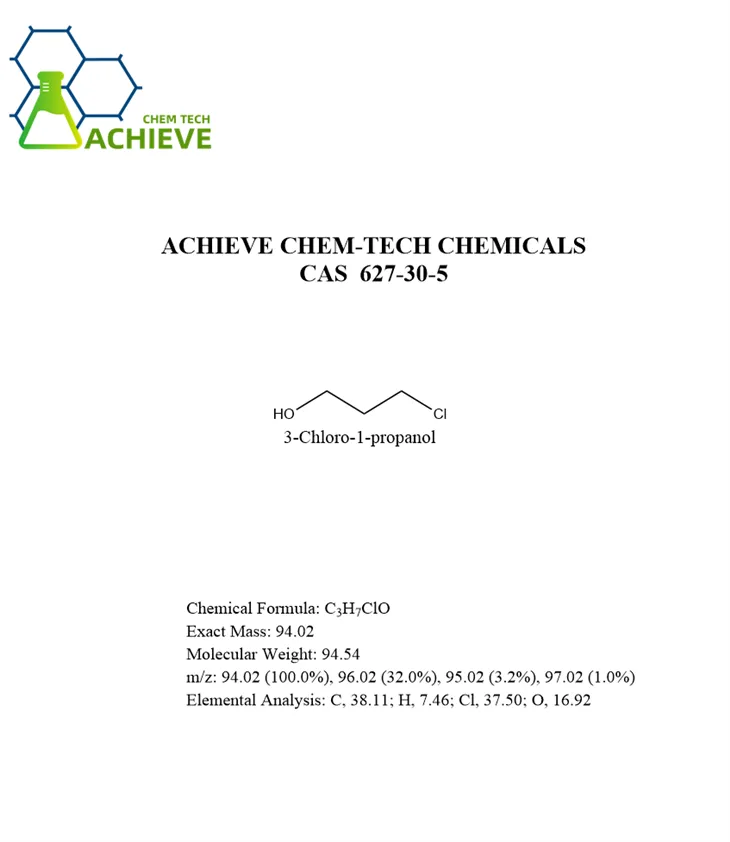


Shaanxi BLOOM Tech Co., Ltd. is one of the most experienced manufacturers and suppliers of 3-chloro-1-propanol cas 627-30-5 in China. Welcome to wholesale bulk high quality 3-chloro-1-propanol cas 627-30-5 for sale here from our factory. Good service and reasonable price are available.
3-Chloro-1-propanol, also known as trimethylchlorosol, 1-chloro-3-hydroxypropane, or 3-chloropropanol, is a colorless and transparent liquid that is easily soluble in water, ethanol, and ether. It is irritating and may irritate the eyes, respiratory system, and skin. It plays an important role in organic synthesis and is a key raw material for various chemical synthesis. It is an important intermediate in drug synthesis, which can be used to synthesize various drugs, such as 3-chloropropyl chloroformate, intermediate of nelfinavir, and intermediate of antithrombotic drug clopidogrel. Due to its good solubility, it is also used as a solvent. It should be stored away from open flames, sealed, and ventilated, and stored separately from food and oxidants.

Additional information of chemical compound:
|
Chemical Formula |
C3H7ClO |
|
Exact Mass |
94.02 |
|
Molecular Weight |
94.54 |
|
m/z |
94.02(100.0%),96.02(32.0%),95.02(3.2%),97.02(1.0%) |
|
Elemental Analysis |
C, 38.11; H, 7.46; Cl, 37.50; O, 16.92 |
|
Melting point |
-20℃ |
|
Boiling point |
160-162℃(lit.) |
|
Density |
1.131 g/mL at 25℃(lit.) |
|
Storage conditions |
0-6℃ |
|
|
|


3-Chloro-1-propanol is an important organic compound with wide applications in various fields. The following is a detailed explanation of its purpose:
This compound plays an important role in chemical synthesis as an organic intermediate. It can participate in various chemical reactions to generate a series of organic compounds with specific functions. These compounds have a wide range of applications in the fields of medicine, pesticides, dyes, fragrances, and more. In drug synthesis, it is an important raw material. It can be used for the synthesis of various drugs, such as chloroformate 3-chloropropyl ester, intermediate of nelfinavir, and intermediate of antithrombotic drug clopidogrel. The synthesis of these drugs cannot be separated from their participation, therefore they have an irreplaceable position in the field of drug synthesis.

Applications in the field of solvents

This compound has good solubility and can dissolve various organic and inorganic substances. Therefore, it is often used as a solvent and has a wide range of applications in chemical synthesis, coatings, inks, dyes, and other fields. In the process of chemical synthesis, it can act as a solvent to help the reactants mix and react better. Its solubility and stability make it an ideal solvent for many chemical reactions. In the manufacturing of coatings and inks, it can serve as a solvent to help pigments and resins disperse and mix better. Its use can improve the uniformity and stability of coatings and inks, thereby enhancing the quality and performance of products.
Due to its important position in drug synthesis, this substance also has a wide range of applications in the pharmaceutical field. Here are some specific examples: 3-chloro-1-propanol is an important intermediate of the antithrombotic drug clopidogrel. Clopidogrel is a commonly used antiplatelet aggregation drug, mainly used in clinical practice to prevent and treat heart, brain, and other arterial circulation disorders caused by platelet aggregation. Its involvement has made the synthesis of clopidogrel possible, thereby contributing to human health. In addition to antithrombotic drugs, it can also be used to synthesize some antiviral drugs. These drugs play an important role in treating viral infections, helping to alleviate patients' symptoms and shorten the course of the disease. In addition, it can also be used to synthesize various other drugs, such as analgesics, anti-inflammatory drugs, anti allergic drugs, etc. The synthesis and application of these drugs provide more choices and guarantees for human health.

Application in the field of pesticides

This compound also has a wide range of applications in the field of pesticides. It can be used as a raw material or intermediate for pesticides, participating in the synthesis and preparation of pesticides. Here are some specific examples: it can be used to synthesize insecticides that have strong killing effects on pests and can effectively protect crops from pest damage. In addition to insecticides, it can also be used for synthesizing herbicides. These herbicides can kill or inhibit the growth of weeds, providing a better growing environment for crops. In addition, it can also be used to synthesize plant growth regulators. These regulators can regulate the growth and development process of plants, improve crop yield and quality.
It also has certain applications in the field of dyes. It can be used as a raw material or intermediate for dyes, participating in the synthesis and preparation of dyes. Here are some specific examples: This compound can be used to synthesize dyes with specific colors and properties. These dyes have a wide range of applications in textile, printing and dyeing fields, providing rich colors and patterns for textiles. In addition, it can also serve as a raw material for dye intermediates and participate in the synthesis process of other dyes. Its use can make the synthesis of dyes more efficient and stable, thereby improving the quality and performance of dyes.

Application in the field of spices

It also has certain applications in the field of spices. It can be used as a raw material or intermediate for spices, participating in the synthesis and preparation of spices. Here are some specific examples: This substance can be used to synthesize spices with specific aromas. These spices have a wide range of applications in the fields of food, cosmetics, etc., and can provide unique aroma and taste to products. In addition, it can also serve as a raw material for spice intermediates and participate in the synthesis process of other spices. Its use can make the synthesis of spices more flexible and diverse, thus meeting the needs of different fields for spices.
It can be used to synthesize some surfactants. These surfactants have a wide range of applications in detergents, emulsifiers, and other fields, which can improve the cleaning effect and stability of products. In addition, this compound can also be used to synthesize some lubricants. These lubricants have a wide range of applications in fields such as machinery and automobiles, which can reduce friction and wear, improve the operational efficiency and lifespan of machinery. It can also be used to synthesize other compounds such as chlorides, esters, ethers, etc. These compounds have a wide range of applications in chemistry, materials and other fields, and can provide more support and guarantee for the development of human society.

What impact does this compound have on the environment?
Environmental impact
1. Impact on aquatic ecosystems
acute toxicity
Sanya methyl chlorohydrin has certain acute toxicity to aquatic organisms. When aquatic organisms are exposed to water containing 3-chloro-1-propanol, they may be affected by varying degrees of toxicity. This effect may manifest as growth inhibition, behavioral abnormalities, physiological dysfunction, and even death.
Bioaccumulation
Sanya methyl chlorohydrin has lipophilicity and is easy to accumulate in aquatic organisms. With the transmission and enrichment of the food chain, the concentration of trimethylchlorosol may reach high levels in higher organisms, causing long-term impacts on ecosystems.
The impact on algae
Research has shown that trimethylchlorosol has an inhibitory effect on the growth of algae. Algae are important producers in aquatic ecosystems, and their growth inhibition will directly affect the balance and stability of the entire ecosystem.
2. Impact on soil ecosystem
soil pollution
Sanya methyl chlorohydrin may enter the soil through methods such as wastewater irrigation and agricultural waste. Once it enters the soil, trimethyl chlorohydrin may have toxic effects on soil microorganisms and disrupt soil ecological balance.
The impact on plant growth
Sanya methyl chlorohydrin has an inhibitory effect on plant growth. It may interfere with the normal physiological functions of plants, leading to phenomena such as slow plant growth, yellowing of leaves, and decreased yield. Long term exposure to soil contaminated with trichloromethane may cause plants to gradually lose their vitality and even die.
Changes in Soil Microbial Community Structure
The pollution of methyl chlorohydrin in Sanya may lead to changes in soil microbial community structure. Some sensitive microorganisms may decrease or disappear, while some more tolerant microorganisms may become dominant populations. This change in community structure will directly affect soil fertility and ecosystem stability.
3.Impact on atmospheric environment
volatility
Sanya methyl chlorohydrin has a certain degree of volatility and may evaporate into the atmosphere during storage, use, or processing. Trimethylchlorohydrin, which evaporates into the atmosphere, may react with other compounds in the atmosphere to generate secondary pollutants.
photochemical reaction
In the atmosphere, trimethyl chlorohydrin may participate in photochemical reactions, generating secondary pollutants such as ozone and peroxyacetyl nitrate (PAN). These secondary pollutants pose greater harm to human health and the environment.
The impact on climate
Although the direct impact of trimethylchlorohydrin on climate may be relatively small, its presence and transformation in the atmosphere may indirectly affect the climate system. For example, the photochemical reactions involving trimethylchlorohydrin may alter the chemical composition and energy balance in the atmosphere, thereby affecting the stability and predictability of the climate system.
4.The impact on human health (indirectly reflecting environmental impact)
Sanya methyl chlorohydrin has acute toxicity and irritation to the human body, and long-term exposure may cause damage to the nervous system, respiratory system, etc. These health effects may be transmitted to the human body through the food chain, drinking water, and other pathways, indirectly reflecting the degree of environmental pollution caused by trimethylchlorosol.
Environmental risk management and prevention measures
Given the potential impact of 3-chloro-1-propanol on the environment, effective risk management and prevention measures must be taken to reduce its environmental risks:
- Strengthen the construction of laws and regulations
The government should formulate and improve relevant laws and regulations to clarify the environmental requirements for the production, use, storage, and disposal of trimethylchlorohydrin. At the same time, the punishment for illegal activities should be increased to ensure the effective implementation of laws and regulations.
- Promote clean production technology
Encourage enterprises to adopt clean production technologies and reduce waste emissions during the production process of trimethyl chlorohydrin. By improving production processes, increasing raw material utilization, and other measures, the production cost and environmental pollution of trimethyl chlorohydrin can be reduced.
- Strengthen environmental monitoring and assessment
Establish a sound environmental monitoring system and conduct regular environmental monitoring of the production, use, and disposal sites of methyl chlorohydrin in Sanya. Evaluate the actual impact of Sanya methyl chlorohydrin on the environment through monitoring data, and provide scientific basis for formulating prevention and control measures.
- Carry out environmental education and publicity
Strengthen environmental education and publicity, raise public awareness of environmental protection and risk awareness of chemicals such as Sanya methyl chlorohydrin. Through education and promotion, guide the public to use and handle products containing trimethyl chlorohydrin correctly, and reduce their pollution to the environment.
- Implement strict environmental management system
Establish a strict environmental management system to supervise the entire process of production, use, storage, and disposal of trimethyl chlorohydrin. By implementing systems such as environmental impact assessment and pollutant discharge permits, we ensure effective control of the environmental risks associated with Sanya methyl chlorohydrin.
Conclusion and Prospect
3-chloro-1-propanol, as an important organic synthesis intermediate, has a wide range of applications in drug synthesis, solvent preparation, and other fields. However, its potential impact on the environment cannot be ignored. By strengthening the construction of laws and regulations, promoting clean production technologies, enhancing environmental monitoring and evaluation, conducting environmental education and publicity, and implementing strict environmental management systems, the environmental risks of 3-chloro-1-propanol can be effectively reduced. In the future, with the continuous improvement of environmental awareness and the continuous development of technology, we are expected to find more environmentally friendly and efficient alternatives or treatment methods to further reduce pollution and damage to the environment. At the same time, it is also necessary to strengthen international cooperation and exchanges to jointly address global environmental issues.
It is a cornerstone of modern synthetic chemistry, bridging raw materials and high-value products across industries. Its versatility stems from a balance of reactivity, solubility, and functional group compatibility.
Hot Tags: 3-chloro-1-propanol cas 627-30-5, suppliers, manufacturers, factory, wholesale, buy, price, bulk, for sale, hydroxyethyl urea powder, 5 Bromoisatoic Anhydride CAS 4692 98 2, 1-Bromododecane, Peptone Powder CAS 73049 73 7, 2 Chlorobenzaldehyde CAS 89 98 5, 1,1'-Thiocarbonyldiimidazole CAS 6160-65-2