




Shaanxi BLOOM Tech Co., Ltd. is one of the most experienced manufacturers and suppliers of (r)-glycidyl butyrate cas 60456-26-0 in China. Welcome to wholesale bulk high quality (r)-glycidyl butyrate cas 60456-26-0 for sale here from our factory. Good service and reasonable price are available.
(R)-Glycidyl butyrate (CAS 60456-26-0), also named Oxyran-2-ylmethyl butyrate, is a high-value organic synthetic intermediate presented as a colorless to pale yellow transparent liquid. Widely applied in fine chemical and pharmaceutical synthesis, this compound serves as a critical chiral building block for drug intermediate preparation and can also be utilized in formula research for feed additives and daily chemical raw materials.As a reliable manufacturer and supplier, Bloomtechz provides high-purity (R)-Glycidyl butyrate with strictly controlled chiral purity and stable batch consistency. We support lab sample evaluation, bulk wholesale and customized technical services to meet customers' diverse synthetic research and industrial production demands.

Additional information of chemical compound:
|
Chemical Formula |
C7H12O3 |
|
Exact Mass |
144.08 |
|
Molecular Weight |
144.17 |
|
m/z |
144.08 (100.0%), 145.08 (7.6%) |
|
Elemental Analysis |
C, 58.32; H, 8.39; O, 33.29 |
|
Boiling point |
197℃(lit.) |
|
Density |
1.032 g/mL at 20℃(lit.) |
|
Storage conditions |
2-8℃ |
|
|
|
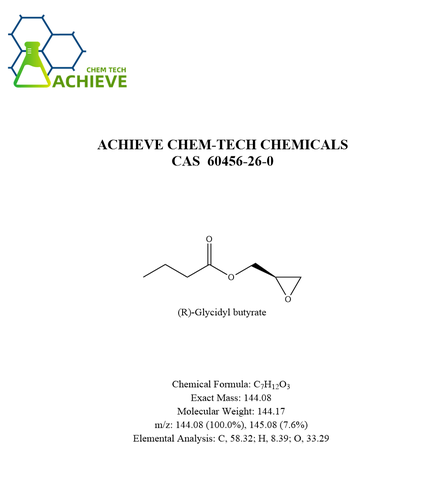


(R)-Glycidyl butyrate,(R) - (-) - Butyric acid glycidyl ester, with CAS number 60456-26-0, the following is a detailed explanation of its use:
Application of drug synthesis
This substance, as an important intermediate in drug synthesis, has wide application value in the pharmaceutical field. Specifically, it is a key raw material for the synthesis of antibacterial drugs such as linezolidone.
Linezolidone is a drug with broad-spectrum antibacterial activity, which is mainly used to treat various bacterial infectious diseases. In the process of synthesizing linezolidone, (R) - (-) - butyric acid glycidyl ester is used as the starting material or key intermediate, and through a series of chemical reactions such as esterification, condensation, cyclization, etc., the target product linezolidone is finally obtained.This synthesis process not only requires high purity of the raw materials,


but also requires strict reaction conditions and fine operating techniques to ensure the quality and yield of the products.It can be further chemically modified or transformed to synthesize compounds with different pharmacological activities, thereby expanding its application scope in the pharmaceutical field. In addition, the structural characteristics of (R) - (-) - butyric acid glycidyl ester also give it unique advantages in the synthesis of certain specific drugs, such as improving drug solubility, stability, or bioavailability.
Application in the field of chemical engineering
Epoxy resin is an important thermosetting resin with excellent physical properties and chemical stability, widely used in coatings, adhesives, composite materials and other fields.
(R) - (-) - Butyric acid glycidyl ester can be used as a diluent for epoxy resin, reducing its viscosity and improving its processing performance, thus facilitating construction and application. Meanwhile, the addition of (R) - (-) - butyric acid glycidyl ester can also have a certain impact on the curing behavior of epoxy resin, such as accelerating the curing speed and improving the properties of the cured product. In the field of coatings and adhesives, it can be used as a modifier or plasticizer to improve the flexibility and adhesion of products.By mixing and reacting (R) - (-) - butyric acid glycidyl ester with other components in coatings or adhesives, composite materials with excellent properties can be prepared to meet the application needs of different fields.


It can also be used for modifying plastics and rubber. By adding it to plastic or rubber, its processing and physical properties can be improved, such as increasing tensile strength, wear resistance, weather resistance, etc. Meanwhile, the addition of (R) - (-) - butyric acid glycidyl ester can also reduce the cost of plastics or rubber and improve their cost-effectiveness.
Application of Fine Chemicals
(R) - (-) - glycidyl butyrate has unique aroma and taste characteristics, which can be used to synthesize various spices and essence. These spices and essence can be widely used in food, beverage, tobacco and other fields to improve the quality and taste of products.By adjusting the dosage of (R) - (-) - butyric acid glycidyl ester and reaction conditions, spices and essence products with different aroma and taste can be prepared.
(R) - (-) - Butyric acid glycidyl ester can also be used in the synthesis of pesticides and herbicides. These products have excellent insecticidal and weed control effects, and are environmentally friendly with low toxicity and residue. By mixing and reacting (R) - (-) - butyric acid glycidyl ester with other pesticide or herbicide components, pesticide and herbicide products with high efficiency, broad spectrum, low toxicity and other characteristics can be prepared. (R) - (-) - Butyric acid glycidyl ester can also be used to synthesize various other fine chemicals, such as dyes, pigments, additives, etc.These products have wide application value in the fields of textile, printing and dyeing, papermaking, etc., such as improving the color brightness, fastness and other properties of products.


Research and experimental purposes
(R) - (-) - Butyric acid glycidyl ester has a unique chemical structure and reactivity, which can be used to study the mechanisms and processes of certain chemical reactions. By observing and analyzing the behavioral changes of (R) - (-) - butyric acid glycidyl ester during the reaction, as well as the structure and properties of the products, the inherent laws and mechanisms of chemical reactions can be revealed. (R) - (-) - Butyric acid glycidyl ester can also be used as a research object for the synthesis of new methods. By changing factors such as reaction conditions, catalyst types, and reaction pathways, more efficient and environmentally friendly synthesis methods can be explored.These new methods can not only improve product quality and yield, but also reduce production costs and environmental pollution.
(R) - (-) - Butyric acid glycidyl ester can also be used to develop new functional materials. By compounding or modifying it with other materials, new materials with special functions can be prepared. These new materials have broad application prospects and potential in fields such as electronic information, biomedicine, and aerospace.

(R)-Glycidyl butyrate,R-Butyrate glycidyl ester is an organic compound with a specific chemical structure and properties. Its unique chemical properties make it have potential application value in multiple fields. Here are its development prospects:
Market demand
With the continuous growth of the global pharmaceutical market and the increasing demand for health, the market demand for antibiotics is also constantly increasing. As an intermediate of the antibacterial drug linezolidone, the market demand for R-butyric acid glycidyl ester is also increasing year by year. In addition, with the continuous development of the chemical industry and the exploration of new fields, the application of R-butyric acid glycidyl ester in other fields will gradually expand, further promoting the growth of its market demand.


Production Status
At present, the production of R-butyric acid glycidyl ester is mainly concentrated in countries such as China, Belgium, Germany, France, South Korea, Canada, and the United States. As one of the world's largest producers of chemicals, China also plays an important role in the production of R-butyric acid glycidyl ester. Several domestic enterprises have mastered the production technology of R-butyric acid glycidyl ester and have a certain production scale. However, compared with developed countries, the production technology and product quality of R-butyric acid glycidyl ester in China still need to be improved.
Analysis of Development Prospects
Continued growth in the pharmaceutical industry
With the intensification of global population aging and the continuous increase of chronic diseases, the demand for the pharmaceutical market will continue to grow. As an intermediate of the antibacterial drug linezolidone, R-butyric acid glycidyl ester has broad application prospects in the pharmaceutical field. With the continuous advancement of new drug development and the upgrading of antibacterial drugs, the market demand for R-butyric acid glycidyl ester will further increase.
The continuous expansion of the chemical industry
The chemical industry is one of the important pillars of the national economy, and its level of development directly affects the country's economic strength and people's living standards. With the continuous development of the chemical industry and the exploration of new fields, the application areas of R-butyric acid glycidyl ester will gradually expand. For example, in industries such as plastics, coatings, and rubber, (R)-Glycidyl butyrate ester can be used as a plasticizer, stabilizer, crosslinking agent, etc., thereby improving product performance and quality. In addition, R-butyric acid glycidyl ester also has potential application value in industries such as pesticides and dyes.
The demand for environmental protection and sustainable development
With the continuous improvement of global environmental awareness and the deepening of sustainable development concepts, green chemistry and environmental protection technology have become important directions for the development of the chemical industry. R-Butyrate glycidyl ester, as an environmentally friendly chemical, meets environmental requirements in both its production process and product applications. Therefore, in the context of environmental protection and sustainable development, the market demand for R-butyric acid glycidyl ester will further increase.
The promotion of technological innovation and industrial upgrading
Technological innovation and industrial upgrading are important driving forces for the development of the chemical industry. With the continuous advancement of technology and the increasing demand for chemical performance, the production technology and product quality of R-butyric acid glycidyl ester also need to be constantly innovated and upgraded. By introducing advanced technology, optimizing production processes, and improving product quality, the market competitiveness of R-butyric acid glycidyl ester can be further enhanced, and its application fields can be expanded.
Types and characteristics of biocatalysts

Enzyme catalyst
Enzymes are proteins with catalytic functions in living organisms, possessing high specificity and efficiency. Enzyme catalysts can catalyze various chemical reactions under mild conditions, such as redox reactions, hydrolysis reactions, esterification reactions, etc. In the synthesis of (R) - Glycidyl Butyrate, enzyme catalysts can selectively catalyze specific reaction steps, improving the selectivity and yield of the reaction. For example, some lipases can catalyze ester exchange reactions, reacting butyric acid with glycidol to produce (R) - Glycidyl butyrate.
Microbial cell catalyst
Microbial cells contain multiple enzyme systems that can act as integral catalysts to catalyze complex chemical reactions. Microbial cell catalysts have the advantages of easy operation and low cost, making them suitable for large-scale production. In the synthesis of (R) - Glycidyl Butyrate, some microorganisms can convert substrates into (R) - Glycidyl Butyrate through metabolic pathways. For example, certain yeast strains can use carbon sources such as glucose to synthesize butyric acid, which is then esterified to produce (R) - Glycidyl butyrate.


Characteristics of Biocatalysts
Compared with traditional chemical catalysts, biocatalysts have the following characteristics:
Mild reaction conditions: Biocatalysts typically undergo catalytic reactions at room temperature, atmospheric pressure, and near neutral conditions, without the need for harsh conditions such as high temperature and high pressure, reducing energy consumption and equipment costs.
High selectivity: Biocatalysts have high specificity and can selectively catalyze specific reaction steps, reduce the occurrence of side reactions, and improve the selectivity and yield of reactions.
Characteristics of Biocatalysts
Environmentally friendly: The catalytic process of biocatalysts usually does not produce harmful by-products, is environmentally friendly, and meets the requirements of sustainable development.
Reproducibility: Biocatalysts can be produced and regenerated on a large scale through biotechnology, and have renewability.

Application of Biocatalysts in the Synthesis of (R) - Glycidyl Butyrate
In recent years, significant progress has been made in enzyme catalyzed synthesis of (R) - Glycidyl Butyrate. Researchers have improved the activity and selectivity of enzymes by screening and modifying enzyme catalysts. For example, some lipases have been genetically engineered to have higher catalytic efficiency for the ester exchange reaction between butyric acid and glycidol. At the same time, the researchers also optimized the reaction conditions, such as temperature, pH value, substrate concentration, etc., further improving the yield of (R) - Glycidyl Butyrate.
In the process of enzyme catalyzed synthesis of (R) - Glycidyl Butyrate, immobilized enzyme technology can also be used. Fixed enzymes are enzymes that are immobilized on a carrier to enhance their stability and reusability. By using immobilized enzyme technology, the cost of enzyme usage can be reduced and production efficiency can be improved.
Microbial cell catalyzed synthesis of (R) - Glycidyl Butyrate is also a promising method. Researchers have screened and modified microbial strains to efficiently synthesize (R) - Glycidyl Butyrate. For example, some yeast strains can be genetically engineered to increase the synthesis of butyric acid, which can then be esterified to produce (R) - Glycidyl Butyrate.
In the process of microbial cell catalyzed synthesis of (R) - Glycidyl Butyrate, fermentation process optimization techniques can also be used. By optimizing fermentation conditions such as medium composition, fermentation temperature, aeration rate, etc., the growth rate and metabolic activity of microorganisms can be increased, thereby increasing the yield of (R) - Glycidyl Butyrate.
In order to improve the synthesis efficiency and yield of (R) - Glycidyl Butyrate, researchers have also combined biocatalysts with other technologies. For example, combining enzyme catalysis with chemical catalysis, using enzyme catalysis to selectively catalyze specific reaction steps, and then using chemical catalysis to complete subsequent reactions. Biocatalysts can also be combined with nanotechnology to enhance their activity and stability by utilizing the unique properties of nanomaterials.
reference
Jiang, C., & Yan, J. (2011). Enantioselective preparation of chiral glycidyl esters. Letters in Organic Chemistry, 8(4), 242–243.
Wang, Z., et al. (2006). Synthesis of chiral epoxide building blocks for pharmaceutical intermediates. Tetrahedron Letters, 47(20), 3453–3457.
Khan, M. A. (2011). Liquid chromatographic estimation of (S)-glycidyl butyrate in (R)-glycidyl butyrate. Journal of Natural Science, Biology and Medicine, 2(2), 180–184.
Jia, S., Xu, J., Li, Q., & Yu, J. (2003). Isolation of lipase producer and its performance in enantioselective hydrolysis of glycidyl butyrate. Applied Biochemistry and Biotechnology, 104, 69–79.
Li, L., Liu, M., Wang, Z., Wang, X., & Li, Z. (2026). Synthesis of glycerol-based polyethers via ring-opening polymerization of glycidyl butyrate. Polymer Chemistry, 17(8), 856–864.
Frequently Asked Questions
1. What purity and chiral quality does Bloomtechz provide for (R)-Glycidyl butyrate?
+
-
Bloomtechz supplies high-purity (R)-Glycidyl butyrate (CAS 60456-26-0) with standard ≥98% GC purity and stable chiral purity. We strictly control isomer impurities to avoid racemization issues during your chiral drug synthesis. Every batch is fully tested and delivered with official COA, GC and quality inspection records to support lab research, CRO filing and industrial scale-up.
2. Can I order lab samples of (R)-Glycidyl butyrate for pre-experiment testing?
+
-
Yes. Bloomtechz supports flexible small-scale sample orders for laboratory evaluation. We provide gram-level trial packages to help clients verify synthetic routes and product stability before bulk procurement, effectively reducing R&D risks and trial costs.
3. What packaging and shipping solutions does Bloomtechz offer for this liquid intermediate?
+
-
As a moisture-sensitive chiral liquid, (R)-Glycidyl butyrate requires professional sealed packaging. Bloomtechz adopts anti-leakage, light-proof and moisture-proof packaging for all liquid products. We support customized neutral packaging and complete export documents, ensuring safe and stable global transportation without product deterioration or leakage.
4. How to store (R)-Glycidyl butyrate and what is the shelf life?
+
-
(R)-Glycidyl butyrate is sensitive to moisture and high temperature. Bloomtechz recommends sealed storage in a cool, dry and dark environment. Under standard storage conditions, our products maintain a guaranteed 24-month shelf life with stable activity and no obvious impurity growth. We also provide professional storage and operation guidance for long-term use.
5. Why choose Bloomtechz for bulk purchase of (R)-Glycidyl butyrate?
+
-
Bloomtechz is a professional factory supplier specializing in chiral intermediates. We maintain stable batch consistency, low impurity content and reliable chiral stability. Compared with unstable market bulk goods, our factory direct supply avoids middlemen markup and batch data deviation. We support long-term stable bulk supply, custom specifications and one-stop technical after-sales service to support your pharmaceutical intermediate synthesis and fine chemical production.
Hot Tags: (r)-glycidyl butyrate cas 60456-26-0, suppliers, manufacturers, factory, wholesale, buy, price, bulk, for sale, 4 Methoxyphenylacetone CAS 122 84 9, 3 6 Dibromopyridazide, 1 2 Naphthoquinone 4 sulfonic acid sodium salt, Cinnamamide, Hydroxylamine Solution, Cyclohexapentylose CAS 10016 20 3