


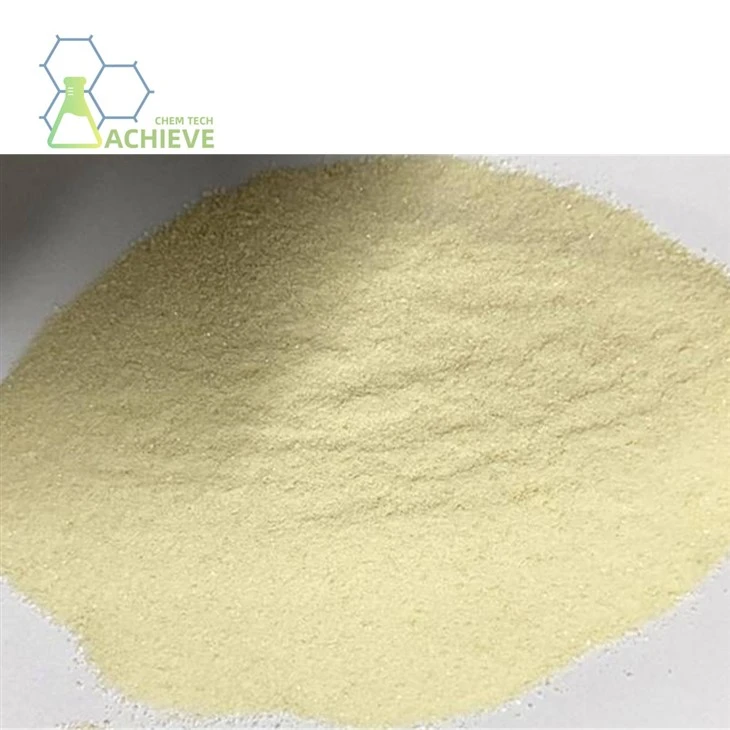

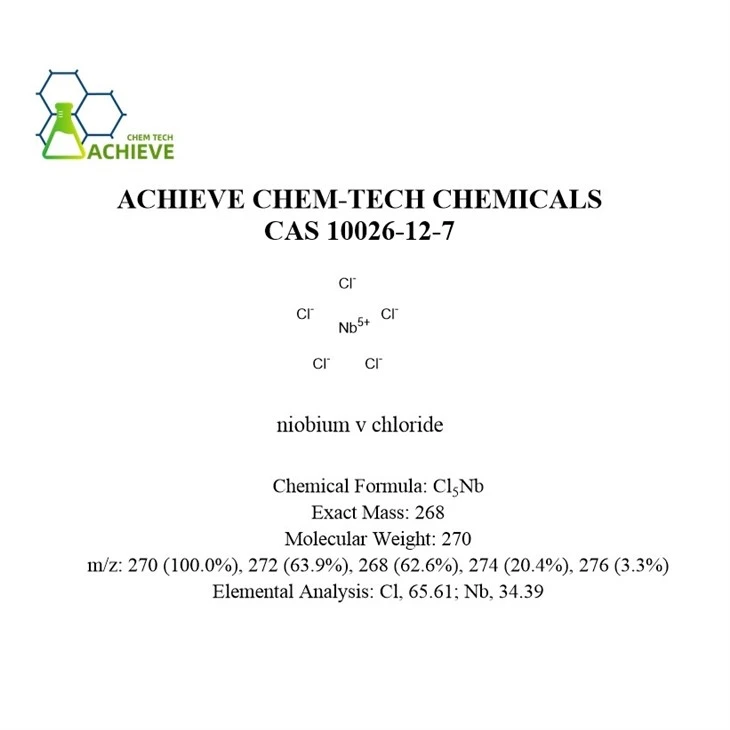
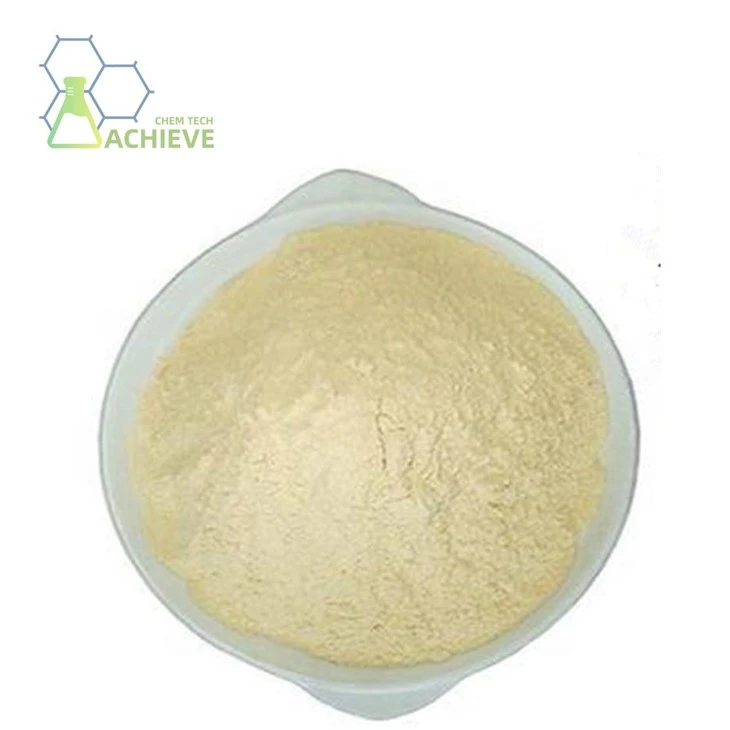
Niobium V Chloride, CAS 10026-12-7, Molecular formula Cl5Nb, yellow crystalline powder, melting point 204.7 ℃, boiling point 254 ℃. It is a strong Lewis acid that can promote various organic synthesis reactions. Solid niobium (V) chloride is actually a dimer structure, and its chemical formula can be expressed as Nb ₂ Cl ₁₀. This dimer is composed of two niobium atoms connected by a chlorine bridge, with six chlorine atoms coordinated around each niobium atom, forming a six coordinated distorted octahedral configuration. In the crystal structure, niobium atoms are connected by chlorine bridge bonds, forming a two-dimensional or three-dimensional network structure. This structural characteristic determines the uniqueness of its physical and chemical properties. Relatively stable at room temperature, but decomposition reactions may occur at high temperatures, producing low valent chlorides or oxides of niobium. It is a strong Lewis acid that can react with various organic and inorganic compounds. For example, it can form coordination compounds with compounds containing lone pair electrons such as alcohols and phenols; It can also undergo hydrolysis reaction with water to generate niobium hydroxide or niobium oxide.
|
Chemical Formula |
Cl5Nb |
|
Exact Mass |
268 |
|
Molecular Weight |
270 |
|
m/z |
270 (100.0%), 272 (63.9%), 268 (62.6%), 274 (20.4%), 276 (3.3%) |
|
Elemental Analysis |
Cl, 65.61; Nb, 34.39 |
|
|
|


The use and application examples of niobium v chloride
Niobium (V) chloride, with the chemical formula NbCl ₅, is an important inorganic compound that has shown wide application value in multiple fields. Its unique physical and chemical properties, such as strong Lewis acidity, good thermal stability, and solubility, make it play a key role in fields such as materials science, electronics industry, chemical synthesis, energy storage and conversion, and environmental governance. The following will elaborate on the uses and specific application examples of niobium (V) chloride.
(1) Preparation of Superconducting Materials
Application principle: Niobium (V) chloride is one of the important raw materials for preparing superconducting materials. Superconducting materials have extremely high application value as their resistance disappears under specific low temperature conditions and current can be transmitted without loss. Niobium (V) chloride can form niobium based compounds with superconducting properties by reacting with other metals or compounds.
Application example: In the preparation of niobium titanium alloy superconducting materials, niobium (V) chloride is used as the niobium source, which reacts with the titanium source through chemical vapor deposition or high-temperature melting methods to generate niobium titanium alloy. This alloy exhibits excellent superconducting properties at low temperatures and is widely used in fields such as magnetic resonance imaging (MRI) equipment and superconducting maglev trains.


(2) Preparation of Nanocomposite Materials
Application example: In the preparation of niobium pentoxide/reduced graphene oxide nanocomposite negative electrode materials, graphene oxide nanosheets are first mixed with water and dispersed by ultrasound to obtain graphene oxide nanodispersion liquid. Then, dissolve niobium (V) chloride in water, add organic co solvents and hexamethylenetetramine, and stir to obtain a white solution. Mix the graphene oxide nano dispersion with a white solution and perform a hydrothermal reaction to obtain a precipitate. After washing, drying, and heat treatment, niobium pentoxide/reduced graphene oxide nanocomposite negative electrode material is obtained. This material exhibits high specific capacity, long cycle life, and excellent rate performance in lithium-ion batteries, and is expected to be applied in fields such as electric vehicles and energy storage stations.
Application principle: Niobium (V) chloride can be used to prepare various nanocomposites, such as niobium pentoxide/reduced graphene oxide nanocomposite negative electrode materials. This composite material combines the high specific capacity of niobium pentoxide and the high conductivity of reduced graphene oxide, exhibiting excellent electrochemical performance.
(3) Preparation of Highly Permeable Nanoinfrared Excitation Media
Application principle: Niobium v chloride can be used to prepare highly permeable nano infrared excitation media that can efficiently absorb infrared short waves. This material is capable of absorbing specific wavelengths of infrared light and converting it into thermal energy or other forms of energy, with broad application prospects.


Application example: In the preparation of highly permeable nano infrared excitation media, niobium (V) chloride is first dissolved in anhydrous ethanol, nano silver oxide is added, and mixed evenly to obtain a mixed solution. Then, slowly drop the ethanol aqueous solution into the mixture, add N, N-dimethylformamide, and continue stirring to obtain the second mixture. After drying and calcination, nano modified niobium oxide is obtained. Mixing nano modified niobium oxide with water to obtain a highly permeable nano infrared excitation medium. This material can be used in the field of air purification to treat volatile organic compounds inside the board and improve indoor air quality.
(1) Preparation of Semiconductor Materials
Application principle: Niobium (V) chloride is a key raw material for preparing high-purity niobium compounds and niobium metals. High purity niobium compounds, as additives for electronic materials in semiconductor manufacturing, can significantly improve the performance of electronic products, such as increasing storage density and speed.
Application example: Niobium (V) chloride is used as a key material for preparing magnetic media in the manufacturing of high-density magnetic storage devices. By using chemical vapor deposition and other methods, niobium (V) chloride is converted into high-purity niobium thin films, which are deposited on a substrate to form a magnetic dielectric layer. This magnetic medium layer has excellent magnetic properties, which can improve the storage density and read/write speed of magnetic storage devices, and is widely used in fields such as computer hard drives and mobile storage devices.


(2) Coating materials for electronic components
Application principle: Niobium (V) chloride can be used to prepare coating materials for electronic components, improving the wear resistance and corrosion resistance of electronic devices. Coating materials can form a protective film on the surface of electronic components to prevent corrosion from the external environment.
Application example: When preparing electronic component coating materials, niobium (V) chloride is dissolved in an organic solvent, other additives are added, and the coating solution is obtained by stirring. By spraying, dipping, and other methods, the coating solution is applied to the surface of electronic components, and after drying and curing, a uniform protective film is formed. This protective film can effectively improve the wear resistance and corrosion resistance of electronic components, and extend the service life of electronic devices.
(3) Purification agent for photovoltaic materials
Application principle: Niobium (V) chloride acts as a purifying agent in the manufacturing of photovoltaic cells, which can improve the efficiency and stability of photovoltaic cells. By removing impurities from photovoltaic materials, reducing defect density, and improving carrier mobility, the photoelectric conversion efficiency of photovoltaic cells can be enhanced.
Application example: Niobium (V) chloride is used to purify silicon materials in the preparation of silicon-based solar cells. Mixing niobium (V) chloride with silicon material, and using high-temperature heat treatment and other methods to react niobium (V) chloride with impurities to generate volatile compounds, thereby removing impurities. The solar cells prepared from purified silicon materials have higher photoelectric conversion efficiency and longer service life, and are widely used in fields such as solar power generation systems and photovoltaic building integration.

Chemical synthesis field

(1) Organic synthesis catalyst
Application principle: Niobium v chloride is a strong Lewis acid that can promote various organic synthesis reactions. It can form coordination bonds with lone pair electrons in organic compounds, reduce reaction activation energy, and improve reaction rate and selectivity.
Application example: Niobium (V) chloride can be used as a catalyst to promote the addition reaction of aldehydes or ketones with hydrogen gas in the preparation of alcohol compounds. Add aldehydes or ketones, hydrogen gas, and niobium (V) chloride catalyst into a reaction vessel and react at a certain temperature and pressure to produce alcohol compounds. This reaction has the advantages of mild reaction conditions, high yield, and good selectivity, and is widely used in the synthesis of pharmaceuticals, pesticides, fragrances, and other fields.
(3) Synthesis of mixed chlorine aromatic oxides
Application principle: Niobium (V) chloride can be used to form mixed chloroaromatic oxides, such as [Nb (OC ₆ H ∝ -2,6-i-Pr ₂) ₂ Cl ∝] ₂. These compounds have unique coordination chemical properties and can form pyridine or phosphine adducts with six coordinate twisted geometries, which have potential applications in catalysis, materials science, and other fields.
Application example: In the synthesis of [Nb (OC ₆ H ∝ -2,6-i-Pr ₂) ₂ Cl ∝] ₂, niobium (V) chloride is reacted with specific aromatic alcohols and chlorinating agents in an organic solvent. The target product is obtained by controlling the reaction temperature, time, and ratio. This compound can be used as a catalyst for organic synthesis reactions and also for the preparation of coordination polymers with special functions.


(2) Petrochemical catalyst
Application principle: Niobium (V) chloride also has important applications in the petrochemical industry, serving as a catalyst to promote reactions such as petroleum cracking and reforming. It can alter the reaction pathway, increase the yield of the target product, and reduce the occurrence of side reactions.
Application example: In petroleum cracking reactions, niobium (V) chloride catalyst can promote the breakage of long-chain hydrocarbon molecules to generate short chain hydrocarbon molecules, thereby improving the yield of light oil products such as gasoline and diesel. By optimizing the composition of catalysts and reaction conditions, the economic and environmental benefits of petroleum cracking can be effectively improved.
(1) Negative electrode material for lithium-ion batteries
Application principle: As mentioned earlier, the niobium (V) chloride prepared niobium pentoxide/reduced graphene oxide nanocomposite negative electrode material has high specific capacity, long cycle life, and excellent rate performance. Niobium pentoxide provides lithium ion storage sites, while reduced graphene oxide provides a highly conductive network. The synergistic effect of the two enhances battery performance.
Application example: In the assembly process of lithium-ion batteries, niobium pentoxide/reduced graphene oxide nanocomposite negative electrode material is mixed with conductive agents and binders to form a negative electrode slurry, which is coated on copper foil and processed through drying, rolling and other processes to produce negative electrode sheets. Assemble lithium-ion batteries with positive electrode plates, separators, electrolytes, etc. This battery has broad application prospects in fields such as electric vehicles and energy storage stations, and can improve the energy density and power density of the battery.


(2) Other energy storage materials
Application principle: Niobium (V) chloride can also be used to prepare other types of energy storage materials, such as negative electrode materials for sodium ion batteries and electrode materials for supercapacitors. By regulating the structure and composition of materials, high energy density and high power density energy storage can be achieved.
Application example: When preparing negative electrode materials for sodium ion batteries, niobium (V) chloride is used as the raw material to prepare niobium based compounds through hydrothermal synthesis, high-temperature calcination, and other methods. This material has a stable crystal structure and good sodium ion insertion/extraction performance, and can be used as a negative electrode material for sodium ion batteries. In the preparation of electrode materials for supercapacitors, niobium (V) chloride can be used to prepare niobium oxide based electrode materials, improving the specific capacitance and cycling stability of supercapacitors.
(1) Air purification
Application principle: As mentioned earlier, the highly permeable nano infrared excitation medium prepared from niobium (V) chloride can be used in the field of air purification. This material can absorb infrared light and convert it into heat energy, causing volatile organic compounds inside the board to evaporate, and then remove them through adsorption, catalytic oxidation, and other methods.
Application example: In indoor air purification devices, high permeability nano infrared excitation media are coated on porous carriers to produce air purification filter cartridges. When air passes through the filter, the infrared excitation medium absorbs infrared light and generates heat, causing volatile organic compounds inside the board to evaporate and be adsorbed or oxidized by the adsorbent or catalyst in the filter, thereby purifying the air.


(2) Wastewater treatment
Application principle: Niobium (V) chloride and its derivatives have catalytic oxidation properties and can be used in advanced oxidation processes in wastewater treatment. They can catalyze the generation of highly oxidizing free radicals, such as hydroxyl radicals (· OH), which oxidize and decompose organic pollutants in wastewater into harmless substances such as carbon dioxide and water.
Application example: When treating industrial wastewater containing recalcitrant organic pollutants, niobium (V) chloride catalyst is added to the wastewater, along with oxidants such as hydrogen peroxide. Under illumination or heating conditions, niobium (V) chloride catalyzes the decomposition of hydrogen peroxide to produce hydroxyl radicals, which oxidize and degrade organic pollutants. By optimizing the reaction conditions, the efficiency of wastewater treatment and the quality of effluent can be effectively improved.
(1) Preparation of Advanced Lubricants
Application principle: Niobium (V) chloride can be used to prepare advanced lubricants, and its mechanism of action may be related to the formation of a protective film on the metal surface and the reduction of friction coefficient. This lubricant has excellent lubrication and wear resistance, which can extend the service life of mechanical equipment.
Application example: When preparing advanced lubricants, niobium (V) chloride is mixed with base oil, additives, etc., and lubricant products are made through processes such as stirring and grinding. This lubricant can be used for mechanical equipment such as automotive engines and industrial gearboxes to improve the operational efficiency and reliability of the equipment.


(2) Photographic photosensitive material surfactant
Application principle: Niobium (V) chloride or its derivatives can be used as surfactants for photographic photosensitive materials to improve their dispersibility, coating properties, and imaging performance. They can form a uniform film on the surface of photosensitive materials, improving their sensitivity and resolution to light.
Application example: when preparing photographic film, the photosensitive lotion containing niobium chloride (V) surfactant is coated on the substrate, and the photographic film is made through drying, exposure, development and other processes. This film has high definition, high contrast, and good preservation performance, and is widely used in fields such as photography and printing.
Application principle: Niobium based compounds prepared from niobium v chloride have high specific surface area, good thermal and chemical stability, and can be used as catalyst supports. By loading active components, high-performance catalysts can be prepared for various chemical reactions.
Application example: when preparing hydrogenation catalyst, niobium chloride (V) is prepared into niobium based oxide support by sol gel method, hydrothermal synthesis method and other methods, and then noble metal active components (such as platinum, palladium, etc.) are loaded on the support. This catalyst exhibits excellent catalytic performance in hydrogenation reactions in the fields of petrochemicals, fine chemicals, etc., which can improve the selectivity and yield of the reaction.

Frequently Asked Questions
What is the color of niobium chloride?
+
-
Colorless.
Niobium(V) fluoride, also known as niobium pentafluoride, is the inorganic compound with the formula NbF5. It is a colorless solid.
What is the formula for niobium V perchlorate?
+
-
Niobium perchlorate, or more precisely niobium(V) perchlorate, is a chemical compound with the formula Nb(ClO 4) 5.
What are the disadvantages of niobium?
+
-
Challenges with Niobium.
Niobium's lower melting point compared to tantalum presents a challenge. Furthermore, niobium exhibits multiple oxide forms and readily transitions between them. This transition ability can significantly undermine the metal's effectiveness, particularly in harsh environments and capacitors.
Is niobium more expensive than gold?
+
-
Niobium is significantly less expensive than gold. Offering your clients a high quality, stylish jewelry at a fraction of the price, which is ideal when your customers are balling on a budget.
Why is niobium expensive?
+
-
Niobium is a rare metal found in numerous locations around the world in rocks of volcanic origin. It is relatively difficult to find and is produced from pyrochlore and tantalite ores, and as a by-product of mining for other minerals.
Hot Tags: niobium v chloride cas 10026-12-7, suppliers, manufacturers, factory, wholesale, buy, price, bulk, for sale, 3-Chloropropyltrimethoxysilane, Benzyltriethylammonium chloride, 3-Isocyanatopropyltriethoxysilane, Coconut Oil Acid Diethanolamine, 1 10 Phenanthroline hydrate, Sodium Lignosulphonate Powder CAS 8061 51 6