




Shaanxi BLOOM Tech Co., Ltd. is one of the most experienced manufacturers and suppliers of lithium nitride cas 26134-62-3 in China. Welcome to wholesale bulk high quality lithium nitride cas 26134-62-3 for sale here from our factory. Good service and reasonable price are available.
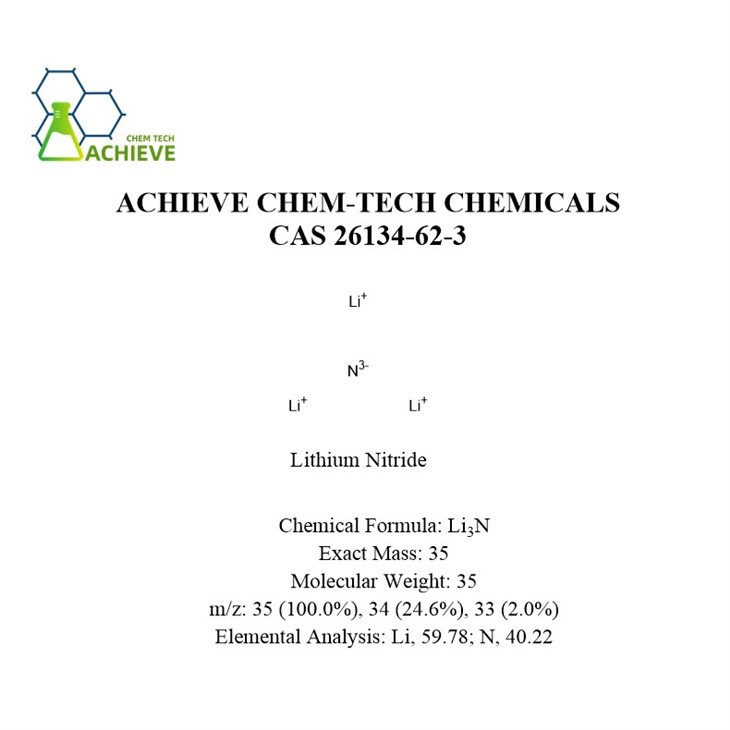
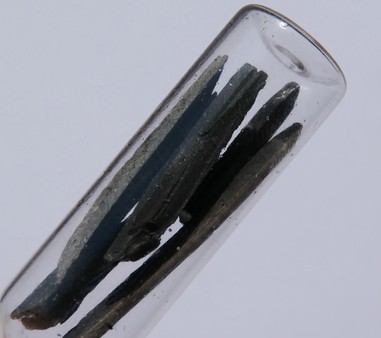
Lithium nitride is a metal nitride with the chemical formula Li3N and CAS 26134-62-3. It is a purple or red crystalline solid with a light green luster under reflected light and a ruby color under transmitted light. Long term exposure to air will eventually turn into lithium carbonate. Alkali metal nitride chemistry is extremely limited, and only lithium nitrid is stable and easy to prepare in binary compounds (sodium nitride and potassium nitride can only be prepared under relatively extreme conditions). At room temperature, exposure to air can partially generate lithium nitrid. Lithium generates lithium ntride in a nitrogen stream 10-15 times faster than in air, at which point all lithium is converted into lithium nitrid.

|
Chemical Formula |
Li3N |
|
Exact Mass |
35 |
|
Molecular Weight |
35 |
|
m/z |
35 (100.0%), 34 (24.6%), 33 (2.0%) |
|
Elemental Analysis |
Li, 59.78; N, 40.22 |
|
|
|
Compared to the property of lithium, other alkali metals are difficult to form nitrides, such as sodium nitride, which can only be prepared by depositing atomic beams on sapphire at low temperatures and will decompose upon slight heating. Easy to hydrolyze, generating lithium hydroxide and ammonia gas, especially fine powder lithium ntride, which can undergo violent combustion when heated in air. Therefore, the operation must be carried out in an inert atmosphere (such as nitrogen). Can be used as a nitriding agent, a reducing agent in organic reactions, and a source of nitrogen gas in inorganic reactions


1. Solid electrolyte
Lithium nitride is a fast ion conductor with higher conductivity than other inorganic lithium salts. Many studies have focused on the application of lithium ntride as a solid electrode and cathode material for batteries.
A series of lithium fast ion conductors were prepared based on lithium ntride. Analyze and identify their phase composition, study their electrochemical properties such as ion conductivity, decomposition voltage, and conductivity, and assemble experimental batteries with these materials for discharge tests.
Research has shown that the lithium ntride based binary system (Li3N LiCl) has formed Li9N2Cl3 compounds, with a decomposition voltage of over 2.5V and a conductivity of 1.3 × 10⁻⁵ S cm-1 at 25 ℃. As a fast ion conductor material, it should have high decomposition voltage, low electronic conductivity, high ionic conductivity, and good chemical stability. Many fast ion conductors of lithium have the above characteristics, which can be used to manufacture high-performance all solid state batteries, used as power sources for calculators, camera flashes, electronic watches, and an increasing number of electronic devices and products; In addition, lithium-ion conductors can also be used to manufacture special ion devices.


People once imagined using lithium fast ion conductor materials to build large energy storage (electricity) piles. During the low peak period of electricity consumption in big cities at night, excess electricity could be charged into energy storage stations, and during the peak period of electricity consumption, it could continuously supply power to the grid. Due to the broad application prospects of lithium fast ion conductors, it has aroused great interest and extensive and in-depth research has been carried out to find better lithium fast ion conductors.
The decomposition voltage of Li3N is only 0.44V (25 ℃), which limits its practical application. Therefore, it is necessary to modify and synthesize Li3N based binary and ternary ion conductor materials. One improvement method is to mix the ground Li3N powder with an appropriate amount of anhydrous LiCl powder (2:3 molar ratio) evenly, press the tablets on a tablet press, load them into a nickel boat, place them in a synthesis device, use nitrogen as a protective atmosphere, heat to 600 ℃ (90 minutes), and obtain a gray white Li9N2Cl3 solid powder. From the study of electrochemical experiments, it was found that the decomposition voltage of Li9N2Cl3 compound prepared by adding LiCl to Li3N increased from 0.4V to over 2.5V.


2. Preparation of cubic boron nitride
In addition to being used as a solid electrolyte, lithium nitride is also an effective catalyst for the conversion of hexagonal boron nitride to cubic boron nitride.
In 1987, Japanese scholars used the seed crystal method under ultra-high pressure and high temperature conditions to obtain N-type cBN single crystals with a particle size of 2mm and irregular shape by doping Si. Then, they grew P-type cBN single crystals doped with Be on the surface of the crystal under secondary high pressure, and finally obtained cBN homogeneous P-N junctions by cutting and grinding. There are similar synthesis experiments in China, which were conducted on the domestically produced DS-029B six sided top press machine.
In order to investigate the effect of catalysts/additives on the shape of high-pressure synthesized cBN samples, the experiment used hBN with a purity of 99% as the initial raw material, self-made lithium ntride Li3N and lithium hydride LiH as catalysts, and commercial 99% purity amino lithium LiNH2 as an additive. Before the experiment, hexagonal boron nitride (hBN) was first dried at 100 ℃ for 12 hours under vacuum conditions to remove adsorbed moisture and gases from the raw materials. Then, the initial hBN was uniformly mixed with LiH, Li3N, LiH+Li3N, LiH+LiNH2, and Li3N+LiNH2 in a certain proportion, and pressed into a cylindrical shape with a diameter of 15.3mm and a height of 6mm.


The synthesis pressure used in the experiment is 4.0-6.0 GPa, the temperature is 1400-1900 ℃, and the holding time is 10-20 minutes. After the experiment, slowly release the pressure, take out the sample for acid and alkali treatment, rinse and filter to obtain cBN crystals.
In addition to the above experiments, based on the traditional phase transition method, cubic boron nitride was synthesized by studying the use of lithium ntride as a catalyst, hexagonal boron nitride as a raw material, and adding different additives. By using X-ray diffraction technology, Raman diffraction technology, and other techniques to analyze and characterize the experimental products, it can be concluded that different additives will have different effects on the system.
The influence of ammonia fluoride on the synthesis of cubic boron nitride from lithium ntride and hexagonal boron nitride systems was analyzed. using X-ray diffraction technology to analyze the synthesized products, it was found that although ammonia fluoride consumes the catalyst lithium ntride, it also produces additional product ammonia gas, which can reduce the pressure of the synthesis experiment. Analyzing the effect of lithium hydride on the synthesis of cubic boron nitride from lithium ntride and hexagonal boron nitride systems, X-ray diffraction and Raman diffraction techniques were used to analyze the synthesized products.


It was found that lithium hydride reacts with hexagonal boron nitride to generate catalytic lithium ntride, ammonia gas, and elemental boron atoms. Elemental boron atoms have the effect of blackening the crystal color and inhibiting crystal growth along the (111) plane. The influence of catalyst assembly on the synthesis results can be discussed as follows: If it is considered that the formation process of cubic boron nitride first involves the diffusion reaction of catalyst into adjacent hexagonal boron nitride under high temperature and pressure, resulting in the formation of some intermediate compound.
The latter can dissolve the remaining hexagonal boron nitride and become a solvent melt. As the temperature and pressure enter the stable zone of cubic boron nitride, the dissolved nitrogen boron ions in the melt may exist individually or more likely in some group form. Due to the concentration reaching supersaturation, they will crystallize and precipitate according to the structure of cubic boron nitride. As these ions or ion groups continuously diffuse and deposit onto the precipitated cubic boron nitride crystals through the solvent melt, the crystals will continue to grow until the process stops.


3. Organic light-emitting devices
Organic Light Emitting Devices (OLEDs) have solid-state, active emission properties
Due to its wide viewing angle, fast response speed (<1 μ s), wide operating temperature range (-45 ℃~+85 ℃), ability to be fabricated on flexible substrates, and low unit power consumption, it is regarded as one of the mainstream display and lighting technologies of the next generation in the industry. The application of various new organic semiconductor materials and new organic device structures has made significant progress in OLED performance and industrialization.
Due to the fact that the lowest unoccupied molecular orbital (LUMO) energy level of electronic transport materials in OLEDs is approximately 3eV, the corresponding organic n-dopant materials are difficult to find, and even if found, they are often unstable in air. Therefore, they need to be placed in a protective gas during material synthesis and device fabrication. Therefore, inorganic dopant materials are often used for n-type doping of organic semiconductor materials, such as metal lithium and metal cesium, which are applied in n-type doping of OLEDs. Later, some Li and Cs compound materials are also used as n-type dopants. However, the development of n-type doping in organic semiconductor materials still lags behind that of p-type doping. Therefore, the search for new n-type dopant materials to improve the effect of n-type doping is extremely urgent.

Lithium nitride (Li3N) is used as an n-type dopant to be doped into the tris (8-hydroxyquinoline) aluminum (Alq3) layer of the electron transport material to improve the performance of OLED devices. There have been literature reports that Li3N can improve the performance of devices as a buffer layer between the electron injection layer and the cathode. During the evaporation process, Li3N decomposes into Li and N2, and only Li can deposit on the device. N2 also has no adverse effect on the device performance. The experiment shows that the Alq3 layer doped with Li3N can effectively improve the efficiency of OLED and reduce the operating voltage of the device when applied as an electron injection layer.

The preparation of lithium ntride can directly react elemental nitrogen and lithium, usually by burning lithium in pure nitrogen gas. This method is the most commonly used for preparing lithium ntride, whether in the laboratory or in industry. In addition, nitrogen can also be introduced into liquid sodium dissolved with metallic lithium, which produces high-purity lithium ntride.
Method 1
This method involves the direct reaction of metallic lithium and pure nitrogen at high temperatures, resulting in a product purity of 95% to 99%.
Preparation device:
1- Nitrogen cylinder; 2- Cooling pipe; 3- Electric furnace; 4- Rubber stopper;
G-reaction tube; J-U-shaped tube; K - Reverse flow bottle;
L - Gas washing cylinder; M - Glass plug

Pass nitrogen through a U-shaped tube filled with phosphorus pentoxide and a quartz tube filled with red hot copper chips to completely deoxygenate it.
Then, nitrogen is passed through a potassium hydroxide drying tube and a concentrated sulfuric acid washing tank to further remove moisture. The reaction tube is an iron tube that is 90 centimeters long and has an inner diameter of 5 centimeters, containing a small iron plate and a large iron plate. There is resistance wire heating outside the tube, and a thermocouple measures the temperature.
Firstly, inject nitrogen into the reaction tube (note: the preparation, execution, and completion of the reaction are always carried out in nitrogen). Gradually increase the temperature to 200 ° C to remove air and moisture from the reaction tube.
After cooling the reaction tube, add the newly cut 0.5 cm lithium particles to the small plate for deoxidation and dehydration. Add 10-12 lithium particles of the same size as the reactants onto the plate.
After 1 hour of ventilation, slowly raise the temperature to 450 ° C. After the reaction is complete, slowly open the valve and gradually reduce the nitrogen pressure. After the reaction tube cools to room temperature, remove the lithium nitride product.
Method 2
This method uses a zirconia crucible as a container and reacts at a high temperature of 800 ℃ to obtain lithium ntride crystals.
Preparation device:

A - Zirconia crucible; B - Iron crucible; C - Ceramic tube; D-reaction instrument
A is a zirconium crucible covered with a layer of molten lithium fluoride (melting point 840 ° C) on its surface. A is placed in an iron protective crucible B, and then both are placed together in a high-temperature resistant ceramic tube C. Cover the porcelain tube with a glass cover and seal it. The glass cover is connected to a three-way piston, which can be emptied or filled with gas. There is a serpentine tube around the sealing area between the glass cover and the ceramic tube, which can be used for cooling water.
Scrape off the lithium surface inside the operating box with argon gas, cut it into small pieces, and place it in crucible A under argon protection. After sealing the ceramic tube, evacuate and discharge nitrogen gas, repeat the operation multiple times.
If you want to produce larger lithium uranium crystals, you can start nitriding at 400 ° C and dilute pure nitrogen and dry nitrogen with 20% (volume fraction) high-purity argon gas.
Then gradually increase the temperature to 800 ° C to obtain lithium oxalate ions.
FAQ
How stable is lithium nitride?
It is the only stable alkali metal nitride. It is a reddish-pink solid with a high melting point. Except where otherwise noted, data are given for materials in their standard state (at 25 °C [77 °F], 100 kPa).
Lithium Nitride Application
There have been many studies on the application of lithium nitride as a solid electrode and cathode material for batteries. In addition to being used as a solid electrolyte, lithium nitride is also an effective catalyst for the conversion of hexagonal boron nitride to cubic boron nitride.
How is Li3N formed?
Li3N was prepared between lithium metal and Li2O. Nitrogen should diffuse through the Li2CO3 and Li2O layers to react with lithium. The small amount of H2O may react with Li2CO3 and Li2O resulting in promotion of the diffusion of nitrogen gas through these layers.
Does lithium nitride dissolve in water?
Lithium nitride reacts vigorously with water to generate gaseous NH3. Based on a scenario where the chemical is spilled into an excess of water (at least 5 fold excess of water), half of the maximum theoretical yield of Ammonia gas will be created in 0.04 minutes.
Hot Tags: lithium nitride cas 26134-62-3, suppliers, manufacturers, factory, wholesale, buy, price, bulk, for sale, Chrysene powder, P Terphenyl CAS 92 94 4, Octocrylene Liquid, 1-Dodecanethiol, Sodium Isopropyl Xanthate SIPX , Benzyltriethylammonium chloride