




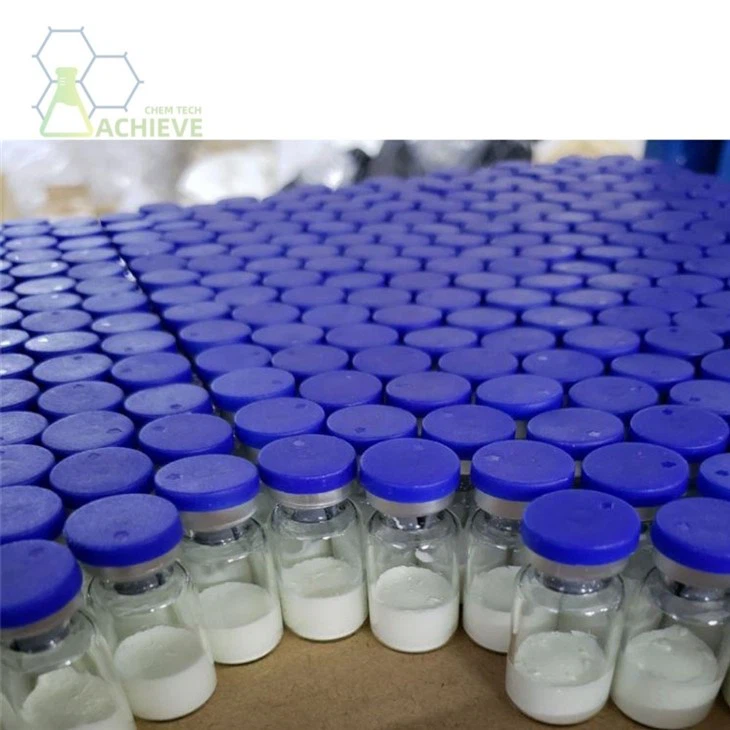
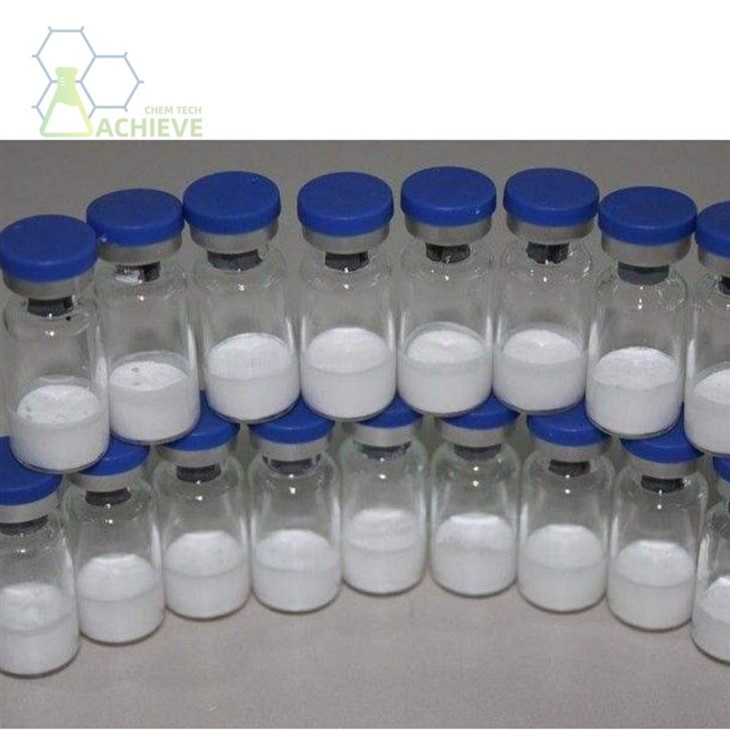

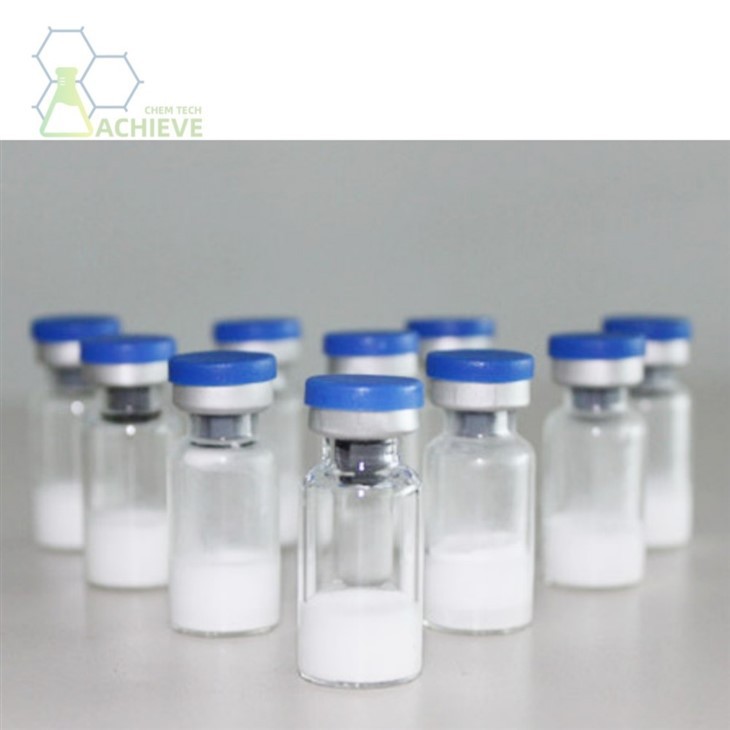
Abaloparatide, also known as terlipide, appears as a white or almost white powder in its pure state and is a synthetic peptide drug. Abapatide is composed of 34 amino acid residues, with a molecular formula of C174H300N56O49, CAS 247062-33-5, and a molecular weight of approximately 3478 Daltons. Its amino acid sequence is: H-Ser Val Ser Ser Ser Glu Ile Xaa Gln Gly Chr Leu Eu Glu Lys Gln Gln Asp Al Gly Ser Asn The He His Leu Lys Asp Eu Gly OH. The solubility in water is relatively low, but it can have a certain solubility in organic solvents such as methanol and ethanol. In addition, abapatide is relatively stable under acidic conditions, so acetic acid is commonly used as the base. Its amino acid sequence contains multiple chiral centers, so there may be multiple stereoisomers. It is acidic with a pKa value of 6.0. Under acidic conditions, its amino groups protonate, making it more soluble in water. It is not a surfactant itself, but it has membrane related activity that can interact with the cell membrane and regulate cell function. It should be emphasized that the substance is a chemical and its chemical and physical properties may vary due to factors such as drug dosage form, production process, storage conditions, etc. Therefore, in practical applications, chemical experimental procedures should be strictly followed to ensure safe and effective use.
|
Customized Bottle Caps And Corks:
|
|


Physical and Chemical Properties
It is a white to off-white lyophilized powder, with a molecular weight of approximately 3960 Da. It is soluble in water or physiological saline, forming a colorless to slightly yellow clear solution. The lyophilized powder is stable at 2 - 8°C, but is sensitive to light and needs to be stored in a dark place. The commercial formulation (such as Tymlos®) is a sterile solution in a pre-filled injection pen, with a pH value of approximately 5.0 - 6.0, and contains benzyl alcohol as a preservative.
Pharmacological characteristics
As a selective PTH1 receptor agonist, it significantly promotes bone formation through intermittent administration, increases bone density, and reduces the risk of vertebral and non-vertebral fractures. Compared with teriparatide, it has a lower risk of hypercalcemia. Clinical studies have shown that a daily subcutaneous injection of 80 μg can increase lumbar bone density by 9.2% within 18 months.

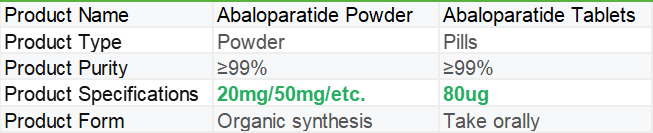
Abaloparatide Powder COA


Novel Mechanistic Insights: Beyond Bone Formation
Modulation of Bone Microarchitecture
While abaloparatide's anabolic effects on trabecular bone are well-established, new research highlights its impact on cortical bone, critical for hip fracture prevention. A 2023 Journal of Bone and Mineral Research study using high-resolution peripheral quantitative computed tomography (HR-pQCT) demonstrated that abaloparatide increases cortical thickness and porosity reduction more effectively than teriparatide, potentially explaining its superior nonvertebral fracture risk reduction (ACTIVE trial: 43% vs. teriparatide's 39%).
Anti-Inflammatory and Anti-Oxidative Properties
Chronic inflammation and oxidative stress accelerate bone loss in osteoporosis. Preclinical models suggest abaloparatide may mitigate these processes by downregulating pro-inflammatory cytokines (e.g., TNF-α, IL-6) and enhancing antioxidant enzymes (e.g., superoxide dismutase). A 2022 Osteoporosis International study found that abaloparatide-treated mice exhibited reduced osteoclastogenesis and increased osteoblast activity in inflammatory bone loss models, hinting at broader therapeutic applications beyond age-related osteoporosis.
Synergy with Wnt/β-Catenin Signaling
The Wnt/β-catenin pathway is pivotal for osteoblast differentiation. Abaloparatide appears to upregulate Wnt ligands (e.g., Wnt10b) and inhibit sclerostin, a Wnt antagonist, thereby amplifying bone formation. This dual mechanism-PTH1R activation and Wnt pathway modulation-may explain its rapid BMD gains compared to teriparatide, which lacks direct Wnt interactions.
 |
 |
 |
The following will describe in detail these steps and their corresponding chemical equations.
Acquisition of target genes: Chemical synthesis method: If the sequence of the abapatide gene is known, the target gene can be synthesized through solid-phase peptide chain synthesis or liquid-phase peptide chain synthesis. These methods typically use activated amino acids as raw materials and connect them through a series of condensation reactions to form peptide chains. Common condensation agents include amino acids protected by Boc and amino acids protected by Fmoc.
Gene cloning method: If the sequence of the abapamide gene is unknown, genes can be extracted from organisms containing abapamide through gene cloning technology. This process usually includes steps such as gene isolation, purification, and PCR amplification.
Construction of expression vector: Construction of Plasmid Vector: Inserting the Abapatide gene into plasmid vectors, commonly used plasmid vectors include pET series, etc. This process involves restriction endonucleases cutting the target gene and plasmid vector, as well as DNA ligases connecting the target gene to the plasmid vector.
Construction of viral vectors: For mammalian cells, it is necessary to construct appropriate viral vectors, such as retroviral vectors or adenoviral vectors, in order to efficiently introduce the abapenetin gene into cells.

Transfection of host cells: Transfection of prokaryotic cells: Transfer the constructed expression vector into prokaryotic cells, such as E. coli. Common transfection methods include electroporation and liposome transfection. After transfection, the cells need to be cultured in the selected culture medium in order to screen for stable expression clones.
Eukaryotic cell transfection: For mammalian cells, viral vectors can be introduced into cells using methods such as calcium phosphate co precipitation, electroporation, or liposome transfection. After transfection, cells need to be cultured under suitable conditions to facilitate the expression of the target protein.
Expression and Purification of Proteins: Induced expression: After successful transfection of the target gene into host cells, inducers such as IPTG (for Escherichia coli) or viral infection (for mammalian cells) need to be added to induce the expression of the target protein. After induction of expression, the target protein in the host cell will form inclusion bodies or secrete into the extracellular fluid along with the heteroproteins.
Separation and purification: use various separation and purification technologies, such as centrifugation, filtration, affinity chromatography, gel filtration chromatography and ultrafiltration, to isolate and purify the target protein from the inclusion body or extracellular fluid. A combination of multiple techniques may be required in this process to obtain high-purity abapatide.
Renaturation: During the process of separation and purification, abapatide may form insoluble inclusion bodies. Therefore, after obtaining high-purity abapatide, it is necessary to perform a refolding operation in
Indications: Treating osteoporosis and reducing the risk of fractures
ts function in clinical application is manifested as:

Reducing the risk of vertebral and non-vertebral fractures
A phase III clinical study (ACTIVE) involving 2,463 postmenopausal women with osteoporosis showed that after daily subcutaneous injection of 80 micrograms of Abaloparatide for 18 months, the incidence of new vertebral fractures was reduced by 73% compared to the placebo group, and the incidence of non-vertebral fractures was reduced by 43%.
In Japanese postmenopausal osteoporosis patients, after 78 weeks of Abaloparatide treatment, the bone density of the lumbar spine, total hip joint, and femoral neck increased by 12.5%, 4.3%, and 4.3% respectively, and no new vertebral fractures occurred.
Improving bone metabolism markers
During the treatment period, the serum level of type I procollagen N-terminal propeptide (PINP, a marker of bone formation) significantly increased, reaching up to 140% of the baseline level, and remained higher than the baseline level by 25% after 18 months of treatment.
The serum level of type I collagen carboxy-terminal cross-linked peptide (CTX, a marker of bone resorption) increased briefly in the early stage of treatment and then gradually decreased, indicating that Abaloparatide has a weak promoting effect on bone resorption and tends to balance over time.

Novel Mechanistic Insights: Beyond Bone Formation
Modulation of Bone Microarchitecture
While abaloparatide's anabolic effects on trabecular bone are well-established, new research highlights its impact on cortical bone, critical for hip fracture prevention. A 2023 Journal of Bone and Mineral Research study using high-resolution peripheral quantitative computed tomography (HR-pQCT) demonstrated that abaloparatide increases cortical thickness and porosity reduction more effectively than teriparatide, potentially explaining its superior nonvertebral fracture risk reduction (ACTIVE trial: 43% vs. teriparatide's 39%).
Anti-Inflammatory and Anti-Oxidative Properties
Chronic inflammation and oxidative stress accelerate bone loss in osteoporosis. Preclinical models suggest abaloparatide may mitigate these processes by downregulating pro-inflammatory cytokines (e.g., TNF-α, IL-6) and enhancing antioxidant enzymes (e.g., superoxide dismutase). A 2022 Osteoporosis International study found that abaloparatide-treated mice exhibited reduced osteoclastogenesis and increased osteoblast activity in inflammatory bone loss models, hinting at broader therapeutic applications beyond age-related osteoporosis.
Synergy with Wnt/β-Catenin Signaling
The Wnt/β-catenin pathway is pivotal for osteoblast differentiation. Abaloparatide appears to upregulate Wnt ligands (e.g., Wnt10b) and inhibit sclerostin, a Wnt antagonist, thereby amplifying bone formation. This dual mechanism-PTH1R activation and Wnt pathway modulation-may explain its rapid BMD gains compared to teriparatide, which lacks direct Wnt interactions.
It's represents a significant advancement in osteoporosis therapy, offering unparalleled fracture reduction and bone density improvements with a favorable safety profile compared to teriparatide. Its selective PTH1 receptor binding minimizes hypercalcemia risk, while its 18-month treatment limit balances efficacy with caution regarding osteosarcoma concerns.
For high-risk postmenopausal women, it is a transformative option, particularly when antiresorptives fail or are contraindicated. However, its high cost and injection requirement limit widespread use, underscoring the need for ongoing research into oral formulations and expanded indications.
Frequently Asked Questions
What is the difference between teriparatide and abaloparatide?
+
-
Abaloparatide (ABL) and Teriparatide (TPTD) are parathyroid hormone (PTH) analogs for osteoporosis, both stimulating bone formation, but ABL shows stronger effects, increasing bone mineral density (BMD) more significantly at the hip and neck, reducing fracture risk more effectively (especially hip/nonvertebral), and causing less hypercalcemia due to its distinct receptor binding profile, favoring bone formation over resorption pathways. ABL binds differently to the PTH receptor, leading to less beta-arrestin recruitment and reduced calcium elevation, making it a more "bone-building" focused agent than TPTD, which has a more balanced bone turnover effect.
Is it better than alendronic acid?
+
-
Initial treatment with abaloparatide may result in greater vertebral fracture reduction compared with alendronate in postmenopausal women with osteoporosis.
What is the new drug that rebuilds the bone?
+
-
EVENITY is a one-of-a-kind osteoporosis treatment-the first and only one that works both ways by building new bone and helping to slow bone loss. Ask your doctor if it's time to start building new bone with EVENITY.
Hot Tags: abaloparatide cas 247062-33-5, suppliers, manufacturers, factory, wholesale, buy, price, bulk, for sale, Best Growth Hormone Releasing Peptide CAS 87616 84 0, DecaPeptide 12 CAS 137665 91 9, GLP 1 Peptide CAS 87805 34 3, Melanotan 2 Powder, Tesamorelin CAS 218949 48 5, Melanotan ii powder