




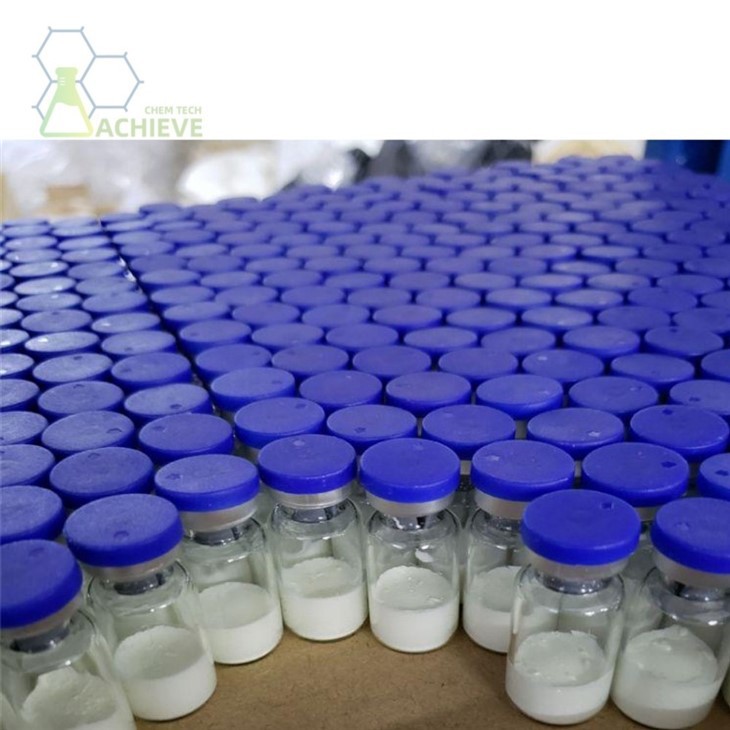


Shaanxi BLOOM Tech Co., Ltd. is one of the most experienced manufacturers and suppliers of carbetocin cas 37025-55-1 in China. Welcome to wholesale bulk high quality carbetocin cas 37025-55-1 for sale here from our factory. Good service and reasonable price are available.
Carbetocin is a white to beige powder with excellent covering power. Molecular formula C45H69N11O12S, CAS 37025-55-1. It has a certain solubility in DMSO (a small amount) and methanol (a small amount), and is soluble in certain solvents. The isoelectric point is about 9.5, indicating that it carries a positive charge in an environment with a pH above 9.5, and a negative charge in an environment with a pH below 9.5. It is a peptide drug with a complex chemical structure and belongs to the category of biochemistry. It has multiple uses in chemistry, involving its applications in the synthesis of oxytocin analogues, drug development, and industrial production. However, in practical applications, relevant safety guidelines and operating procedures still need to be followed to ensure the safety and effectiveness of the experimental process. In the future, with the deepening of research and the development of technology, the application in chemistry may further expand.
|
Customized Bottle Caps And Corks:
|
|


|
Chemical Formula |
C45H69N11O12S |
|
Exact Mass |
987 |
|
Molecular Weight |
988 |
|
m/z |
987 (100.0%), 988 (48.7%), 989 (11.6%), 989 (4.5%), 988 (4.1%), 989 (2.5%), 990 (2.2%), 989 (2.0%), 990 (1.2%) |
|
Elemental Analysis |
C, 54.70; H, 7.04; N, 15.59; O, 19.43; S, 3.24 |

Carbetocin is a synthetic long-acting oxytocin 8-peptide analogue with agonist properties, and its clinical and pharmacological properties are similar to those of naturally occurring oxytocin. The main uses include prevention and treatment of postpartum hemorrhage, promotion of uterine recovery, and application in scientific research and specific industrial fields.
1. Firstly, its main purpose is to prevent and treat postpartum hemorrhage. Postpartum hemorrhage is a common obstetric complication that can lead to serious health problems and even death. By stimulating uterine contractions and increasing uterine tension, postpartum hemorrhage can be effectively controlled. Research has shown that a single dose of carbetocin100 is administered intravenously immediately after a cesarean section under epidural or spinal anesthesia μ g. It can significantly reduce the occurrence of postpartum hemorrhage, prevent insufficient uterine tension, and reduce the risk of related complications.
2. Secondly, it also helps to promote the recovery of the uterus. In the early stages of postpartum delivery, administration can stimulate uterine contractions and promote uterine recovery. This helps to reduce the occurrence of postpartum complications and improve the health level of postpartum women.
In addition to its application in the field of obstetrics, it also has certain applications in other areas. In the field of scientific research, as a research drug, it is used to explore the physiological and pharmacological mechanisms of oxytocin receptors, as well as to develop new therapeutic strategies. In addition, it also has certain application value in certain specific industrial fields. For example, it can be used in the paint industry, telecommunications equipment, synthetic fibers, metallurgy, papermaking, plastics, rubber, printing and dyeing, enamel, and other fields.

3. It is a long-acting synthetic oxytocin analogue with anti bleeding and uterine contractile effects. Its chemical structure is similar to that of human oxytocin, but has been optimized to enhance its stability and efficacy. Due to its anti bleeding and uterine contractile properties, it is often used as a ligand in chemical synthesis to study oxytocin receptors. By binding to oxytocin receptors, it can be used to explore the pharmacological mechanisms and signal transduction pathways of oxytocin receptors. This helps to gain a deeper understanding of the role of oxytocin receptors in regulating uterine contractions and preventing postpartum hemorrhage.
4. It is also used to develop new drugs or treatment strategies. Based on its interaction with oxytocin receptors, it can serve as a lead compound to develop drugs with higher activity and selectivity through further structural optimization and pharmacological research. These drugs may be used to treat diseases related to oxytocin receptors, such as postpartum hemorrhage, uterine atony, etc.
5. In industrial production, it also has certain application value. Due to its ability to stimulate uterine contractions, it can be used to synthesize other drugs or biological products related to uterine contractions. These drugs or products can be used to treat uterine related diseases, such as postpartum hemorrhage, uterine fibroids, etc.

A preparation method for Carbetocin, characterized in that it comprises the following steps:
(1) Using the fmoc solid-phase synthesis strategy, gly, leu, pro, cys (ch2ch2ch2co2r1), asn (r2), gln (r3), ile, and tyr (me) were sequentially coupled to amino resin to obtain fmoc fully protective peptide resin, namely fmoc tyr (me) - ile gln (r3) - asn (r2) - cys (ch2ch2ch2co2r1) - pro neu gly amino resin;
(2) Remove the fmoc protective group and r1 from the fmoc fully protective peptide resin to obtain h-tyr (me) - ile gln (r3) - asn (r2) - cys (ch2ch2ch2cooh) - pro neu gly amino resin;
(3) Condensing the peptide resin obtained in step (2) to obtain cyclized carbetoxin peptide resin;
(4) Cracking the cyclized carboplatin peptide resin using cutting solution, and then precipitating it in ether or tert butyl methyl ether to obtain carboplatin crude peptide;
(5) Using a preparative reverse phase high-performance liquid chromatography system to separate and purify the crude peptide of carbetoxin, freeze-drying was performed to obtain carbetoxin.

This method relates to the field of peptide synthesis technology, in particular to a method for preparing carbetoxin. The preparation method comprises the following steps: sequentially coupling Gly, Leu, Pro, Cys (CH2CH2CH2CO2R1), Asn (R2), Gln (R3), Ile, Tyr (Me) onto an amino resin to obtain Fmoc fully protective peptide resin; Remove the Fmoc protective group and R1, and condense the peptide resin to obtain a cyclized carbetoxin peptide resin; Cracking and precipitation to obtain crude peptides; Separate and purify the crude peptide, and freeze dry it. The R1 group of the present invention can be removed under mild conditions, so that the peptide chain will not detach from the resin during the removal of R1. The present invention successfully forms a ring on the resin by forming amide bonds, with high efficiency, fast speed, and high yield, which is conducive to large-scale industrial production. Beneficial for large-scale industrial production.

Carbetocin is a synthetic long-acting oxytocin analog primarily used for the prevention and treatment of postpartum hemorrhage (PPH). As a structurally modified derivative of oxytocin, Carbetocin combines the biological activity and longer half-life of oxytocin, making it important in clinical obstetrics. Oxytocin is a nine peptide hormone synthesized by the hypothalamus and released by the posterior pituitary gland, which promotes uterine contractions and milk secretion. At the beginning of the 20th century, British physiologist Henry Dale (1910) first reported the uterine contraction effect of pituitary extract, laying the foundation for the discovery of oxytocin. In 1953, the team of American biochemist Vincent du Vigneaud successfully resolved the primary structure of oxytocin (Cys Tyr Ile Gln Asn Cys Pro Leu Gly NH ₂) and achieved total synthesis in 1955, making it the first peptide hormone to be artificially synthesized. This groundbreaking research earned du Vigneaud the Nobel Prize in Chemistry in 1955. In the 1950s and 1960s, oxytocin was widely used for induction of labor and prevention of postpartum hemorrhage. However, its short half-life (about 3-12 minutes) requires continuous intravenous infusion, which limits its clinical application. Due to the pharmacokinetic defects of natural oxytocin, scientists have begun exploring structural modification strategies: prolonging half-life and reducing enzyme degradation. Improve receptor selectivity: enhance uterine contractions and reduce cardiovascular side effects. In the 1960s and 1970s, multiple research teams attempted to modify the structure of oxytocin: Demoxytocin, synthesized in 1964, is effective orally but has lower activity. Carboprost: a prostaglandin analogue used for refractory postpartum hemorrhage, but with significant side effects. In the 1980s, scientists from Swiss Ferring Pharmaceuticals discovered that C-terminal modifications (such as Gly-NH ₂ → β - mercaptopropionic acid) could enhance stability. Methylation of 1-position cysteine can reduce oxidative degradation. These findings provide key ideas for the design of Carbetocin.
The structural characteristics of Carbetocin (chemical name: 1-deamino-1-monocarboxy-2-O-methyltyrosin-otocin):
- 1-deamination: reduces aminopeptidase degradation.
- 2-Tyrosine methylation: enhances receptor binding.
- C-terminal β - mercaptopropionic acid substitution: prolongs half-life.
- The Ferring team adopts a solid-phase peptide synthesis (SPPS) strategy:
- Fmoc protecting group chemistry: gradually constructing a nine peptide backbone.
- Side chain modification: a key methylation step.
- Oxidative folding: Formation of disulfide bonds (Cys1-Cys6).
- In vitro activity: Similar binding affinity to oxytocin receptor (OXTR) (EC ₅₀~1 nM).
- In vivo half-life: The rat model showed an extension of half-life to 40 minutes (vs oxytocin 10 minutes).
- Uterine Contraction Test: Longer lasting than Oxytocin Effect.
- Cardiovascular safety: No significant blood pressure fluctuations were observed.
- Single dose administration: A dose of 100 μ g showed good tolerability.
- Pharmacokinetics: Half life of approximately 30-45 minutes (vs. 5-10 minutes for oxytocin).
- Prevention of PPH: Carbetocin (100 μ g IV) vs Oxytocin (10 IU IV).
It was first approved in Canada in 1997 under the trade name Duratocin. After 2000, the European Union (Pabal) and several Asian countries successively approved it. In 2018, WHO included Carbetocin in the Essential Medicines List (for PPH prevention). Reduce the incidence of PPH: from 5% to 2% (global data). Cost effectiveness: Single dose administration vs continuous infusion of oxytocin, saving medical resources. Receptor signaling pathway:
OXTR activation → Gq protein coupling → phospholipase C (PLC) activation → intracellular calcium release → uterine smooth muscle contraction.
Hot Tags: carbetocin cas 37025-55-1, suppliers, manufacturers, factory, wholesale, buy, price, bulk, for sale, Bremelanotide Powder CAS 189691 06 3, Melanotan ii powder, DecaPeptide 12 CAS 137665 91 9, LONG R3 IGF I CAS 143045 27 6, CJC 1295 Peptide, Melanotan 2 Powder