




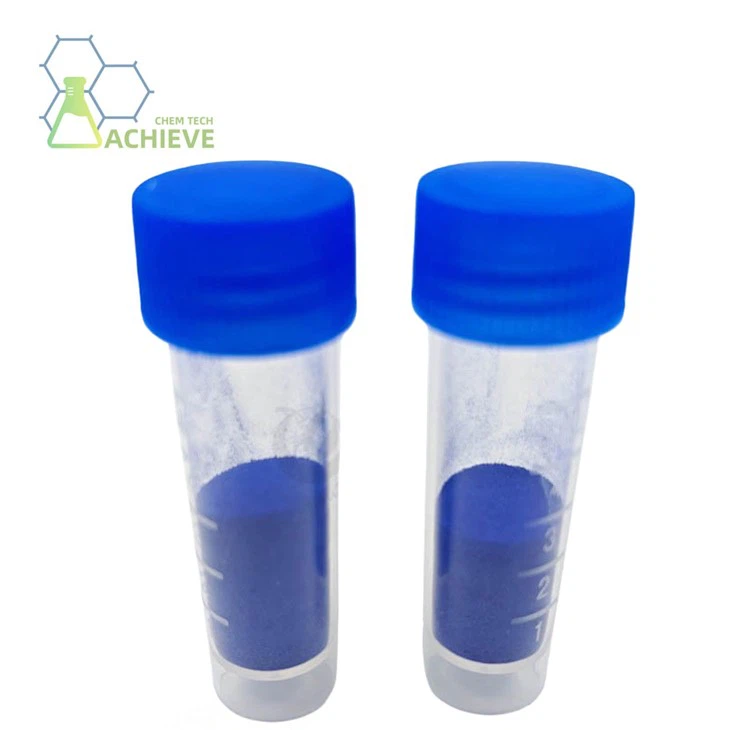


GHK-Cu powder is a blue complex formed by the tripeptide of glycine-histidine-lysine and copper ions (Cu²⁺). It is commonly used as a cosmetic raw material and research reagent. The core mechanism lies in mimicking the naturally existing GHK-Cu complex in the human body, which can directly interact with cell DNA and regulate the expression of genes related to tissue repair, anti-inflammatory and antioxidant functions. In the field of skin care, it is renowned for effectively promoting the synthesis of collagen and elastin, thereby significantly improving skin firmness, reducing fine lines, and accelerating wound healing and scar repair. In the research of health supplements, it is also being explored for use in promoting hair regeneration and overall tissue regeneration. This powder usually needs to be dissolved in sterile water, formulated into an essence or solution, and then used topically. Its stability and bioavailability are the key to its application. When using it, attention should be paid to concentration control and following relevant regulations and safety guidelines.


|
Customized Bottle Caps And Corks:
|
|


GHK-cu Powder is an important bioactive substance that plays various important roles in the human body.

1. Signal transduction and cellular communication
As a small molecule signaling molecule, peptides can bind to receptors on the cell surface and participate in cell signal transduction and communication. In some nervous systems, tripeptides can serve as neurotransmitters to communicate with other neurons or muscle cells. In other systems, tripeptides can serve as modulators of cytokines or hormones, affecting processes such as cell growth, differentiation, migration, and apoptosis.
2. Bone protection and bone regeneration
Three peptides can promote the growth and differentiation of osteoblasts, inhibit the activity of osteoclasts, thereby maintaining bone mass and promoting bone regeneration. These effects help prevent bone metabolic diseases such as osteoporosis and promote fracture healing and repair of other bone injuries.


3. Tumor suppression and anticancer therapy
Three peptides play an important role in the occurrence and development of tumors. It can inhibit the growth, proliferation, and migration of tumor cells, and induce tumor cell apoptosis. These effects help prevent and treat cancer. In addition, the three peptides can also regulate the function of the immune system and enhance the body's anti-tumor immunity.
4. Antioxidation and anti-aging
San Sheng Peptide is an effective antioxidant that can eliminate free radicals in the body and inhibit oxidative stress reactions. These effects help to slow down the aging process and maintain the health and function of the body. In addition, tripeptides can also inhibit cell apoptosis and autophagy, thereby protecting cells from oxidative stress damage.

In summary, the three peptides play multiple important roles in the human body, and are of great significance for maintaining normal physiological functions and health status of the body.

5. The repair function of the human body:
Copper is a trace element required to maintain bodily functions (2 milligrams per day), with many and complex functions, and is necessary for the action of various cellular enzymes. In terms of the function of skin tissue, it has the functions of antioxidant, promoting collagen proliferation, and assisting wound healing. Scientists have discovered that the wrinkle removing effect of copper molecules is mainly achieved through the carrier of amino acid complexes (peptide complexes), which allow divalent copper ions with biochemical effects to enter cells and exert physiological functions. Copper bonded amino acid GHK-CU is a complex composed of three amino acids and one copper ion discovered by scientists from serum.
This blue copper peptide can effectively promote the production of collagen and elastin proteins, increase vascular growth and antioxidant capacity, and stimulate the production of glucose polyamines (GAGs), helping the skin restore its innate ability for self repair. Copper Peptide Complex ™ The discovery and purification have become Neova's exclusive global patent. Using this breakthrough GHK-CU can increase the vitality of cells, gradually repair the collagen lost in the body, strengthen the subcutaneous tissue, and quickly heal the wound without hurting or stimulating the skin, so as to achieve the purpose of wrinkle removal and anti-aging. The composition of GHK Cu is glycine-histidine lysine copper. The copper ion Cu2+is not the yellow color of copper metal, but appears blue in aqueous solution, so GHK Cu is also known as blue copper peptide.

The beauty benefits of blue copper peptide
Copper bonded amino acids have been tested by numerous scientists in both theory and clinical practice, and their efficacy has been confirmed as follows
Stimulating the formation of collagen and elastin, firming the skin and reducing fine lines.
Restore skin repair ability, increase the production of intercellular adhesion, and reduce skin damage.
Stimulate the formation of glucose polyamines, increase skin thickness, reduce skin sagging and firm skin.
Promote vascular proliferation and increase skin oxygen supply.
The auxiliary antioxidant enzyme SOD has strong and beneficial anti free radical function.
Expand hair follicles to accelerate hair growth and inhibit hair loss.
Stimulate the production of melanin in hair, regulate the energy metabolism of hair follicle cells, eliminate free radicals on the skin, and inhibit the activity of 5-alpha-reductase.

Chemical synthesis is the most commonly used method for synthesizing GHK-cu Powder , typically using two techniques: liquid-phase synthesis and solid-phase synthesis. The liquid phase synthesis method involves dissolving amino acids in organic solvents and completing the synthesis of peptide chains through steps such as protection, activation, and condensation. The advantages of liquid phase synthesis are mild conditions, simple operation, and easy purification of the product, but there are many reaction steps and low yields. The solid-state synthesis method links amino acids to the carrier through active links, and then gradually increases the length of the peptide chain through condensation reactions. The advantages of solid-state synthesis are simple operation and mass production, but the product is not easy to purify and there are by-products such as isomers.

In chemical synthesis, in order to protect the amino and carboxyl groups of amino acids, these groups need to be protected. Among them, the most commonly used protective groups are Boc (tert butoxycarbonyl) and Fmoc (fluorene methoxycarbonyl). The function of the protective group is to prevent side reactions of amino acids during the condensation process.
The purpose of activation is to enable amino acids to participate in condensation reactions. Commonly used activators include HOBt (1-hydroxybenzotriazole), HBTU (2- (4-hydroxyphenyl) -4,5-dihydro-4-methyl-6-nitroimidazolo [1,2-a] pyridine-3-one), TBTU (2- (2-pyridyldithio) benzotriazole sodium salt), etc. The function of an activator is to react with the amino group of an amino acid to form an activation intermediate, enabling the amino acid to undergo a condensation reaction with another molecule of amino acid.
Condensation reaction is the process of connecting two amino acid molecules through peptide bonds. The condensation reaction is usually carried out in anhydrous organic solvents, commonly used solvents include DMF (dimethylformamide), CHCl3 (chloroform), etc. The condensation reaction can be carried out at room temperature, sometimes requiring reflux at a certain temperature. The chemical equation for condensation reaction is as follows:
C6H5N3O + C11H16F6N5OP + C5H11NO + C7H7NO2 + C10H18O5-R1-NH2 →C6H5N3O + C11H16F6N5OP + C5H11NO + C7H7NO2 + C10H18O5-R1-NH2
After the condensation reaction is completed, the protective group of the amino acid needs to be removed to obtain the target peptide chain. Commonly used reagents for deprotecting groups include TFA (trifluoroacetic acid), TLC (chloroform), etc. The deprotection of functional groups is usually carried out at lower temperatures, and sometimes reflux is required at a certain temperature. The chemical equation for deprotecting groups is as follows:
C10H18O5-R1-NH2 → R1-NH2
If it is necessary to modify certain properties of the target peptide GHK-cu Powder , such as solubility, biological activity, etc., the peptide chain can be modified. Common modification methods include the introduction of non natural amino acids, cyclization of peptide chains, and glycosylation of peptide chains. Modifications can be carried out at any position in the peptide chain, and commonly used modifiers include cyclic amino acids, carbohydrate reagents, etc. The chemical equation for modification varies depending on the specific modification method. Below is an example of introducing non natural amino acids:
R1-NH2 + C10H10N2O2-OH → C10H10N2O2-R1 + H2O
It should be noted that due to the different structures of the amino acid side chain group R1, the reaction conditions, solvents, reagents, etc. of the above chemical reaction formula may need to be adjusted appropriately. In addition, the specific operation and experimental conditions of the chemical synthesis method still need to be adjusted and improved according to the actual situation in the laboratory.
In summary, the chemical synthesis method for synthesizing tripeptides requires multiple steps, including protecting groups, activating, condensing, deprotecting groups, and modifying. These steps need to follow certain chemical reaction principles and experimental operation specifications to ensure that the quality and purity of the final obtained target peptide meet the requirements.
FAQ
1. How to use ghk-cu powder?
GHK Copper Peptide | GHK-Cu | Tripeptide-1
We recommend adding a 1 - 3% concentration of GHK copper peptide tripeptide-1 powder to your homemade skin, nail, or hair care recipe. This will give you a clinical-strength product with 1% pure GHK. For a 1% concentration, add 1 gram to 100 ml of base. For a 3% concentration, add 1 gram to 33 ml of base.
2. What is GHK-Cu used for?
In humans, GHK-Cu is proposed to promote wound healing, attraction of immune cells, antioxidant and anti-inflammatory effects, stimulation of collagen and glycosaminoglycan synthesis in skin fibroblasts and promotion of blood vessels growth.
3. How quickly does GHK-Cu work?
GHK-Cu Peptide | The benefits, side effects, and more.
GHK-Cu skin care results timeline
First two weeks: Users may notice better skin hydration, reduced redness or irritation, and smoother skin. After 1-2 months: Fine lines and wrinkles might start to noticeably fade as skin texture and elasticity begin to improve.
Hot Tags: ghk-cu powder cas 49557-75-7, suppliers, manufacturers, factory, wholesale, buy, price, bulk, for sale, sermorelin powder, LONG R3 IGF I CAS 143045 27 6, Selank Peptide CAS 129954 34 3, Tesamorelin CAS 218949 48 5, Kisspeptin powder, CJC 1295 Peptide