


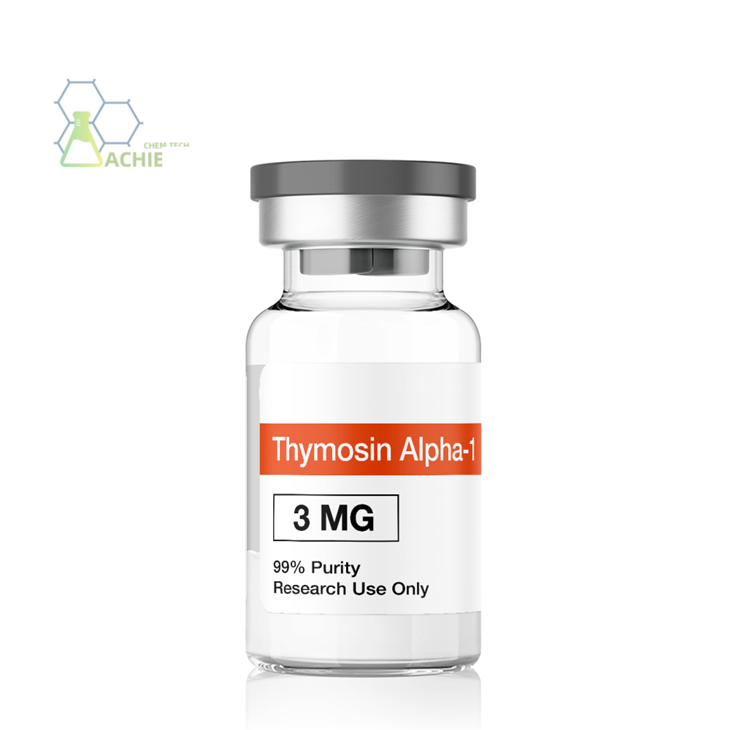


Thymosin a1 peptide (Tα₁) is a small, highly biologically active polypeptide composed of precisely 28 sequentially arranged amino acid residues, initially isolated and purified from mammalian thymic tissue with fresh calf thymus serving as the core raw material in early laboratory extraction work. Featuring a definitive molecular formula of C₁₂₉H₂₁₅N₃₃O₅₅ and the exclusive CAS registry number 62304-98-7, this peptide ranks among the most extensively researched and pharmacologically potent bioactive members across the entire thymosin family. Its core biological activity mainly focuses on activating and balancing multi-layered cellular defensive responses by regulating the proliferation and differentiation of T lymphocytes and related immune cells.


Thymosin A1 COA
 |
||
| Certificate of Analysis | ||
| Compound name | Thymosin A1 | |
| Grade | Pharmaceutical grade | |
| CAS No. | 62304-98-7 | |
| Quantity | 35kg | |
| Packaging standard | PE bag+Al foil bag | |
| Manufacturer | Shaanxi BLOOM TECH Co., Ltd | |
| Lot No. | 202601090056 | |
| MFG | Jan 9th 2026 | |
| EXP | Jan 8th 2029 | |
| Structure |
|
|
| Item | Enterprise standard | Analysis result |
| Appearance | White or almost white powder | Conformed |
| Water content | ≤5.0% | 0.54% |
| Loss on drying | ≤1.0% | 0.42% |
| Heavy Metals | Pb≤0.5ppm | N.D. |
| As≤0.5ppm | N.D. | |
| Hg≤0.5ppm | N.D. | |
| Cd≤0.5ppm | N.D. | |
| Purity (HPLC) | ≥99.0% | 99.90% |
| Single impurity | <0.8% | 0.52% |
| Total microbial count | ≤750cfu/g | 95 |
| E. Coli | ≤2MPN/g | N.D. |
| Salmonella | N.D. | N.D. |
| Ethanol (by GC) | ≤5000ppm | 500ppm |

| Storage | Store in a sealed, dark, and dry place below -20°C | |
|
|
||


In the treatment of infectious diseases
Purified thymosin a1 peptide is clinically mainly widely applied for targeted adjuvant antiviral treatment of chronic hepatitis B, which can significantly lift the sustained rate of virological response and the long-term probability of functional cure, especially for chronic hepatitis B patients with inherently weak immune defensive response; In life-threatening critical severe infections such as severe COVID-19, it can effectively promote functional T cell proliferation, regulate disordered abnormal inflammatory cytokine expression, thereby cutting overall all-cause mortality and shortening total overall patient hospitalization time.
In the field of tumor therapy
It functions as a potent immune defensive modulator to effectively inhibit progressive malignant tumor progression by markedly boosting dendritic cell antigen presentation efficiency, promoting robust cytotoxic T cell proliferation and elevating natural killer cell cytotoxic activity; Recent high-quality preclinical and clinical research has increasingly focused on its safe rational combined use with immune defensive checkpoint inhibitors (such as PD-1/PD-L1 inhibitors) alongside traditional conventional radiotherapy and chemotherapy regimens.


For example, in the standardized neoadjuvant comprehensive therapy of malignant solid tumors such as advanced gastric cancer and metastatic colorectal cancer, it can greatly improve pathological complete remission rate and long-term event free survival rate, while obviously alleviating severe chemotherapy-induced immune defensive suppression. In clinical vaccine assisted applications, it can serve as an effective immunological adjuvant to remarkably enhance overall vaccine efficacy by raising specific antibody titers, speeding up rapid defensive response, or extending the sustained protection period. It is particularly well-suited for fragile immunocompromised populations or poor low responders, and may realize targeted vaccine reduction to cut down unwanted adverse reactions.
In terms of immune deficiency diseases
It is used to treat defensive dysfunction related diseases, improving patient prognosis by correcting T cell subpopulation imbalance and enhancing defensive surveillance function; In addition, its regulatory role in autoimmune and allergic diseases has also received attention, but further research is needed to verify it.


Molecular Composition and Structural Characteristics
It is a linear polypeptide composed of 28 amino acid residues, with the amino acid sequence of Ac-Ser-Asp-Ala-Ala-Val-Asp-Thr-Ser-Ser-Glu-Ile-Thr-Thr-Lys-Asp-Leu-Lys-Glu-Lys-Lys-Glu-Val-Val-Glu-Glu-Ala-Glu-Asn-OH. Its N-terminus is acetylated, a modification critical for maintaining its biological activity and structural stability. The molecule contains no disulfide bonds and exists as a single-chain structure overall.
Molecular Weight and Isoelectric Point
The theoretical molecular weight of Thymosin A1 is approximately 3108 Da, and its isoelectric point (pI) is 4.2, formally classifying it as a typical acidic polypeptide. It tends to carry stable negative charge in neutral or weakly alkaline aqueous environments, and can be efficiently separated and purified by mainstream laboratory methods such as ion exchange chromatography.


Solubility and Stability
It has good water solubility and is easily dissolved in polar solvents like water and normal saline, but poorly soluble in organic solvents such as methanol and ethanol. Its structural stability is affected by temperature and pH: it can be stably stored under refrigerated conditions (2–8℃). High temperatures (>60℃) or extreme pH conditions (strong acid/strong alkali) will cause conformational changes in the polypeptide chain, thereby leading to the loss of biological activity.
Feasibility of Chemical Synthesis
Thymosin a1 peptide can be prepared by solid-phase peptide synthesis or genetic engineering technology. In solid-phase synthesis, precise synthesis is achieved through the stepwise coupling of amino acid residues. For genetic engineering expression, Escherichia coli is mostly used as the host, and the target polypeptide is expressed via recombinant plasmids. Both methods can yield high-purity it, and the chemical structure of the synthetic product is consistent with that of natural extracts.


Regulating the Differentiation and Activation of T Lymphocytes
It effectively induces the orderly differentiation of immature precursor T cells residing inside the thymus into functional CD4⁺ helper T cells and CD8⁺ cytotoxic T cells. Meanwhile, it remarkably enhances the expression efficiency of vital antigen receptors on the surface of mature circulating T cells, markedly accelerates the secretion of core immune-related cytokines such as interferon-γ and interleukin-2, and substantially elevates the overall capability of differentiated T cells to accurately recognize and clear invasive foreign antigens and abnormal mutated cells.
Enhancing the Killing and Antigen-presenting Functions of Innate Immune Cells
It significantly elevates the targeted cytotoxic killing activity of natural killer cells (NK cells) toward abnormally virus-infected somatic cells and malignant tumor cells. Besides, it steadily facilitates the full maturation process of immature dendritic cells within defensive tissues, greatly strengthening their robust antigen-presenting capacity to capture and process foreign antigens. Through these coordinated regulatory effects, the peptide successfully constructs an essential functional response bridge linking rapid innate immunity and specific adaptive immunity in the human immune network.

Improving the Immune Suppression State of the Organism

Modulating the Balance of Immune Response
It precisely regulates the response ratio of Th1/Th2 cells, inhibits the apoptosis of abnormally activated immune cells, alleviates the pathological damage related to autoimmune diseases or immune disorders, and maintains the stable operation of the immune system.
Administration and Safety
Main Administration Routes-Subcutaneous injection is the preferred administration route in clinical practice, which is easy to operate and ensures stable drug absorption. In addition, for severe infections or specific treatment needs, intravenous injection or nebulized inhalation can also be explored, and the specific route should be adjusted by clinicians according to the indications and individual conditions of patients.
Local Adverse Reactions-The incidence of local reactions after medication is relatively low, mainly manifested as mild pain, redness, induration or itching at the injection site. These reactions are mostly temporary, do not require special treatment, and usually resolve spontaneously within 1-3 days after drug withdrawal.


Systemic Adverse Reactions
Systemic adverse reactions are relatively rare, with occasional mild symptoms such as low-grade fever, fatigue, dizziness or muscle soreness. The symptoms are mostly mild and will not affect the continuation of medication. If persistent high fever or severe discomfort occurs, timely drug withdrawal and medical evaluation are required.
Contraindicated and Special Populations Requiring Caution
Patients allergic to thymosin a1 peptide or any component in the preparation are absolutely contraindicated and prohibited from use; pregnant women, lactating women, children and special populations with severe defensive deficiency need to use it with caution. The benefits and risks should be fully evaluated before medication.


Preliminary Exploration of Thymus Extracts
Back in the 1960s and 1970s, global immunology research heavily focused on exploring the critical immunomodulatory role of the thymus. Scientists extracted crude thymosin mixtures from fresh thymus tissues of animals such as cattle and pigs, and found that these raw extracts could promote lymphocyte proliferation and restore impaired immune function in immunodeficient animals, laying the solid experimental foundation for the subsequent isolation of various bioactive peptides.
Isolation, Purification and Structural Identification of it
In 1977, the research team led by American scientist Alan L. Goldstein isolated a group of highly bioactive peptides from thymus extracts. Through chromatography and amino acid sequencing analysis, they identified the complete sequence of a peptide composed of 28 amino acids, named it thymosin a1 peptide, and discovered that its N-terminal acetylation modification is the key structural feature for maintaining biological activity.


Optimization and Upgrading of Combined Immunotherapy Regimens
The synergistic therapeutic effects of it combined with immune checkpoint inhibitors, targeted drugs, tumor vaccines and other clinical agents will be thoroughly studied in ongoing preclinical trials. By regulating the body's complicated immune microenvironment, it can remarkably enhance the therapeutic effects of anti-tumor and anti-viral treatments, providing promising new ideas for overcoming refractory tumors and stubborn chronic infectious diseases.
Development of Novel Administration Routes and Dosage Forms
Currently, injection is the main clinical dosage form, and the future R&D focus will be on oral, sublingual or long-acting sustained-release preparations. These dosage forms can reduce the pain and operational threshold of injection administration, improve patient medication compliance, and are particularly suitable for chronic disease populations requiring long-term immunomodulatory therapy.
Expansion of Clinical Indication Application Scope
Beyond the existing applications in viral hepatitis and adjuvant tumor therapy, the potential value of it in COVID-19, autoimmune diseases, neurodegenerative diseases and other fields will be further explored.


Through the optimization of combination medication regimens, it is expected to become a therapeutic option for more immune-related diseases.
In-depth Verification of Bioactivity Mechanism
From the 1980s to the 1990s, researchers verified the core functions of it through in vitro cell experiments and animal models, confirming that it could specifically induce the differentiation and maturation of precursor T cells, enhance the killing activity of NK cells, and had no obvious toxic and side effects. This clarified its action targets and molecular mechanism as an immunomodulator, providing a theoretical basis for clinical translation.
Artificial Synthesis and Clinical Application Transformation
After the 1990s, with the development of genetic engineering technology and solid-phase peptide synthesis technology, researchers successfully achieved the artificial synthesis of it, solving the problems of low purity and large batch differences of natural extracts. In 1997, synthetic it was first approved for marketing in Italy for the adjuvant treatment of chronic hepatitis B, and then gradually expanded to multiple clinical fields such as tumors and immunodeficiency diseases.


Breakthroughs in Localized and Low-cost Production Technologies
With the advancement of genetic engineering and solid-phase peptide synthesis technologies, the production process of domestic it will be continuously optimized, and the production cost will be gradually reduced. This can improve drug accessibility and meet the clinical medication needs of more primary medical institutions and developing countries.
FAQ
What does the product do?
+
-
It has a very prominent role in both immunity control and inflammation (Table 2). So far, it has been used in various pathologic conditions: Infections, sepsis, immune deficiencies and malignancies, just to name a few.
What are the side effects of the product?
+
-
As with all injections, redness and pain at the site of injection may be present. Rare adverse reactions include erythema, transient muscle atrophy, polyarthralgia combined with hand edema, and rash. A transient increase in ALT to more than twice baseline value can occur during it therapy.
Is it the same as TB500?
+
-
While Thymosin Alpha 1 devotes its primary biological effects to comprehensive immune regulation and immune function modulation, Thymosin Beta-4, widely recognized under the research alias TB-500, centers its core pharmacological properties on regulating cellular migration cascades and accelerating systematic soft tissue repair. Numerous laboratory researchers exploring fields ranging from superficial wound healing and strained skeletal muscle restoration to chronic tissue injury recovery frequently conduct comparative testing of these two thymic-derived peptides to analyze their distinct yet mutually complementary physiological roles across preclinical study models.
Is the product legal?
+
-
As of now, substances like BPC-157, Tα1, TB-500 (Thymosin β4 fragment), CJC-1295, Ipamorelin, AOD-9604, GHK-Cu (injectable), Melanotan II, KPV, Selank, Semax, and others are essentially off-limits to compound (unless and until FDA changes their status)
Hot Tags: thymosin a1 peptide, suppliers, manufacturers, factory, wholesale, buy, price, bulk, for sale, Tesamorelin CAS 218949 48 5, CJC 1295 Peptide, DecaPeptide 12 CAS 137665 91 9, LONG R3 IGF I CAS 143045 27 6, Best Growth Hormone Releasing Peptide CAS 87616 84 0, Epitalon Powder CAS 307297 39 8