



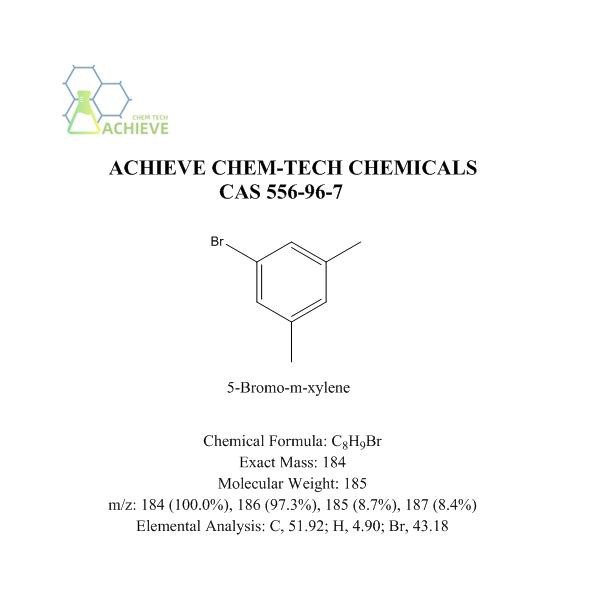

5-Bromo-m-xylene, molecular formula C8H9Br, CAS number 556-96-7. Light yellow to transparent liquid. Soluble in common organic solvents including ethyl acetate, dichloromethane, dimethyl sulfoxide, tetrahydrofuran, ether, toluene, etc., but insoluble in water. It can participate in the construction of light-emitting molecular materials through Suzuki coupling reaction or Buchwald coupling reaction, and can also be used as an intermediate of organic synthesis and pharmaceutical chemistry for basic experimental research of organic chemistry, fine chemical production, and the synthesis of pharmaceutical molecules and biological reagents.

|
Chemical Formula |
C8H9Br |
|
Exact Mass |
184 |
|
Molecular Weight |
185 |
|
m/z |
184 (100.0%), 186 (97.3%), 185 (8.7%), 187 (8.4%) |
|
Elemental Analysis |
C, 51.92; H, 4.90; Br, 43.18 |

The unique properties of bromine atoms
Analysis of the unique properties of the bromine atom in 5-bromo-m-xylene is an aromatic compound containing bromine. In its molecular structure, the positions 1, 3, and 5 of the benzene ring are respectively substituted by two methyl groups and one bromine atom. The bromine atom, as a member of the halogen family, exhibits unique chemical properties in 5-Bromo-m-xylene, which significantly influence the reactivity, stability, and application fields of this compound.
Electronic effect of bromine atom: Electron-withdrawing property and reactivity regulation
As an electron-withdrawing group, the bromine atom reduces the electron cloud density of the benzene ring through an induction effect. This electronic effect directly influences the chemical reactivity of 5-Bromo-m-xylene:

Inhibition of electrophilic substitution reactions
In the electrophilic substitution reactions of the benzene ring, the electron-withdrawing property of the bromine atom reduces the electron cloud density of the benzene ring, thereby weakening the attraction of the benzene ring for electrophilic reagents. Therefore, 5-Bromo-m-xylene has lower activity in electrophilic substitution reactions such as nitration and sulfonation compared to the unsubstituted xylene.
Enhancement of nucleophilic substitution reactions
Although the electron-withdrawing property of bromine atoms inhibits the electrophilic substitution reaction, they act as excellent leaving groups, significantly enhancing the nucleophilic substitution reaction activity of bromine atoms on the benzene ring. Under alkaline conditions, bromine atoms can be replaced by nucleophilic reagents such as hydroxyl groups and amino groups, generating 3,5-dimethylbenzophenol or 3,5-dimethylbenzidine. Such reactions are particularly important in drug synthesis, for example, through nucleophilic substitution reactions, biologically active aromatic amine compounds can be prepared.


The participation of coupling reactions
The electron-withdrawing nature of the bromine atom makes it an ideal substrate for coupling reactions. In Suzuki coupling or Buchwald-Hartwig coupling, the bromine atom can react with boronic acids or amine compounds to form biphenyl or aromatic amine derivatives. Such reactions have wide applications in materials science, for example, through coupling reactions, luminescent molecular materials can be constructed, used as the electron transport layer in organic light-emitting diodes (OLEDs).
The spatial effect of bromine atoms: Steric hindrance and reaction selectivity
The large volume of the bromine atom has a significant impact on the reaction selectivity of 5-Bromo-m-xylene through its steric hindrance effect:
Inhibition of adjacent effect
Due to the large size of the bromine atom, its adjacent positions (2, 4, and 6 positions of the benzene ring) have significant steric hindrance, making it difficult for substitution reactions to occur. Therefore, in nucleophilic substitution or coupling reactions, the bromine atom is preferentially substituted or participates in the reaction rather than its adjacent hydrogen atoms.
Preference for para-substitution
In electrophilic substitution reactions, although the electron-withdrawing property of the bromine atom inhibits the reactivity of the benzene ring, its para-position (4 position of the benzene ring) has a smaller steric hindrance and can still undergo substitution reactions. For example, in the Friedel-Crafts acylation reaction, 5-Bromo-m-xylene can generate para-substituted products rather than ortho- or meta-substituted products.
Stability of Bromine Atoms and Compound Storage Conditions
The chemical stability of bromine atoms directly affects the storage conditions of 5-Bromo-m-xylene:
Sensitivity to light and heat
5-Bromo-m-xylene is sensitive to light and heat. Long-term exposure may cause the bromine atoms to detach, generating harmful gases such as carbon monoxide, carbon dioxide, and hydrogen bromide. Therefore, this compound should be stored in a sealed container in a cool and dry place to avoid exposure to light and high temperatures.
Reactivity with oxidants
The bromine atoms can react with strong oxidants (such as concentrated nitric acid, potassium permanganate) to produce toxic gases such as hydrogen bromide. Therefore, during storage and transportation, it is necessary to avoid contact with oxidants to prevent dangerous accidents.
Biological Activity and Pharmaceutical Synthesis Applications of Bromine Atoms
The introduction of bromine atoms can significantly modify the biological activity of compounds, making them highly applicable in pharmaceutical synthesis:t.
As a bioactive group
The bromine atom itself has certain biological activity and can interact with biological macromolecules such as proteins and enzymes in the body, influencing their functions. Therefore, brominated compounds are often used as key structural units in drug design to construct drug molecules with specific biological activity.
As a synthetic intermediate
5-Bromo-m-xylene can be generated through substitution or coupling reactions of the bromine atom, resulting in various bioactive derivatives. For example, through the Suzuki coupling reaction, it can be converted into biphenyl compounds, which are used for the synthesis of anti-tumor drugs; through nucleophilic substitution reactions, it can be converted into aromatic amine compounds, which are used for the synthesis of antibacterial drugs.
From basic research to industrial production
5-Bromo-m-xylene, as a brominated aromatic compound with its unique molecular structure (the bromine atom and the meta-methyl group), demonstrated high reactivity at the initial stage of basic research and became a key intermediate for constructing complex organic molecules. With the advancement of research, its application scope gradually expanded from the laboratory to industrial production, forming an industrial ecosystem covering materials science, drug synthesis, environmental monitoring, and other dimensions.
Basic Research: Exploration of Reactivity and Mechanism
During the basic research stage, the core value of 5-Bromo-m-xylene lies in its bromine atom's reactivity. The bromine atom, as a good leaving group, can participate in various coupling reactions, such as the classic reactions of Suzuki, Buchwald, and Negishi. For example, in the Suzuki coupling, 5-Bromo-m-xylene reacts with arylboronic acid to form biphenyl derivatives. These compounds, due to the elongation of the conjugated system, have special optical properties and can be used as the electron transport layer in organic light-emitting diodes (OLEDs). The basic research significantly improved the reaction yield (up to 70%-90%) by optimizing reaction conditions (such as the selection of catalysts, bases, and solvents), and revealed the oxidative addition- metalation-reduction elimination mechanism under metal catalysis, laying a theoretical foundation for subsequent industrial applications.
Materials Science: Functionalization Modification from Laboratory to Industrialization
In the field of materials science, the industrial application of 5-Bromo-m-xylene mainly lies in the modification of high-molecular materials and nanomaterials.
Polymer materials
Introducing 5-Bromo-m-xylene into the polymer chain through copolymerization can improve the thermal stability or mechanical properties of the material. For example, brominated polystyrene, due to the flame-retardant effect of the bromine atoms, is widely used in the synthesis of high-performance flame-retardant materials, meeting safety standards in industries such as electronics and construction.

Nanomaterials
5-Bromo-m-xylene can be used as a ligand to modify the surface of quantum dots, regulating their fluorescence properties. For instance, by coordinating the bromine atoms with the lead ions on the surface of quantum dots, the fluorescence quantum yield of the quantum dots can be significantly increased, making them more sensitive for biological imaging. In industrial production, such quantum dots have been applied in medical diagnostic equipment, high-resolution displays, and other fields.

Hyperbranched polymers
By utilizing the reactivity of bromine atoms, hyperbranched polymers can be synthesized, forming a polymer network with a three-dimensional conformation. Due to the abundant terminal functional groups, these polymers can be used for gas separation, catalyst carriers, etc., and their separation performance is superior to that of traditional linear polymers, gradually achieving industrial production.

Drug Synthesis: From Molecular Design to Large-Scale Production
In the field of drug synthesis, the value of 5-Bromo-m-xylene lies in its wide application as a drug intermediate.
Antibacterial drugs: Compounds of 3,5-dimethylphenol formed through nucleophilic substitution reactions can be further synthesized into quinolone antibacterial drugs. These drugs exert antibacterial effects by inhibiting bacterial DNA gyrase and have strong inhibitory activity against Gram-negative bacteria. In industrial production, by optimizing the synthesis route (such as continuous flow reaction technology), the production efficiency and product quality have been significantly improved.
Antitumor drugs: Biphenyl derivatives generated based on the Suzuki coupling reaction can serve as the framework of tyrosine kinase inhibitors. For example, certain brominated biphenyl compounds inhibit tumor cell signal transduction pathways and suppress tumor proliferation. Currently, several candidate drugs have entered clinical trials, and their industrial production needs to meet GMP standards to ensure drug safety and efficacy.
Drug intermediates: 5-Bromo-m-xylene can also be used to synthesize antidepressants, anti-inflammatory drugs, etc. The bromine atom in it may be removed or converted into other active groups during metabolism, thereby regulating the pharmacokinetic properties of the drugs. In industrial production, the application of technologies such as enzyme catalysis and green chemistry has reduced production costs and environmental impact.
Environmental Monitoring: From Trace Detection to Online Monitoring
In the field of environmental monitoring, the industrial application of 5-Bromo-m-xylene mainly lies in the detection of heavy metal ions and volatile organic compounds (VOCs).

Heavy metal ion detection
Based on the coordination reaction between bromine atoms and heavy metal ions, fluorescent probes can be designed for the detection of heavy metal ions such as mercury and lead in water bodies. For example, certain brominated aromatic compounds show a significant increase in fluorescence intensity after forming complexes with heavy metal ions, and the detection limit can reach the nanomolar level. In industrial production, such probes have been applied in environmental monitoring equipment to achieve rapid and sensitive detection of heavy metal ions.
VOCs monitoring
5-Bromo-m-xylene can be used as a stationary liquid in gas chromatography to separate and analyze VOCs in the air. The interaction force between the bromine atom and the VOCs molecule is strong, which can improve the separation efficiency, especially suitable for the analysis of complex environmental samples. In industrial production, gas chromatographs have been widely used in environmental monitoring stations, industrial exhaust gas emission outlets, etc., providing data support for pollution control.

FAQ
1. What is 5-bromo-m-xylene?
It is an aromatic organic compound with the chemical formula C₈H₉Br. Its structure is that the 5th position of the 2-methylaniline (1,3-dimethylbenzene) is replaced by a bromine atom.
2. What are the main applications?
It is mainly used as an intermediate in organic synthesis and is widely applied in the synthesis of medicines, pesticides, dyes and polymer materials. It can be further functionalized through coupling reactions.
3. What should be noted when using it?
It needs to be sealed and stored in a dark place away from light; during operation, avoid inhaling the vapor or coming into contact with the skin; it is irritating, so it should be used in a fume hood and kept away from fire sources and oxidants.
Hot Tags: 5-bromo-m-xylene cas 556-96-7, suppliers, manufacturers, factory, wholesale, buy, price, bulk, for sale, ebs powder, Potassium Formate Powder, propylene oxide market, benzoyl peroxide powder, Potassium Iodide Powder CAS 7681 11 0, 4 4 Methylenedianiline