





Shaanxi BLOOM Tech Co., Ltd. is one of the most experienced manufacturers and suppliers of bromocresol green powder cas 76-60-8 in China. Welcome to wholesale bulk high quality bromocresol green powder cas 76-60-8 for sale here from our factory. Good service and reasonable price are available.
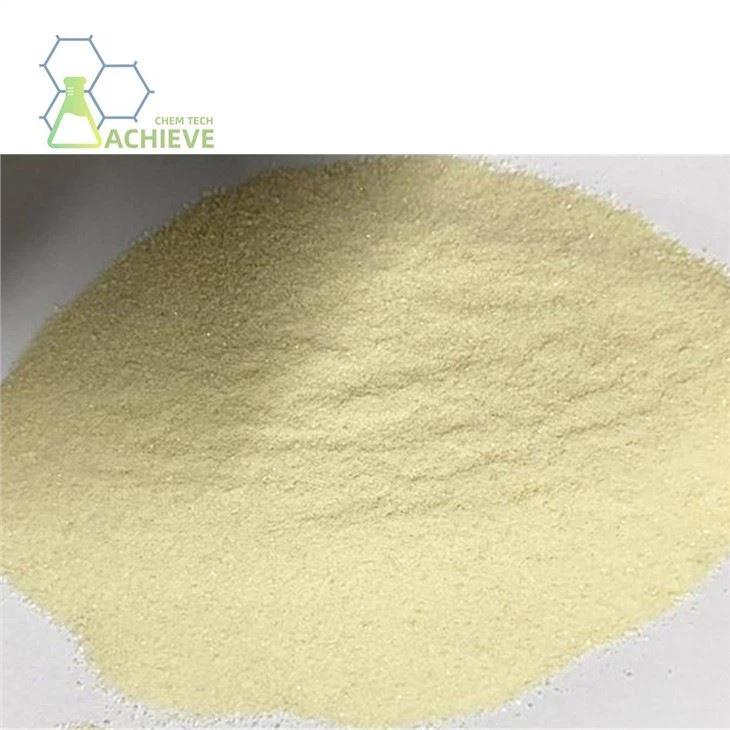
Bromocresol green powder is an organic compound with the chemical formula c21h14br4o5s, CAS 76-60-8. It is a fine light yellow crystal precipitated from acetic acid. Slightly soluble in water, soluble in ethanol, ether, ethyl acetate and benzene. It is mainly used as acid-base indicator, and its sodium salt is often used for colorimetric determination of pH value. Acid base indicator, pH 3.8 (yellow)~5.4 (blue). Its sodium salt solution is used as a color developing agent for spectrophotometric determination of pH value. It is used as a reagent for the determination of aliphatic hydroxy acids and alkaloids by thin-layer chromatography, and an extraction and separation agent for the determination of quaternary ammonium cations by spectrophotometry. It can also be used as a cell stain.

|
Chemical Formula |
C21H14Br4O5S |
|
Exact Mass |
694 |
|
Molecular Weight |
698 |
|
m/z |
698 (100.0%), 696 (68.5%), 700 (64.9%), 699 (18.4%), 694 (17.6%), 702 (15.8%), 697 (15.6%), 701 (14.7%), 700 (4.5%), 699 (4.3%), 695 (4.0%), 703 (3.6%), 698 (3.1%), 702 (2.9%), 698 (1.7%), 702 (1.6%), 700 (1.3%), 700 (1.2%), 700 (1.0%) |
|
Elemental Analysis |
C, 36.14; H, 2.02; Br, 45.79; O, 11.46; S, 4.59 |
|
|
|


Bromocresol green (BCG), as an important dye, is widely used in analytical field
1) A method for measuring the content of free amine in NMP.
The method comprises the following steps: preparing bromocresol green powder methyl red indicator; Take a certain amount of NMP sample into the container, add isopropanol and shake it stably to mix it; Add the bromocresol green methyl red indicator, mix it evenly, titrate with hydrochloric acid standard solution, and end the titration from green to yellowish; According to the formula:% free amine=c * V standard * K/ ρ* 5. Calculate the% free amine in the NMP sample.
By preparing bromocresol green methyl red indicator, the invention uses acid-base titration method to test the amine content in NMP. According to the parameters in the acid-base titration process, the content of free amine is expressed by mass percentage:% free amine=c * V standard * K/ ρ* 5. Evaluate the performance of NMP according to the test results. In addition, the test method is simple, convenient, fast and low cost, which can be widely used in production and research.


2) The invention relates to a mixed indicator test paper for measuring the ammonia concentration in the air and a preparation and detection method thereof, belonging to the technical field of environmental monitoring and industrial hygiene.
The test paper is a test paper loaded with bromocresol green, methyl red, acid and non-ionic surfactant on the base paper; According to the mass ratio, bromocresol green: methyl red: acid: non-ionic surfactant=(1.0 ~ 2.0): (0.188 ~ 0.75): (0.75 ~ 2.0): (2.5 ~ 7) × 10-3. The preparation method is to prepare soaking solution according to the reagent ratio, soak the base paper, and dry and plastic seal.
The detection method is: the mixed reagent reaction between ammonia in the air of the detection area and the test paper changes from wine red to green, and the ammonia concentration in the air of the detection area is obtained according to the relationship between the length of the discoloration band of the test paper and the ammonia concentration. The test paper has the characteristics of sensitive response, high precision, low production cost, convenient use, etc. It has practicability and significant economic benefits.


3) It is used to detect whether the pH value of ammonium nitrate solution in emulsion explosive is qualified.
(1) Take the ammonium nitrate solution to be tested and divide it into several parts, add dimethyl yellow indicator to the first part, and add bromocresol green indicator to the second part;
(2) Judge whether the pH value of the ammonium nitrate solution to be tested is qualified according to the discoloration of the solution to be tested in step (1);
When the first solution to be tested turns orange and the second solution to be tested turns yellow green, it indicates that the solution to be tested is qualified; Otherwise, it is unqualified.
4) The degree of deacetylation of chitosan oligosaccharide was determined by acid-base indicator method.
The acid base indicator method is used to determine the degree of deacetylation of chitosan oligosaccharide. Bromocresol green is used as the indicator. The color of the titration end point changes obviously, which can accurately determine the titration end point and reduce the measurement error.

Bromocresol Green (BCG) is an important organic compound with the chemical formula C12H41Br4O5S and CAS number 76-60-8. As a pH sensitive triphenylmethane dye, it has a wide range of applications in multiple fields.

Acid-base indicator
One of the most common uses of bromocresol green powder is as an acid-base indicator. It will show different colors with the change of pH value, which helps people judge the acidity or alkalinity of the solution.
(1) Color variation range
Bromocresol green turns yellow (λ max=435 nm, protonated form) in acidic solutions (e.g. pH=4.15), while it appears blue (λ max=615 nm, deprotonated form) in alkaline solutions. Specifically, at pH 3.8, bromocresol green appears yellow; When pH=5.4, it appears blue-green; When pH=4.5, there is a noticeable change in color.
Application scenarios
Acid base titration: In acid-base titration experiments, bromocresol green can be used as an indicator to determine the endpoint of titration by changing color. For example, in the experiment of strong acid titrating weak base or strong base titrating weak acid, when the pH value of the solution reaches the color changing range of bromocresol green, the color of the solution will change significantly, indicating the completion of titration.


PH measurement: Bromocresol green can also be used for determining the pH value of a solution. By comparing with the standard color chart, the pH range of the solution can be roughly determined. Although this method is not as accurate as pH meters, it has the advantages of easy operation and low cost in some situations where accuracy is not required, such as teaching experiments, preliminary screening, etc.
Biochemical analysis
Bromocresol green also has important applications in the field of biochemical analysis.
(1) Protein and albumin determination
Bromocresol green is commonly used to determine the concentration of albumin in proteins and serum. The principle is that bromocresol green forms a complex with albumin at a specific pH value, which has an absorption peak at a specific wavelength. The concentration of albumin can be calculated by measuring the absorbance.


1. Preparation of reagents
Prepare 0.05 M phosphate buffer solution or other required buffer solution, and add NaCl as needed to ensure at least 0.03 ion strength. Dissolve bromocresol green in water and adjust the pH to form a divalent anion form with NaOH to prepare a 0.04% stock solution.
2. Sample preparation
Prepare human serum albumin solution. After determining the nitrogen content using the Kjeldahl method, dilute with the required buffer to obtain an appropriate concentration of albumin solution. According to the experimental design, prepare buffer solutions with different pH values and bromocresol green solutions with different concentrations.
3. Combining experiments
Add a certain amount of bromocresol green to a solution containing a fixed concentration of human serum albumin under set pH conditions (e.g. pH 6.95).


Use a spectrometer to measure the absorbance changes of a solution at a specific wavelength and record the data. Pay special attention to the change at 615 nm, as this is where the maximum absorption difference of bromocresol green occurs between the free state and the albumin bound state. Separate free and bound indicators through ultrafiltration and measure absorbance again.
4. Data analysis
Analyze absorbance data to determine binding constants and the number of binding sites.
Use Scatchard plot analysis method to estimate the number of binding sites and their corresponding binding constants. Compare experimental data with theoretical curves and evaluate the effect of different pH values on binding.
(1) Other biochemical indicators testing
In addition to protein and albumin measurements, bromocresol green can also be used to detect the concentration of molecules such as creatinine and to assess cell viability. For example, in cell culture experiments, by observing the color changes of cells after bromocresol green staining, the survival status of cells can be preliminarily determined.


Bacterial culture and cell culture
(1) Bacterial cultivation
Bromocresol green can be added to the culture medium to inhibit the growth of Gram positive bacteria, thereby facilitating selective cultivation of Gram negative bacteria. The principle is that bromocresol green will change the pH value of the culture medium or produce other substances that inhibit the growth of Gram positive bacteria under specific conditions, while having a relatively small impact on the growth of Gram negative bacteria.
(2) Cell culture
In cell culture, bromocresol green can also be added to the cell culture medium to help inhibit the growth of bacteria and fungi, ensuring the purity of cell culture. Cell culture requires high environmental standards, and any microbial contamination can lead to culture failure. The addition of bromocresol green can reduce the risk of contamination to a certain extent and improve the success rate of cell culture.


Drug development and medical diagnosis
(1) Drug development
Researchers are exploring the use of bromocresol green as a drug carrier and combining it with other drugs to improve drug stability and efficacy. A drug carrier is a material that can encapsulate or adsorb drug molecules and transport them to specific sites. Bromocresol green, as a compound with unique properties, has the potential to become an effective drug carrier. By combining it with drugs, the solubility, stability, and targeting of drugs can be improved, thereby enhancing their therapeutic efficacy.
(2) Medical diagnosis
Bromocresol green also has potential application value in medical diagnosis. For example, the binding properties of bromocresol green with specific biomolecules can be utilized to develop novel diagnostic reagents or detection methods. These reagents or methods can be used to detect disease biomarkers, monitor disease progression, or evaluate treatment efficacy.


Other applications
(1) Staining agent
Bromocresol green can also be used as a dye to stain cells, bacteria, or other biological samples for observation under a microscope. In biological and medical research, it is often necessary to stain biological samples in order to observe their morphological structure and physiological characteristics more clearly. Bromocresol green, as a commonly used dye, has the advantages of good staining effect and easy operation.
(2) Antifungal agent
Due to its antibacterial properties, bromocresol green powder can also be used as a mold inhibitor. In some products with high requirements for mold prevention, such as food, medicine, cosmetics, etc., adding an appropriate amount of bromocresol green can effectively inhibit the growth of mold and extend the shelf life of the product.


Bromocresol green powder can be synthesized through the following specific steps:
Firstly, accurately weigh 1.5kg of bromine and slowly add it to a 1.25L solution of glacial acetic acid. Stir continuously during the addition process to fully dissolve the bromine in the glacial acetic acid, resulting in a mixture of bromine and glacial acetic acid. This step should be noted that bromine has strong volatility and corrosiveness. The operation should be carried out in a well ventilated environment and appropriate protective equipment should be worn.
Next, weigh 2kg of high-purity m-cresol violet and dissolve it in 2.5L of glacial acetic acid solution. During the dissolution process, appropriate heating or stirring can be used to accelerate the dissolution, ensuring that m-cresol violet is completely dissolved in glacial acetic acid, forming a uniform m-cresol violet solution.
Slowly add the prepared mixture of bromoglacial acetic acid to the prepared m-cresol violet solution through a dropping funnel and other equipment, under strict temperature control not exceeding 80 ℃. The drip acceleration should not be too fast to avoid excessive local reactions. After the dropwise addition is complete, continue to stir the reaction system to fully mix the reactants and initiate the reaction. Subsequently, the reaction system was kept at a temperature range of 80-90 ℃ for 24 hours to ensure thorough reaction. During this insulation process, it is necessary to closely monitor the temperature changes of the reaction system, which can be precisely controlled through equipment such as a constant temperature water bath.
After the reaction is complete, the reaction system is naturally cooled to room temperature and then filtered to separate the precipitate. The obtained precipitate is crude bromocresol green. To remove residual impurities on the surface of the precipitate, wash the precipitate twice with glacial acetic acid. After washing, dry the sediment or further remove moisture by filtration. Finally, dry the processed precipitate in an environment of 50-60 ℃ until a dry crude bromocresol green solid is obtained.
To obtain higher purity bromocresol green, the dried crude bromocresol green is subjected to recrystallization operation. Benzene or glacial acetic acid can be chosen as recrystallization solvents. Add crude bromocresol green to an appropriate amount of solvent, heat to dissolve it, and then slowly cool the solution to precipitate bromocresol green in the form of crystals. After recrystallization, the obtained pure bromocresol green crystal appears white with a melting point range of 218-219 ℃. The purity of the product can be preliminarily determined through methods such as melting point measurement.
FAQ
What does bromocresol green test for?
Background: The bromocresol green (BCG) assay is commonly used for measuring albumin (ALB), but is affected by α1- and α2-globulins, which are elevated in systemic inflammation. The modified bromocresol purple (mBCP) assay is another dye-binding method developed to overcome non-specific reactions.
At what pH does bromocresol green change color?
Bromocresol green changes color gradually within the pH range of 3.8 to 5.4.
Its color transition goes from yellow (at or below pH 3.8) to blue (at or above pH 5.4). Between these pH values, the indicator appears as intermediate shades of green.
What is bromocresol green indicator used for?
Bromocresol Green pH Indicator - Preparation, Formula, UsesBromocresol green is a synthetic triphenylmethane dye primarily used as a pH indicator and in clinical laboratories to measure mammalian serum albumin levels.
What is the color change of bromocresol green?
Bromocresol green is a popular acid-base indicator that transitions from yellow to blue within a pH range of 3.8 to 5.4. The solution shifts through intermediate shades of green around its of 4.8, making it highly useful for acid-base titrations and clinical assays.
Hot Tags: bromocresol green powder cas 76-60-8, suppliers, manufacturers, factory, wholesale, buy, price, bulk, for sale, CHICAGO SKY BLUE 6B, Cobalt tpp, 6 Aminocaproic Acid CAS 60 32 2, Thioacetic acid powder, 3 5 Dichlorophenylboronic acid, Tetramethylbenzidine CAS 54827 17 7