




Dipotassium Tetrachloroplatinate, also known as potassium chloroplatinate, is an inorganic compound. Usually an orange yellow to yellow brown powder. Its crystal structure is a tetragonal crystal system, which is relatively stable. The solubility is relatively low in water, but it can dissolve well in acidic solutions. In addition, it is also soluble in organic solvents such as alcohols and acetone. Relatively stable under normal conditions, but decomposition reactions may occur in strong acid or high temperature environments. It easily reacts with strong oxidants, bases, and certain metal ions. It is an electrical conductor with low conductivity. It exhibits certain electrochemical properties in certain electrolyte solutions, such as redox reactions. Not magnetic because it does not contain magnetic elements. Mainly used for preparing precious metal catalysts and precious metal coatings. It is also an important raw material for preparing other precious metal compounds and catalysts. The synthesis method usually involves reacting chloroplatinic acid with potassium hydroxide, followed by crystallization and separation to obtain a pure product.

|
Chemical Formula |
C5H13Cl2N |
|
Exact Mass |
157 |
|
Molecular Weight |
158 |
|
m/z |
157 (100.0%), 159 (63.9%), 161 (10.2%), 158 (5.4%), 160 (3.5%) |
|
Elemental Analysis |
C, 37.99; H, 8.29; Cl, 44.85; N, 8.86 |
|
Morphological |
Crystal or crystal powder |
|
Color |
red brown |
|
Melting point |
250 ° C |
|
Boiling point |
360 ° C |
|
Density |
3.38 g / ml at 25 ° C (lit.) |
|
Storage conditions |
insert atmosphere |
|
solubility alcohol |
solublesoluble 40 parts of solvent |
|
Acidity coefficient ( pKa ) |
15.03 ± 0.70 (predicted) |
|
Flash point |
250 ° C |
|
Solubility H2O |
10 g / L (20 º C) |
|
|
|

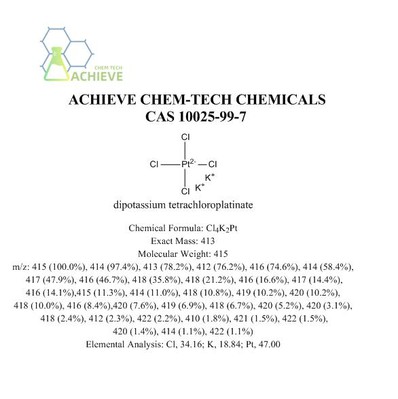

We supply Dipotassium Tetrachloroplatinate.
Remark: BLOOM TECH(Since 2008), ACHIEVE CHEM-TECH is the subsidiary of us.

A preparation method of potassium chloroplatinate, which is characterized in that potassium chloroplatinate is reduced by hydrazine hydrochloride as a reducing agent to prepare the pharmaceutical intermediate potassium chloroplatinate. The process is to prepare a suspension of potassium chloroplatinate (with a mass concentration of 100% - 150% in terms of platinum), drop a hydrazine hydrochloride solution with a mass concentration of 20% - 35% into the suspension, add 0.3-0.5g hydrazine hydrochloride per gram of platinum, and conduct a reduction reaction. After the drop is completed, react for 2-3H at a temperature of 60-80 ℃, After cooling, the mixture was filtered to obtain insoluble matter and scarlet filtrate; The insoluble substances are potassium chloroplatinate and platinum black, which are recycled; The filtrate was evaporated and concentrated until potassium chloroplatinate crystals appeared, and then dried under vacuum at 50-60 ℃ to obtain dark red potassium chloroplatinate product. According to the method of the invention, the prepared potassium chloroplatinate has a platinum content of 46.9 ± 0.2% and a potassium content of 19.0 ± 0.2 ° /. The total content of metal impurities is not more than 0.08%. The preparation process is short, the production cost is low and the operation environment is good.

Potassium tetrachloroplatinate or potassium platinolide plays a crucial role in the camera industry, especially in platinum salt printing.

Basic properties
Potassium chloroplatinate is an inorganic compound that typically appears as a red solid. It is an important raw material for preparing precious metal catalysts and precious metal coatings, and has a wide range of applications in the photography industry. Potassium chloroplatinate can be prepared by reducing potassium chloroplatinate with sulfur dioxide, or by dissolving platinum dichloride in hydrochloric acid and reacting with potassium chloride. This compound is stable at room temperature and pressure, but is prone to deliquescence, so special attention should be paid when storing and using it.
The main use in the camera industry
The main use of potassium chloroplatinate in the camera industry is platinum salt printing, which is an ancient but highly artistic photography technique. Platinum salt printing method uses platinum compounds to form images on photosensitive materials, and potassium chloroplatinate is an indispensable chemical in this process.
History and Development of Platinum Salt Printing Method
Platinum salt printing originated in the 19th century and is the most beautiful form of iron salt printing technology. It is also more favored by artists than silver salt printing technology. In 1873, William Willis obtained a patent for platinum salt printing technology in England, but this technology was not implemented until 1879. The emergence of platinum salt printing method has brought new expressive power and aesthetic experience to photography art.


The role of potassium chloroplatinate in platinum salt printing method
In the platinum salt printing method, potassium chloroplatinate is one of the key components for preparing photosensitive materials. Photographic materials are usually made by coating a solution containing dipotassium tetrachloroplatinate (or potassium chloroplatinate) and iron oxalate onto photographic paper. During the exposure process, iron oxalate is reduced to ferrous state, at which point platinum salt can be reduced to metallic platinum, forming an image. Therefore, the purity, concentration, and ratio with other chemicals of potassium chloroplatinate directly affect the photosensitive performance and image quality of photosensitive materials.
Process flow of platinum salt printing method
The process flow of platinum salt printing method includes steps such as coating, exposure, development, and fixing. Among them, coating is to uniformly apply a solution containing potassium chloroplatinate and iron oxalate onto the photographic paper; Exposure is the process of placing coated photographic paper underneath a negative film with lower contrast for exposure; Development is the process of using a developing solution to develop the exposed photographic paper, reducing platinum salts to metallic platinum to form an image; Fixing is the process of using a fixing solution to remove unreduced platinum salts and fix the image.


Imaging characteristics of platinum salt printing method
The images formed by platinum salt printing method have unique artistic charm. Firstly, as photographic paper is directly photosensitive and not covered by a gelatin coating, the image has the surface texture of the paper used. Secondly, the basic color tones of platinum salt images range from soft silver gray to reddish brown, with rich layers. Although it cannot produce a thick and rich black color like silver salt emulsion, the tone effect is quite good. In addition, platinum salt imaging has the best color fastness and chemical stability among all metal images, and will not change unless the paper substrate supporting it is damaged.
Application examples
(1) Art Photography
Platinum salt printing method has a wide range of applications in the field of artistic photography. Many famous art photographers have used or are currently using platinum salt printing to create their own works. This technique not only produces unique visual effects, but also enhances the artistic and collectible value of the artwork. For example, contemporary photographers such as Owen Payne and George Tais revived the platinum salt process and prepared their own photographic paper and processed exhibition photos.


(2) Portrait photography
In the field of portrait photography, platinum salt printing can also produce stunning effects. Due to the soft color tone and rich layering of platinum salt images, they are very suitable for post production in portrait photography. By adjusting the temperature of the developer and chemical additives, it is easy to adjust the color tone and contrast of the image, thus creating works that are more in line with personal aesthetics and style.
(3) Landscape Photography
Landscape photography is another field suitable for using platinum salt printing method. The delicacy and layering of platinum salt images can perfectly present the magnificent scenery and delicate changes of nature. In landscape photography, using platinum salt printing not only preserves more details and color information, but also gives the work a more unique artistic style.

Other applications in the camera industry
In addition to the platinum salt printing method, potassium chloroplatinate has other applications in the camera industry. For example, it can be used to prepare other precious metal compounds and catalysts, which also have wide applications in fields such as photography and electroplating.

Preparation of precious metal compounds
Potassium chloroplatinate can react with other compounds to prepare other precious metal compounds. These precious metal compounds have important application value in fields such as photography and electroplating. For example, precious metal coating materials for electroplating can be prepared through the reaction of potassium chloroplatinate, which have excellent conductivity and corrosion resistance, and can meet the needs of various electroplating processes.
Preparation of catalyst
Dipotassium tetrachloroplatinate can also be used to prepare catalysts. These catalysts can accelerate reaction rates and improve reaction efficiency in chemical reactions, making them widely used in the chemical industry. For example, in the photography industry, catalysts prepared using potassium chloroplatinate can be used to accelerate the reaction rate of developing solutions, thereby improving development efficiency and quality.


|
|
|
|
|


The chemical properties of Dipotassium Tetrachloroplatinate can be comprehensively described from aspects such as its composition, structure, physical state, solubility, stability, reactivity and application:
I. Composition and Structure
The chemical formula of potassium tetrachloroplatate is K₂PtCl₄, which is composed of two potassium ions (K⁺) and one tetrachloroplatate ion (PtCl₄²⁻). In this compound, platinum (Pt) is in the +2 oxidation state, and the four chlorine atoms (Cl) are arranged in a planar square configuration around the platinum atom, forming a stable coordination structure. This structure gives potassium tetrachloroplatate unique chemical properties, such as specific solubility and reactivity.
II. Physical State and Appearance
Dichloroplatinic acid potassium dihydrate typically appears as a red to dark red crystalline solid at room temperature. The specific form may vary slightly depending on the preparation method and purity, such as prismatic flake-like powder or blocky crystals. The color mainly results from the charge transfer transition between platinum ions and chloride ions. This substance is stable in the air, but it should be avoided from direct contact with strong oxidants or acidic substances to prevent dangerous reactions.
III. Solubility
Potassium tetrachloroplatinate is highly soluble in water, and its solubility significantly increases with rising temperature. For instance, at 20℃, its solubility is approximately 10g/L; while at 100℃, the solubility can reach 5.3g/100mL (some data may vary slightly due to different measurement conditions). This excellent water solubility enables potassium tetrachloroplatinate to fully dissociate in solution, releasing platinum ions and chloride ions, thereby participating in various chemical reactions. However, it is almost insoluble in organic solvents such as ethanol, and this property has significant application value in separation and purification processes.
IV. Stability
Stannous tetrachloroplatinate exhibits good stability under dry and light-protected conditions, allowing for long-term storage without decomposition. However, its stability may be affected under specific conditions, such as high temperature, strong acid, or strong base environments. For instance, when treated with ethanol in the presence of alkali, the platinum ions in stannous tetrachloroplatinate may be reduced to metallic platinum, resulting in a change in the nature of the substance. Additionally, stannous tetrachloroplatinate has a certain degree of hygroscopicity and should be stored in a dry environment to prevent deliquescence.
V. Reactivity
The platinum ions in potassium tetrachloroplatinate exhibit high reactivity and can participate in various chemical reactions. For example:
Reduction reaction: Under the action of an appropriate reducing agent, the platinum ions in potassium tetrachloroplatinate can be reduced to metallic platinum or low-valent platinum compounds. This property has significant applications in the preparation of platinum nanoparticles or platinum-based catalysts.
Coordination reaction: The platinum ions in potassium tetrachloroplatinate can form stable coordination compounds with various ligands (such as amines, thioalcohols, etc.). These coordination compounds have broad application prospects in fields such as catalysis and materials science.
Oxidation reaction: Although the platinum ions in potassium tetrachloroplatinate are already in a relatively high oxidation state (+2), they may still be further oxidized to higher-valent platinum compounds (such as +4 valence) under the action of certain strong oxidants. However, this oxidation reaction is relatively difficult to occur under normal conditions.
VI. Applications
Based on its unique chemical properties, potassium tetrachloroplatinate has significant application value in multiple fields:
Catalyst Preparation: Potassium tetrachloroplatinate is an important reagent for the preparation of other platinum complexes. Through reduction or coordination reactions, it can be converted into platinum-based catalysts with specific catalytic activities, which are used in organic synthesis, petrochemicals, and other fields.
Antitumor Drug Research: Potassium tetrachloroplatinate and its derivatives have certain antitumor activities and can inhibit the growth and proliferation of tumor cells. Therefore, in the field of medicine, potassium tetrachloroplatinate is used as a research object or precursor substance for antitumor drugs.
Materials Science: By utilizing the reducibility and coordination property of potassium tetrachloroplatinate, platinum nanoparticles, platinum-based films, and other nanomaterials can be prepared. These materials have broad application prospects in electronics, optics, catalysis, and other fields.
FAQ
1. What is Dipotassium Tetrachloroplatinate?
The chemical formula is K₂[PtCl₄], which is a coordination compound of platinum (II), presenting as an orange-red crystal. It is commonly used as a precursor in platinum chemistry.
2. What are its main purposes?
It is mainly used for preparing other platinum compounds, catalysts, electronic material coatings, and as an intermediate in the synthesis of anti-cancer drugs (such as cisplatin) in the laboratory.
3. What should be noted when using it?
It is toxic and has irritant effects on the skin and eyes. It should be handled in a fume hood and protective equipment should be worn. Avoid contact with strong oxidants and store it in a sealed, dark place.
Hot Tags: dipotassium tetrachloroplatinate cas 10025-99-7, suppliers, manufacturers, factory, wholesale, buy, price, bulk, for sale, 3 Aminopyrazine 2 carboxylic acid, Trifluoromethanesulfonic Acid CAS 1493 13 6, Consumable, Iridium(III) chloride, 2-bromo-3-hexylthiophene, 3 Acetylphenylboronic acid