




Shaanxi BLOOM Tech Co., Ltd. is one of the most experienced manufacturers and suppliers of fast blue b salt cas 14263-94-6 in China. Welcome to wholesale bulk high quality fast blue b salt cas 14263-94-6 for sale here from our factory. Good service and reasonable price are available.
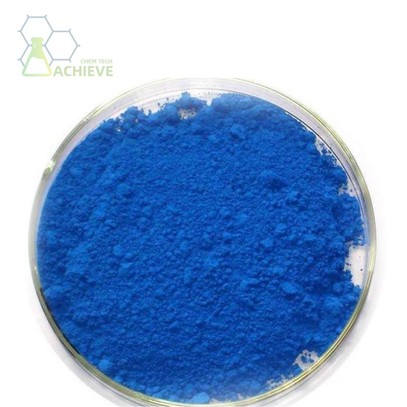
Fast Blue B Salt, with the chemical name 3,3'-dimethoxy-4,4'-biphenyl diamine dinitrogen salt, is a diazo compound that appears as a light yellow to light brown powder or crystal. Its core characteristic lies in its unstable chemical nature, which is particularly sensitive to light and heat. It can rapidly decompose in neutral or alkaline aqueous solutions. The most notable property of this compound is its strong diazotization activity. In coupling reactions, it serves as the diazo component and can rapidly react with various phenolic or aromatic amine coupling agents to form insoluble azo dyes with high coloring power, such as blue, purple, or black. Therefore, it is widely used in the dye industry, textile printing and dyeing, and biochemical detection fields. Especially in histochemistry, it is used as an important coloring substrate, for detecting phosphatase activity. It can form an insoluble blue precipitate at the enzyme activity site, thereby achieving precise localization and visualization analysis of specific components or activities in biological samples.

|
|
|
|
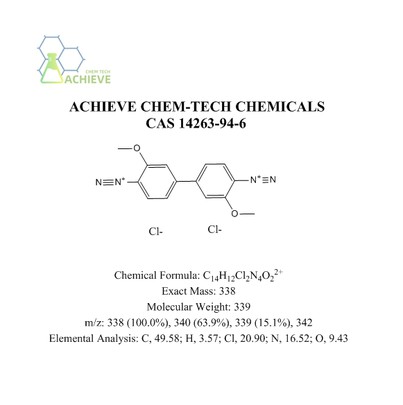
Chemical Formula |
C14H12Cl2N4O22+ |
|
Exact Mass |
338 |
|
Molecular Weight |
339 |
|
m/z |
338 (100.0%), 340 (63.9%), 339 (15.1%), 342 |
|
Elemental Analysis |
C, 49.58; H, 3.57; Cl, 20.90; N, 16.52; O, 9.43 |

Fast Blue B salt has wide application value in biochemistry, dye industry, and other fields. Its use as a protein staining agent, cell staining agent, tissue staining agent, and enzyme activity assay reagent is of great significance in biochemical research; As both a coloring agent and a color developing agent, it has a wide range of applications in the dye industry and chemical analysis; In addition, it also has certain application value in fields such as scientific research experiments and clinical diagnosis.
Biochemistry field

1. Protein staining and electrophoresis analysis
It is often used as a protein staining agent in biochemical experiments. It can bind to specific amino acid residues in proteins, such as lysine, to form visible bands. In the process of SDS-PAGE (sodium dodecyl sulfate polyacrylamide gel electrophoresis), different proteins form different bands on the gel due to their different migration rates and charges, which facilitates researchers to identify and analyze proteins. This staining method has high sensitivity and specificity, and is one of the indispensable tools in biochemical research.
2. Organizational research
In histological research, it is also an important staining agent. It can be used for staining tissue sections, helping researchers observe and analyze the structure and function of tissues. Through tissue staining, researchers can understand the structural characteristics, cell types, and distribution of different tissues and organs, providing strong support for the diagnosis and treatment of diseases.


3. Cell staining
Plays an important role in cell culture and histological research. It can be used for cell staining, helping researchers observe the structure and morphology of cells, and then analyze their function and state. Through cell staining, researchers can intuitively understand the processes of cell growth, division, apoptosis, etc., providing important basis for the study of cell biology and pathology.
4. Immunoblotting
In immunoblotting experiments, it can be used as a background staining agent. By increasing the contrast of the signal, it can improve the accuracy and sensitivity of the experiment. Immunoblotting is an important method for detecting protein expression levels, and its application further enhances the reliability and accuracy of this method.


5. Enzyme activity assay
It can also be used to measure the activity of various enzymes. For example, it can be used as a reactant or reagent to participate in biochemical reactions such as diazotization coupling reactions, and the activity level of enzymes can be determined by detecting the color changes of the reaction products. This method has wide application value in biochemical research and clinical testing.
In the field of dye industry

1. Coloring agent
As a dye compound, it also has important applications in the dye industry. It can be used to dye various fibers and fabric materials, giving them bright colors and long-lasting color fastness. Due to its excellent dyeing performance and stability, it has been widely used in the textile printing and dyeing industry.
2. Chromogenic agent
In chemical analysis, it is commonly used as a coloring agent. Fast Blue B salt can undergo chemical reactions with the substance being tested and produce significant color changes, thereby achieving qualitative and quantitative detection of the target substance. For example, in paper chromatography and thin-layer chromatography analysis, it is often used as a color reagent to detect compounds such as flavonoids, amines, and phenols.

Other fields

1. Scientific research experiment
It also has a wide range of applications in scientific research experiments. Whether it is biochemical experiments or other types of scientific research experiments, as long as they involve steps that require staining or color development, they may become one of the important choices for experimenters. Its wide range of applications and excellent performance make it highly favored in the field of scientific research.
2. Clinical diagnosis
In the field of clinical diagnosis, it also has certain application value. Although its direct application in clinical diagnosis is relatively rare, its combination with other diagnostic reagents or methods can provide auxiliary support for the diagnosis and treatment of diseases. For example, in certain biochemical indicator tests, it may be used as a color reagent or reactant to assist in determining the patient's condition and prognosis.

The synthesis of Fast Blue B salt usually involves two main steps: diazotization reaction and coupling reaction. The diazotization reaction is the process of converting aromatic amines into diazonium salts, while the coupling reaction is the process of coupling diazonium salts with another molecule of aromatic amines or phenolic compounds to form azo compounds.
Detailed synthesis steps and chemical equations
1. diazotization reaction
Step description:
(1) Choose appropriate aromatic amines as starting materials, such as o-phenylenediamine or its derivatives.
(2) Under low temperature (such as 0-5 ° C) and acidic (such as hydrochloric acid) conditions, react aromatic amines with sodium nitrite.
(3) By controlling the reaction temperature and droplet rate, the diazotization reaction can proceed smoothly, avoiding the decomposition of diazonium sats and the occurrence of side reactions.
Example of chemical equation:
Assuming that ortho phenylenediamine reacts with sodium nitrite under acidic conditions to form diazo ortho phenylenediamine sat, the reaction equation can be expressed as:
C6H4(NH2)2 + 2NaNO2 + 2HCl → C6H4(N2Cl)2Na2 + 2H2O
Note: The above equation is a simplified representation, and in actual reactions, free diazonium ions (N ≡ N ^+) may be generated instead of directly bound chloride ions, and more complex intermediates and equilibrium states may be involved.
2. Coupling reaction
Step description:
(1) The generated diazonium sat is coupled with another molecule of aromatic amine or phenolic compound under appropriate conditions.
(2) Control the reaction temperature, pH value, and reaction time to ensure the smooth progress of the coupling reaction and the generation of products.
(3) After the reaction is complete, pure and stable Blue B sat is obtained through appropriate post-processing steps such as filtration, washing, drying, etc.
Example of chemical equation:
Due to the fact that the specific conditions and product structures of coupling reactions may vary depending on the reactants, an exact chemical equation cannot be given here. But generally speaking, coupling reactions can be expressed as the coupling process of diazonium sats with another molecule of aromatic amine or phenolic compound, forming a new azo bond (N=N).

Fast Blue B salt is used to prepare a coagulase detection test strip, comprising the following steps:
The immersion solution comprises a substrate, a buffer solution, a stabilizer, and a dispersant; Dissolve the substrate in a solution containing a buffer solution, stabilizer, and dispersant to obtain the immersion solution; The substrate is glycyl arginine 4-methoxy - β - naphthylamine hydrochloride, glycyl arginine - β - naphthylamine, coumarin derivative or umbelliferone derivative; The buffer solution is Tris HCl buffer, potassium dihydrogen phosphate sodium hydroxide buffer, or boric acid borax buffer; The stabilizer is sucrose, trehalose, glucose, lactose, galactose or arabinose; The dispersant is one or more of PVP-K30, PVP-K90, PEG-2000, PEG-4000, and PEG-6000;
The immersion solution prepared in step 1 is soaked in filter paper using an immersion dryer automated drying method to prepare the detection test paper; Temperature setting of immersion dryer: Immersion solution: After starting up, set the main heating temperature of the equipment to 60-80 ℃ and the auxiliary heating temperature to 60 ℃. When the main heating temperature reaches 60-80 ℃ and the temperature of each drying chamber is ≥ 60 ℃, start immersion solution; Immersion dryer speed setting: 7.0-11.0Hz;
The color developing solution comprises a color developing agent, a stabilizer, and a dispersant; The color developing agent, stabilizer, and dispersant are dissolved in sulfuric acid solution or distilled water to prepare the color developing solution; The color developing agent is dimethylaminocinnamaldehyde, p-dimethylaminobenzaldehyde, solid blue B sat, solid red B sat, solid blue BB sat, solid blue RR salt, solid red T or solid red TR; The stabilizer is TritonX-100 or TritonX-200; The dispersant is PVP-K30 or PVP-K90; The colorimetric solution is used in conjunction with the detection strip to jointly detect the coagulase component in the secretion.
Hot Tags: fast blue b salt cas 14263-94-6, suppliers, manufacturers, factory, wholesale, buy, price, bulk, for sale, sulfosalicylic acid powder, praseodymium powder, Acetaldehyde solution, Cobalt II phthalocyanine, Cinchonine, 3-Bromobiphenyl