


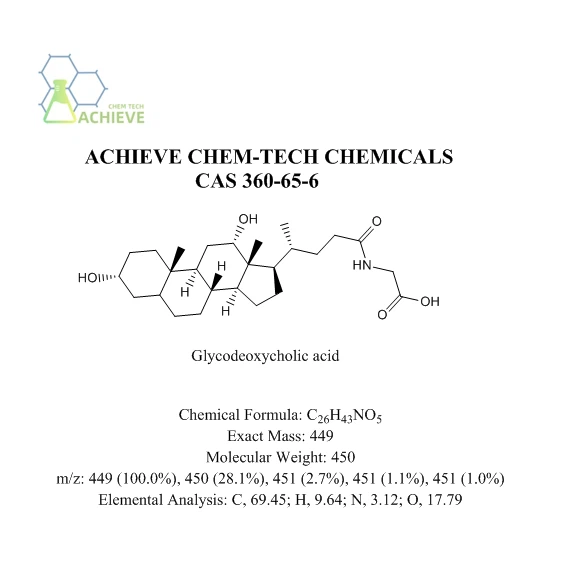


Glycodeoxycholic acid (C26H45NO6 · xH2O, CAS 360-65-6, is an organic compound with a white powdery solid appearance and good crystallinity. Its form is stable, but it may exhibit some moisture absorption in humid environments, so moisture prevention should be taken into account during storage. Has a certain degree of solubility, although the solubility is relatively low. Specifically, it can dissolve slightly in solvents such as acetonitrile, ethanol, and methanol. This solubility characteristic allows for extraction, purification, and application under laboratory conditions through appropriate solvent selection. As an important organic compound, it has a wide range of applications in biochemical research, medicine, and biotechnology. Its characteristics as a lipase accelerator, ion remover, protein solubilizer, etc. make it play an important role in biochemical experiments; In the field of medicine, it can be used to induce hepatocyte apoptosis, as a component of bacterial culture media, and in drug development; In the field of biotechnology, it can be used in techniques such as cell analysis and chromatographic separation. With the continuous deepening of research on product and the expansion of its application fields, it is believed that it will play a more important role in the future.

|
|
|


|
Chemical Formula |
C26H43NO5 |
|
Exact Mass |
449 |
|
Molecular Weight |
450 |
|
m/z |
449 (100.0%), 450 (28.1%), 451 (2.7%), 451 (1.1%), 451 (1.0%) |
|
Elemental Analysis |
C, 69.45; H, 9.64; N, 3.12; O, 17.79 |
Core Functions
● Emulsification and Absorption Enhancement
As a member of the bile acid family, GDCA significantly improves the water solubility and intestinal absorption efficiency of dietary fats and fat-soluble vitamins (such as vitamins A, D, E, and K) by emulsifying them into minute particles through reducing the surface tension at the lipid-water interface. This function is crucial for maintaining lipid metabolism balance, particularly in patients with insufficient bile secretion or fat absorption disorders (e.g., post-cholecystectomy, pancreatic insufficiency), where GDCA supplementation improves nutrient absorption.
● Participants in the Bile Acid Cycle
GDCA is produced by intestinal bacteria through the dehydroxylation of primary bile acids (e.g., cholic acid). After reabsorption in the ileum, it returns to the liver where it conjugates with glycine or taurine to form conjugated bile acids, completing the "liver-intestine cycle." This process not only conserves energy for bile acid synthesis but also indirectly influences cholesterol metabolism by regulating bile composition to affect cholesterol solubility.
● Signaling Molecules and Metabolic Regulation
Recent studies reveal that GDCA modulates hepatic lipid synthesis, glucose metabolism, and energy balance by activating the farnesoid X receptor (FXR) and the G protein-coupled bile acid receptor 1 (TGR5). For example, FXR activation suppresses hepatic cholesterol 7α-hydroxylase (CYP7A1) expression, reducing bile acid synthesis; TGR5 activation promotes glucagon-like peptide-1 (GLP-1) secretion, enhancing insulin sensitivity.

Glycodeoxycholic acid (GDCA) is an important organic compound with wide applications in biochemical research, medicine, biotechnology, and other related fields.
1. Lipase Accelerator:
Can act as an accelerator for lipase, promoting the breakdown and metabolism of lipid substances. In biochemical experiments, this characteristic makes it an important tool for studying lipid metabolism, lipase function, and their regulatory mechanisms. By accelerating the reaction rate of lipase, researchers can more accurately observe and analyze the metabolic processes of lipid substances, thereby revealing their physiological and pathological significance.
2. Ionic remover:
It also has the characteristic of ion removal, which can remove certain ions in the solution under specific conditions. This characteristic is particularly important in biochemical research, as changes in ion concentration often affect the activity and function of biomolecules. By utilizing its ion removal effect, researchers can optimize experimental conditions, reduce ion interference, and improve the accuracy and reproducibility of experiments.


3. Protein dissolution:
The ability to effectively dissolve certain proteins is of great significance for protein extraction, purification, and structural research. Proteins are the main carriers of life activities, with diverse and complex functions. By utilizing its protein solubility properties, researchers can more conveniently obtain high-purity protein samples and further investigate their structure and function.
4. Inducing hepatocyte apoptosis:
Widely used in the study of inducing hepatocyte apoptosis. Hepatocellular apoptosis is one of the important mechanisms underlying the occurrence and development of liver diseases. By inducing apoptosis of liver cells, researchers can simulate the pathological process of liver diseases and explore the mechanisms and development patterns of the disease. Meanwhile, it may also induce DNA clearance, further revealing its complex mechanism of action in the process of cell apoptosis. This discovery provides new ideas and methods for the prevention and treatment of liver diseases.
2. Composition of bacterial culture medium:
In microbiology research, it is often used as one of the components of bacterial culture medium, especially for the cultivation and isolation of intestinal bacteria. Intestinal bacteria play an important role in human health, and changes in their quantity and types are often closely related to the occurrence and development of various diseases. By adding it to the culture medium, the growth conditions of bacteria can be optimized, promoting the growth and reproduction of specific bacteria, thereby providing more reliable and effective experimental materials for the study of gut microbiota.
3. Drug development:
Based on the unique role of GDCA in inducing hepatocyte apoptosis and bacterial culture, researchers are exploring its potential as a drug target. Through in-depth research on its mechanism of action and biological activity, it is expected to develop new drugs for the treatment of liver diseases, intestinal infections, and other diseases. In addition, it may also have other pharmacological effects, such as anti-inflammatory and antifungal effects, which provide new directions for drug development.

3, Biotechnology field

1. Cell analysis:
In cell analysis, it can be used for cell lysis and extraction. By dissolving structural components such as cell walls and membranes, intracellular biomolecules (such as DNA, RNA, and proteins) can be released for analysis. This application provides important technical support for research in fields such as cell biology and molecular biology. By obtaining information on biomolecules within cells, researchers can further reveal the physiological functions and pathological changes of cells.
2. Chromatographic separation:
It also has certain application value in chromatographic separation technology. Chromatography separation is an efficient and rapid separation and analysis technique widely used in fields such as biochemistry and medicine. By selecting appropriate chromatographic columns and mobile phase conditions, the interaction between the product and the substance to be separated can be utilized for efficient separation and purification. This application provides a new method and approach for the purification and analysis of biomolecules.
1. Cosmetics and pharmaceutical emulsifiers:
This substance and its salts have surface activity and can be used as emulsifiers in cosmetics and pharmaceuticals. They can stabilize the oil-water interface, form a uniform emulsion system, thereby improving the texture and usability of the product. In addition, GDCA and its salts also have antifungal and anti-inflammatory effects, which can be used to treat certain skin diseases or as drug carriers. However, these applications are still in the research or preliminary application stage and require further experimental validation and clinical evaluation.
2. Other potential applications:
With the continuous deepening of research on this substance and the expansion of its application fields, it is believed that it will have more potential application value in the future. For example, it can be used as a food additive in the food industry; It can be used as a plant growth regulator in the agricultural field. However, further research and exploration are needed to realize these potential applications.

side effect
Glycodeoxycholic acid (GDCA) is an endogenous bile acid derivative that plays important roles in physiological and pathological processes. However, when used as a drug or research reagent, it may cause a series of side effects involving multiple organs and systems such as the liver, gastrointestinal tract, and immune system. The following provides a detailed analysis of its potential side effects and mechanisms from multiple dimensions:
Liver toxicity
GDCA can induce apoptosis and necrosis of liver cells under specific conditions. Animal experiments have shown that high-dose GDCA (such as intravenous injection of 140mg/kg) can induce liver cell toxicity, manifested as liver cell necrosis and autophagy. This process may be related to bile stasis, leading to an increase in bile acid concentration in liver cells, triggering mitochondrial dysfunction and oxidative stress. GDCA may exacerbate liver damage in patients with obstructive cholestasis. The mechanism includes:
Dysregulation of bile acid metabolism: GDCA, as a secondary bile acid, accumulates during bile stasis, further damaging the integrity of liver cell membranes.
Oxidative stress: GDCA can inhibit cytochrome c oxidase activity, leading to mitochondrial dysfunction, oxidative stress, and cell death.
Inflammatory response: GDCA may activate hepatic stellate cells and Kupffer cells, release pro-inflammatory cytokines, and exacerbate liver fibrosis.
Gastrointestinal reactions
GDCA, as a bile acid component, may interfere with the balance of gut microbiota, leading to indigestion, abdominal pain, and diarrhea. The mechanism includes:
Imbalance of gut microbiota: GDCA has inhibitory effects on certain gut bacteria, which may disrupt the balance of gut microbiota.
Enhanced intestinal peristalsis: High concentrations of bile acids can stimulate intestinal smooth muscles, leading to accelerated peristalsis and causing diarrhea.
GDCA may disrupt the tight junctions between intestinal epithelial cells, increase intestinal permeability, lead to endotoxin translocation, and further trigger systemic inflammatory responses.
Immune system response
Individual patients may be allergic to GDCA, manifested as rash, itching, difficulty breathing, etc. The mechanism may be related to the abnormal recognition of GDCA by the immune system, leading to IgE mediated allergic reactions.Long term high-dose use of GDCA may suppress immune system function and increase the risk of infection. The mechanism may be related to the direct toxicity of GDCA on immune cells or its interference with immune signaling pathways.
Metabolic and electrolyte disorders
Glycodeoxycholic acid may affect lipid metabolism and lead to dyslipidemia. The mechanism includes:
Imbalance between bile acid synthesis and secretion: GDCA, as a bile acid component, may interfere with cholesterol metabolism and affect lipoprotein synthesis.
Changes in intestinal lipid absorption: GDCA may affect the emulsification and absorption of fat in the intestine, leading to fat diarrhea. Diarrhea caused by GDCA may lead to electrolyte loss, such as sodium, potassium, chloride, etc., which in turn can cause electrolyte disorders such as hypokalemia and hyponatremia.
Other potential side effects
Long term high-dose use of GDCA may cause toxicity to the kidneys, manifested as renal dysfunction. The mechanism may be related to the accumulation of GDCA in the kidneys or its direct toxicity to renal tubular cells.Animal experiments have shown that GDCA may have certain effects on the reproductive system, such as affecting sperm motility or embryonic development. However, this conclusion still requires further human research to verify.
Dose dependence and individual differences of side effects
The side effects of GDCA are usually dose-dependent. When used at low doses, the side effects may be mild or not significant; When used in high doses, the risk of side effects significantly increases. For example, intravenous injection of 140mg/kg GDCA in animal experiments can cause significant liver toxicity, while lower doses may only cause mild reactions.There are differences in the tolerance of different individuals to GDCA. Genetic factors such as polymorphisms in bile acid metabolism related genes, liver function status, and gut microbiota composition may all affect the risk of side effects of GDCA.
Hot Tags: glycodeoxycholic acid cas 360-65-6, suppliers, manufacturers, factory, wholesale, buy, price, bulk, for sale, CAS 1332939 29 3, diphenylcarbazide reagent, 4-bromo-1-chlorophenanthrene, pure procaine powder, Chemical Reagent, N9 dibenzo b d thiophen 3 yl 7 7 dimethyl N5 N5 N9 triphenyl 7H benzo c fluorene 5 9 diamine