


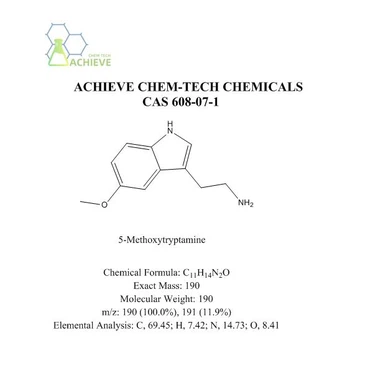
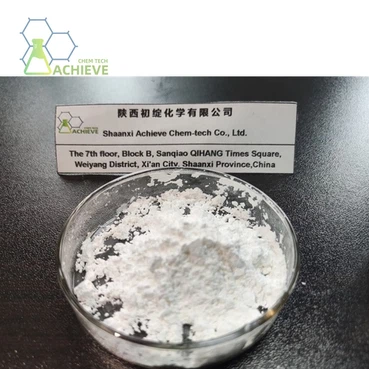
5-Methoxytryptamine(link:https://www.bloomtechz.com/synthetic-chemical/api-researching-only/5-methoxytryptamine-cas-608-07-1.html) is an organic compound also known as 5-MeO-DMT. The molecular formula is C13H16N2O, and the relative molecular mass is 220.28 g/mol. It consists of an indole ring, an ethylamino group and a methoxy group. Ethylamino and methoxy groups are attached to positions 3 and 5 on the indole ring, respectively. Common forms are colorless to pale yellow crystalline solid, or white to beige crystalline powder. As a compound containing an ethylamine group, 5-Methoxytryptamine exhibits basic properties. It can react with acids to form salts and can be protonated under appropriate conditions. This protonation can affect its solubility and chemical reactivity. It is relatively stable under dry, airtight and proper storage conditions. However, it may undergo degradation, oxidation, or other chemical changes when exposed to light, heat, humidity, or exposure to air. Widely used as chemical synthesis intermediates. It can be used to synthesize other organic compounds such as drugs, fragrances and dyes. The chemical structure and reactivity of 5-Methoxytryptamine make it an important starting material for the synthesis of diverse compounds.
|
|
|
1. Amino substitution reaction:
The amine group (NH2) in 5-Methoxytryptamine has strong nucleophilicity, which makes it prone to various amine group substitution reactions. For example, it can react with an acid anhydride to generate an amide compound; react with an alkyl halide to generate an alkylamine; react with an aromatic acid chloride to generate an aromatic amide, etc.
1.1. Amidation reaction:
Amidation reaction is a common amine group substitution reaction. The amine group in 5-Methoxytryptamine is reacted with an acid anhydride to generate the corresponding amide compound. This reaction is usually carried out under basic conditions, and the acyl group (C=O) in the anhydride is replaced by an amine group by nucleophilic attack.
Example reaction equation:
R-CO-O-R' + C11H14N2O → R-CO-NH-C11H14N2O + ROH
1.2. Amino alkylation reaction:
Amino alkylation reaction is a reaction in which the amine group in 5-Methoxytryptamine is reacted with an alkyl halide, and the alkyl group is introduced into the amine group. This reaction is often carried out under alkaline conditions.
Example reaction equation:
R-X + C11H14N2O → R-NH-C11H14N2O + HX
Among them, R represents an alkyl group, and X represents a halogen atom (such as Cl, Br, etc.).
1.3. Aromatic amidation reaction:
The aromatic amidation reaction is to react the amino group in 5-Methoxytryptamine with aromatic acid chloride to form the corresponding aromatic amide. This reaction is usually carried out under basic conditions.
Example reaction equation:
Ar-CO-Cl + C11H14N2O → Ar-CO-NH-C11H14N2O + HCl
Wherein, Ar represents an aromatic group.
1.4. Simple etherification reaction:
The etherification reaction is to react the amino group in 5-Methoxytryptamine with alcohol to generate ether compound. This reaction is generally carried out under acidic conditions.
Example reaction equation:
R-OH + C11H14N2O → R-O-C11H14N2O + H2O
Wherein, R represents an alkyl group or an aromatic group.
2. Reversibility of the reaction:
The amine group of 5-Methoxytryptamine undergoes hydrogen bonding or other non-covalent interactions with many compounds, making some reactions reversible. For example, it can undergo a protonation reaction under acidic conditions to form a cation, and undergo a deprotonation reaction under alkaline conditions to return to a neutral state. The reactions in 5-Methoxytryptamine can be divided into reversible reactions and irreversible reactions. A reversible reaction means that the reactant can transform with the product under certain conditions to form an equilibrium state. An irreversible reaction means that the reactants cannot return to their original state after a chemical change.
Here are some examples of the reversibility of 5-Methoxytryptamine reactions and their corresponding chemical equations:
2.1. Chemical oxidation reaction:
5-Methoxytryptamine can be oxidized by oxidant oxygen (O2) to the corresponding quinone compounds, such as 5-Methoxy-N-acetyltryptamine quinone. This reaction is reversible, and 5-Methoxy-N-acetyltryptamine quinone can be reduced back to 5-Methoxytryptamine by a reducing agent (such as sulfite).
Example of a reaction equation:
C11H14N2O + O2 → C13H16N2O2 quinone
Example reduction equation:
C13H16N2O2 quinone + reducing agent → C11H14N2O
2.2. Amino substitution reaction:
The amine group of 5-Methoxytryptamine can undergo a substitution reaction to form a new amine group substitution product. This reaction is reversible, and the product can be reduced back to 5-Methoxytryptamine by appropriate conditions (such as acid or base).
Example of a reaction equation:
C11H14N2O + R-X → C11H14N2O-R
Example reduction equation:
C11H14N2O-R + H2O → C11H14N2O
2.3. Condensation reaction:
5-Methoxytryptamine can undergo condensation reaction with other compounds to form C-C bonds to form new compounds. This reaction is reversible, and the product can be decomposed into 5-Methoxytryptamine and the original reactant again through appropriate conditions (such as acid or base).
Example of a reaction equation:
C11H14N2O + C6H12O3 → Imine
Example factoring equations:
Imine + H2O → C11H14N2O + C6H12O3
3. Oxidation reaction:
The methoxy group (-OCH3) of 5-Methoxytryptamine has strong electron-donating properties and is easily attacked by oxidants. It can be oxidized to the corresponding quinone compounds. Common oxidants include oxygen (O2), hydrogen peroxide (H2O2) and ammonium persulfate (NH4)2S2O8).

4. Reduction reaction:
The quinone derivatives of 5-Methoxytryptamine can be reduced back to the corresponding phenol derivatives by a reduction reaction. Commonly used reducing agents include phosphites, sulfites, metal hydrides, and the like.
5. Hydroxyl substitution reaction:
The hydroxyl group (-OH) on the aromatic ring of 5-Methoxytryptamine can undergo a substitution reaction. It can undergo methylation reactions to generate corresponding methylated products; it can also react with acid aldehydes to form ketals.
6. Rearrangement reaction:

5-Methoxytryptamine may undergo rearrangement reaction under appropriate conditions. For example, it can undergo the ring-opening rearrangement of oxirane under acidic conditions. 5-MeO-DMT is a compound containing aromatic ring and amine group, which has certain reactivity.
6.1. Hoffmann rearrangement reaction:
The Hoffmann rearrangement reaction is one of the important rearrangement reactions of amine compounds, which is carried out under alkaline conditions. This reaction converts the alkanolamine to the corresponding isobutyric acid amide via migration of the amine group. In 5-Methoxytryptamine, this reaction can initiate rearrangement of aromatic rings.
Example of a reaction equation:
C11H14N2O + C4H7ClO → N-isobutyryl-C11H14N2O
6.2. Curtius rearrangement reaction:
The Curtius rearrangement is a rearrangement reaction in which amines are formed via amide shedding and isonitrile intermediates. In 5-Methoxytryptamine, this reaction leads to the corresponding isonitrile intermediate which is subsequently hydrolyzed to the corresponding amine.
Example of a reaction equation:
C11H14N2O + acid chloride + isonitrile intermediate + H2O → C11H14N2O
6.3. Lossen rearrangement reaction:
The Lossen rearrangement reaction is a rearrangement reaction that occurs under acidic or basic conditions, through amide deamination and electrophilic substitution to generate the corresponding isonitrile intermediates, followed by further isomerization to generate new amine products.
Example of a reaction equation:
C11H14N2O + isonitrile intermediate → isonitrile intermediate + amine product
6.4. Pictet-Spengler rearrangement reaction:
The Pictet-Spengler rearrangement reaction is a special kind of amine rearrangement reaction, which occurs between the aromatic ring and the substituent. In 5-Methoxytryptamine, this reaction usually occurs between an aldehyde or ketone and an amine, forming a new ring structure.
Example of a reaction equation:
C11H14N2O + aldehyde/ketone → new ring structure
Please keep in mind that the above is only an overview of some of the main reaction properties of 5-Methoxytryptamine, and cannot cover all reaction types and details. For more detailed and comprehensive information, refer to the relevant scientific literature, professional chemistry handbooks or organic chemistry textbooks. In the meantime, please follow proper laboratory safety practices and comply with laws and regulations when performing any laboratory work.