


2-Chloronicotinic acid is an organic compound with CAS 2942-59-8 and chemical formula C6H4ClNO2. It is a white crystalline powder. The solubility in water is relatively low, about 0.9 grams per 100 milliliters of water. When burned in the air, toxic nitrogen oxide gases are produced. It has good solubility in common organic solvents such as ethanol, acetone, and dimethyl sulfoxide. It is an organic acid with an acidic aqueous solution and a pH value below 7. It is an asymmetric molecule and therefore has chirality. It can have two chiral isomers, namely left-handed and right-handed.
(Product link: https://www.bloomtechz.com/synthetic-chemical/organic-intermediates/2-chloronicotinic-acid-cas-2942-59-8.html)
Inject chlorine gas into a mixture of phosphorus oxychloride and phosphorus trichloride, control the temperature at around 60 ℃, until residual chlorine escapes. After cooling, add N-oxidized niacin in batches and heat. React at 100-105 ℃ for 1-1.5 hours, make the reaction mixture transparent, stir for 30 minutes, reduce pressure to remove phosphorus oxychloride, cool the residue to room temperature, and add water to obtain the finished product.
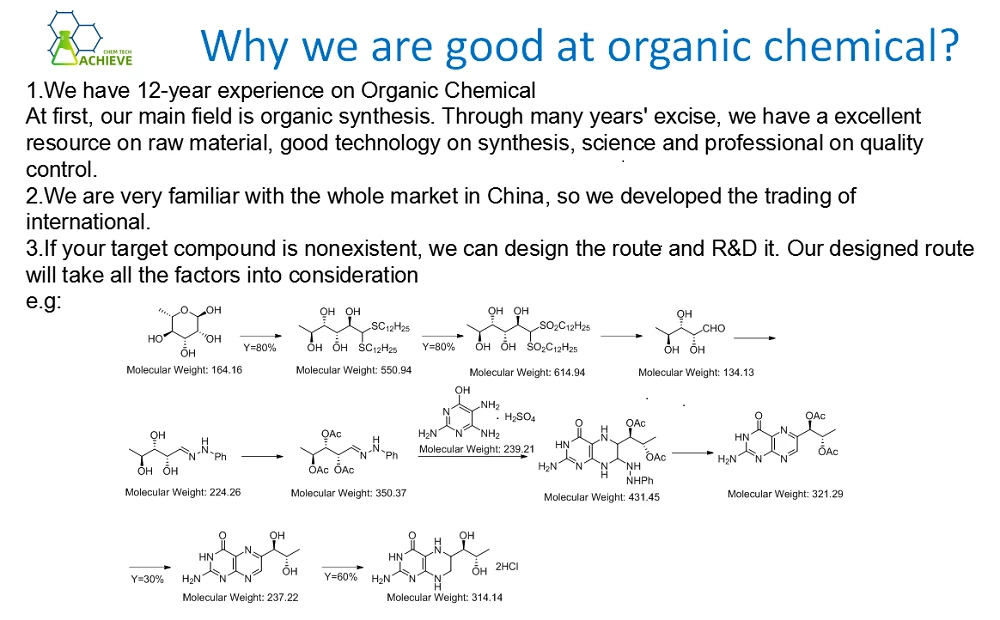
It mainly includes the following steps:
1. Synthesis of 3-methylpyridine oxide:
Chemical equation:
C6H7N+H2O2->C6H7NO
This step involves oxidizing 3-methylpyridine to 3-methylpyridine oxide under the action of hydrogen peroxide. This is a typical oxidation reaction, in which hydrogen peroxide acts as an oxidant to oxidize the C-H bond of 3-methylpyridine to the C-O bond.
2. Synthesis of 2-chloro-3,5-dimethylpyridine:
Chemical equation:
C6H7NO+Cl3P ->C7H8ClN
In this step, 3-methylpyridine oxide reacts with phosphorus oxychloride to produce 2-chloro-3,5-dimethylpyridine. This is a typical substitution reaction, in which phosphorus oxychloride acts as a halogenating agent to replace the hydroxyl (or oxygen) in 3-methylpyridine oxide with a chlorine atom.
3. Separate 2-chloro-3,5-dimethylpyridine and 2-chloro-3-methylpyridine:
Through crystallization and distillation techniques, 2-chloro-3,5-dimethylpyridine and 2-chloro-3-methylpyridine can be separated from the reaction products. This separation method is based on the differences in physical properties (such as melting and boiling points) between two substances.
4. Synthesis of 2-chloro-3-trichloromethylpyridine:
Chemical equation:
C6H6ClN+Cl2->C6H3Cl4N
In this step, 2-chloro-3-methylpyridine reacts with chlorine gas under certain conditions to produce 2-chloro-3-trichloromethylpyridine. This is a typical substitution reaction, in which chlorine gas acts as a halogenating agent to replace the hydrogen atom in 2-chloro-3-methylpyridine with a chlorine atom.
5. Hydrolysis of 2-chloro-3-trichloromethylpyridine:
Chemical equation:
C6H3Cl4N+H2O ->C6H4ClNO2
The final step is to convert 2-chloro-3-trichloromethylpyridine to 2-chloronicotinic acid through hydrolysis reaction. In this step, water is used as the reaction reagent to replace the three chlorine atoms in 2-chloro-3-trichloromethylpyridine with hydroxyl groups, generating 2-chloronicotinic acid. This hydrolysis reaction may generate 2-chloronicotinic acid or its related salts.
2-Chloroniacin is an organic compound with the molecular formula C6H4ClNO2. In the molecular structure, 2-chloronicotinic acid contains one chlorine atom, one nitrogen atom, two oxygen atoms, and a benzene ring. The arrangement of these elements in the molecule determines their unique physicochemical properties and reactivity.
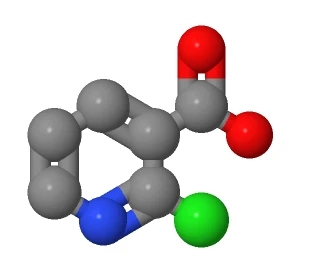
Firstly, let's analyze the benzene ring structure in 2-chloronicotinic acid molecules. The benzene ring is a closed ring composed of six carbon atoms, which form stable bonds by sharing electrons. In 2-chloronicotinic acid, a hydrogen atom on the benzene ring is replaced by a chlorine atom, forming a 2-chloro substituent. The presence of this chlorine atom gives 2-chloronicotinic acid certain reactivity and allows it to participate in various chemical reactions.
Next are the nitrogen and oxygen atoms in the molecule. Both nitrogen and oxygen atoms are non-metallic atoms containing a pair of lone pair electrons, forming amino and carbonyl groups in the molecule, respectively. The amino group is - NH2, which gives 2-chloronicotinic acid a certain alkalinity and allows it to react with acids or undergo nucleophilic substitution reactions. The carbonyl group is the - CO2 group, which gives 2-chloronicotinic acid a certain acidity and enables electrophilic substitution reactions.
In addition to the substituents mentioned above, 2-chloronicotinic acid also has a certain rigid structure. Due to the presence of benzene rings and chlorine atoms, the entire molecule exhibits a certain planar structure. This rigid structure gives 2-chloronicotinic acid high reactivity and selectivity in chemical reactions, and can be used to synthesize various compounds with specific functions.

In the chemical industry, 2-chloronicotinic acid is mainly used to synthesize some important organic compounds, such as pyridine, pyrimidine, etc. These compounds have extensive applications in fields such as dyes, fragrances, and pesticides. By reacting with different chemical groups, compounds with specific structures and properties can be obtained, providing important intermediates for the synthesis of dyes, fragrances, pesticides and other products.
In addition to its application in the chemical industry, 2-chloronicotinic acid is also used to synthesize some biologically active compounds. For example, it can be used to synthesize some antibacterial agents, anti-cancer drugs, etc. By combining with different bioactive molecules, small molecule compounds with specific biological activity can be obtained, which have important application value in the fields of medicine and biotechnology.
In addition, the molecular structure of 2-chloronicotinic acid also provides possibilities for its application in the synthesis of fluorescent dyes. Due to the presence of certain electronic transition groups and conjugated systems in the molecule, 2-chloronicotinic acid can be used to synthesize dyes with specific wavelength fluorescence. These dyes have important application prospects in fields such as biomarkers, fluorescent probes, and fluorescence imaging.