


Tetraethoxylate, also known as tetraethyl orthosilicate, is called TEOS for short. Ethyl silicate is a colorless and transparent liquid with special odor under normal temperature. It is stable in the presence of anhydrous water, decomposes into ethanol and silicic acid in the presence of water, becomes turbid in humid air, and dissolves in organic solvents such as alcohol and ether. The molecular formula is (C2H5O) 4Si, melting point - 77 ℃, boiling point 168.1 ℃. Toxic, strongly irritating to human eyes and respiratory tract. It is prepared by distillation after the action of silicon tetrachloride and absolute ethanol. It is used for preparing heat-resistant and chemical corrosion-resistant coatings and silicone solvents. It can also be used for organic synthesis, basic raw materials for preparing high-grade crystals, optical glass treatment agents, binders, insulating materials in electronic industry, etc.
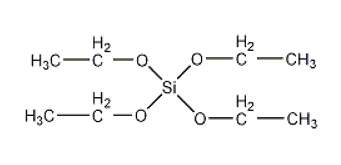
Ethyl silicate is a liquid silicate, which can be used as a dissolving agent for mural pigments. Ethyl silicate is a clear and thin liquid, which is similar to volatile solvent on the surface. After carefully adding alcohol and a small amount of water, it will be hydrolyzed into pure silicic acid adhesive. Before drying, it will go through the intermediate stage of viscosity and adhesion. Applying Ethyl Silicate Pigment on the absorbent or permeable surface can produce an effect that can compete with the fresco; The durability of Ethyl Silicate Pigment and the freshness of chemicalbook color are better than those of frescoes. The pigment must be prepared every day to keep fresh, and once water is added, the hydrolysis will not stop. Ethyl silicate is the best and easiest to use among various silicon esters. Ethyl silicate was first introduced into pigment solvent by George king in Britain in 1931, and was introduced into the United States by Ralph Mayer in 1937.
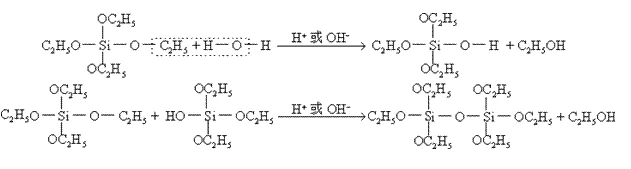
Ethyl silicate itself has no binding capacity. If ethyl silicate is used as the binder of refractory materials, it can be used only after hydrolysis treatment. The hydrolysis of ethyl silicate proceeds very slowly under the condition of only water. Once catalyzed by acid (H +) or chemical Book base (OH -), the hydrolysis speed is greatly accelerated. Generally, hydrochloric acid is used as the catalyst, because using alkali as the catalyst will make the hydrolytic solution gel quickly and make the hydrolytic sol lose stability, thus losing the binding ability. The hydrolysis reaction of ethyl silicate occurs under the catalysis of acid. In essence, the hydrolysis reaction is that the ethoxy group (C2H5O -) in ethyl silicate is replaced by hydroxyl (- OH) in water. As a result, ethyl silicate (si4-oc2h5) is transformed into silanol group (si4-oh). Silanol group has high activity and can continue acid exchange or etherification with other ethyl silicate or silanol groups. However, the degree of hydrolysis reaction must be controlled to make a stable ethyl silicate hydrolysate. Otherwise, the continuous reaction results will form organic polysiloxane and lose its stability, and become insoluble gel, thus losing its operability. The stability of ethyl silicate hydrolysate is mainly adjusted by adding acid or alkali into chemicalbook. When the pH value is between 1.5 and 2.5, the gel appears for a long time, and the hydrolysate is the most stable. When it is lower than or higher than this range, the hydrolysate is prone to appear gel, and when the pH value is between 5 and 6, the gel appears, and the hydrolysate is the most unstable. Therefore, the general hydrolysate should be controlled between 2.0 ~ 2.5 to maintain its stability, so as to maintain a certain operation time (construction or molding time) after mixing with refractory materials. Ethyl silicate hydrolysate can be used as the binder of precision casting mold refractory materials, as well as the binder of clay, high alumina, corundum, zircon containing quartz, mullite, silicon carbide and other products and castables.
Used in precision casting as the binder of sand mold; The metal surface treated with ethyl silicate vapor can be anticorrosive and waterproof. Ethyl silicate can be used to infiltrate silicon on the metal surface, and the treatment of optical glass can improve the light transmittance; The very fine oxygen chemicalbook silicon powder produced after complete hydrolysis can be used to manufacture phosphors. Ethyl silicate is the raw material of organic silicone oil. Ethyl silicate can also be used to manufacture heat-resistant and chemical resistant coatings. In Japan, 90% ethyl silicate is used as the base material of anti-corrosion coating (zinc rich paint).
It can also be used in chemical resistant coatings and heat-resistant coatings, silicone solvents and precision adhesives. After complete hydrolysis, very fine silica powder is produced, which is used to make phosphor and chemical reagent. However, it is mainly used for optical glass, chemical resistant coatings, heat-resistant coatings and adhesives; Modification of anticorrosive coatings; Crosslinking agent, binder and dehydrating agent; Manufacturing application of catalyst framework and high-purity ultra-fine silica tetraethyl orthosilicate is mainly used for optical glass, chemical resistant coatings, heat-resistant coatings and adhesives; Modification of anticorrosive coatings; Crosslinking agent, binder and dehydrating agent; Manufacture of catalyst framework and high-purity ultrafine silica. Application: insulating materials for electronic industry, coatings, optical glass treatment agent, coagulant, organic synthesis, solvent for preparing organosilicon. In the embedded compound forming H + - Magadiite, it will react with dodecylamine to study mixed metal bioactive glass. Precursor for preparing dry gel.