


GABA helps plants defend against external natural enemies. When insects feed, cell rupture and tissue injury are caused by plant injury. This mechanical cutting will stimulate the increase of Ca2 + in plants. Plants secrete GABA under the stimulation of Ca2 + as a measure to resist insect feeding. In this process, there is no jasmonate signal involved in the accumulation of GABA. There are ionic GABA receptors in insects. The GABA gated chloride channel subunit RDL (resistant to dieldrin) of Drosophila is the target of many insecticides. GABA induction reduced the single current of GABA receptor. Specifically, GABA acts through GABA receptor gated chloride channels in invertebrates. Like most pesticides, through GABA receptor chloride channels, Cl-downstream driven by electrochemical gradients, leading to plasma membrane hyperpolarization and inhibiting insect feeding. In tobacco plants overexpressing GABA, when inoculated with northern nematodes, it was found that the reproductive ability of female adult nematodes decreased as a whole. This way can make plants achieve the effect of defense against natural enemies. In the process of feeding Ligustrum lucidum by herbivorous female e larvae, it is found that Ligustrum lucidum will reduce its lysine activity and make protein nutritious, while female e larvae will secrete glycine β- Alanine, amine and other molecules inhibit the reduction of plant lysine. The communication process between plants and herbivores also proves the function of GABA as a signal molecule.
Role in the process of antioxidation and oxidation: GABA shunt, as an intermediate product of the branch pathway of the tricarboxylic acid cycle, is closely related to the energy cycle. At the same time, GABA plays a role as a regulator of oxidative metabolites. When Arabidopsis SSADH mutant was exposed to high temperature, it was found that its reactive oxygen intermediate (ROI) accumulated, resulting in plant death. proved that there was a relationship between ROI and GABA. Similarly, the mutants of SSADH and GABA-T genes have a large amount of ROI at high temperature α-Phenylnitrone (PBN) can accumulate a large amount of GABA and improve the survival rate of yeast. Therefore, it is considered that GABA shunt pathway plays a role in inhibiting ROI at high temperature. In the process of GABA shunt, SSA can be transformed into GHB through GlyR / ssar, and GHB is closely related to ROI. There is a large accumulation of GHB and ROI in SSADH deletion mutant, and guabatrin can inhibit the accumulation of GHB and ROI and inhibit peroxidation death. GABA shunting process can reduce the accumulation of ROI and protect organisms from oxidative damage and peroxide decay caused by high temperature.
There are two pathways of GABA synthesis and transformation in plants: one is that glutamic acid decarboxylase (GAD) catalyzes the decarboxylation of glutamic acid to synthesize GABA, which is called GABA shunt; The other is GABA formed by the transformation of polyamine degradation products, which is called polyamine degradation pathway.
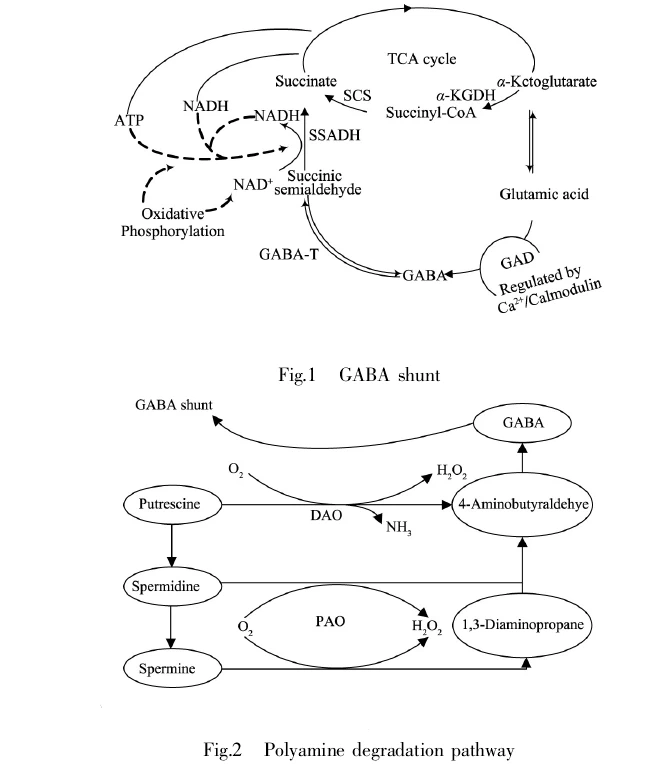
It can also maintain carbon and oxygen balance: carbon and nitrogen metabolic balance involves many physiological processes, including energy metabolism, amino acid metabolism and so on. Because GABA synthesis and shunt pathway involves nitrogen metabolism, GABA is also an important part of the tricarboxylic acid cycle in the energy cycle. GABA shunt pathway competes with the respiratory chain for SSADH. Therefore, GABA has been considered as an important link of carbon and nitrogen metabolism for a long time. The GABA pathway of glutamate synthesis in the branch of tricarboxylic acid cycle is one of the key factors for plants to respond quickly to external stimuli. Most NH3 + is synthesized by glutamine synthetase / glutamate synthetase pathway, which is considered to be the main synthetic pathway of amino acids. Most of the free amino molecules are fixed by glutamine. Glutamate is considered to be the main accumulation form of nitrogen in the old roots of plants. Nitrogen is stored in amino acids such as arginine. At the same time, arginine can also be used for transportation to meet the nitrogen needs of organisms. Similarly, amino acids also participate in energy metabolism through conversion to precursors or intermediates of the tricarboxylic acid cycle. In the study of spinach, it was found that proline accounted for 8.1% ~ 36% of the total free amino acids, GABA accounted for 12.8% ~ 22.2%, glutamate accounted for 5.6% ~ 21.5%. Glutamate is the precursor of GABA and proline. Under low temperature, plants will divert the nitrogen of glutamate into the metabolic pathway of nitrogen regulated by GABA and proline. In addition, in Arabidopsis cultured under 50mmol / L GABA, except NADP + dependent citrate dehydrogenase, glutamine synthetase in root and bud and phosphoenolpyruvate carboxylase in bud, almost all enzyme activities related to primary nitrogen metabolism and nitrate absorption were affected. In Arabidopsis cultured under NaCl conditions, it was found that GABA accumulation led to the increase of overall amino acids in Arabidopsis. In Arabidopsis leaves cultured with different nitrogen compounds (10mmol / L NH4Cl, 5mmol / L NH4NO3, 5mmol / L glutamate and 5mmol / L glutamine) as the only nitrogen source, their GAD activity and protein level are different, indicating that GAD plays a role in nitrogen metabolism.
The increase of GAD activity and GABA and dopamine were also found in bananas under no stress. Under salt stress, glutamate dehydrogenase activity and GAD expression increased instantaneously, and then increased the flux of GABA shunt and other related pathways to regulate carbon and nitrogen balance. Under stress, the ratio of NADH: NAD + and ADP: ATP can also affect GABA-T, resulting in GABA accumulation. Under salt stress, plants make more use of C / N balance pathway to alleviate stress.
In addition, GABA also has ripening effect. GABA can stimulate ethylene biosynthesis by stimulating the transcriptional abundance of 1-aminocyclopropane-1-carboxylic acid (ACC) synthase. Ethylene can provide oxygen for plants by promoting the growth of adventitious roots under water logging. High concentration of GABA can inhibit the growth of plant and bacterial GABA aminotransferase (GABA-T, gabt) mutants, and high concentration can inhibit the reproduction of bacteria in plants. The inhibition of GABA-T in tomato will lead to the accumulation of GABA and the emergence of dwarfism in tomato.