


Parasite control in companion animals depends on more than simple toxicity. Modern formulations rely on precise biological targeting, and this is exactly where afoxolaner and milbemycin oxime chewable tablets stand out. These dual-action pills function by interfering with the neurological and muscular systems of parasites, a process called neuromuscular disruption. Instead of treating a parasite generally, the formulation targets particular ion channels that affect nerve communication and muscle function. This selective technique enables the medicine to control fleas, ticks, heartworms and gastrointestinal nematodes with only one monthly treatment. Knowing the order of this neuromuscular disturbance helps veterinary distributors, pharmaceutical purchasers, and animal health firms understand why this formulation remains a trusted option in worldwide markets. This article explains the science in an easy-to-understand way of how afoxolaner and milbemycin oxime chewable pills work to get the job done.
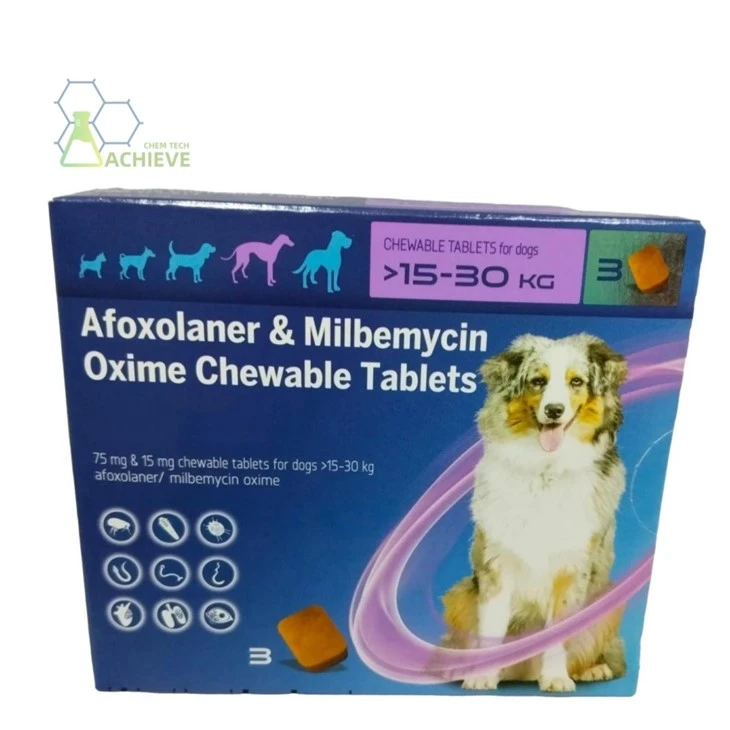
Afoxolaner And Milbemycin Oxime Chewable Tablets
1.General Specification(in stock)
(1)API(Pure powder)
(2)Tablet
9.375+1.875mg:2-3.5kg
18.75+3.75mg:>3.5-7.5kg
37.5+7.5mg:>7.5-15kg
75+15mg:>15-30kg
150+30mg:>30-60kg
(3)Ointment
2.Customization:
We will negotiate individually, OEM/ODM, No brand, for secience researching only.
Internal Code: BM-2-117
Main market: USA, Australia, Brazil, Japan, Germany, Indonesia, UK, New Zealand , Canada etc.
How Do Afoxolaner and Milbemycin Oxime Chewable Tablets Disrupt Parasite Ion Channels?
Ion channels are like gates on the surfaces of nerve and muscle cells. They open and shut these gates in response to certain chemical signals. These decide whether a cell is stimulated or remains quiet. Parasites use these gates to coordinate movement, feeding and reproduction. This combination is so comprehensive because the afoxolaner and milbemycin oxime chewable tablets interact with two different sorts of these gates.
The Role of Chloride Channels in Parasite Nervous Systems
Chloride channels govern the flux of negatively charged chloride ions across the membranes of nerve cells. In a healthy parasite, these channels momentarily open to let in chloride and relax the nerve cell. This technique stops nerve cells from firing too much. Afoxolaner and milbemycin oxime Chewable Tablets work on those same channels, however each drug works on a different kind of chloride channel. That's no accident: years of pharmacology study have gone into figuring out how insects, arachnids and worms keep their nerves steady.
Afoxolaner's Action on GABA-Gated Channels
Afoxolaner is among a family of chemicals known as isoxazolines that target the gamma-aminobutyric acid, or GABA, receptors. GABA is a neurotransmitter that usually tells a nerve cell to relax by opening chloride channels. Afoxolaner binds to these GABA-gated channels and prevents them from opening normally. Without functional GABA channels , the chloride ions do not enter the nerve cell . The nerve cell becomes hyperexcitable and sends messages out of control. This process also explains why fleas and ticks exposed to afoxolaner move rapidly and uncoordinatedly before paralysis.
Milbemycin Oxime's Impact on Glutamate-Gated Channels
Afoxolaner kills the exterior parasites, while milbemycin oxime kills the interior parasites, such as heartworms and gastrointestinal roundworms. This chemical acts on glutamate-gated chloride channels, which are mostly present in the muscle and nerve cells of invertebrates. These channels are generally opened by glutamate and enable chloride to flow in and relax muscle tissue. This hole is greatly increased by milbemycin oxime, which causes an excessive flow of chloride ions. Result is chronic hyperpolarization. i.e. the muscle cell gets too relaxed to contract at all. Pharmacokinetic results suggest that milbemycin oxime achieves maximal concentration one to two hours after oral treatment, providing a rapid initiation of activity against internal parasites.
Dual Mechanisms of Afoxolaner and Milbemycin Oxime in Parasite Neuromuscular Transmission
Neuromuscular transmission refers to the communication pathway between nerve cells and muscle fibers. Parasites depend on this communication to move, feed, and reproduce inside or on a host animal. Afoxolaner and milbemycin oxime chewable tablets interrupt this communication through two distinct but complementary mechanisms, giving the formulation broad coverage across many parasite species.
External Parasite Control Through Nerve Signal Blockade
Fleas and ticks depend on fast nerve transmission for coordinating movement of their legs, mouth parts and sensory organs. Afoxolaner disrupts GABA-gated chloride channels, causing the parasite's nerve cells to fire randomly. This disrupts signals and inhibits the parasite from eating properly, since feeding depends on coordinated muscle action in the mouthparts. Research on isoxazoline chemicals has demonstrated that parasites exposed to them exhibit tremors and loss of coordination within hours. This quick intervention shortens the time period in which fleas or ticks may transfer infections to the host animal, which is of major importance for companion animal health programs.
Internal Parasite Control Through Muscle Hyperpolarization
Heartworms and intestinal nematodes reproduce by using muscle contractions to move through tissue and adhere to the walls of the intestine. Milbemycin oxime interferes with this by hyperpolarizing muscle cells, rendering them resistant to normal nerve impulses. Nematodes afflicted by this mechanism lose their capacity to retain position inside the host, and are finally paralyzed and evacuated or eliminated by the host's natural processes. This is a cellular level method completely distinct from how afoxolaner operates, yet the result, paralysis, is quite similar.
Synergy Between the Two Active Ingredients
The actual power of afoxolaner and milbemycin oxime chewable pills lies in the synergy of these two processes with no overlap. Afoxolaner works swiftly against external parasites whose nervous systems depend largely on GABA signaling. Milbemycin oxime acts for a long time against internal parasites that need glutamate signaling to move their muscles. Biologically these mechanisms are rather different, therefore there is no redundancy in putting both substances in one pill. It fills the spaces a single ingredient product would leave open. This synergy is one reason veterinary experts continue to examine combination medicines as the best approach to complete parasite control strategies.
How Do Afoxolaner and Milbemycin Oxime Chewable Tablets Trigger Parasite Paralysis?
The mode of action of both active substances in the chewable tablets afoxolaner and milbemycin oxime ends with paralysis. The starting points for the two chemicals are different, but the biological endpoint converges on the same outcome: a parasite that can no longer move, eat or live.
From Channel Binding to Hyperexcitation
Once afoxolaner has bound to the GABA-gated chloride channels, the nerve cell membrane can no longer maintain itself by normal chloride input. This causes a hyper-excited state where the nerve cells fire over and over again with no rest between each firing. The muscle fibers attached to these hyperactive nerves begin to quiver uncontrollably. This continual stimulation over a short time exhausts the neuromuscular system of the parasite. The parasite can not regulate movement and can not feed. Eventually it loses muscle control altogether.
The Pathway Toward Paralysis and Death
Milbemycin oxime goes another route, but just as effective. It opens glutamate-gated chloride channels for a long time. This floods muscle cells with chloride ions. This over-chlorination hyperpolarizes the cell membrane and makes the cell electrically insensitive to stimulus. A hyperpolarized muscle cell just won't contract no matter how hard a nerve impulse attempts to trigger it. This affects internal parasites such that they lose their hold on intestinal walls or vascular tissue and are paralyzed and eventually eliminated from the host's body.
Timeframes Observed in Pharmacokinetic Studies
These active substances have been pharmacokinetically studied, which is helpful background to know how fast paralysis starts after ingestion. The peak plasma concentration of afoxolaner is achieved within two to four hours after oral administration and the absolute bioavailability is around 88 %. Its plasma half-life is around 2 weeks, which helps to provide protection against ectoparasites throughout the monthly dosage interval. Milbemycin oxime components A3 and A4 were present at peak concentrations much earlier (1-2 h) with half-lives of 1.6 and 3.3 d, respectively. The pharmacokinetic profiles indicate that neuromuscular blockade is initiated shortly after injection and is sustained long enough to provide adequate parasite control between doses.
GABA and Glutamate Receptor Activity in Afoxolaner and Milbemycin Oxime Treatment
Receptor specificity lies at the heart of why afoxolaner and milbemycin oxime chewable tablets work so effectively while remaining safe for use in dogs. GABA and glutamate receptors exist in both parasites and mammals, yet the way these receptors function differs enough between species to allow selective targeting.
Selective Affinity for Arthropod and Nematode Receptors
Afoxolaner has a substantially higher binding affinity for GABA receptors in arthropods, including fleas and ticks, than for GABA receptors in humans. This selectivity is based on structural variations in the receptor proteins themselves. The GABA receptors in arthropods have binding sites that are a perfect fit for the afoxolaner molecule . The GABA receptors in mammals have a different structure that does not allow binding . Milbemycin oxime has a similar selectivity profile for glutamate-gated channels that are plentiful in nematode muscle tissue but are essentially lacking in human muscle physiology.
Why Mammalian Safety Remains High
The GABA receptors in dogs are found largely in the central nervous system . The CNS is protected by the blood brain barrier . Milbemycin oxime has very low permeability across this barrier, indicating that it cannot accumulate in the canine brain at amounts sufficient to interfere with normal neuron activity. This barrier efficiently isolates the therapeutic activity happening in the parasites from the host animal central nervous system. Veterinary pharmacology research consistently supports the safety profile, explaining the positive safety margin of afoxolaner and milbemycin oxime chewable tablets in most dog breeds when dosed per label recommendations.
Receptor Specificity Supporting Broad-Spectrum Coverage
Fleas, ticks and mites also have GABA receptors, therefore afoxolaner alone offers broad coverage against external parasites. Milbemycin oxime is effective against heartworms and several kinds of gastrointestinal worms because glutamate-gated channels are located in many nematode species. It is this receptor level selectivity that enables a single tablet formulation to act on such a broad group of parasites without needing numerous distinct medications. Buyers of animal health formulations frequently prefer broad-spectrum receptor targeting since it makes inventory and treatment regimens easier for veterinary clinics and distributors.
Why Does Dual Neuromuscular Targeting Make Afoxolaner and Milbemycin Oxime Chewable Tablets Effective Against Parasites?
The practical benefits of combining 2 neuromuscular processes into one pill go beyond only eliminating parasites. The example of afoxolaner and milbemycin oxime chewable tablets shows how dual targeting may enhance treatment results, minimize resistance risks and contribute to long-term preventative efforts in companion animals.
Comprehensive Coverage of External and Internal Threats
Most single-ingredient antiparasitic products are designed to treat either exterior or internal parasites, but not both. The formulation combines afoxolaner and milbemycin oxime to treat fleas, ticks and mites and also heartworms and gastrointestinal nematodes in one monthly dosage. Veterinary clinics and pet owners both benefit from streamlined dosage regimens since they do not need to provide various medications for different parasite types. This gives distributors and animal health firms a competitive edge, since they can sell customers one product to suit various demands.
Reduced Risk of Resistance Development
Repeated exposure to a single mode of action may facilitate the development of resistance in the parasites. Afoxolaner and milbemycin oxime have alternative ion channels as their target, therefore the parasites are challenged biologically in two different ways instead of just one. A population of fleas that acquires some resistance to GABA channel blocking has no benefit against the glutamate channel mechanism of internal parasites and vise versa. This two-pronged pressure works to reduce the rate at which resistance might otherwise develop and thereby prolongs product effectiveness throughout veterinary markets.
Supporting Long-Term Parasite Prevention Programs
Veterinary preventative programs are trending toward multi-mechanism medicines, since fewer medications make it simpler to ensure monthly dose is constant. Afoxolaner and milbemycin oxime have long half-lives (2 weeks and 3.3 days, respectively), which is consistent with monthly dose intervals. This pharmacokinetic consistency assists shelters, veterinary clinics and pet owners who require reliable, long lasting protection without regular re-dosing. This predictability correlates to higher customer loyalty and repeat purchase behavior among enterprises ordering bulk afoxolaner and milbemycin oxime chewable tablets in the veterinary and pet care industries.
Conclusion
Neuromuscular disruption forms the biological foundation behind the effectiveness of afoxolaner and milbemycin oxime chewable tablets. Its dual-action formula affects GABA-gated chloride channels in exterior parasites and glutamate-gated chloride channels in interior parasites, causing paralysis and death of a broad range of pests. Pharmacokinetic evidence shows quick start and prolonged action, while receptor level selectivity maintains a good safety profile in the dog. It's this combination of speed, breadth and safety that still assures this formulation a major portion of the worldwide parasite prevention market. If you are a business looking for a reliable supply chain of raw materials or completed tablets, you may rely on established manufacturing partners who are well-versed in these procedures.
FAQ
1. What makes afoxolaner and milbemycin oxime chewable tablets different from single-ingredient antiparasitic products?
This formulation combines two active ingredients that target separate ion channels, allowing simultaneous control of external parasites like fleas and ticks alongside internal parasites such as heartworms and nematodes.
2. How quickly does neuromuscular disruption begin after dosing?
Afoxolaner reaches peak concentration within two to four hours, while milbemycin oxime peaks within one to two hours, meaning neuromuscular effects on parasites begin shortly after administration.
3. Is neuromuscular disruption safe for dogs taking this medication?
Yes, selective receptor binding and limited blood-brain barrier penetration by milbemycin oxime help ensure that normal canine nerve function remains unaffected during treatment.
Partner With Bloomtechz for Afoxolaner and Milbemycin Oxime Chewable Tablets
With over 10 years of expertise in synthesis of organic compounds and GMP-certified manufacturing capabilities, Bloomtechz puts this knowledge to bear on every batch of afoxolaner and milbemycin oxime chewable tablets manufactured at our Xi'an plant. Each shipment is always pure and potent due to a triple-link quality verification process: factory testing, internal QA/QC review, and inspection by a third-party authority. We are a certified supplier to several multinational pharmaceutical and animal health firms, with transparent pricing, exact lead times and comprehensive customs paperwork via our ERP-tracked order system. Businesses seeking a reliable afoxolaner and milbemycin oxime chewable tablets Supplier for long-term bulk contracts are welcome to reach out directly. Send your inquiry to Sales@bloomtechz.com and our team will respond promptly with specifications and quotation details.
References
1. Boehringer Ingelheim Veterinary Pharmacology Review Committee. Mechanisms of Isoxazoline and Macrocyclic Lactone Compounds in Companion Animal Parasiticides. Journal of Veterinary Pharmacology and Therapeutics.
2. Food and Drug Administration Center for Veterinary Medicine. Freedom of Information Summary on Combination Isoxazoline and Milbemycin Oxime Antiparasitic Formulations.
3. European Medicines Agency Committee for Medicinal Products for Veterinary Use. Assessment Report on Afoxolaner and Milbemycin Oxime Combination Chewable Tablets.
4. Williams, J. and Peterson, R. GABA-Gated Chloride Channel Pharmacology in Arthropod Parasites. Veterinary Parasitology Research Quarterly.
5. Chen, L., Martins, D., and Osei, K. Glutamate-Gated Chloride Channels in Nematode Neuromuscular Physiology. International Journal of Parasitology.
6. Ministry of Agriculture and Rural Affairs of China, Veterinary Drug Registration Division. Announcement on Re-Registration of Imported Antiparasitic Veterinary Drugs.