


Pet owners frequently question how a single pill can protect their companion animals for weeks at a time, which is why they typically look for reliable flea and tick remedies. Fluralaner's solution to that question is a complicated one, founded in both neurology and biology. The molecule belongs to the isoxazoline class and acts on certain receptors in the neurological systems of fleas, ticks and mites, impairing their normal function without affecting mammalian hosts. Understanding the molecular basis of Fluralaner action helps veterinarians, researchers and pet health firms grasp why this molecule has become a cornerstone in parasite care. Herein, we describe the receptor interactions, structural features and physiological repercussions that characterize the action of Fluralaner at the cellular level, giving clarity for those interested in the scientific background of today's antiparasitic medicines.
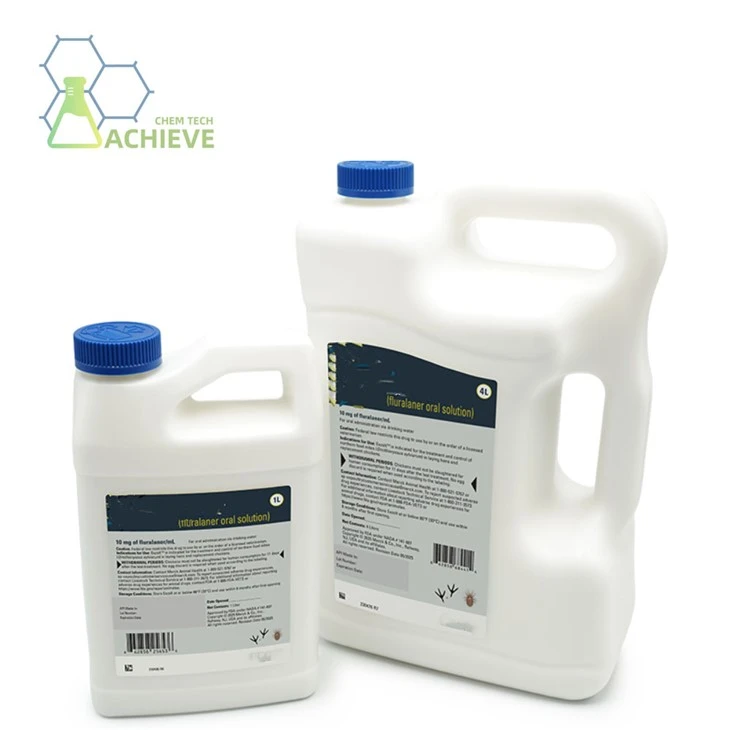
Fluralaner Solution
1.General Specification(in stock)
(1)Solution
(2)Tablet
(3)Injection
(4)Spray
(5)Drops
2.Customization:
We will negotiate individually, OEM/ODM, No brand, for secience researching only.
Internal Code:BM-9-001
Fluralaner CAS 864731-61-3
Main market: USA, Australia, Brazil, Japan, Germany, Indonesia, UK, New Zealand , Canada etc.
Manufacturer: BLOOM TECH Xi'an Factory
Analysis: HPLC, LC-MS, HNMR
Technology support: R&D Dept.-4
How Does Fluralaner Interact With Ligand-Gated Chloride Channels in Parasites?
Arthropods have ligand-gated chloride channels that gate the passage of nerve signals. These channels open or shut in response to certain chemical messengers, enabling chloride ions to pass across neuronal membranes. Fluralaner acts primarily by binding to these channels, changing their normal function, and upsetting the electrical equilibrium upon which insect and arachnid nervous systems rely.
The Role of Chloride Ion Flow in Neural Signaling
In healthy neurons, the influx of chloride ions into the cell is tightly controlled to maintain a resting membrane potential. When the chloride channels open at the right time, neurons settle down after firing, avoiding over-excitation. Parasites rely especially on this regulation mechanism since their neural systems fire at fast rates essential for mobility, feeding and reproduction. Fluralaner interferes with such regulation by binding to channel proteins such that correct closure becomes impossible and there is continuous and uncontrolled ion flow.
Binding Affinity and Selectivity Mechanisms
Studies published in veterinary pharmacology publications reveal that Fluralaner has a much greater binding affinity for arthropod chloride channels than for mammalian chloride channels. This selectivity is due to structural variations between the insect and mammalian channel proteins, namely the amino acid sequences bordering the binding pocket. Differences in channel design between dogs and cats and the presence of a protective blood-brain barrier substantially restrict the drug from the central nervous system, explaining the superior safety profile seen with clinical usage.
Consequences of Prolonged Channel Activation
If the chloride channels stay open longer than they should, the neurons will stay hyperpolarized or, in certain cases, be paradoxically excited, depending on the kind of channel. The prolonged interruption hinders normal patterns of neurotransmission that are needed for muscular coordination and sensory perception in fleas and ticks. Over time this molecular interference accumulates and finally overwhelms the parasite's capacity to sustain essential physiological activities. This fundamental interaction is the starting point to study how the structural properties of Fluralaner allow such a precise targeting.
Fluralaner Molecular Structure and Its Selective Binding to Arthropod Neural Targets
The chemical structure dictates biological function and this is directly relevant to Fluralaner. The isoxazoline ring structure and carefully positioned halogen substituents combine to form a chemical designed to interact with arthropod brain receptors but with little cross-reactivity with human proteins.
Isoxazoline Ring Configuration and Receptor Fit
The isoxazoline core offers a solid scaffold for the placement of functional groups in three-dimensional space for optimum interaction with amino acid residues in the chloride channel binding site. The rigidity is important because flexible compounds will typically attach to several kinds of receptors indiscriminately but stiff structures such as Fluralaner have precise targeting. Computational modeling studies have shown that this ring conformation fits tightly into niches typically seen in insect and acarine glutamate-gated and GABA-gated channels.
Halogen Substituents and Lipophilicity
Fluralaner is a molecule with many halogen atoms, including chlorine and fluorine groups, which boost its lipophilic property. This characteristic permits the chemical to permeate the lipid-rich cuticle of fleas and ticks effectively after these parasites suck blood from treated animals. Also responsible for the long duration of action is the lipophilicity of this molecule as the active ingredient is stored in the fatty tissue of the host animal from whence it is slowly released into the blood over a longer period of time.
Structural Comparison With Other Isoxazoline Compounds
Scientists working on the isoxazoline family have identified minor structural differences between related compounds that affect potency and range of action. Fluralaner's unique substitution pattern provides it with wide spectrum activity against a number of arthropod species including numerous tick genera and mite species, setting it apart within this chemical family. These structural intricacies are why formulation scientists investigate molecular architecture in the development of veterinary antiparasitic medicines, since even small alterations in the arrangement of atoms may result in substantial shifts in receptor selectivity and effectiveness profiles.
How Does Fluralaner Inhibit GABA Receptor Function at the Molecular Level?
Gamma-aminobutyric acid , or GABA , is the major inhibitory neurotransmitter in arthropod nervous systems . Fluralaner binds to the GABA receptors via a process of noncompetitive antagonism . This changes the basic response of these receptors to their natural ligand .
Noncompetitive Antagonism Explained
Fluralaner binds to a separate allosteric location on the receptor complex, unlike competitive inhibitors that bind to the same site as GABA itself. The fact that it binds to a specific site means it doesn't have to fight for space with GABA molecules. Rather, it modifies the receptor shape via conformational modification, such that the chloride channel doesn't open correctly, even when GABA binds to its typical position. This method is very powerful in that it is independent of the amount of natural neurotransmitter in the synaptic region.
Conformational Changes in Receptor Proteins
Proteins don't have a fixed form . Their shape changes as they interact to molecules . When Fluralaner binds to its allosteric site, the receptor protein changes shape and the accompanying chloride channel becomes nonfunctional. Studies in structural biology, including those using cryo-electron microscopy, have shown how these shape changes cascade across the protein complex, thereby locking the channel gate and blocking the usual passage of chloride ions that would normally quiet neuronal activity.
Downstream Effects on Synaptic Transmission
If the GABA receptors do not work properly, synaptic communication in the parasite nervous system is disrupted. Inhibitory signals that typically prevent too much neuronal activation are ignored, and a cascade of unregulated electrical activity ensues . The effect is not just on individual synapses but also on coordinated movement patterns, eating behavior and reproductive capabilities in impacted parasites. This particular GABA receptor interaction is one of the reasons why Fluralaner is particularly effective against fleas and ticks within hours of contact (as shown in a number of veterinary effectiveness studies).
Molecular Interactions Between Fluralaner and Insect Neuronal Receptor Subunits
In addition to GABA receptors, fluralaner is also a ligand of glutamate-gated chloride channels, a receptor type that exists only in invertebrate nervous systems. Taking a closer look at the precise subunit interactions uncovers more levels of molecular precision in the antiparasitic effect of this chemical.
Glutamate-Gated Chloride Channel Architecture
Glutamate-gated chloride channels are a class of receptors that are not found in mammals, making them a good target for selective antiparasitic drugs. The channels consist of many protein subunits, organized in a ring with a central hole through which chloride ions may flow. Fluralaner works at certain interfaces between subunits, binding at the points where neighboring protein chains meet, rather than within one subunit on its own. Such an interface-binding pattern demands a very exact molecular geometry, which may be perfectly assured by the stiff isoxazoline structure of the molecule.
Subunit Composition Variability Across Species
Different species of arthropods express different combinations of receptor subunits, resulting in small changes in channel composition amongst fleas, ticks and mites. However, Fluralaner is active against a wide range of strains since it works on conserved structural motifs that are present in different combinations of subunits. Entomological studies have shown that the conserved binding site enables the chemical to be effective against various populations of the parasites, even those with minor genetic differences or from different geographical areas.
Cooperative Binding and Receptor Desensitization
Receptor subunits typically behave in a cooperative fashion , that is , ligand binding at one site affects the properties of other subunits in the same complex . This cooperative interaction increases the inhibition of the whole receptor assembly when Fluralaner binds to its target location. Furthermore, extended exposure to the chemical may lead to receptor desensitization , a condition in which the channel becomes insensitive to even its native ligand glutamate . This desensitization further contributes to the paralytic impact, and explains the quick beginning of action seen in treated parasites in the first few hours after exposure .
How Does Fluralaner-Induced Ion Channel Inhibition Lead to Parasite Paralysis?
These molecular interactions of Fluralaner result in the physical paralysis of fleas, ticks and mites. Following the journey from first receptor binding to observable physiological response shows how molecular events lead to practical pest management outcomes.
From Receptor Binding to Neuronal Hyperexcitability
Fluralaner attaches to chloride channels and stops them from working correctly. When this happens, neurons can no longer control electrical activity appropriately. The lack of this regulation results in a condition of hyperexcitability, when nerve cells fire in a repetitive manner without sufficient inhibition. The muscles attached to these hyperactive neurons are constantly receiving stimulation messages, which leads to disorganized and excessive muscular spasms that the parasites cannot control freely.
Progressive Motor Dysfunction in Affected Parasites
The observable effects after Fluralaner exposure often adhere to a particular progression. The first tremors become increasingly violent muscular spasms as the disturbance of the neurological system increases. Clinical tests have shown that fleas that are exposed to blood from animals treated with Fluralaner start to display reduced movement within a few hours and soon after become completely immobile. The advancement is due to the concerted action of many affected receptor sites in the nervous system of the parasite leading to a systemic motor failure.
Metabolic Exhaustion and Parasite Mortality
The afflicted cells have to work rather hard to keep the neurons hyperexcited for a long time. Such prolonged aberrant activity quickly exhausts the cellular energy stores of the parasites and leads to ultimate metabolic collapse. Eventually, the parasite succumbs to this metabolic stress, compounded by the incapacity to feed, migrate and escape treated hosts. Field studies in treated companion animals have consistently indicated high rates of flea and tick eradication within 48 hours of dosing, which clearly correlates with the chemical cascade begun by chloride channel blockage discussed throughout this presentation.
Conclusion
The molecular foundation of Fluralaner action, which provides a surprisingly accurate biochemical method for controlling fleas, ticks and mites. It is selective for GABA and glutamate-gated chloride channels. It affects critical brain activities that are specific to arthropod physiology. Its isoxazoline core and halogen substituents are structural properties that provide potency and prolonged duration of action, while maintaining safety for treated animals. Each step, from initial receptor binding to the final paralysis and death of the parasite, tells a story of molecular design. Veterinary health professionals and procurement teams should grasp these processes when considering antiparasitic solutions for veterinary uses and research objectives.
FAQ
1. What makes Fluralaner different from older flea and tick treatments?
Fluralaner belongs to the isoxazoline chemical class, offering longer-lasting protection and a distinct mechanism compared to older pyrethroid or organophosphate compounds, which often require more frequent dosing.
2. Does Fluralaner affect mammalian nervous systems?
Fluralaner shows strong selectivity for arthropod-specific receptor subtypes and structural differences, combined with the mammalian blood-brain barrier, that limit meaningful interaction with canine or feline central nervous systems.
3. How quickly does Fluralaner begin working after administration?
Laboratory and field studies indicate that Fluralaner begins affecting flea mobility within a few hours, with substantial elimination of fleas and ticks occurring within 48 hours after dosing.
Partner With Bloomtechz for Reliable Fluralaner Supply
Bloomtechz stands ready to support your pharmaceutical, veterinary, and research needs with high-quality Fluralaner products manufactured under GMP-certified conditions. In our Xi'an facility, we perform rigorous three-tier quality checks to ensure that each batch conforms to worldwide standards, recognized by regulatory agencies in several countries. A trusted Fluralaner Supplier with over ten years of expertise in organic synthesizing, we provide fair pricing, consistent lead times and complete technical documentation for customs clearance and research purposes. Bulk powder, pills or bespoke formulations. Our experienced R&D team offer immediate help during your procurement process. Reach out today at Sales@bloomtechz.com to discuss your requirements and discover how our manufacturing capabilities can serve your business goals.
References
1. Gassel, M., Wolf, C., Noack, S., Williams, H., and Ilg, T. "The Novel Isoxazoline Ectoparasiticide Fluralaner: Selective Inhibition of Arthropod γ-Aminobutyric Acid and L-Glutamate-Gated Chloride Channels." Insect Biochemistry and Molecular Biology.
2. Ozoe, Yoshihisa. "γ-Aminobutyrate- and Glutamate-Gated Chloride Channels as Targets of Insecticides." Advances in Insect Physiology.
3. Rohdich, Nadine, Roepke, Rainer K.A., and Zschiesche, Eva. "A Randomized, Blinded, Controlled and Multi-Centered Field Study Comparing the Efficacy and Safety of Bravecto Against Fleas and Ticks in Dogs." Parasites & Vectors.
4. Shoop, Wesley L., Hartline, Eric J., Gould, Brian R., et al. "Discovery and Mode of Action of Afoxolaner, a New Isoxazoline Parasiticide for Dogs." Veterinary Parasitology.
5. Weber, Thomas, and Selzer, Paul M. "Isoxazolines: A Novel Chemotype Highly Effective on Ectoparasites." ChemMedChem.
6. Zhao, Chen, Casida, John E. "Insect γ-Aminobutyric Acid Receptors and Isoxazoline Insecticides: Toxicological Profiles Relative to the Binding Sites of Insecticidal Agents." Journal of Agricultural and Food Chemistry.