


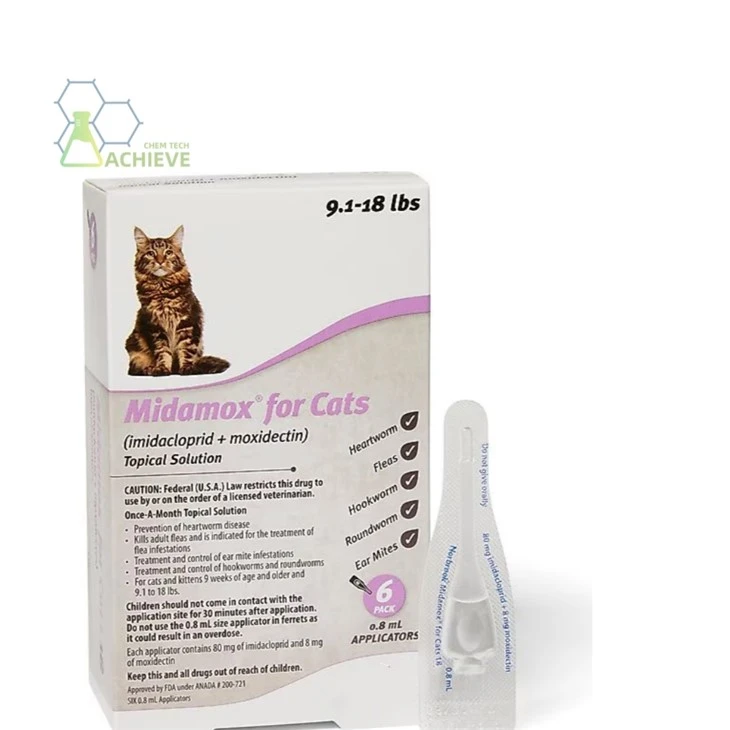


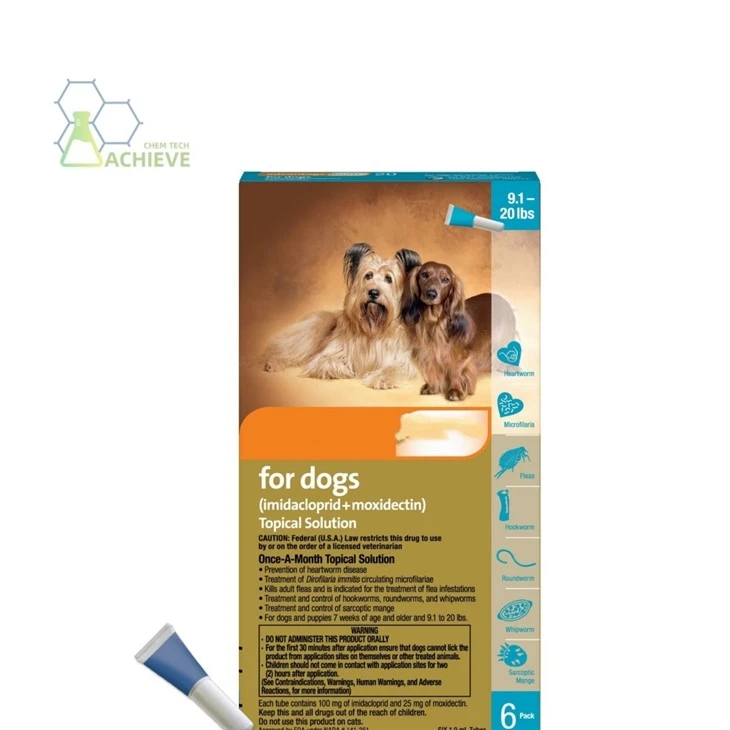
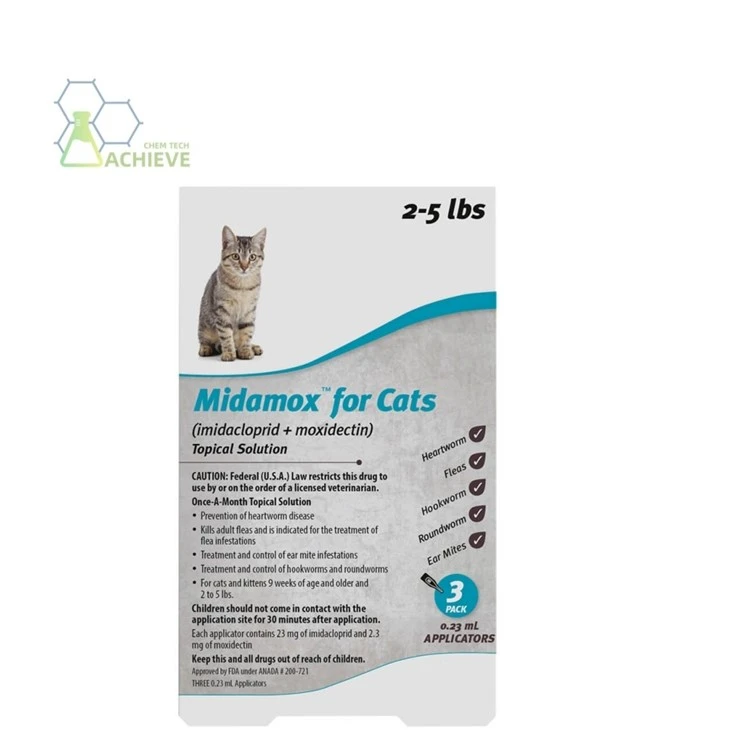
Shaanxi BLOOM Tech Co., Ltd. is one of the most experienced manufacturers and suppliers of imidacloprid moxidectin topical solution in China. Welcome to wholesale bulk high quality imidacloprid moxidectin topical solution for sale here from our factory. Good service and reasonable price are available.
Imidacloprid moxidectin topical solution is a compound formulation that achieves synchronous prevention and control of parasites both in vitro and in vivo through transdermal administration. Its core mechanism is based on the targeted destruction of the parasitic nervous system by two active ingredients. It is a compound veterinary drug that achieves synchronous prevention and control of parasites both inside and outside the body through transdermal administration. It is widely used for the prevention and treatment of fleas, ticks, heartworms, and gastrointestinal nematodes in dogs and cats. Its core advantage lies in the synergistic effect of dual active ingredients, combining the quick acting in vitro insecticidal properties of imidacloprid with the long-lasting in vivo insecticidal properties of moxifloxacin.
Our products


Indications and medication scenarios
Indications for cats:
External parasites: precaution and treatment of flea infections (cat flea) and ear mite infections (ear itch mite).
Parasites in the body: Treatment of gastrointestinal nematode infections (adult, immature, and L4 stage larvae of cat head ascarids and tubular hook mouth nematodes).
Adjuvant treatment: Allergic dermatitis caused by fleas.
Heartworm precaution: For cats living in areas where canine filariasis is prevalent, use it once a month, starting from one month before the mosquito season or throughout the year.
Indications for dogs:
External parasites: treatment for flea infections (cat flea), lice infections (dog lice), ear mite infections (ear itching mites), scabies mites (scabies mites), and demodex mites (dog demodex mites).
Internal parasites: Treatment of vascular ascarid and gastrointestinal nematode infections (adult, immature, and L4 stage larvae of canine ascarid, canine hookworm, and narrow headed hookworm, as well as adult and L4 stage larvae of lion ascarid and fox hair ascarid), precaution of heartworm disease (L3 and L4 stage larvae of canine filariasis), and treatment of circulating microfilament (canine filariasis).
Adjuvant treatment: Allergic dermatitis caused by fleas.


Medication method and dosage
Cat operating procedures:
Administration site: skin on the back of the neck (avoid licking).
Operation steps:
Tear open along the packaging dividing line and take out the medicine bottle.
Peel off the back cover, remove the lid and insert lmidacloprid moxidectin topical solution upside down into the tube opening.
Rotate the lid and unscrew the leak proof sealing plug, separating the hair until the skin is exposed.
Place the front end of the dropper tightly against the skin, squeeze out all the medicine, and press the dropper 2-3 times to ensure complete extrusion.
Cover the medcation area with hair.
Dosage standard: Use 0.1ml per 1kg body weight (containing 10mg imidacloprid and 1mg moxifloxacin) once a month.
Dog operating procedures:
Administration site: Apply 3-4 drops to the skin between the two scapulas on the back and buttocks.
Dosage standard: Use 0.1ml per 1kg body weight (containing 10mg imidacloprid and 2.5mg moxifloxacin) once a month.


Molecular mechanism of action: dual attack targeting parasitic nervous system
Imidacloprid belongs to the second-generation chloronicotinoid insecticides, and its target is the nicotinic acetylcholine receptor (nAChR) in the postsynaptic membrane of the insect central nervous system. This receptor is a key channel for neural signal transmission, responsible for receiving acetylcholine (ACh) released from the presynaptic membrane and triggering nerve impulse conduction.
Process of action:
Competitive binding: Imidacloprid has a highly similar molecular structure to acetylcholine and can competitively bind to the active site of nAChR.
Continuous opening of channels: After binding to receptors, imidacloprid causes non selective opening of ion channels, leading to a large influx of sodium ions (NaE) and causing sustained depolarization of neurons.


Signal transduction interruption: Continuous depolarization forfends neurons from producing action potentials, resulting in the postsynaptic membrane being unresponsive to subsequent acetylcholine stimulation, ultimately leading to parasite paralysis and death.
Specific advantages:
There are structural differences between insect nAChR and mammalian receptors, and imidacloprid has extremely low affinity for mammalian nAChR (supported by safety data), ensuring drug safety.
Effective against flea adults, larvae, and eggs, it can kill over 98% of environmental flea eggs within 48 hours.
Imidacloprid moxidectin topical solution is a macrocyclic lactone antiparasitic drug that achieves anthelmintic effects by enhancing the sensitivity of gamma aminobutyric acid (GABA) receptors. Its targets include inhibitory interneurons in nematodes and neuromuscular junctions in arthropods.
Process of action:
GABA receptor activation: After binding to GABA receptors, moxifloxacin enhances the opening frequency of chloride ion (Cl ⁻) channels, leading to intracellular Cl ⁻ concentration overload.
Neuromuscular paralysis: The influx of Cl ⁻ triggers neuronal hyperpolarization, inhibits the production of action potentials, and forfends the contraction of nematode motor neurons and arthropod muscle cells, ultimately leading to relaxation and paralysis of the insect body.


Glutamate channel blockade: Moxibustin can selectively bind to glutamate mediated chloride ion channels, further interfering with neural signal transmission.
Broad spectrum manifestation:
The killing rate of heartworm worms (L3/L4 stage larvae of canine filarial worms) and gastrointestinal nematodes (ascarids, hookworms) is over 99%.
The ED value of ectoparasites such as ear mites and scabies mites is as low as 0.03mg/kg, and a single administration can maintain a protection period of 84 days.
Synergistic effect: Compound deworming strategy of 1+1>2
Imidacloprid is rapidly distributed on the body surface through sebaceous gland secretion, forming a flea killing barrier within 48 hours; Moxibustin penetrates the skin and enters the bloodstream, continuously acting on nematodes and microfilaments in the body. Combining the two to achieve:
External precaution: Imidacloprid blocks the bite transmission of external parasites such as fleas and lice.
Internal treatment: Moxibustion eliminates infected parasites in the body and forfends fatal diseases such as filariasis.
Clinical data support:
In mixed infection cases, the cure rate of compound preparations is 30% higher than that of single drugs.
The incubation inhibition of flea pupae in the environment lasts for more than 6 weeks, significantly reducing the risk of reinfection.

Time synergy: quick onset+long-lasting protection

The quick acting property of imidacloprid (100% flea mortality within 24 hours) complements the long-lasting property of moxifloxacin (blood concentration maintained for 1 month):
Acute phase control: Imidacloprid quickly alleviates allergic dermatitis caused by flea bites in pets.
Chronic precaution: Moxifloxacin continuously inhibits nematode development and blocks the migration of heartworm larvae.
Pharmacokinetic validation:
After the first administration, imidacloprid remains on the body surface until the next administration cycle.
Moxifloxacin reaches its peak blood concentration 4-9 days after administration and is slowly metabolized and excreted within one month.
Pharmacokinetic characteristics: precise design for transdermal drug delivery
Imidacloprid: Surface Distribution and Metabolism
Distribution mechanism:
After transdermal penetration, it spreads along the sebaceous glands and preferentially deposits in the hair follicles and stratum corneum.
A protective film is formed through the gaps between the hairs, which has a contact killing effect on flea adults and larvae.
Metabolic pathway:
It mainly evaporates slowly through the stratum corneum of the skin, with a small amount metabolized through the bloodstream.
The half-life is about 72 hours, ensuring sustained effectiveness during the dosing interval.
Moxibustin: In vivo permeation and accumulation
Penetration mechanism:
The lipophilic structure promotes its penetration into the dermis layer and into the capillary network.
Accumulation in adipose tissue, with a concentration maintained for more than 21 days.
Metabolic pathway:
Metabolized by the liver cytochrome P450 enzyme system, inactive products are generated.
Fecal excretion is predominant, with urine excretion less than 5%.
Clinical significance:
Compound preparations can be administered once a month to maintain effective concentration and reduce the risk of missed use.
It is necessary to strictly avoid licking and forfend neurotoxicity in MDR1 gene mutant breeds such as Collies.
Security mechanism: multiple protections to reduce risks
Imidacloprid has an affinity for mammalian nAChR that is over 1000 times lower than that of insects, avoiding central nervous system toxicity.
The GABA target of moxifloxacin only exists in invertebrates and has a weak effect on mammalian neuromuscular junctions.
Cat dosage: 0.1ml per 1kg body weight (containing 10mg of imidacloprid and 1mg of moxifloxacin).
Dog dose: 0.1ml per 1kg body weight (containing 10mg of imidacloprid and 2.5mg of moxifloxacin).
Strictly limit the use of pets weighing less than 1kg to avoid excessive accumulation.
Licking treatment: Immediately rinse the mouth with clean water and take orally activated carbon to absorb unabsorbed drugs.
Neurological symptom management: Administer diazepam sedation when tremors and drooling occur to maintain respiratory and circulatory stability.
Environmental control: Isolate pets before medcation dries to forfend cross licking.
Mechanism optimization in clinical applications
Drug resistance management: rotating medication strategy
Long term use of a single ingredient may induce parasite resistance, while compound formulations delay the development of resistance through dual target attacks.
It is recommended to switch to other mechanism of action drugs (such as Celestin) every 2-3 years.
Environmental synergy: flea lifecycle disruption
Imidacloprid kills both adults and larvae, while lmidacloprid moxidectin topical solution inhibits egg hatching, forming a complete chain of control.
It is necessary to remove residual eggs in the environment in combnation with environmental treatment (such as imidacloprid spray).
Special scenario adaptation: Multi pet family management
Separate pets for 1-2 hours after administration to forfend them from licking each other.
Collies need to wear Elizabeth rings to avoid licking back medcation.
Drug Interactions and Alternative Solutions
Drug interactions
Taboo combnation:
Combined use with macrolides such as ivermectin and doramectin may increase the risk of neurotoxicity.
Combined use with carbamate insecticides may enhance acetylcholine receptor inhibition.
Cautious combnation:
Combined use with sedatives may worsen neurological symptoms.
When used in combnation with anticoagulants, the risk of bleeding needs to be monitored.
Hot Tags: Imidacloprid Moxidectin Topical Solution, suppliers, manufacturers, factory, wholesale, buy, price, bulk, for sale