




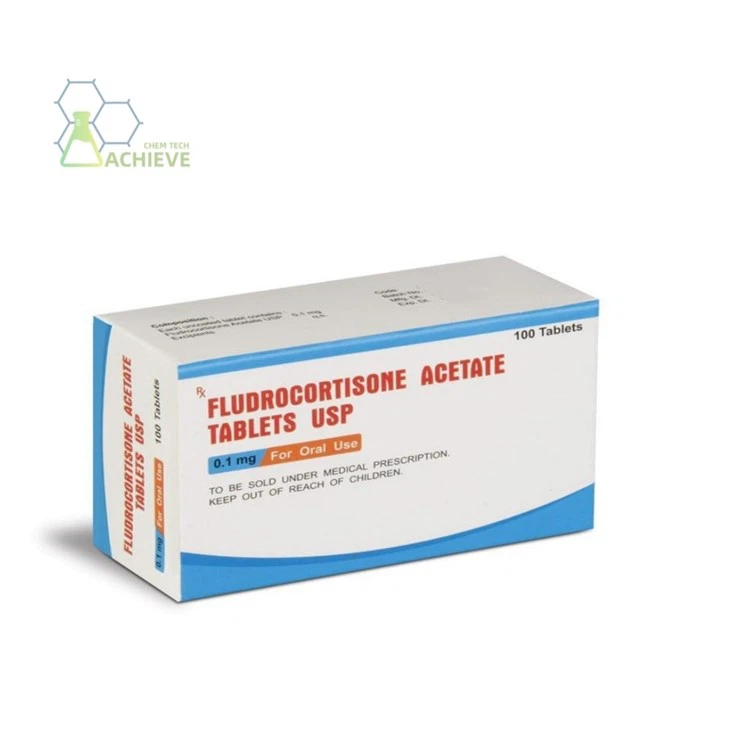


Shaanxi BLOOM Tech Co., Ltd. is one of the most experienced manufacturers and suppliers of fludrocortisone acetate tablet in China. Welcome to wholesale bulk high quality fludrocortisone acetate tablet for sale here from our factory. Good service and reasonable price are available.
Fludrocortisone acetate tablet are a fluorinated synthetic glucocorticoid belonging to the mineralocorticoid class. The active ingredient is Fluhydrocortisone acetate, with a standard dose of 0.1 milligrams (100 micrograms) per tablet. This drug exerts therapeutic effects by regulating electrolyte balance and fluid distribution in the body, mainly used to replace or supplement aldosterone hormones that are lacking in the body.
Formulation and appearance:
Acetate tablets are white to off white circular thin film coated tablets. There are various packaging specifications, commonly 30, 50, or 100 pieces per box. Some products require refrigeration storage (2-8 ℃), and can be stored at room temperature for a short period of time (≤ 25 ℃, not exceeding 30 days) when unopened.
Our products


Fludrocortisone Acetate COA
|
|


Fludrocortisone acetate tablet is an artificially synthesized mineralocorticoid drug. Since its successful development in the 1940s, it has become a core drug for treating various endocrine and metabolic diseases and skin inflammations due to its unique balance between mineralocorticoid activity and glucocorticoid activity.
(1) Primary adrenal insufficiency (Addison's disease)
Addison's disease is a disease caused by adrenal cortex destruction leading to insufficient secretion of aldosterone and cortisol. Patients present with hyponatremia (blood sodium<135mmol/L), hyperkalemia (blood potassium>5.5mmol/L), hypotension, and fatigue. Fluhydrocortisone acetate achieves alternative therapy through the following mechanisms:
Water sodium balance regulation: A daily dose of 0.1mg can increase blood volume by 5% -10%, increase systolic blood pressure by 10-15 mmHg, promote sodium reabsorption, and reduce urinary sodium excretion by 50% -70%.
Electrolyte correction: Within one week of treatment, blood sodium can be restored to 135-145mmol/L, blood potassium can be reduced to 4.0-5.0mmol/L, and acid-base balance can be restored to normal range.


Combination therapy strategy: It needs to be used in combination with hydrocortisone (20-30mg/day), with the former supplementing mineralocorticoid activity and the latter supplementing glucocorticoid activity, forming a complete alternative treatment plan.
(2) Salt loss type adrenal reproductive syndrome (21 hydroxylase deficiency)
This disease is the most common type of congenital adrenal hyperplasia, characterized by insufficient aldosterone synthesis due to 21 hydroxylase deficiency, and severe salt loss crisis (hyponatremia, hyperkalemia, dehydration) in the neonatal period. The key points of treatment for dexamethasone acetate include:
Individualized dosage: 0.05-0.1mg/kg per day in neonatal period, divided into 2 oral doses, supplemented with sodium chloride solution to address sodium deficiency.
Efficacy monitoring: Within one week of treatment, blood sodium levels returned to 135-145mmol/L, blood potassium levels decreased to 4.0-5.0mmol/L, and blood pressure stabilized within the normal range.
Long term management: The dosage should be adjusted according to the growth curve during childhood to avoid excessive intake leading to hypertension or hypokalemia.
(3) Orthostatic hypotension (orthostatic hypotension)
This disease is caused by dysfunction of the autonomic nervous system, leading to a sharp drop in blood pressure while standing (systolic blood pressure drop>20mmHg). Fluhydrocortisone acetate improves symptoms through the following mechanisms:
Blood volume expansion: A daily dose of 0.1-0.2mg/day can increase blood volume and enhance peripheral vascular resistance.
Vascular tone maintenance: Enhance the sensitivity of blood vessels to catecholamines and reduce blood pressure fluctuations while standing.
Clinical evidence: Studies have shown that a daily dose of 0.2mg/day can reduce upright systolic blood pressure by less than 10mmHg in 80% of patients, and significantly improve symptoms such as dizziness and blackness.

Autoimmune skin diseases: dual effects of anti-inflammatory and immune regulation

Although dexamethasone acetate mainly exhibits mineralocorticoid activity, it retains some glucocorticoid properties and can effectively treat various autoimmune skin diseases by inhibiting immune cell activation and reducing the production of pro-inflammatory factors
(1) Eczema
Chronic eczema: Fluhydrochloroacetic acid soft cream can reduce skin thickening and lichenification. Apply 2-3 times a day locally, and the relief rate of redness and itching symptoms within 2 weeks can reach 70% -80%.
Subacute eczema: By inhibiting the production of prostaglandin E2 (PGE2) and leukotriene C4 (LTC4), reducing exudation and edema, the treatment efficacy reaches 65% -75%.
(2) Neurodermatitis
Antipruritic mechanism: Stabilize the mast cell membrane, prevent histamine release, block nerve conduction, and reduce itching sensation.
Anti inflammatory effect: Inhibits T lymphocyte activation, reduces the expression of pro-inflammatory cytokines such as IL-2 and IFN - γ, and alleviates skin inflammation and damage.
Clinical efficacy: Apply locally twice a day, reduce itching score by more than 50% within 4 weeks, and improve skin thickening by 40% -50%.
(3) Atopic dermatitis
Severe itching relief: By inhibiting phospholipase A2 (PLA2) activity and reducing the production of arachidonic acid metabolites, itching symptoms can be quickly relieved.


Skin barrier repair: inhibits fibroblast proliferation, improves microcirculation, and promotes wound healing.
Research data: Local application twice a day in pediatric patients resulted in a decrease in itch VAS score from 7.2 ± 1.5 to 3.1 ± 1.2 within 2 weeks, and a 50% improvement in skin dryness score.
(4) Contact dermatitis and allergic dermatitis
Allergy mediator inhibition: prevents degranulation of mast cells, reduces histamine and serotonin release, and alleviates redness, swelling, and blistering symptoms.
Anti inflammatory effect: Downregulate the expression of inflammatory factors such as TNF - α and IL-6, and alleviate skin inflammation.
Clinical application: Apply locally three times a day during the acute phase, reducing the erythema area by 40% -60% within three days and achieving an 80% cessation rate of exudation.
(1) Septic shock
The adjuvant therapeutic effect of fludrocortisone acetate tablet in septic shock is still controversial, but some studies suggest that it may improve prognosis through the following mechanisms:
Vascular tone maintenance: Enhance the sensitivity of blood vessels to catecholamines and increase mean arterial pressure (MAP).
Inflammation regulation: Inhibiting the NF - κ B pathway, reducing the release of inflammatory factors such as IL-1 β and IL-6, and alleviating systemic inflammatory response syndrome (SIRS).
Clinical evidence: A randomized controlled trial (RCT) study involving 120 patients with septic shock showed that the 28 day mortality rate was reduced by 15% (p<0.05) compared to the control group in the treatment group with combination therapy of 0.1 mg/kg/day of fluorohydrocortisone acetate.


(2) Cerebral Salt Wasting Syndrome (CSWS)
CSWS is a syndrome characterized by hyponatremia (blood sodium<130mmol/L) and increased urinary sodium excretion after traumatic brain injury. Fluhydrocortisone acetate is treated through the following mechanisms:
Sodium reabsorption promotion: increases the reabsorption of sodium by renal tubules and reduces urinary sodium excretion.
Blood volume recovery: Within 3 days of treatment, blood sodium can be restored to 135-145mmol/L, and urinary sodium excretion can be reduced by 50% -70%.
Dose adjustment: The initial dose is 0.05mg/day, adjusted every 3 days based on blood sodium levels, with a maximum dose not exceeding 0.2mg/day.

Fludrocortisone acetate is an artificially synthesized mineralocorticoid drug. Since its successful development in the 1940s, it has become a core drug for the treatment of rare diseases such as primary adrenal insufficiency (Addison's disease) and salt loss adrenal reproductive syndrome.
The active ingredient Fludrocortisone significantly enhances its affinity for mineralocorticoid receptors (MR) by introducing 9 α - fluorine atoms, while reducing its binding ability to glucocorticoid receptors (GR). This structural characteristic makes it a potent mineralocorticoid with minimal impact on glucose and protein metabolism.
1. Receptor binding and nuclear translocation
After entering the target cell, Fludrocortisone acetate tablet binds to mineralocorticoid receptors in the cytoplasm, forming a complex and transferring to the nucleus. This complex directly regulates gene transcription by binding to specific DNA sequences, such as hormone response elements.
2. Synthesis regulation of key proteins
Sodium channel (ENaC):
Upregulation of ENaC expression in renal tubular epithelial cells enhances the reabsorption ability of sodium ions. For example, in patients with primary adrenal insufficiency, 0.1mg of dexamethasone per day can reduce urinary sodium excretion by 50% -70%.
Sodium potassium ATPase:
Promotes the synthesis of sodium potassium ATPase in the renal tubular basement membrane, accelerates the transport of sodium ions into the cell and the secretion of potassium ions into the lumen.
Carbonic anhydrase:
Inhibits carbonic anhydrase activity in proximal renal tubules, reduces hydrogen ion reabsorption, and indirectly promotes sodium retention.
3. Inactive properties of metabolites
Fluhydrocortisone is oxidized by cytochrome P450 enzyme (CYP3A4) in the liver to inactive 3-keto-4-pregnen-17,21-diol, avoiding long-term accumulation toxicity. Its half-life is 3.5-4.5 hours, but once daily administration can maintain stable blood drug concentration, as the drug binds to plasma proteins (mainly transferrin) at a rate of over 90%, forming a sustained release reservoir effect.
1. Precise regulation of renal water sodium balance
Hydrocortisone acetate can achieve water and sodium retention by increasing glomerular filtration rate (GFR) and reabsorption of sodium and chlorine by renal tubules. Clinical data shows that:
Blood volume expansion:
A daily dose of 0.1mg can increase blood volume by 5% -10% and systolic blood pressure by 10-15 mmHg.
Electrolyte correction:
In Addison's disease patients, blood sodium levels can recover from<130mmol/L to the normal range within one week of treatment, and blood potassium levels can decrease from>5.5mmol/L to 4.0-5.0mmol/L.
Acid base balance regulation:
By promoting hydrogen ion excretion, correcting metabolic acidosis, and increasing blood pH from<7.30 to 7.35-7.45.
2. Maintenance of cardiovascular system tension
Increased vascular resistance: By dilating blood volume and enhancing the sensitivity of blood vessels to catecholamines, peripheral vascular resistance is increased. For example, in patients with orthostatic hypotension, a daily dose of 0.1-0.2mg/day can reduce the decrease in systolic blood pressure during standing (>20mmHg) and improve symptoms such as dizziness and blackness.
Cardiac function support: increases myocardial contractility and cardiac output, improves tissue perfusion in patients with hypovolemic shock.
Although fluorocortisone acetate primarily exhibits mineralocorticoid activity, it still retains some glucocorticoid properties and can exert immunomodulatory effects through the following pathways:
1. Inhibit the release of inflammatory mediators
Arachidonic acid metabolism: Inhibits phospholipase A2 (PLA2) activity and reduces the production of inflammatory mediators such as prostaglandin E2 (PGE2) and leukotriene C4 (LTC4). For example, in a model of contact dermatitis, the local application of fluoxetine cream can reduce the redness and swelling area of the skin by 40% -60%.
Cytokine regulation: Downregulate the expression of pro-inflammatory cytokines such as IL-2 and IFN - γ, and alleviate tissue inflammatory damage.
2. Stabilize the mast cell membrane
Prevent the release of allergens such as histamine and serotonin, and alleviate allergic reactions such as urticaria and allergic rhinitis. Clinical studies have shown that a daily oral dose of 0.1mg/day can reduce fludrocortisone acetate tablet scores in patients with allergic dermatitis by more than 50%.
3. Inhibit T lymphocyte activation
By downregulating the expression of co stimulatory molecules on the surface of T cells, such as CD28 and CTLA-4, T cell proliferation and cytokine secretion can be inhibited, thereby reducing pathological damage in autoimmune diseases such as systemic lupus erythematosus.
Hot Tags: fludrocortisone acetate tablet, suppliers, manufacturers, factory, wholesale, buy, price, bulk, for sale