



Shaanxi BLOOM Tech Co., Ltd. is one of the most experienced manufacturers and suppliers of lactoferrin tablet in China. Welcome to wholesale bulk high quality lactoferrin tablet for sale here from our factory. Good service and reasonable price are available.
Lactoferrin Tablet is a nutritional supplement or pharmaceutical preparation made with lactoferrin as the main active ingredient. Lactoferrin is a multifunctional glycoprotein naturally present in the milk of mammals, belonging to the transferrin family. It possesses various biological activities such as antibacterial, antiviral, immunomodulatory, and promoting iron absorption. This product may also contain other auxiliary ingredients, such as lactose, starch, etc., to enhance its stability and bioavailability.
As people's attention to health and nutrition continues to rise, the demand for this tablet, as a functional nutritional supplement or drug preparation, is gradually increasing in the market. At present, there are already products of multiple brands on the market, and the competition is becoming increasingly fierce. In the future, with the continuous advancement of science and technology and the diversified development of consumer demands, this product will pay more attention to the improvement of quality, safety and effectiveness. Meanwhile, customized products tailored to different groups of people and their needs will also become an important trend in market development.
 |
 |


Lactoferrin powder COA
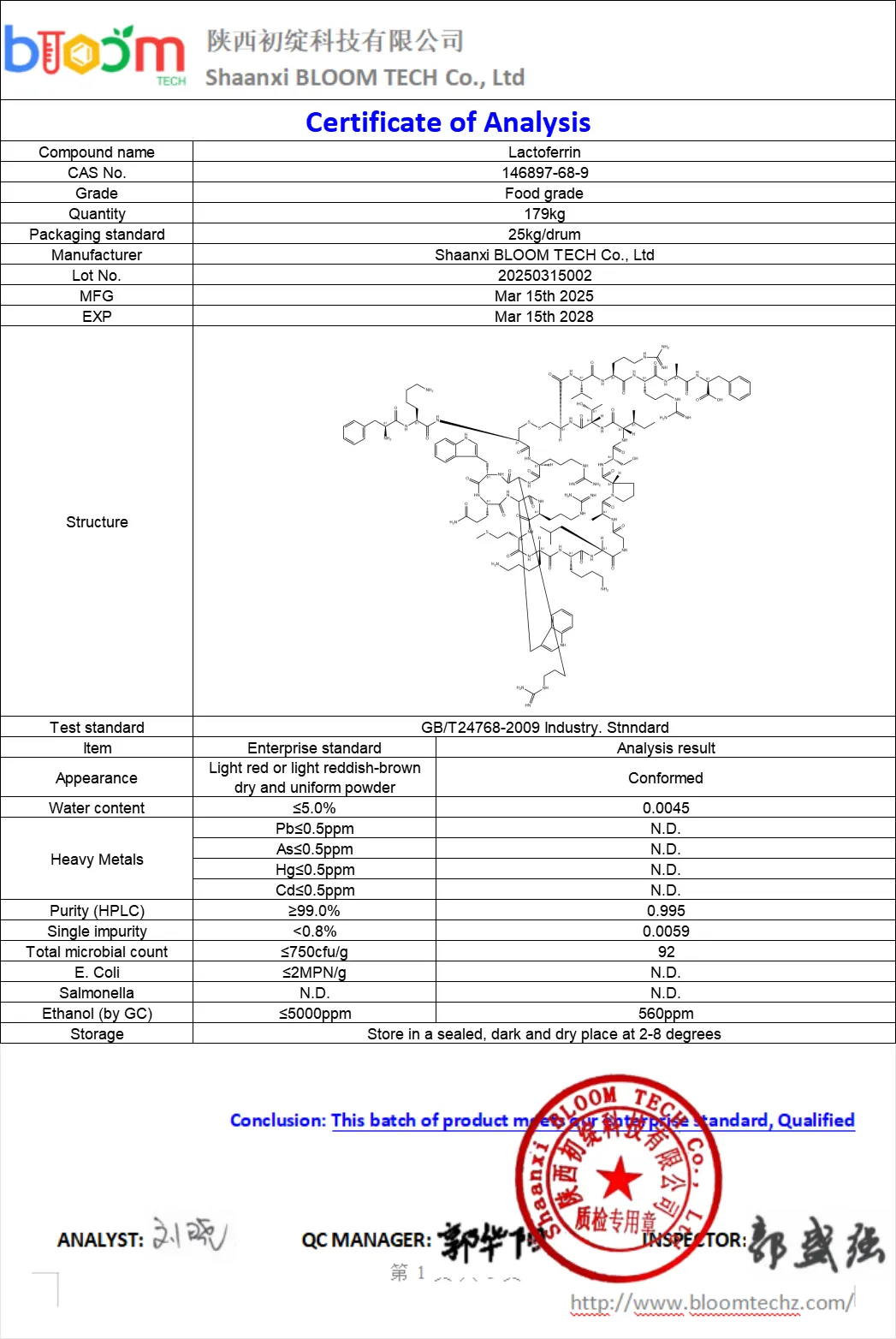

Lactoferrin Tablet is a kind of preparation containing Lactoferrin (LF) as the main active ingredient. Lactoferrin is an iron-binding glycoprotein with various biological activities, such as antibacterial, antiviral, immunomodulatory and promoting iron absorption. When analyzing this product, multiple methods need to be adopted to ensure its content, purity and activity. The analysis method of it will be detailed below.
 |
 |
 |
Content Determination
High Performance liquid Chromatography (HPLC)
HPLC is a common method for determining the content of lactoferrin. The principle is to separate lactoferrin from other impurities by taking advantage of the different distribution coefficients of different substances between the stationary phase and the mobile phase. HPLC features high sensitivity, high accuracy and good repeatability, and is widely used in the quantitative analysis of lactoferrin.
Operation steps:
Sample pretreatment: Dissolve the lactoferrin tablets in an appropriate buffer solution, centrifuge to remove insoluble substances, and take the supernatant for determination.
Chromatographic conditions: A reversed-phase chromatographic column is used, and the mobile phase is usually a mixture containing organic solvents and buffers, with gradient elution.
Detection: A UV detector is used, with a detection wavelength typically of 280 nm. The content of lactoferrin is calculated based on the standard curve.
Enzyme linked immunosorbent assay (ELISA)
ELISA is an immunological method based on the specific reaction between antigens and antibodies, featuring high sensitivity and specificity, and is suitable for the quantitative analysis of lactoferrin.
Operation steps:
Coating: The specific anti-lactoferrin antibody is coated on the microplate.
Blocking: Add blocking solution to prevent non-specific binding.
Sample incubation: Add the sample to be tested and react with the coated antibody.
Incubation of enzyme-labeled secondary antibody: Add the enzyme-labeled secondary antibody and bind it to the lactoferrin-antibody complex.
Color reaction: Add the substrate solution to produce a color reaction, and measure the absorbance at a specific wavelength.
Calculation: Based on the standard curve, calculate the content of lactoferrin in the sample.
Purity Analysis
High performance liquid chromatography mass spectrometry (HPLC-MS)
HPLC-MS combines the separation ability of chromatography and the qualitative ability of mass spectrometry, and is capable of accurately determining the purity and molecular weight of lactoferrin.
Operation steps:
Sample pretreatment: The same as the HPLC method.
Chromatographic separation: Use an appropriate chromatographic column and mobile phase to separate lactoferrin.
Mass spectrometry detection: Mass spectrometry analysis is conducted on the isolated lactoferrin to determine its molecular weight and purity.
Capillary electrophoresis (CE)
CE is a separation technology based on the difference in ion migration speeds under the action of an electric field, and it is suitable for the analysis of biological macromolecules such as proteins.
Operation steps:
Sample preparation: Dissolve the tablet and centrifuge to remove impurities.
Electrophoresis conditions: Select an appropriate buffer and voltage for electrophoresis separation.
Detection: Use a UV detector to record the electrophoresis pattern and analyze the purity of lactoferrin.
Activity Analysis
Determination of iron binding capacity
The iron-binding ability of lactoferrin is one of its important biological activities and can be determined by the iron saturation method.
Operation steps:
Iron saturation: Incubate lactoferrin with an excess of iron ions to achieve an iron saturation state.
Free iron removal: Unbound free iron is removed by centrifugation or ultrafiltration.
Color reaction: Add the color developer, determine the amount of bound iron, and calculate the iron binding capacity of lactoferrin.
Determination of antibacterial activity
Lactoferrin has antibacterial activity and can be determined by the inhibition zone method or the minimum inhibitory concentration (MIC).
Operation steps:
Inhibition zone method: Add the sample containing lactoferrin to the AGAR plate containing the test strain and observe the formation of the inhibition zone.
MIC determination: Lactoferrin is diluted in a series and added to the medium containing the test strain to measure the minimum concentration that inhibits bacterial growth.
Structural Analysis
Circular dichroism (CD)
CD can be used to analyze the secondary structure of lactoferrin and understand its conformational changes in tablets.
Operation steps:
Sample preparation: Dissolve the tablet and dilute it to an appropriate concentration.
Determination: Use a circular dichroism chromatograph to scan within the wavelength range of 190-260 nm and analyze the composition of the secondary structure.
Fourier transform infrared spectroscopy (FTIR)
FTIR can be used to analyze the chemical bonds and functional groups of lactoferrin and understand its structural characteristics.
Operation steps:
Sample preparation: Mix lactoferrin with KBr and press into tablets.
Determination: Use an infrared spectrometer to scan the sample and analyze the infrared spectrum.
Allergy risk
Lactoferrin tablets are a type of nutritional supplement mainly composed of lactoferrin, which have the functions of enhancing immunity and promoting iron absorption. However, lactoferrin, as a protein, may trigger allergic reactions and poses a certain risk of allergy. The following will conduct a detailed analysis from aspects such as allergy risk factors, symptom manifestations, and preventive measures.
Allergy Risk Factors
People with allergic constitutions have a higher sensitivity to lactoferrin, and a family history of allergies significantly increases the individual's risk of allergies. When the immune system misjudges lactoferrin as a foreign antigen, it may trigger an excessive immune response, leading to an allergic reaction. In addition, people such as infants and young children and the elderly, whose immune systems have not yet fully developed or whose functions have declined, have a relatively higher risk of allergies.
During the production process of this product, if the purity is not properly controlled or there are other protein impurities, it may induce cross-allergic reactions. Antigenic substances in impurities can stimulate the immune system and increase the risk of allergies. Therefore, it is of vital importance to choose products produced by regular manufacturers and of reliable quality.
Excessive intake of lactoferrin may increase the probability of allergic reactions, especially during the first exposure. In addition, the difference in allergic risk between swallowing tablets directly and taking them after dissolving still needs further research. However, it is recommended to follow the dosage and administration method indicated on the product instructions or as advised by a doctor.
Allergic Symptoms
After exposure to lactoferrin, symptoms such as skin itching, erythema, wheals and rashes may occur. In severe cases, it may develop into urticaria or eczema. These symptoms usually appear within minutes to hours after contact and may be confined to the contact site or spread throughout the body.
Coughing, wheezing and breathing difficulties may occur. In severe cases, it may lead to respiratory distress. Such symptoms indicate that the allergic reaction has affected the respiratory tract mucosa, which may cause bronchospasm or laryngeal edema. Immediate medical intervention is required.
Gastrointestinal discomforts such as nausea, vomiting, abdominal pain and diarrhea may occur. Symptoms of the digestive system may occur alone or concurrently with those of other systems. Excessive intake of lactoferrin may also lead to indigestion, such as bloating and constipation.
Redness, swelling, tearing, itching or a burning sensation in the eyes may occur. These symptoms reflect an allergic reaction of the eyes to lactoferrin, which may cause blurred vision or discomfort.
Fever, fatigue, dizziness and even anaphylactic shock may occur. Systemic allergic reactions are acute and severe cases that may be life-threatening and require immediate emergency treatment such as epinephrine injections.
Allergy Risk Prevention Measures


Allergy history assessment
Before taking it, one should have a thorough understanding of personal and family allergy history, especially allergies to foods such as milk protein. If there is a history of relevant allergies, lactoferrin tablets should be used with caution. Allergy tests should be conducted if necessary.
Allergy test
The presence of lactoferrin allergy can be confirmed through skin prick test or serum specific IgE detection. Food provocation tests can be conducted when necessary, but they should be carried out under medical supervision to avoid severe allergic reactions.
Follow the doctor's advice
When using it for the first time, start with a low dose and closely observe the body's response. If any suspicious symptoms occur, stop using it immediately and seek medical attention. For those who have been diagnosed with allergies, it is strictly necessary to avoid contact with lactoferrin and its products, including milk powder and nutritional supplements containing lactoferrin.
Alternative solution
Those who are allergic to lactoferrin can choose plant protein nutritional supplements, such as soy protein and pea protein. It is necessary to pay attention to the differences in nutritional components between substitutes and lactoferrin. If necessary, consult a nutritionist to ensure a balanced diet.
Product selection and preservation
Choose products produced by regular manufacturers and of reliable quality to avoid purchasing products of unknown origin.When storing, it is necessary to keep it away from light, sealed and moisture-proof. Avoid high temperature or humid environments that may cause the product to deteriorate and increase the risk of allergies.
Emergency handling preparation
For high-risk groups, it is recommended to carry anti-allergy medications (such as loratadine, cetirizine, etc.) or epinephrine auto-injectors with you at all times in case of emergency. At the same time, be aware of the locations of nearby medical institutions so that you can seek medical treatment promptly in case of severe allergic reactions.
JAK-STAT signaling pathway
The JAK-STAT signaling pathway is an important cytokine signaling pathway that can transmit cytokine signals from the cell surface to the nucleus, regulating physiological processes such as cell proliferation, differentiation, apoptosis, and immune response. When cytokines bind to receptors on the cell surface, the receptors undergo dimerization, activating the JAK kinase that binds to them. JAK kinase can phosphorylate tyrosine residues of receptors, forming STAT binding sites. STAT (signal transducer and activator of transcription) proteins can bind to phosphorylated tyrosine residues of receptors, which are then phosphorylated by JAK kinases. Phosphorylated STAT proteins form dimers, enter the nucleus, and bind to the STAT binding site in the promoter region of target genes, initiating the expression of target genes and participating in the regulation of immune responses.
JAK-STAT signaling pathway
Oral lactoferrin can affect the differentiation and function of immune cells by regulating the activity of the JAK-STAT signaling pathway. For example, lactoferrin can activate the JAK1-STAT3 signaling pathway and promote the differentiation of Th17 cells; Meanwhile, lactoferrin can also activate the JAK2-STAT5 signaling pathway, promoting the differentiation of Treg cells. Research has shown that oral administration of lactoferrin can significantly increase the levels of phosphorylated JAK2 and STAT5 in Treg cells, promote their proliferation and differentiation, and enhance their immunosuppressive function; At the same time, lactoferrin can also reduce the levels of phosphorylated JAK1 and STAT3 in Th17 cells, inhibit Th17 cell differentiation, and reduce IL-17 production. In addition, oral lactoferrin can also regulate the JAK-STAT signaling pathway, affect B cell proliferation and antibody secretion, and promote humoral immune response. For example, lactoferrin can activate the JAK2-STAT5 signaling pathway, promote the proliferation and differentiation of B cells into plasma cells, and enhance antibody secretion.
TGF - β/Smad signaling pathway
The TGF - β/Smad signaling pathway is an important anti-inflammatory and immune regulatory signaling pathway that can regulate physiological processes such as cell proliferation, differentiation, apoptosis, and immune tolerance. TGF - β is a multifunctional cytokine that can bind to the TGF - β receptors (T β R Ⅰ and T β R Ⅱ) on the cell surface, forming a complex and activating the kinase activity of T β R Ⅰ. T β R Ⅰ can phosphorylate Smad2 and Smad3 proteins, and phosphorylated Smad2 and Smad3 will form a complex with Smad4 protein, enter the nucleus, bind to the Smad binding site in the promoter region of the target gene, initiate the expression of the target gene, and participate in the regulation of immune tolerance and inflammatory response.
TGF - β/Smad signaling pathway
Oral administration of lactoferrin can activate the TGF - β/Smad signaling pathway, promote the differentiation and immune tolerance of Treg cells. Research has shown that oral administration of lactoferrin can significantly increase the levels of TGF - β in the gut and peripheral blood, activate the phosphorylation of Smad2 and Smad3, promote the formation of Smad2/3-Smad4 complexes and nuclear translocation, thereby initiating the expression of Treg cell specific transcription factors (such as Foxp3) and promoting the differentiation and proliferation of Treg cells. Meanwhile, oral lactoferrin can also activate the TGF - β/Smad signaling pathway, inhibit the differentiation of Th1 and Th17 cells, reduce the production of pro-inflammatory cytokines, and alleviate inflammatory reactions. For example, in a mouse model of autoimmune encephalomyelitis (EAE), oral administration of lactoferrin can activate the TGF - β/Smad signaling pathway, increase the number of Treg cells, reduce the proportion of Th17 cells, lower levels of pro-inflammatory cytokines, and alleviate symptoms and pathological damage of EAE.
Hot Tags: lactoferrin tablet, suppliers, manufacturers, factory, wholesale, buy, price, bulk, for sale, pontocaine, 9 bromo 10 phenyl d5 anthracene, Hinokitiol powder, 3 7 dibromodibenzo b d thiophene, 2 chloro 4 phenylbenzo h quinazoline, benzoyl peroxide powder