



Shaanxi BLOOM Tech Co., Ltd. is one of the most experienced manufacturers and suppliers of dl-sulforaphane cas 4478-93-7 in China. Welcome to wholesale bulk high quality dl-sulforaphane cas 4478-93-7 for sale here from our factory. Good service and reasonable price are available.
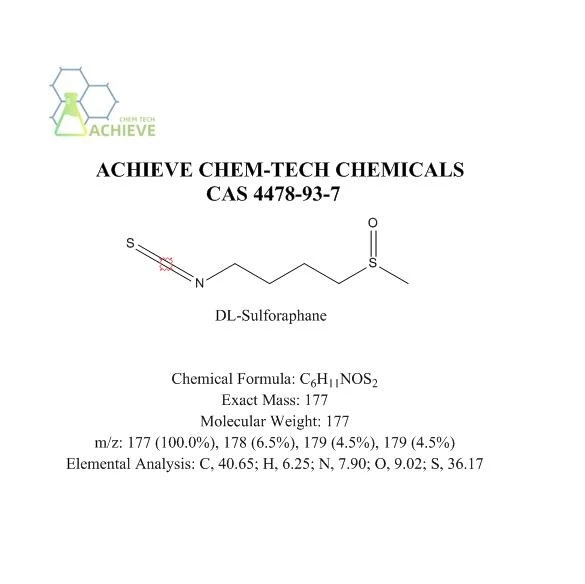
DL-Sulforaphane , CAS 4478-93-7, the molecular formula C6H11NoS2 is a yellow or colorless liquid at room temperature, insoluble in water, easily soluble in organic solvents such as methanol, dichloromethane, acetonitrile, etc., and prone to decomposition under high-temperature alkaline conditions. It is an isothiocyanate ester obtained by hydrolysis of glucosinolates in plants through myrosinase. It is rich in cruciferous plants such as broccoli, kale, and radish, and is a common antioxidant. It is the most anti-cancer plant active substance in vegetables.

|
Chemical Formula |
C6H11NOS2 |
|
Exact Mass |
177 |
|
Molecular Weight |
177 |
|
m/z |
177 (100.0%), 178 (6.5%), 179 (4.5%), 179 (4.5%) |
|
Elemental Analysis |
C, 40.65; H, 6.25; N, 7.90; O, 9.02; S, 36.17 |
|
|
|


DL-Sulforaphane (SFN), also known as sulforaphane, is an isothiocyanate compound found in cruciferous plants. Since its discovery in the early 20th century, its unique chemical structure and biological activity have gradually been revealed, becoming a research hotspot in the fields of natural product chemistry, nutrition, and medicine.It is mainly found in cruciferous plants, with a high content in broccoli, cabbage and other vegetables, and the highest content in broccoli buds. Radish sulforaphane is converted from its precursor glucosinolates under the action of myrosinase. The N=C=S group is prone to polarization and gains a positive charge, making it easy to react with nucleophiles such as amino groups, hydroxyl groups, and carboxylic acids. It is a key structure for its various biological activities.
Anti cancer effect: multi-target inhibition of tumor occurrence and development

The research in the field of anti-cancer is the most in-depth, and its mechanism of action involves multiple aspects such as cell cycle regulation, apoptosis induction, angiogenesis inhibition, and enhanced immune surveillance.
1. Activate the Nrf2 pathway to enhance cellular detoxification ability
It is a potent activator of nuclear factor erythroid 2-related factor 2 (Nrf2). Nrf2, as a transcription factor, can regulate the expression of over 500 cell protective genes, including antioxidant enzymes such as glutathione S-transferase (GST) and superoxide dismutase (SOD), as well as detoxifying enzymes such as glutathione synthase. By activating Nrf2, sulforaphane can significantly enhance cells' resistance to oxidative stress and chemical carcinogens. For example, in liver cancer cell models, pretreatment can reduce DNA damage induced by aflatoxin B1 and decrease tumor incidence.
2. Inducing cancer cell apoptosis and inhibiting proliferation
By regulating the expression of cell cycle related proteins such as Cyclin D1 and CDK4, cancer cells are arrested in the G1 phase, while activating caspase family proteins to induce mitochondrial pathway apoptosis. In breast cancer cells, it can down regulate the expression of anti apoptotic protein Bcl-2, up regulate the level of pro apoptotic protein Bax, and finally trigger programmed cell death. In addition, it can inhibit the phosphorylation of epidermal growth factor receptor (EGFR), block downstream signaling pathways, and thus inhibit cancer cell proliferation.
3. Inhibit angiogenesis and metastasis
Tumor growth relies on neovascularization to provide nutrition, which can inhibit angiogenesis by downregulating the expression of vascular endothelial growth factor (VEGF).


In a mouse model of colon cancer, oral administration of sulforaphane can reduce tumor volume by up to 60% and significantly reduce the incidence of lung metastasis. The mechanism involves inhibiting the activity of matrix metalloproteinases (MMPs), reducing extracellular matrix degradation, and thus hindering cancer cell invasion and metastasis.
4. Enhance immune surveillance function
It can regulate the function of immune cells and enhance the body's immune response to tumors. For example, it can promote the maturation of dendritic cells and enhance their antigen presentation ability; Simultaneously activate natural killer (NK) cells and cytotoxic T lymphocytes (CTL) to enhance the killing effect on cancer cells. In lung cancer patients, the combination of sulforaphane supplements and chemotherapy can significantly prolong progression free survival.
Antioxidant and anti-inflammatory: protecting cells from damage
Oxidative stress and chronic inflammation are the common pathological basis of various diseases, and they exert protective effects through a dual mechanism.
1. Directly eliminate free radicals
The N=C=S group in sulforaphane molecules has strong polarity and can react with reactive oxygen species (ROS) such as superoxide anions (O ₂⁻) and hydroxyl radicals (· OH) to form stable adducts, thereby directly neutralizing free radicals. In vitro experiments have shown that sulforaphane has a scavenging rate of over 90% against DPPH free radicals, and its antioxidant capacity is 10 times that of vitamin C.
2. Activate the antioxidant enzyme system
By activating the Nrf2 pathway, the expression of antioxidant enzymes such as glutathione peroxidase (GPx) and heme oxygenase-1 (HO-1) can be induced, enhancing the endogenous antioxidant capacity of cells.


In a mouse model of Alzheimer's disease, pretreatment with sulforaphane can reduce the content of lipid peroxidation product malondialdehyde (MDA) in brain tissue, while increasing SOD activity and significantly improving cognitive function.
3. Inhibit inflammatory signaling pathways
DL-Sulforaphane can downregulate the activity of nuclear factor kappa B (NF - κ B) and reduce the release of pro-inflammatory factors such as tumor necrosis factor alpha (TNF - α) and interleukin-6 (IL-6). In a rat model of rheumatoid arthritis, local injection of sulforaphane can alleviate joint swelling and reduce serum C-reactive protein (CRP) levels, with an effect comparable to methotrexate.
Metabolic regulation: improving obesity and diabetes
With the global prevalence of metabolic diseases, their role in weight management, blood glucose control, and lipid metabolism regulation has attracted much attention.
1. Inhibit fat production and promote energy expenditure
It can inhibit adipocyte differentiation and lipid synthesis by activating the AMP activated protein kinase (AMPK) pathway. In high-fat diet induced obese mice, sulforaphane supplements can reduce epididymal fat pad weight by up to 30%, while increasing brown adipose tissue (BAT) thermogenesis and energy expenditure.
2. Improve insulin sensitivity
It can upregulate the expression of insulin receptor base-1 (IRS-1) and enhance insulin signaling.


In type 2 diabetes rats, oral sulforaphane can reduce fasting blood glucose level by 25% and improve glucose tolerance. The mechanism also involves inhibiting the activity of the key hepatic gluconeogenesis enzyme phosphoenolpyruvate carboxykinase (PEPCK).
3. Regulate the balance of gut microbiota
It can promote the growth of beneficial bacteria such as Bifidobacterium and Lactobacillus, and inhibit the proliferation of pathogenic bacteria such as Escherichia coli and Clostridium. In obese individuals, supplementing with sulforaphane for 12 consecutive weeks can increase the content of short chain fatty acids (SCFAs) in feces, reduce intestinal permeability, and improve metabolic endotoxemia.
Neuroprotection: Delaying the progression of neurodegenerative diseases
It can penetrate the blood-brain barrier and exert antioxidant, anti-inflammatory, and anti apoptotic effects in brain tissue, providing new strategies for the treatment of neurodegenerative diseases such as Alzheimer's disease and Parkinson's disease.
1. Reduce the deposition of β - amyloid protein
In a mouse model of Alzheimer's disease, it can inhibit the activity of β - secretase 1 (BACE1) and reduce the production of β - amyloid protein (A β); Simultaneously promoting the phagocytosis of A β plaques by microglia and reducing the A β load in brain tissue.


2. Protect dopaminergic neurons
The main pathological feature of Parkinson's disease is the death of dopaminergic neurons in the substantia nigra of the midbrain, while sulforaphane can activate the Nrf2 pathway, upregulate glutathione (GSH) levels, and reduce oxidative stress damage induced by 6-hydroxydopamine (6-OHDA). In the Parkinson's disease cell model, pretreatment with sulforaphane can increase neuronal survival by 40%.
3. Improve cognitive function
Can promote hippocampal neurogenesis and enhance synaptic plasticity. In aging mice, continuous supplementation of sulforaphane for 8 weeks can improve spatial memory ability, and its effect is comparable to that of cognitive enhancer donepezil.
Clinical Application and Product Development
Based on the above scientific evidence, it has been widely applied in the fields of health products, functional foods, and pharmaceuticals.
1. Health products and dietary supplements
On the global market, sulforaphane supplements exist in the form of soft capsules, hard capsules, and tablets, mainly made from broccoli seed extract. For example, Nutramax Laboratories' Avmacol product ensures efficient conversion of sulforaphane in the intestine by stabilizing myrosinase activity; Jarrow Formulas' BroccoMax uses sustained-release technology to extend the duration of action.
2. Development of functional foods
It can be added to beverages, yogurt, energy bars and other foods to meet consumers' demand for healthy weight loss. For example, a certain brand of broccoli flower bud and seedling juice contains 15mg of sulforaphane per bottle, which is equivalent to consuming 300g of fresh broccoli.


3. Progress in pharmaceutical research and development
Currently, multiple clinical trials targeting sulforaphane are underway. For example, a phase II trial conducted by Johns Hopkins University showed that sulforaphane supplements can significantly improve lung function in patients with chronic obstructive pulmonary disease (COPD); In patients with non-alcoholic fatty liver disease, sulforaphane can reduce liver fat content by up to 20%.
From anti-cancer to neuroprotection, sulforaphane has become a "star molecule" in the field of natural product chemistry due to its multi-target and multi pathway biological activities. With the development of synthetic biology technology, the large-scale production and precise delivery system of sulforaphane are constantly improving, and its clinical application prospects will be even broader.


Synthesis method of DL-sulforaphane :
Thioside and myrosinase are stable in plant tissue cells and vacuoles, respectively. Only when the plant tissue is destroyed can radish sulfur be hydrolyzed. Because the hydrolysis process will be affected by pH, temperature, moisture and other factors, the yield of sulforaphane is often reduced. Although the natural enzymatic hydrolysis is easily affected by the external environment, the enzymatic hydrolysis environment conducive to the synthesis of sulforaphane can be created according to the chemical characteristics of sulforaphane. For example, the appropriate enzymatic hydrolysis pH is 5~7, which is conducive to the synthesis of sulforaphane.

The types and genotypes of plants have a significant impact on the sulforaphane synthesis in their bodies, and the sulforaphane content in different kinds of vegetables is significantly different. The research shows that the content of sulforaphane in Brassica vegetables is higher than that in Brassica, and the content of sulforaphane in broccoli is very high, reaching 480 μ g · g-1 DW. The content of glucosinolates in different varieties of the same vegetable also differed significantly.
P é rez-Balibrea et al. reported that plant genotype and its growth environment are the main factors affecting radish sulfur content, and genotype plays a key role.
The College of Horticulture and Landscape Architecture of Hunan Agricultural University has carried out the breeding of high-radish sulfur broccoli varieties for many years, and selected new high-radish sulfur broccoli varieties Xianglu 2 and Xianglu 3, laying a foundation for the domestic breeding of high-radish sulfur broccoli varieties. The gene network of sulforaphane biosynthesis pathway is very complex, involving many key genes, such as epithelial sulfur specific protein (ESP), black mustard enzyme regulatory gene (MY), selenium methyltransferase gene (SMT), etc.
The research shows that ESP in broccoli is a protein in the black mustard enzyme system. Its over-expression is beneficial to the production of nitriles and inhibits the synthesis of sulforaphane; MY directly regulates black mustard enzyme, and SMT can regulate sulforaphane content under selenium stress. The results of overexpression test of MY and SMT show that both MY and SMT can significantly increase sulforaphane content. These genes are related to the key enzyme of radish sulfur synthesis - black mustard enzyme, which regulates the expression and activity of black mustard enzyme. Therefore, enhancing the activity of black mustard enzyme in radish sulfur synthesis can effectively improve the content of radish sulfur, while SMT gene can alleviate the decrease of radish sulfur content caused by the competitive metabolism of sulfur and selenium.
(1) Light quality:
Different light quality has certain influence on the content of sulfur in plant radish. The content of glucosinolates in broccoli seedlings under natural light was significantly higher than that under dark conditions. Light can also increase the content of radish sulfur in radish callus, and the effect of red and blue light is particularly significant. The brief blue light is helpful to increase the content of sulforaphane in broccoli before harvest. Therefore, light can significantly increase the content of radish sulfur in the plant. Red and blue light can be appropriately supplemented to increase the content of radish sulfur in indoor cultivation, and the area with sufficient light can be selected for field cultivation.
(2) Temperature:
The synthesis of sulforaphane needs suitable temperature conditions to make the protein activity in the synthesis pathway reach the optimum state. The results showed that the content of sulforaphane in radish increased and the content of sulforaphane in radish decreased after the broccoli bulb was treated with appropriate high temperature (60 ℃); But when the temperature reached 70 ℃, the content of sulforaphane and sulforaphane decreased. However, there are few studies on this aspect, and there is no sufficient evidence that temperature can directly regulate sulforaphane synthesis.
DL-Sulforaphane represents a paradigm shift in natural product therapeutics, bridging nutrition and pharmacology. Its multifaceted mechanisms-ranging from Nrf2 activation to epigenetic modulation-underpin its efficacy across diverse diseases. While dietary intake provides foundational benefits, supplemental SFN offers targeted therapeutic potential. Ongoing research and formulation advances promise to expand its clinical applications, solidifying SFN's role as a cornerstone of integrative medicine. As we unravel its complexities, SFN stands as a testament to the power of bioactive compounds derived from nature.

DL‑Sulforaphane is a racemic mixture of natural sulforaphane (R‑form). Its discovery and research have been closely centered on the anticancer activity of cruciferous plants.
From the 1970s to the 1980s, epidemiological studies found that the intake of cruciferous vegetables was associated with a reduced risk of cancer, driving the scientific community to search for the active substances responsible. In the late 1980s, Prochaska's team established a screening system for phase II detoxification enzyme-inducing activity and found that broccoli extract exhibited the strongest activity. In 1992, the team led by Paul Talalay at Johns Hopkins University isolated and identified R‑sulforaphane from broccoli, confirming it as a potent phase II enzyme inducer, which launched a research boom in sulforaphane.
As research progressed, chemical synthesis was widely adopted to meet the demands of large‑scale preparation and structure‑activity studies. The mixture of R‑ and S‑enantiomers produced during synthesis, namely DL‑sulforaphane, gradually became an important research subject. Subsequent studies confirmed that DL‑sulforaphane also possesses biological activities such as activating the Nrf2 pathway, antioxidation, and anti‑inflammation. Although its monomeric activity is slightly lower than that of natural R‑form, it is widely used in functional food and pharmaceutical development due to its simple synthesis and controllable cost.
FAQ
Who should not take sulforaphane?
+
-
Sulforaphane, a compound found in cruciferous vegetables like broccoli, is generally safe in food form, but concentrated supplements should be avoided or used with caution by pregnant/breastfeeding women, individuals with severe iodine deficiency, those with thyroid disorders (hypothyroidism), or people taking certain medications.
What does sulforaphane do to your body?
+
-
Sulforaphane is a potent antioxidant and anti-inflammatory compound found in cruciferous vegetables (broccoli, sprouts) that neutralizes toxins, protects DNA, and reduces cancer risk. It supports heart health, improves insulin sensitivity, provides neuroprotection, and aids liver detoxification by activating the Nrf2 pathway.
Is sulforaphane hard on the liver?
+
-
Recently, a growing number of studies have reported that SFN could significantly ameliorate hepatic steatosis and prevent the development of fatty liver, improve insulin sensitivity, attenuate oxidative damage and liver injury, induce apoptosis, and inhibit the proliferation of hepatoma cells through multiple signaling ...
What food is highest in sulforaphane?
+
-
Broccoli sprouts are the highest source of sulforaphane, providing up to 100 times more of the precursor glucoraphanin than mature broccoli. Other top sources include raw or lightly steamed cruciferous vegetables like broccoli, Brussels sprouts, kale, cabbage, cauliflower, and watercress. Consuming them raw or chopped is best for maximum benefit.
Hot Tags: dl-sulforaphane cas 4478-93-7, suppliers, manufacturers, factory, wholesale, buy, price, bulk, for sale, Phenothiazine Powder, Isoflurane Solution, Norepinephrine Tartrate, daidzein powder, DL Sulforaphane CAS 4478 93 7, tetrahydrobiopterin synthesis