




Shaanxi BLOOM Tech Co., Ltd. is one of the most experienced manufacturers and suppliers of mirtazapine powder in China. Welcome to wholesale bulk high quality mirtazapine powder for sale here from our factory. Good service and reasonable price are available.
Mirtazapine Powder is a white crystalline chemical substance with the chemical formula C ₁₇ H ₁₉ N ∝, molecular weight 265.35 g/mol, CAS accession number 61337-67-5. It belongs to the tetracycline class of antidepressants (TeCA) and is also the world's first norepinephrine and specific 5-hydroxytryptamine antidepressant (NaSSA), exerting antidepressant effects by regulating multiple neurotransmitters.
It can enhance the neurotransmission of norepinephrine (NE) and serotonin (5-HT), antagonize central alpha ₂ receptors, inhibit negative feedback, promote NE release, specifically block 5-HT ₂ and 5-HT ∝ receptors, regulate 5-HT function, and enhance antidepressant effects. Antihistamine (H ₁) receptors can cause drowsiness and are commonly used to improve insomnia. Anti 5-HT ₂/5-HT ∝ receptors can alleviate anxiety, nausea, and improve appetite.
Our product
|
|
|
|
|




| Product Name | Mirtazapine Powder | Mirtazapine Tablets 30mg |
| Product Type | Powder | Tablet |
| Product Purity | ≥99% | ≥99% |
| Product Specifications | 100g/1kg/etc. | 15mg/30mg |
| Product Form | Organic synthesis | Take Orally |
Mirtazapine COA
 |
||
| Certificate of Analysis | ||
| Compound name | Mirtazapine | |
| Grade | Pharmaceutical grade | |
| CAS No. | 85650-52-8 | |
| Quantity | Customized | |
| Packaging standard | Customized | |
| Manufacturer | Shaanxi BLOOM TECH Co., Ltd | |
| Lot No. | 202601090056 | |
| MFG | Jan 9th 2026 | |
| EXP | Jan 8th 2029 | |
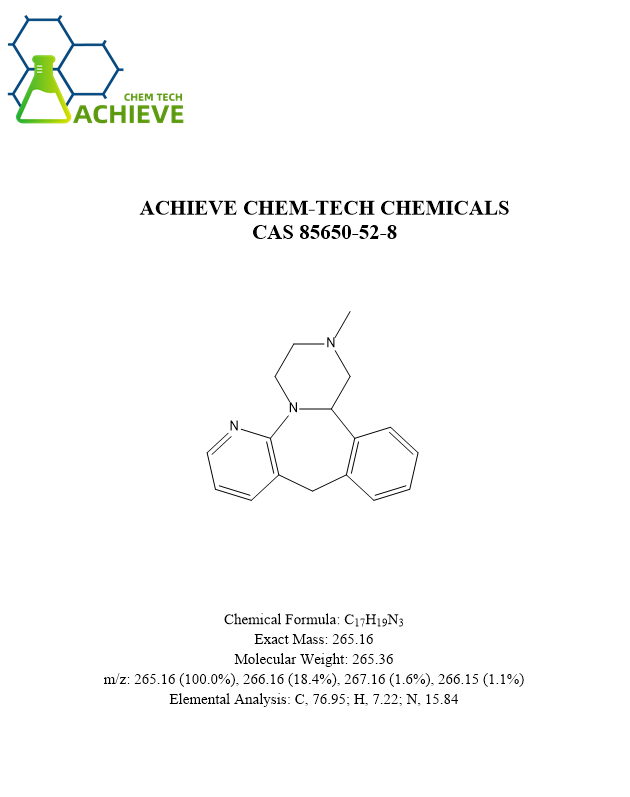
| Structure |
|
|
| Item | Enterprise standard | Analysis result |
| Appearance | White or almost white powder | Conformed |
| Water content | ≤5.0% | 0.49% |
| Loss on drying | ≤1.0% | 0.30% |
| Heavy Metals | Pb≤0.5ppm | N.D. |
| As≤0.5ppm | N.D. | |
| Hg≤0.5ppm | N.D. | |
| Cd≤0.5ppm | N.D. | |
| Purity (HPLC) | ≥99.0% | 99.90% |
| Single impurity | <0.8% | 0.49% |
| Total microbial count | ≤750cfu/g | 80 |
| E. Coli | ≤2MPN/g | N.D. |
| Salmonella | N.D. | N.D. |
| Ethanol (by GC) | ≤5000ppm | 500ppm |
| Storage | Store in a sealed, dark, and dry place below 2-8°C | |
|
|
||
|
|
||


| Chemical Formula | C17H19N3 |
| Exact Mass | 265.16 |
| Molecular Weight | 265.36 |
| m/z | 265.16 (100.0%), 266.16 (18.4%), 267.16 (1.6%), 266.15 (1.1%) |
| Elemental Analysis | C, 76.95; H, 7.22; N, 15.84 |

Mirtazapine Powder, also known as Mirtazapine, is a psychoactive ingredient with significant application value in the medical field. Its unique pharmacological mechanism of action makes it play a key role in the treatment of various mental disorders and related symptoms, and it also has specific uses in the production of pharmaceutical preparations and other fields.
Primary Indication: Major Depressive Disorder (MDD)

Major Depressive Disorder (MDD) is the primary indication for the product. It delivers definite efficacy and rapid onset against core MDD symptoms, including depressed mood, anhedonia, psychomotor retardation, sleep disturbances and weight loss. As a tetracyclic antidepressant, its mechanism of action involves blocking presynaptic α₂-adrenergic receptors, thereby relieving the negative feedback inhibition of norepinephrine (NA) release, while indirectly promoting the release of 5-hydroxytryptamine (5-HT) to precisely regulate central neurotransmitter balance.
Clinical data show that mirtazapine can improve depressed mood and sleep disturbances within 1–2 weeks of treatment, and significantly alleviate core symptoms such as anhedonia and decreased interest within 4 weeks, with an effective rate of 60%–70%. Its efficacy is comparable to that of Selective Serotonin Reuptake Inhibitors (SSRIs), with a faster onset of action.
Mirtazapine exhibits prominent efficacy against suicidal ideation and mood fluctuation (diurnal mood variation: worse in the morning, better in the evening) associated with MDD.


It enhances noradrenergic neurotransmission to elevate central nervous system excitability and relieve psychomotor retardation. Meanwhile, it blocks 5-HT₂ and 5-HT₃ receptors to mitigate mood swings and irritability, and reduce suicide risk. Clinical guidelines recommend mirtazapine for the acute, consolidation and maintenance phases of MDD treatment. The dosage is 15–45 mg per night in the acute phase; the effective dose is maintained during the consolidation phase, and 4–6 months of maintenance treatment can markedly reduce the recurrence rate.
Anxiety Disorders and Depressive-Anxious Comorbidity
Depression-anxiety comorbidity accounts for over 50% of psychiatric clinical cases. With dual antidepressant and anxiolytic activity, mirtazapine is a preferred agent for comorbid treatment. Its anxiolytic mechanism mainly involves blocking histamine H₁ receptors to produce a sedative effect, while modulating 5-HT neurotransmitters to relieve anxiety, tension, fear and other emotional symptoms. It is effective for Generalized Anxiety Disorder (GAD), social anxiety disorder and panic disorder.For patients with depression complicated by severe anxiety, mirtazapine presents remarkable advantages.


Compared with SSRIs, it exerts anxiolytic effects more rapidly, alleviating somatic anxiety symptoms (palpitations, chest tightness, sweating) within 1 week of administration, without the risk of early anxiety aggravation induced by SSRIs. Clinical studies indicate that combined therapy of mirtazapine and SSRIs for refractory depressive-anxious comorbidity can enhance therapeutic efficacy, reduce the dosage of single-agent medication, and lower the incidence of adverse reactions. In addition, mirtazapine improves depressive symptoms, insomnia and nightmares associated with Post-Traumatic Stress Disorder (PTSD), and relieves trauma-related anxiety and sleep disorders by regulating neurotransmitter balance.
Precision Application in Depressive Disorders of Special Populations
1. Geriatric Depressive Disorder
Elderly depressed patients are often accompanied by insomnia, poor appetite, weight loss and physical discomfort, and have low tolerance to drug side effects. Featuring mild sedation, mild gastrointestinal reactions and extremely weak anticholinergic side effects, mirtazapine powder is the first-choice drug for geriatric depression. A low dose (7.5–15 mg per night) can improve sleep and appetite without causing excessive daytime drowsiness, while reducing risks such as orthostatic hypotension and cognitive impairment, which adapts to the physiological characteristics of the elderly.


2. Postpartum Depressive Disorder
Postpartum depression is usually accompanied by insomnia, anxiety, poor appetite and mother-infant bonding disorders. With minimal impact on milk secretion and no obvious teratogenic risk, mirtazapine is suitable for the treatment of postpartum depression. It can rapidly relieve depressed mood and insomnia, improve appetite, and does not interfere with breastfeeding. Clinically, it is recommended to start with a low dose (15 mg per night) and adjust the dosage according to therapeutic response, with favorable safety profiles.
3. Refractory Depressive Disorder
Refractory depression refers to depression that fails to respond to adequate-dose and full-course treatment with two or more antidepressants. Mirtazapine is an important therapeutic option for refractory depression. Combined medication regimens are commonly adopted in clinical practice: mirtazapine combined with SSRIs (fluoxetine, sertraline), Serotonin-Norepinephrine Reuptake Inhibitors (SNRIs) or atypical antipsychotics can synergistically regulate neurotransmitter balance and enhance efficacy. Studies show that the combined use of mirtazapine and venlafaxine achieves an effective rate of 50%–60% in refractory depression, significantly higher than monotherapy.


Mirtazapine (C₁₇H₁₉N₃), chemically named 1,2,3,4,10,14b-hexahydro-2-methylpyrazino[2,1-a]pyrido[2,3-c]benzazepine, belongs to tetracyclic compounds. For industrial synthesis, 2-chloro-3-cyanopyridine and 1-methyl-3-phenylpiperazine are used as starting materials, and the product is prepared via three core reactions: condensation, reduction and cyclization. The process is mature with high yield and suitable for large-scale production.
(I) Synthetic Route and Core Principle
The core of mirtazapine synthesis is to construct the linkage between the piperazine ring and pyridine ring, followed by intramolecular dehydration cyclization to form the tetracyclic parent nucleus.
The mainstream process adopts four consecutive reactions with intermediates directly used in the next step without purification, delivering an overall yield up to 71.5%.
Core reaction mechanism: Carbon-nitrogen bond coupling is realized via nucleophilic substitution; cyano groups are converted into hydroxymethyl groups through catalytic reduction; finally, intramolecular dehydration cyclization occurs under strong acidic conditions to form the tetracyclic structure of mirtazapine.
(II) Detailed Synthetic Procedures
1. Condensation Reaction: Preparation of 2-(4-methyl-2-phenyl-1-piperazinyl)-3-cyanopyridine (Intermediate I)
Using 2-chloro-3-cyanopyridine and 1-methyl-3-phenylpiperazine as raw materials, a nucleophilic substitution reaction is carried out in anhydrous polar solvents (N,N-Dimethylformamide, DMF or Dimethyl Sulfoxide, DMSO).
Reaction conditions: Under nitrogen protection, potassium carbonate is added as an acid-binding agent to neutralize generated HCl. The mixture is heated to 80–90 ℃ and stirred for 6–8 hours, with the reaction progress monitored by TLC.
After the reaction, the mixture is cooled to room temperature, the solvent is removed under reduced pressure, and water is added to precipitate solids. Filtration and drying yield Intermediate I with a yield of approximately 80%, which can be directly used in the next step without purification.
2. Catalytic Reduction Reaction: Preparation of 2-(4-methyl-2-phenyl-1-piperazinyl)-3-hydroxymethylpyridine (Intermediate II)
The cyano group (-CN) of Intermediate I is catalytically reduced to a hydroxymethyl group (-CH₂OH) using Raney-Ni as the catalyst and sodium hypophosphite as the reducing agent, with a mixed solvent system of water/acetic acid/pyridine.Reaction conditions: The temperature is controlled at 50–60 ℃, and the mixture is stirred for 4–6 hours until complete conversion of raw materials is confirmed by TLC.
After the reaction, the catalyst is removed by filtration, the filtrate is concentrated under reduced pressure, and solids are precipitated upon cooling. Filtration and drying afford Intermediate II with a yield of about 85%, and the crude product is directly used for the next step. This step selectively reduces cyano groups without affecting the structures of the piperazine ring and benzene ring, avoiding side reactions.
3. Borohydride Reduction: Preparation of 1-(3-hydroxymethylpyridin-2-yl)-2-phenyl-4-methylpiperazine (Intermediate III)
Trace aldehyde impurities remaining in Intermediate II are selectively reduced to alcoholic hydroxyl groups by sodium borohydride (NaBH₄), with methanol or ethanol as the solvent.Reaction conditions: Stir at room temperature for 2–3 hours to avoid excessive reduction caused by high temperature.
After the reaction, the solvent is evaporated under reduced pressure, water is added for extraction, and the organic layer is dried and concentrated to obtain Intermediate III with a yield of around 90%, which is directly applied to the cyclization reaction without purification.
4. Dehydration Cyclization Reaction: Preparation of Crude Mirtazapine
Intramolecular dehydration cyclization of Intermediate III occurs in concentrated sulfuric acid to construct the tetracyclic parent nucleus and generate mirtazapine.Reaction conditions: Intermediate III is added portionwise into concentrated sulfuric acid, the temperature is maintained at 50–60 ℃, and the mixture is stirred for 8–12 hours until complete cyclization is monitored by TLC.
After the reaction, the solution is cooled to room temperature, slowly poured into ice water, and ammonia water is added to adjust the pH to neutral. Crude mirtazapine is precipitated, filtered, washed with water to neutrality and dried, with a yield of about 85%.
5. Purification and Refinement: Preparation of Refined Mirtazapine (Powder)
The crude product is purified by activated carbon decolorization combined with recrystallization, using ethanol-water mixed solvent or petroleum ether-ethanol mixed solvent as the recrystallization system.Procedure: Dissolve the crude product in hot ethanol, add activated carbon for reflux decolorization for 30 minutes, filter while hot, and cool the filtrate for crystallization.
Filtration and drying yield refined mirtazapine with purity ≥99.5%, meeting pharmaceutical grade standards. The product is obtained after crushing, with an overall process yield of about 71.5%.
FAQ
What is mirtazapine drug used for?
+
-
Mirtazapine (commonly known by the brand name Remeron) is a tetracyclic antidepressant. It works by increasing the levels of mood-enhancing chemicals like serotonin and norepinephrine in the brain.
Is mirtazapine for sleep or depression?
+
-
Mirtazapine is primarily an antidepressant approved for major depressive disorder, but it is very commonly prescribed off-label for insomnia because of its sedative properties. It helps people fall asleep faster and improves sleep quality, particularly for those with both depression and insomnia.
Hot Tags: mirtazapine powder, suppliers, manufacturers, factory, wholesale, buy, price, bulk, for sale, 4 Fluorotropacocaine, Zidovudine powder, Cyclophosphamide monohydrate powder, Uracil Powder CAS 66 22 8, Benzobarbital CAS 744 80 9, 6 methylergoline 8beta carboxylic Acid CAS 5878 43 3