


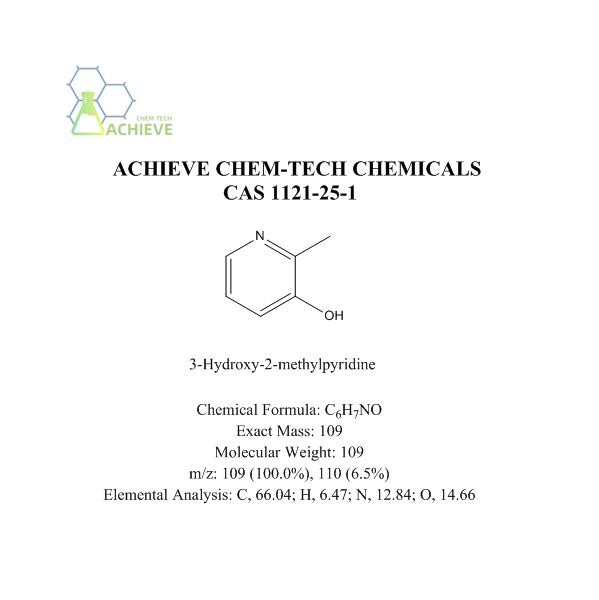


3-Hydroxy-2-methylpyridine is an organic compound that often appears as a colorless to light yellow solid and can exist in crystalline or amorphous form. The molecular formula is C6H7NO, with a molecular weight of approximately 109.13g/mole. It is a nitrogen-containing aromatic compound composed of a pyridine ring and a hydroxyl methyl group. It has a relatively low melting point and high boiling point, and is soluble in many organic solvents, but its solubility in water is relatively low. It is reported that its solubility is about 1.2 grams per liter at 20 degrees Celsius. It has a wide range of applications in the field of chemistry. It can be used in organic synthesis, catalysts, chemical analysis, fluorescent dyes, spices, and other fields. With in-depth research on its chemical properties and reaction mechanisms, more applications will be discovered and developed.

|
Chemical Formula |
C14H24S |
|
Exact Mass |
224 |
|
Molecular Weight |
224 |
|
m/z |
224 (100.0%), 225 (15.1%), 226 (4.5%), 226 (1.1%) |
|
Elemental Analysis |
C, 74.93; H, 10.78; S, 14.29 |
|
|
|


3-Hydroxy-2-methylpyridine is an important organic compound with a wide range of applications in various fields. The following is a detailed explanation of all uses of 3-hydroxy-2-methylpyridin:

1. Organic synthesis:
-Constructing carbon carbon bonds: Due to its active methylene (CH) and hydroxyl functional groups, 3 hydroxy-2-methylpyridine can be used as an important intermediate for constructing carbon carbon bonds. 3 hydroxy-2-methylpyridine can be converted into various organic compounds through reactions such as substitution, condensation, and cyclization. For example, it can react with aldehydes or ketones to form hydroxyimines.
-Synthetic fluorescent dyes: Due to the presence of heteroatoms in the 3 hydroxy-2-methylpyridine molecule, it can participate in different types of chemical reactions, such as alkylation, substitution reactions, etc., thus being used for the synthesis of fluorescent dyes. Fluorescent dyes have important applications in biomarkers, microscopic imaging, and sensors.
-Synthetic pharmaceutical intermediates: 3 hydroxy-2-methylpyridine can be used as a precursor, active molecule, and pharmaceutical intermediate for synthetic drugs. By introducing different substituent groups on the 3 hydroxy-2-methylpyridine molecule, its chemical properties and biological activity can be changed, leading to the development of new drug molecules.

2. Catalyst:
-Metal coordination catalysts: 3 hydroxy-2-methylpyridine and its metal complexes can serve as metal coordination catalysts and play a catalytic role in organic synthesis reactions. For example, it can form complexes with transition metals and participate in important organic synthesis reactions such as oxidation, reduction, and coupling.
-Acid catalyst: Due to the presence of its hydroxyl functional group, 3 hydroxy-2-methylpyridine can be used as an acidic catalyst for acid catalytic reactions. For example, it can be used to catalyze reactions such as esterification, condensation, acylation, etc.
3. Chemical analysis and testing:
-Derivative agent: 3 hydroxy-2-methylpyridine can be used as a derivative agent in chemical analysis to improve the detection and separation ability of compounds. It can undergo substitution or addition reactions with some compounds, resulting in easily detectable derivatives. For example, in the analysis of amino acids and peptides, 3 hydroxy-2-methylpyridine can be used as a derivative to form amino amide compounds.
-Sensor: Due to some chemical properties of 3 hydroxy-2-methylpyridine, such as metal complexing ability and fluorescence properties, it can be used to construct sensors. By modifying the surface of the sensor with 3 hydroxy-2-methylpyridine or assembling it with other substances into nanomaterials, the detection and monitoring of target substances such as metal ions, organic molecules, or biomolecules can be achieved.


4. Other applications:
-Essence and perfume: because 3 hydroxy-2-methylpyridine has unique aromatic characteristics, it can be used as perfume or fragrance agent in food, perfume, essence and other products. Its aromatic properties can bring a unique taste and aroma to the product.
-Reagents and standards: 3 hydroxy-2-methylpyridine can be used as one of the commonly used reagents and standards in the laboratory for quantitative and qualitative analysis in chemical analysis, organic synthesis, and other scientific research.
1, Pharmaceutical intermediates
As an important intermediate in the pharmaceutical field, it has broad application prospects. It can synthesize various bioactive drug molecules through a series of chemical reactions. These drug molecules have a wide range of therapeutic effects in the pharmaceutical field, including but not limited to antibacterial, anti-inflammatory, anti-tumor, and other aspects.


As a pharmaceutical intermediate, drug molecules with specific pharmacological effects can be synthesized through chemical modification and transformation. These drug molecules play an important role in treating various diseases. For example, some drugs containing their structures can be used to treat infectious diseases and achieve the purpose of treatment by inhibiting the growth and reproduction of pathogens. In addition, there are some drugs that can be used to treat inflammatory diseases, by regulating the inflammatory response in the body, reducing inflammatory symptoms, and promoting tissue repair.
Other uses
In addition to the application fields mentioned above, it also has various other uses.
Used as an analytical reagent: 3-Hydroxy-2-methylpyridine can be used as an analytical reagent for content determination, identification, and other analytical work. Its specific chemical properties and reactivity make it one of the important reagents in analytical chemistry.
Used as a solvent: In addition, it can also be used as a solvent to dissolve and dilute other compounds. Its good solubility and stability make it one of the commonly used solvents in chemical production.


Used as a surfactant: It can also be used as a surfactant to improve the surface tension and wetting properties of liquids. Surfactants are widely used in fields such as coatings, inks, and detergents, and as a new type of surfactant, they have potential market prospects.
Used as a corrosion inhibitor: In the field of metal corrosion prevention, it can be used as a corrosion inhibitor. By adsorbing onto the metal surface, a protective film is formed to prevent the metal from being corroded and oxidized. This corrosion inhibitor has important application value in metal processing, storage, and transportation processes.
As a plasticizer: In the plastic industry, 3-hydroxy-2-methylpyridie can also be used as a plasticizer. By adding it to plastic, its flexibility and processability can be improved, making it easier to shape and process. This plasticizer has important application value in the production of plastic products.

Storage and Stability Management
Optimization of Storage Conditions

Temperature Control
The storage of 3-Hydroxy-2-methylpyridine requires strict adherence to temperature management principles. It can be stored for a short period at room temperature (20-25℃), but for long-term storage, it is recommended to keep the temperature below 15℃ to reduce the molecular thermal motion rate and minimize the risk of oxidation or decomposition. Some suppliers recommend storing at 4℃ in a sealed environment, which is particularly suitable for high-purity (≥98%) samples, allowing the shelf life to be extended to over 2 years. It is important to avoid temperature fluctuations and prevent the formation of condensate water, which could cause the samples to get damp.
Light Exposure and Sealing
Light exposure may trigger photochemical reactions, causing changes in the structure of compounds. Therefore, the storage containers should be made of amber glass bottles or transparent bottles wrapped with light-blocking materials, and ensure good sealing. Poor sealing may allow oxidative substances in the air to enter, leading to a slow oxidation reaction, manifested as the sample color deepening (such as from white gradually turning to yellow or orange) or a decrease in purity. Regularly checking the sealing of the containers and replacing old rubber stoppers or bottle caps are key measures to maintain the stability of the samples.


Humidity Management
Although 3-Hydroxy-2-methylpyridine has a relatively low hygroscopicity, prolonged exposure to high humidity environments (relative humidity > 60%) may still cause deliquescence, resulting in sample caking or reduced fluidity. The storage area should be equipped with dehumidification equipment to maintain the humidity within the range of 40-50%. If the sample has been wetted, it can be restored to its fluidity through low-temperature drying (such as treatment in a vacuum drying oven at 40°C for 2 hours), but extreme heat should be avoided as it may lead to thermal decomposition.
Isolation and Classified Storage
This compound must be strictly isolated from strong oxidants (such as potassium permanganate, concentrated nitric acid), acidic substances, and nitrogen oxides to prevent intense oxidation reactions or explosions. The storage area should be divided into dedicated zones and clearly marked with warning signs. Samples of different batches or purities should be stored separately to avoid cross-contamination. For small batches of samples, it is recommended to use independent sealed bags or centrifuge tubes for packaging, and label the date, purity, and responsible person information.

Stability Monitoring and Maintenance
Regular Purity Testing
Samples that have been stored for a long time need to be tested for purity on a regular basis. It is recommended to conduct gas chromatography (GC) or high-performance liquid chromatography (HPLC) analysis every 6 months. If the purity drops below 95%, the sample needs to be re-purified or discarded. The decrease in purity may be caused by oxidation, decomposition, or the introduction of impurities. A comprehensive judgment should be made based on the appearance of the sample (such as color and form). For example, samples with a purity of ≥ 98% are usually white to light yellow powders. If dark lumps appear, decomposition may have occurred.
Compatibility of packaging materials
The storage container must be compatible with the compound. Metal or plastic containers (such as polyethylene or polypropylene) should not be used as some plastics may release plasticizers or adsorb samples, resulting in a decrease in purity. Glass containers (such as borosilicate glass) are recommended as they have high chemical stability and are less likely to react with the samples. For samples that need to be stored for a long time, nitrogen or argon can be filled into the glass bottle to exclude oxygen, thereby delaying oxidation.
Emergency Response Plan
Develop a leakage emergency response plan, and prepare adsorption materials (such as silica gel, vermiculite), neutralizing agents (such as dilute sodium bicarbonate solution), and personal protective equipment (such as gas masks, corrosion-resistant gloves). In case of leakage, immediately isolate the contaminated area, restrict access by personnel, and wear protective equipment to clean up the leaked substances. The cleaned-up waste should be treated as hazardous waste and handed over to professional institutions for disposal. It is prohibited to directly discharge it into sewers or the natural environment.
Operating Procedures and Safety Measures

Personal Protective Equipment
Operators must wear goggles, a filtering respirator (with a filtration efficiency of ≥ 95%), chemical protective clothing, and corrosion-resistant gloves (such as nitrile rubber gloves) to prevent skin or mucous membrane contact. If dust generation is possible during the operation, it should be carried out in a fume hood or local exhaust equipment, and ensure that the ventilation system is regularly maintained to avoid dust accumulation and the risk of explosion.

Operating Precautions and Warnings
It is prohibited to eat, drink, or smoke in the operation area to avoid accidental ingestion or inhalation. After the operation, thoroughly wash hands and exposed skin, and change contaminated clothing. If the sample comes into contact with the skin or eyes, immediately rinse with plenty of water for 15 minutes and seek medical attention. For cases of accidental ingestion, do not induce vomiting; immediately rinse the mouth and drink plenty of water, and seek medical help as soon as possible.

Waste Disposal
The discarded samples should be treated as hazardous waste. They should be collected separately in sealed containers and marked with the "hazardous waste" label. Before disposal, it is necessary to consult the local environmental protection department to ensure compliance with regulations. It is prohibited to pour the waste into the sewer or into the natural environment to prevent water or soil pollution.
Transportation and Handling Requirements
Transportation Conditions
The transportation vehicles must be equipped with fireproof and explosion-proof devices and display hazardous materials signs (although this compound is not classified as a hazardous substance, it should be handled in accordance with chemical transportation regulations). During transportation, avoid severe vibrations or high-temperature environments to prevent packaging damage and leakage. For long-distance transportation, it is recommended to use ice packs or refrigerated vehicles to maintain a low-temperature environment to ensure the stability of the samples.
Handling Specifications
During handling, items should be handled with care, avoiding impacts or upside-down positions. For large quantities of samples, special pallets or shock-absorbing materials should be used for fixation to prevent packaging damage. The handlers must undergo safety training, be familiar with emergency response procedures, and be equipped with personal protective equipment.
Hot Tags: 3-hydroxy-2-methylpyridine cas 1121-25-1, suppliers, manufacturers, factory, wholesale, buy, price, bulk, for sale, 5 Sulfoisophthalic Acid Monosodium Salt CAS 6362 79 4, 2 Bromo 9 9 spirobifluorene, Magnesium Ethoxide, 7 Nitroindole CAS 6960 42 5, 4 4 Dimethylbiphenyl CAS 613 33 2, N N N Trimethylethylenediamine