


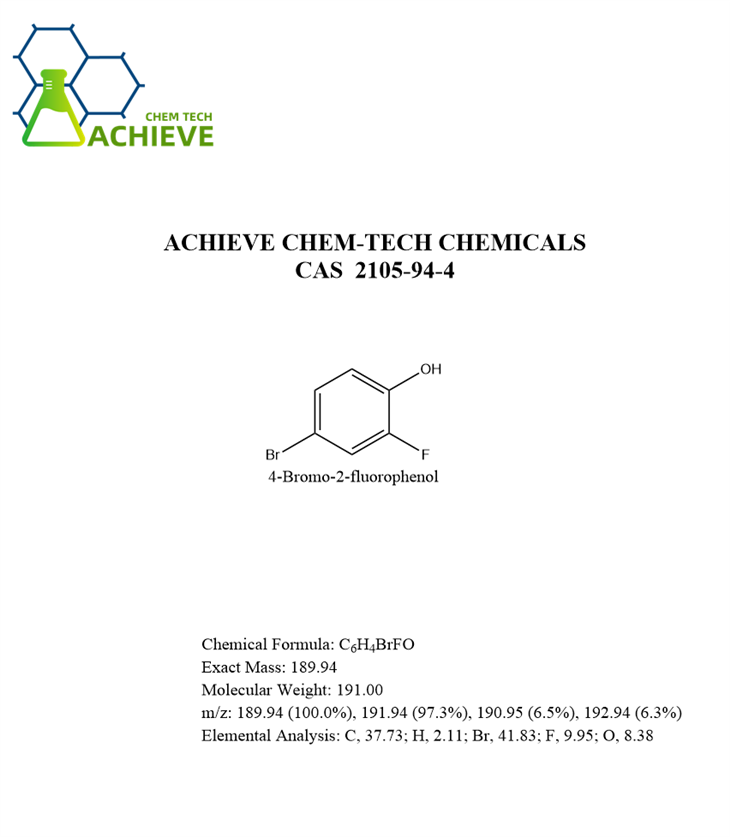


Shaanxi BLOOM Tech Co., Ltd. is one of the most experienced manufacturers and suppliers of 4-bromo-2-fluorophenol cas 2105-94-4 in China. Welcome to wholesale bulk high quality 4-bromo-2-fluorophenol cas 2105-94-4 for sale here from our factory. Good service and reasonable price are available.
Physical properties: Usually it is a white to pale yellow crystalline solid. The melting point is approximately 40-45°C, the boiling point is about 220°C. It is slightly soluble in water and readily soluble in organic solvents (such as ethanol, ether).
Chemical properties: The phenolic hydroxyl group endows it with weak acidity (pKa ≈ 9), enabling it to participate in reactions such as salting out and esterification; the bromine atom is prone to nucleophilic substitution (such as Suzuki coupling), while the strong electron-withdrawing effect of the fluorine atom can influence the electrophilic substitution position of the aromatic ring.
Application: As an intermediate in the synthesis of medicines and pesticides, it can also be used in the construction of functional molecules in materials science. It should be noted that it is irritating, and protective measures should be taken during operation.

Additional information of chemical compound:
|
Chemical Formula |
C6H4BrFO |
|
Exact Mass |
189.94 |
|
Molecular Weight |
191.00 |
|
m/z |
189.94(100.0%),191.94(97.3%),190.95(6.5%),192.94(6.3%) |
|
Elemental Analysis |
C, 37.73; H, 2.11; Br, 41.83; F, 9.95; O, 8.38 |
|
Melting point |
79℃/7 mmHg (lit.) |
|
Boiling point |
1.744 g/mL at 25℃(lit.) |
|
|
|



4-bromo-2-fluorophenol is an important organic fluorine-containing intermediate with unique chemical structure and properties, and therefore has a wide range of applications in multiple fields. The following is a detailed discussion on its use:
In the application of dyes and pigments
The fluorine atoms in it have unique chemical properties and can react with various compounds to produce fluorine-containing dyes. These fluorine-containing dyes typically have excellent light resistance, weather resistance, and chemical corrosion resistance, making them suitable for coloring needs in various harsh environments. For example, a series of fluorinated azo dyes with bright colors and excellent properties can be synthesized through the reaction of 4-bromo-2-fluorophenol with arylamines. In addition to basic coloring properties, it can also be used to synthesize dyes with specific functionalities.


For example, by introducing specific functional groups into their molecules, dyes with fluorescence, thermal sensitivity, or photosensitivity can be synthesized, which have broad application prospects in fields such as anti-counterfeiting labeling, temperature sensors, and optoelectronic devices. These dye molecules typically have excellent color fastness and vivid colors, suitable for coloring various textiles, leather, and paper. Under certain conditions, it can also serve as an intermediate in rearrangement reactions and participate in the synthesis of dye molecules.
For example, through specific catalysts and reaction conditions, intramolecular rearrangement reactions can occur to generate dye molecules with novel structures. These dye molecules typically possess unique colors and properties, bringing new opportunities for development in the field of dyes.
It can be used to synthesize pigments with specific functionalities. For example, by introducing specific functional groups into their molecules, pigments with conductivity, magnetic or optical properties can be synthesized, which have broad application prospects in fields such as electronics, magnetic materials and optical devices. It can undergo condensation reactions with various compounds to generate pigment molecules with more complex structures. For example, a series of azo pigments with bright colors and excellent properties can be synthesized through the condensation reaction of ketone compounds with 4-bromo-2-fluorophenol.


These pigment molecules typically have excellent light resistance, weather resistance, and chemical corrosion resistance, making them suitable for coloring needs in various harsh environments. Under certain conditions, 4-bromo-2-fluorophenol can also serve as an intermediate in cyclization reactions and participate in the synthesis of pigment molecules. For example, through specific catalysts and reaction conditions, 4-bromo-2-fluorophenol can undergo intramolecular cyclization reactions to generate pigment molecules with novel structures. These pigment molecules usually have unique colors and properties, bringing new development opportunities to the pigment field.
The fluorine atom in it has a strong electron withdrawing effect, which can stabilize the chromophore groups in dye and pigment molecules, thereby improving their light resistance. By introducing fluorine atoms into the molecular structure of 4-bromo-2-fluorophenol, dyes and pigments can maintain their bright colors under prolonged light exposure. The fluorine atoms in the molecular structure can also enhance the chemical corrosion resistance of dye and pigment molecules. Dyes and pigments containing 4-bromo-2-fluorophenol structure can still maintain good color and performance in harsh environments such as acidic, alkaline, and organic solvents.


The bromine and fluorine atoms in the molecular structure can interact with other functional groups in the pigment molecule, thereby improving the dispersibility of the pigment. By introducing bromine and fluorine atoms into the molecular structure of 4-bromo-2-fluorophenol, pigments can be better dispersed uniformly in solvents or media, improving coloring effects and printing quality. Under certain conditions, dye molecules are prone to agglomeration, which affects their coloring effect. By introducing bromine and fluorine atoms into the molecular structure, the aggregation tendency of dye molecules can be reduced, allowing them to maintain a stable dispersed state in solution.
Application in Pesticide Chemistry
Due to its unique chemical structure, it is often used as a raw material for synthesizing various pesticides. In the process of pesticide synthesis, 4-bromo-2-fluorophenol can combine with other compounds through substitution, addition, coupling and other reactions to form pesticide molecules with specific biological activities. For example, it can undergo substitution reactions with compounds such as arylamines and arylalcohols to generate pesticide intermediates with insecticidal, bactericidal, or herbicidal activity. These intermediates can be further processed through condensation, cyclization, and other reactions to prepare various highly efficient and low toxicity pesticide products.


In addition, 4-bromo-2-fluorophenol can also combine with other fluorinated compounds to form fluorinated pesticides with special properties, such as fluorinated insecticides, fluorinated herbicides, etc. It is an important raw material for synthesizing various pesticide active ingredients. By modifying and altering its molecular structure, pesticide active ingredients with different biological activities and mechanisms of action can be prepared. For example, some fluorinated phenolic compounds are widely used as active ingredients in insecticides, fungicides, and herbicides. These compounds usually have the characteristics of high efficiency, low toxicity, and broad spectrum, which can meet the diversified needs of modern agriculture for pesticides. As one of the synthetic raw materials for these compounds, 4-bromo-2-fluorophenol provides an important material basis for the development of pesticide active ingredients.
The dispersibility and suspension of pesticides are important factors affecting their effectiveness. By interacting with the active ingredients of pesticides, their dispersibility and suspension can be improved, thereby enhancing the uniformity and coverage of pesticide spraying. For example, by mixing 4-bromo-2-fluorophenol with pesticide active ingredients, pesticide suspensions with good dispersibility and suspension properties can be prepared. This suspension agent can be evenly dispersed in the spray solution during use, improving the spraying effect of pesticides.


The stability of pesticides refers to their ability to maintain biological activity during storage and use. Chemical reactions or physical interactions with pesticide active ingredients can enhance their stability and extend the lifespan of pesticides. For example, by mixing 4-bromo-2-fluorophenol with pesticide active ingredients, pesticide emulsions or wettable powders with good stability can be prepared. These formulations can maintain good biological activity during storage and use, improving the effectiveness of pesticide use.

4-bromo-2-fluorophenol (C6H4BrFO) is a benzene derivative containing both bromine and fluorine substituents. As an important member of the halogenated phenol family, its unique electronic effect and steric hindrance make it of special value in organic synthesis. The molecular weight of the compound is 191.00 g/mol, and it is a white to light yellow crystalline solid at room temperature. Its melting point is between 45-48 ° C, and its boiling point is about 210-212 ° C. Due to the presence of both electron donating hydroxyl groups and electron withdrawing halogen atoms in the molecule, it has interesting acidity and reactivity.
In the history of chemistry, the discovery and development of 4-bromo-2-fluorophenol is not an isolated event, but closely related to the development of halogenated phenol chemistry, especially fluorinated phenol chemistry. Looking back at its discovery process, we can not only understand the origin and development of this specific compound, but also glimpse the development trajectory of organic halogen chemistry, especially fluorine chemistry, a special branch.
The history of halogenated phenol chemistry can be traced back to the discovery of phenol itself. In 1834, German chemist Friedlieb Ferdinand Runge first isolated phenol (then known as "carbonic acid") from coal tar.
In 1841, French chemist Auguste Lorraine opened the door to the study of phenol derivative chemistry by systematically studying the nitration reactions of phenols. These early works laid the foundation for subsequent research on halogenated phenols.
The research on bromophenol began in the mid-19th century. In 1856, French chemist Auguste Cahill reported the direct reaction of phenol with bromine and observed the formation of various brominated products.
In 1872, German chemist Heinrich Linprecht systematically studied the bromination reaction of phenols and for the first time isolated and identified 2,4,6-tribromophenol. These early studies mainly focused on polybrominated products, with relatively less attention paid to monobromophenols. Compared with bromophenol, the research on fluorophenol is significantly lagging behind. There are two main reasons for this: firstly, the scarcity of fluorinated organic compounds in nature; Secondly, early fluorination technology was not yet mature.
It was not until 1886 that French chemist Henri Moissan successfully isolated elemental fluorine, laying the foundation for the development of organic fluorine chemistry.
But it was not until the 1930s that practical organic fluorination methods gradually developed. The clear discovery of 4-bromo-2-fluorophenol was not discovered until the mid-20th century.
In 1958, American chemist William A. Shepard first reported the synthesis and characterization of 4-bromo-2-fluorophenol, while studying the dipole moment of halogenated phenols. He adopted a gradual halogenation strategy: first, he reacted with 2-fluorophenol bromide in glacial acetic acid, and selectively obtained the 4th brominated product by controlling the reaction conditions (temperature 0-5 ° C, bromine equivalent 0.95). Then, the target compound is purified by vacuum distillation. At that time, structural confirmation mainly relied on elemental analysis and simple spectroscopic techniques.
Due to the limited popularity of nuclear magnetic resonance technology, Shepard indirectly verified the structure by measuring the dipole moment (2.71D) of the compound and comparing it with theoretical calculations. This work was published in the Journal of Organic Chemistry, marking the official entry of the substance as a specific isomer into scientific literature.
Frequently Asked Questions
Does it have an "invisible" physical constant that is particularly important for synthesis?
+
-
Its refractive index is about 1.566, which is a very sensitive purity indicator. In practical operation, small impurities or decomposition products can cause refractive index readings to shift. Experienced process personnel often use it to quickly determine the quality of distillation products, which is more immediate than chromatographic analysis.
Why is it prone to causing trouble? What are your special habits when storing?
+
-
Because it is very 'sensitive'. Firstly, it has air sensitivity, and secondly, it also has light sensitivity. This means that when storing in the laboratory, not only should inert gases (such as argon) be used for protection, but brown bottles must also be used to avoid light, otherwise they are prone to oxidation and discoloration, leading to a decrease in purity.
What is its pKa value? What is the 'trick' behind this value?
+
-
Its acidity coefficient (pKa) is calculated to be approximately 8.00. The 'mechanism' of this value lies in its position between strong base and weak acid. In medicinal chemistry, this pKa value means that at physiological pH (7.4), some molecules are in an ionic state and some are neutral, which helps drug molecules better penetrate the cell membrane.
What other cool things can it "transform" into in the laboratory besides making pharmaceuticals and pesticides?
+
-
It is often used as a molecular "skeleton" to build more complex structures. For example, it can be used as a starting material for the synthesis of imidazolium salt compounds. These types of compounds can be used in materials science to prepare ionic liquids or functional materials with antibacterial activity, which is somewhat less common than conventional pharmaceutical intermediate applications.
Does it have an invisible halogen atom? How to choose in the reaction?
+
-
There is no invisibility, but its two halogens (Br and F) have a huge difference in reactivity. Bromine atoms (Br) are "dominant" and easily undergo coupling reactions (such as Suzuki coupling) or nucleophilic substitution; The fluorine atom (F) is "implicit" and extremely stable. If you want to carry out reactions (such as lithiation) adjacent to fluorine atoms, you need very strong bases and extremely low temperature conditions, otherwise side reactions are prone to occur.
Hot Tags: 4-bromo-2-fluorophenol cas 2105-94-4, suppliers, manufacturers, factory, wholesale, buy, price, bulk, for sale, 5H benzo b carbazole, CAS 1846601 95 3, Benz b indolo 2 3 d 1 benzazepine 5 10 dihydro 5 phenyl , 14 4 phenylquinazolin 2 yl 14H benzo c benzo 4 5 thieno 2 3 a carbazole, 2 chloro 4 dibenzo b d furan 3 yl 6 phenyl 1 3 5 triazine, Iodomethane d3