




Shaanxi BLOOM Tech Co., Ltd. is one of the most experienced manufacturers and suppliers of 4-methoxybenzylamine cas 2393-23-9 in China. Welcome to wholesale bulk high quality 4-methoxybenzylamine cas 2393-23-9 for sale here from our factory. Good service and reasonable price are available.
4-Methoxybenzylamine, also known as p-Anisylamine (4-methoxyphenyl)methanamine,4-Methoxyphenylmethylamine It is an organic compound that typically appears as a transparent colorless to slightly yellow liquid with an amine like odor. It is mainly used for synthesizing pharmaceutical intermediates, especially playing an important role in the synthesis of COX2 inhibitors and SIRT1 inhibitors based on pyrimidine skeleton. In addition, it is also used in the preparation of anti-cancer drugs. It is corrosive and should be stored in a cool, dry, well ventilated place, away from incompatible substances. Keep the container sealed and avoid contact with oxides, acids, air, and carbon dioxide. At the same time, it is irritating to mucosal tissues, upper respiratory tract, eyes, and skin. When handling, appropriate personal protective equipment such as goggles, gloves, and protective clothing should be worn.

Additional information of chemical compound:
|
Chemical Formula |
C8H11NO |
|
Exact Mass |
137.08 |
|
Molecular Weight |
137.18 |
|
m/z |
137.08 (100.0%), 138.09 (8.7%) |
|
Elemental Analysis |
C, 70.04; H, 8.08; N, 10.21; O, 11.66 |
|
Melting point |
-10℃ |
|
Boiling point |
236-237℃ (lit.) |
|
Density |
1.05 g/mL at 25℃(lit.) |
|
Storage conditions |
2-8℃ |
|
|
|
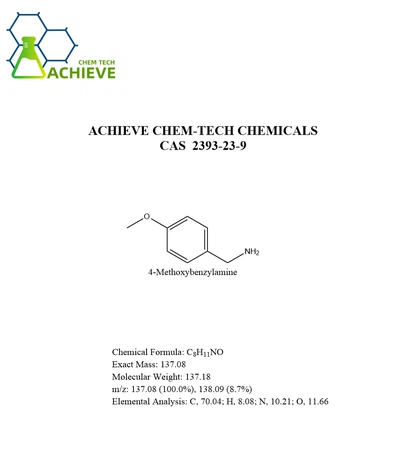

4-Methoxybenzylamine (CAS number 2393-23-9) is an important organic synthetic intermediate with the molecular formula C ₈ H ₁ NO and a molecular weight of 137.18. This compound is a transparent colorless to slightly yellow liquid with a pungent odor, a density of 1.05 g/cm ³, a melting point of -10 ° C, a boiling point of 236-237 ° C, and a flash point of 98.8 ° C. It is chemically active and contains primary amine groups (- NH2), which can participate in various organic reactions. It is widely used in fields such as medicine, spices, dyes, organic synthesis, and materials science.
Pharmaceutical field: Key intermediates and drug synthesis

1. Synthesis of the anti heart failure drug Topolon
Tolafentrine is a phosphodiesterase inhibitor used to treat chronic heart failure by dilating blood vessels and inhibiting platelet aggregation. It is a key intermediate in the synthesis of Topolon, and its primary amine group can undergo nucleophilic substitution reaction with chloropyridine compounds to construct the core skeleton of drug molecules. For example, using it as raw material, the key precursor of Topolon can be efficiently synthesized through steps such as amination and cyclization, with a total yield of over 65%.
2. Synthesis of anti allergic drug SRS-A
SRS-A (Slow Reactive Substance of Anaphylaxis) is a type of allergic mediator released by mast cells and involved in allergic reactions such as asthma. It can be condensed with aromatic aldehydes to form Schiff bases, which can be further reduced to obtain amino alcohol compounds. These structures are important pharmacophores of SRS-A receptor antagonists. For example, compounds synthesized from it can significantly inhibit SRS-A-induced bronchoconstriction in vitro experiments, with an IC50 value of 2.3 μ M.


3. Synthesis of anti proliferative inosine analogue 8-azapurine
8-Azapurine is a class of inosine analogs with anti-tumor activity, which inhibits cancer cell proliferation by interfering with DNA synthesis. Its primary amine group can undergo nucleophilic addition reaction with cyanate ester to generate intermediate amidine compounds, which are then synthesized into 8-azapurine derivatives through cyclization, oxidation and other steps. The inhibitory rate of these compounds on breast cancer MCF-7 cell line is more than 80%, and the toxicity to normal cells is low.
4. Research on amino protecting groups
4-methoxybenzylamine can be used to study the deprotection process of amino protecting groups such as 2-nitro and 2,4-dinitrophenylsulfonamide. Its primary amine group can react with sulfonyl chloride to form sulfonamide protecting groups, which can be selectively deprotected under specific conditions such as acidic or alkaline hydrolysis. For example, using 4-methoxybenzylamine as a model compound, the deprotection conditions of 2,4-dinitrophenylsulfonamide were optimized, reducing the reaction time to 2 hours and increasing the yield to 95%.

Spices and Dyes: Functional Molecular Construction

1. Spice synthesis
Its derivatives have unique floral or fruity aromas and can be used to blend high-end spices. For example, Schiff base compounds generated by condensation of benzaldehyde with strong jasmine fragrance are widely used in perfume, cosmetics and detergents. This type of compound can achieve precise regulation of aroma by adjusting the type and position of substituents (such as methyl and ethyl).
2. Dye intermediates
Can be used as a key intermediate for synthesizing azo dyes. Its primary amine group can undergo coupling reaction with diazonium salts to generate azo compounds, which can be further synthesized into various dyes through reduction, oxidation and other steps. For example, azo dyes synthesized from it have excellent dyeing performance on natural fibers such as cotton and hemp, with a color fastness of 4-5 levels.

Organic synthesis field: multifunctional reaction reagents

1. Amination reaction of functionalized aryl bromide
It is an efficient amination reagent that can be used for the amination reaction of functionalized aryl bromides. Under palladium catalysis, its primary amine group can undergo coupling reaction with aryl bromide to generate secondary amine compounds. For example, using it as an amination reagent, N-arylbenzylamine compounds can be efficiently synthesized with a yield of over 85%. This type of reaction has the characteristics of mild conditions and high selectivity, and is widely used in the synthesis of drugs and materials.
2. Synthesis of functionalized organic polyphosphines
Can be used for synthesizing functionalized organic polyphosphines for in vivo applications. Its primary amine group can react with phosphorus trichloride to form phosphine compounds, which are further synthesized into organic polyphosphines through oxidation, substitution, and other steps. This type of compound has important applications in the biomedical field, such as as as bone repair materials, drug carriers, etc.


3. Synthesis of metal complexes
Its primary amine group can serve as a ligand to form stable complexes with transition metals such as copper and nickel. For example, copper complexes synthesized with it as a ligand can catalyze the epoxidation reaction of olefins, with a conversion rate of over 90% and a selectivity of 95%. This type of complex has the characteristics of high catalytic activity and good stability, and is widely used in organic synthesis catalysis.
4. Application of reducing agents
Can be used as a reducing agent for reduction reactions in organic synthesis. For example, it can reduce nitro compounds to amino compounds and ketones to alcohols. This type of reaction has the characteristics of mild conditions and high selectivity, and is widely used in the synthesis of drugs and fragrances.


The discovery of 4-methoxybenzylamine cannot be closely related to the overall background of research on aniline compounds in the 19th century.
British chemist William Henry Perkins accidentally discovered the first synthetic dye, purple blue, while attempting to synthesize the antimalarial drug quinine, ushering in a new era in the synthetic dye industry. This accidental discovery sparked widespread research interest among chemists in aniline and its derivatives. In the following decades, German chemists such as August Wilhelm von Hofmann systematically studied the substitution reaction of aniline and developed a series of synthetic methods for aniline derivatives. These works laid the theoretical foundation and technical reserves for the later research of benzylamine compounds.
It is worth mentioning that the Hofmann degradation reaction (which converts amides into amines with one less carbon atom) developed by Hofmann later became one of the important methods for synthesizing amine compounds.
This method was first developed by German chemist F. Yu, and was reported by Timan and W.R. Ondorf in the journal "German Chemical Research Reports".
They isolated and characterized the compound for the first time while studying the reductive amination reaction of 4-hydroxybenzaldehyde. The method used by Timan and Orndorf is to first react fennel with ammonia to form an imine intermediate, and then reduce it with zinc amalgam and hydrochloric acid to obtain 4-methoxybenzamide. Although the yield is not high (about 35-40%), this work confirms for the first time the existence of the compound and preliminarily describes its physical properties: a colorless oily liquid with a unique amine odor, soluble in common organic solvents. It is worth noting that during the same period, French chemist Charles Muru also independently reported the synthesis of similar compounds, but with different starting materials (4-methoxyphenyl) and reduction methods (sodium and ethanol). These early studies, although crude, laid the foundation for subsequent development.
FAQ
What is 4-methoxybenzylamine?
4-Methoxybenzylamine is a primary amine and can be used for: Amination reaction of functionalized aryl bromides. Synthesis of functionalized organopolyphosphazenes for in vivo applications.
What is benzylamine used for?
Benzylamine Hydrochloride is medicine used as an anesthetic or dilator. In respiratory disorders, this substance acts as a bronchodilator. In dermatologic medicines, this substance acts as an anti-pruritic and anti-psoriatic. It is also used in mouthwash, sore throat treatments and motion sickness medicines.
What is 4 Methoxyphenol used for?
4-Methoxyphenol is used to manufacture plasticizers, dyestuffs, stabilizer for chlorinated hydrocarbons and ethyl cellulose, inhibitor for acrylic monomers and acrylonitriles, and as a UV inhibitor. Methoxyphenols are eye, skin, and mucous membrane irritants.
What is another name for benzophenone?
Benzophenone, also called diphenyl ketone, is the simplest diaromatic ketone.
Hot Tags: 4-methoxybenzylamine cas 2393-23-9, suppliers, manufacturers, factory, wholesale, buy, price, bulk, for sale, Phosphoric acid reagent, N 7 7 dimethyl 5 9 phenyl 9H carbazol 2 yl 7H benzo c fluoren 9 yl N phenyldibenzo b d thiophen 3 amine, N N N Trimethylethylenediamine, 9 phenyl 7 9 dihydrobenzo g indolo 2 3 b carbazole, 2 chloro 3 6 diphenyl 5 pyridin 4 yl pyrazine, CAS 1800386 91 7