



Shaanxi BLOOM Tech Co., Ltd. is one of the most experienced manufacturers and suppliers of tryptamine powder cas 61-54-1 in China. Welcome to wholesale bulk high quality tryptamine powder cas 61-54-1 for sale here from our factory. Good service and reasonable price are available.
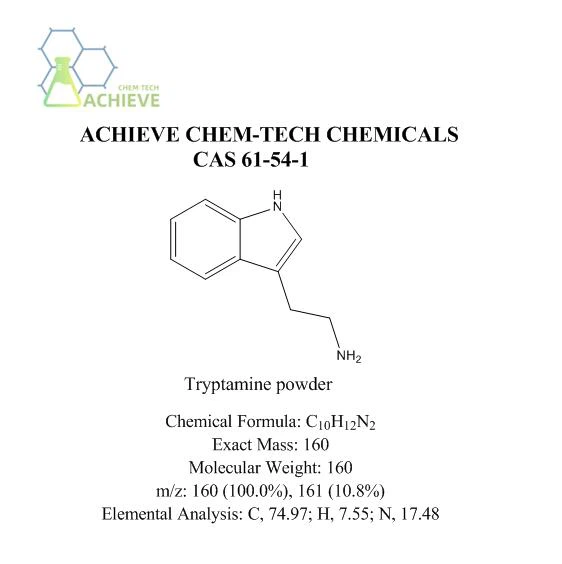
Tryptamine powder is a monoamine alkaloid, Molecular formula C10H12N2, CAS 61-54-. It contains an indole ring structure, which is similar to tryptophan in structure. Tryptophan is the source of the name. Tryptamine exists in the mammalian brain and plays a role as a neuromodulator or neurotransmitter. Similar to other trace amines, tryptamine binds to human trace amine-related receptor 1 (TAAR1) as an agonist. Tryptamines are common functional groups in a group of compounds called collectively substituted tryptamines. This set includes many bioactive compounds, including neurotransmitters and psychedelic drugs. Tryptamine is an amine formed by decarboxylation of tryptophan. It is formed by the oxidation of amine oxidase. Precursor formed for Harman (Harman alkaloid). It exists in mammalian plasma and amphibian skin and has a vasoconstrictive effect.

|
Chemical Formula |
C10H12N2 |
|
Exact Mass |
160 |
|
Molecular Weight |
160 |
|
m/z |
160 (100.0%), 161 (10.8%) |
|
Elemental Analysis |
C, 74.97; H, 7.55; N, 17.48 |
|
|
|


Tryptamine powder (CAS number: 61-54-1) is a monoamine alkaloid containing an indole ring, with the chemical formula C ₁₀ H ₁₂ N ₂ and a molecular weight of 160.216. Its physical properties include white needle shaped crystals, melting point 113-116 ℃, boiling point 378.8 ℃ (760 mmHg), slightly soluble in water but soluble in ethanol and acetone. As a decarboxylation product of tryptophan, serotonin is generated in the body through the action of L-aromatic amino acid decarboxylase. It is a precursor of Halman alkaloids, and its 5-hydroxy derivative 5-hydroxytryptamine (5-HT) has vasoconstrictive effects.
1.Neurotransmitter function
As a neurotransmitter, it affects the transmission of information between neurons and the formation of neural networks by regulating neuronal excitability and inhibition. Its 5-hydroxy derivative 5-hydroxytryptamine (5-HT) plays a key role in emotion regulation, for example, abnormal 5-HT levels are closely related to neurological and psychiatric disorders such as depression and anxiety. Experiments have shown that non selective activation of serotonin receptors can regulate the release of dopamine and norepinephrine, forming the "5-hydroxytryptamine norepinephrine dopamine releasing agent" (SNDRA) effect, thereby affecting emotions, behavior, and cognition.


2. Treatment of neurological and psychiatric disorders
This substance and its derivatives have potential in the treatment of diseases such as depression, anxiety, and obsessive-compulsive disorder. For example, selective serotonin reuptake inhibitors (SSRIs) improve symptoms by increasing the concentration of 5-HT in the synaptic cleft, while serotonin, as a 5-HT precursor, may play an adjuvant therapeutic role by supplementing the neurotransmitter pool. In addition, the excitatory effect on trace amine associated receptor 1 (TAAR1) may provide new therapeutic targets for diseases such as schizophrenia by regulating the monoamine neurotransmitter system.
3. Sleep and physiological regulation
By affecting 5-HT synthesis, it participates in regulating the sleep wake cycle. 5-HT is converted into melatonin in the pineal gland, regulating circadian rhythms. Abnormal levels may lead to insomnia or drowsiness, while supplementing serotonin precursors (such as tryptophan) can improve sleep quality. In addition, serotonin also affects physiological processes such as eating and sexual behavior by regulating the hypothalamic pituitary adrenal axis.

Pharmaceutical industry: key intermediates for the synthesis of bioactive compounds

1. Synthesis of neuroactive drugs
It is a core intermediate for synthesizing various neuroactive drugs. For example, the synthesis of indole alkaloids (such as Halman) relies on serotonin as a precursor, while Halman and its derivatives have activities such as antidepressant and anti anxiety. In addition, psychedelic drugs can be generated through chemical modifications such as methylation and acetylation for use in neuroscience research or potential therapeutic applications.
2. Development of vasoactive drugs
The 5-hydroxy derivative 5-HT of this substance has vasoconstrictive effects and is an important target for antihypertensive drugs. For example, 5-HT receptor antagonists can block vascular smooth muscle contraction and are used to treat pulmonary arterial hypertension.
As a precursor of 5-HT, it may provide new ideas for the development of vasoactive drugs by regulating the 5-HT synthesis pathway.
3. Research on anti-tumor drugs
The latest research suggests that modified substances and their derivatives may inhibit tumor cell proliferation by regulating the 5-HT receptor signaling pathway. For example, 5-HT2B receptor antagonists can block tumor angiogenesis, and serotonin as a ligand may be involved in this process. In addition, its metabolites (such as indole-3-acetic acid) have antioxidant properties and may reduce cancer risk by reducing DNA damage.

Botany field: regulatory factors of plant growth and microbial interactions

1. Plant hormone synthesis precursor
Serotonin is an intermediate product in the biosynthesis pathway of the plant hormone indole-3-acetic acid (IAA). IAA regulates plant growth, development, and phototaxis by promoting cell elongation and division. Tryptamine powder is converted into indole-3-acetic acid through the action of tryptophan transaminase, and further synthesized into IAA. In addition, serotonin may directly participate in the response of plants to environmental stresses such as drought and salinity, by regulating antioxidant enzyme activity to enhance plant stress resistance.
2. Microbial community regulation
As a plant rhizosphere secretion, it can affect the structure of soil microbial communities.
For example, serotonin activates the quorum sensing system of specific microorganisms, promoting the colonization of beneficial bacteria (such as rhizobia) while inhibiting the growth of pathogenic bacteria. This microbial plant interaction is of great significance for sustainable agricultural development.
3. Plant defense mechanisms
May participate in the defense response of plants against pathogens. Research has shown that serotonin enhances plant disease resistance by inducing the synthesis of disease-related proteins (PR proteins). In addition, volatile derivatives of serotonin, such as indole, can attract natural enemies and form indirect defense mechanisms.

Cosmetics Industry: Potential Applications of Skin Health and Product Innovation

1. Repair of skin barrier function
As a metabolite of tryptophan, it may enhance skin barrier function by promoting the differentiation of skin keratinocytes. Experiments have shown that tryptophan deficiency can lead to skin immune dysfunction diseases such as scleroderma, while supplementing with tryptophan precursors (such as tryptophan) can improve skin barrier integrity. In addition, the antioxidant effect of serotonin may reduce UV induced skin damage.
2. Development of emotion regulating cosmetics
Based on the regulating effect of serotonin on emotions, cosmetics can develop "emotional beauty" products.
For example, aromatic essential oils containing tryptamine derivatives affect the limbic system of the brain through the olfactory pathway, relieving anxiety and stress. In addition, serotonin, as a precursor of neurotransmitters, may regulate local skin nerve activity through transdermal absorption and improve skin sensitivity.
3. Innovation in anti-aging products
The antioxidant and vasoconstrictive effects of serotonin may be used in anti-aging cosmetics. For example, 5-HT reduces skin erythema by constricting blood vessels, while serotonin as a precursor may enhance this effect. In addition, the metabolites of serotonin, such as melatonin, have antioxidant properties and can reduce the damage of free radicals to the skin.

We are the supplier of Tryptamine Powder.
Remark: BLOOM TECH(Since 2008), ACHIEVE CHEM-TECH is our subsidiary of us.
Serranine is an important alkaloid that mainly exists in some plants and microorganisms in nature. It has physiological activities such as sedation, anti anxiety, and anti depression. Due to the wide application of tryptamine, its synthesis research has always been an important topic in the field of chemistry.
Method 1- The detailed steps for synthesizing tryptamine from indole are as follows:
1. Bromination of indole: Under acidic conditions, indole reacts with bromine to form bromoindole. The chemical equation for this reaction is:
Br2+C8H7N → C8H6BrN
2. Nitrification of bromoindole: Reacting bromoindole with nitric acid to produce 5-nitroindole. The chemical equation for this reaction is:
HNO3+C8H6BrN → C8H6N2O2
3. Reduction of nitroindole: reducing 5-nitroindole to 5-aminoindole. Sodium sulfide is usually used as a reducing agent. The chemical equation for this reaction is:
Na2S+C8H6N2O2 → C8H8N2
4. Methylation of aminoindole: Under alkaline conditions, 5-aminoindole reacts with iodomethane to form 5-methylindole. The chemical equation for this reaction is:
CH3I+C8H8N2 → C9H9N
5. Cyclization of methylindole: Heating 5-methylindole to high temperature causes cyclization reaction to generate tryptamine. The chemical equation for this reaction is:
C9H9N → C10H12N2
Method 2- The detailed steps for synthesizing tryptamine from amphetamine are as follows:
1. Bromination of amphetamine: Under acidic conditions, amphetamine reacts with bromine to form bromoamphetamine. The chemical equation for this reaction is:
C6H5CH2CH2NHCH3+Br2 → C6H5CH(CH3)CH2BrOH
2. Nitrification of bromoamphetamine: Reacting bromoamphetamine with nitric acid to produce nitrophenylalanine. The chemical equation for this reaction is:
HNO3+C6H5CH(CH3)CH2BrOH → C6H5CH(CH3)CH2NO2
3. Reduction of Nitroamphetamine: Reducing Nitroamphetamine to Amphetamine. Sodium sulfide is usually used as a reducing agent. The chemical equation for this reaction is:
Na2S+C6H5CH(CH3)CH2NO2 → C6H5CH(CH3)CH2NH2
4. Methylation: Under alkaline conditions, phenylalanine reacts with iodomethane to form methamphetamine. The chemical equation for this reaction is:
CH3I+C6H5CH(CH3)CH2NH2 → C6H5CH(CH3)CH (CH3)NCH3
5. The cyclization of methamphetamine: Heating methamphetamine to a high temperature results in a cyclization reaction to produce tryptamine. The chemical equation for this reaction is:
(C6H5CH(CH3)CH (CH3)NCH3) n) → C10H12N2
In addition to the synthesis methods mentioned above, there are many other methods that can be used for the synthesis of tryptamine. These methods may vary depending on factors such as raw materials, conditions, and equipment. Therefore, in the actual synthesis process, it is necessary to choose a suitable method based on the specific situation and carry out corresponding experimental optimization to achieve the best synthesis effect.

The steps for reacting acrylonitrile with diethyl malonate to generate tryptamine powder are as follows:
Firstly, add ethanol to malonic acid, add a certain amount of acidic catalyst (such as sulfuric acid), and carry out esterification reaction at appropriate temperature. After the reaction is completed, diethyl malonate is obtained by distillation and other methods.
C4H6O4+2C2H5OH → C10H16O4+2H2O
Under appropriate reaction conditions, acrylonitrile can be obtained by reacting propylene with ammonia.
CH2=CH-CN+NH3 → CH2=CH-CN+H2
Mix the diethyl malonate obtained in step 1 with the acrylonitrile obtained in step 2, and add an appropriate catalyst. Under appropriate temperature and pressure, acylation reaction is carried out to obtain tryptophan.
C10H16O4+2CH2=CH-CN → C22H34N2O4+2CH3COOH
During this reaction, acrylonitrile undergoes acylation with diethyl malonate to produce tryptophan and acetic acid. Tryptophane is an important organic synthetic raw material widely used in fields such as dyes, fluorescent agents, and pharmaceuticals.
Hot Tags: tryptamine powder cas 61-54-1, suppliers, manufacturers, factory, wholesale, buy, price, bulk, for sale, 5 Bromoisatoic Anhydride CAS 4692 98 2, 3-Nitrobenzaldehyde 99%, Peptone Powder CAS 73049 73 7, Uridine Powder, 3 Nitrobenzonitrile, quinone dioxime