



Shaanxi BLOOM Tech Co., Ltd. is one of the most experienced manufacturers and suppliers of na-931 peptide in China. Welcome to wholesale bulk high quality na-931 peptide for sale here from our factory. Good service and reasonable price are available.
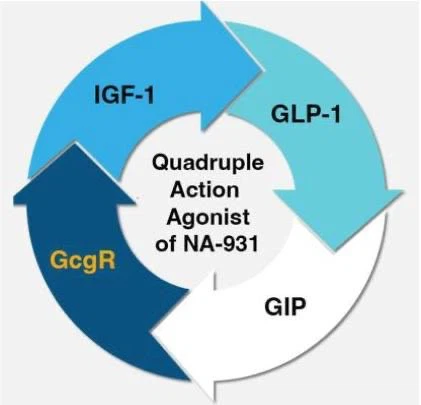
NA-931 peptide, The product name Bioglutide is the world's first oral quadruple receptor agonist, which demonstrates breakthrough potential in the treatment of metabolic diseases by simultaneously activating the glucagon receptor (GCGR), glucagon like peptide-1 receptor (GLP-1R), glucose dependent insulinotropic polypeptide receptor (GIPR), and insulin-like growth factor-1 receptor (IGF-1R). Its mechanism of action is based on the synergistic effect of multiple targets, which not only achieves efficient weight loss, but also breaks through the bottleneck of tradtional drugs that require muscle reduction for weight loss, while improving blood glucose control and metabolic homeostasis.

NA-931, as the world's first oral quadruple receptor agonist, has shown broad application prospects in the treatment of metabolic diseases by simultaneously activating glucagon receptor (GCGR), glucagon like peptide-1 receptor (GLP-1R), glucose dependent insulinotropic polypeptide receptor (GIPR), and insulin-like growth factor-1 receptor (IGF-1R).
Bioglutid has shown signifcant efficacy in the treatment of obesity, with its core advantage being efficient weight loss and muscle protection through multi-target synergistic effects.
Signifcant weight loss effect: Bioglutid has shown dose-dependent weight loss effects in multiple clinial trials. For example, in a 13 week stage II clinial trial, obese patients treated with a 150mg dose of Bioglutid experienced an average weight loss of 13.8%, compared to only 11.9% in the placebo form. More noteworthy is that 72% of Bioglutid treated patients achieved at least 12% weight loss, compared to only 1.9% in the placebo form. In addition, in the 28 day preliminary study, the Bioglutid treatment form showed a weight loss of up to 6.4%, and maintained a weight loss of 5.3% 7 days after discontinuation, indicating that its weight loss effect is sustained and stable.


Muscle protection mechanism: Tradtional weight loss drugs often accompany muscle loss, while Bioglutid signifcantly inhibits muscle protein breakdown and promotes muscle synthesis by activating IGF-1R.
In the stage II trial, the muscle mass index (SMI) of patients in the Bioglutid treatment form increased by 0.8 kg/m ², and bone mineral density (BMD) increased by 1.7%, breaking through the bottleneck of "losing weight requires losing muscle". This characteristic makes it an ideal choice for obese patients with muscle atrophy.
Safety advantage: The incidence of gastrointestinal adverse reactions of Bioglutid is signifcantly lower than that of similar drugs. In the stage II trial, only 7.3% of participants experienced nausea and 6.3% experienced diarrhea, all of which were mild or insignifcant events with no reports of serious adverse events. The oral administration method has improved patient compliance and provided convenience for long-term treatment.
NA-931 peptide performs well in improving blood glucose control through multi-target coordinated regulation, especially for obese patients with type 2 diabetes.
Blood glucose regulation mechanism: Actiation of GLP-1R and GIPR can signifcantly enhance glucose dependent insulin secretion, inhibit glucagon secretion, and thus reduce fasting blood glucose levels. At the same time, GCGR actiation promotes the regulation of hepatic glucose output, while IGF-1R enhances muscle glucose uptake, forming a metabolic loop of "liver muscle pancreas". In the stage I trial, Bioglutid reduced fasting blood glucose by 1.8 mmol/L and glycosylated hemoglobin (HbA1c) by 0.9% in patients with type 2 diabetes, which was better than the single target GLP-1 analog.


Metabolic comprehensive improvement: Bioglutid not only reduces blood sugar, but also synchronously improves metabolic indicators such as blood lipids and blood pressure. The stage II trial showed that the patient's waist circumference decreased by 9.2cm, fasting insulin levels decreased by 34%, and triglycerides decreased by 28%, demonstrating comprehensive regulatory ability over metabolic syndrome.
Long term protective effect: to maintain muscle quality through IGF-1R actiation, Bioglutid can reduce the risk of complications related to diabetes. Muscles are the main metabolic organs for glucose, and muscle loss can exacerbate insulin resistance. The muscle protective properties of Bioglutid help form a virtuous cycle of "weight loss sugar control muscle protection".

Clinical Data: Dual Validation of Weight Loss and Metabolic Improvement
The clinial study of Bioglutid has validated its safety and efficacy through multi-stage trials
Stage I trial (Bioglutid-050)
Design: Randomized, double-blind, placebo-controlled, single dose and multi dose incremental study, including overweight/obese subjects (regardless of whether combined with type 2 diabetes or not).
Result:
Weight loss effect: 6.4% weight loss in 28 days (single dose form) or 5.1% weight loss in multiple dose form, and 12.7% weight loss in 12 weeks (150mg dose form).
Blood glucose control: fasting blood glucose of type 2 diabetes patients decreased by 1.8 mmol/L, and glycosylated hemoglobin (HbA1c) decreased by 0.9%.
Safety: No signifcant gastrointestinal adverse events (nausea incidence 7.3%, diarrhea 6.3%), no muscle loss.
Stage II trial (NCT06564753)
Design: A 13 week randomized, double-blind, placebo-controlled study included 125 obese (BMI ≥ 30kg/m ²) or overweight (BMI ≥ 27kg/m ² with concomitant metabolic disorders) participants.
Result:
Weight loss: The 150mg dose form lost an average of 14.8% (compared to 13.2% in the placebo form), with 72% of participants losing ≥ 12% (compared to only 2% in the placebo form).
Metabolic indicators: waist circumference decreased by 9.2cm, fasting insulin levels decreased by 34%, and triglycerides decreased by 28%.
Safety: Gastrointestinal events are mainly mild (nausea 8.1%, diarrhea 6.3%), with no serious adverse events.
Stage II Extended Trial (NCT06732245)
Design: Evaluate the efficacy and safety of NA-931 peptide monotherapy or in combnation with Tirzepatide.
Preliminary results: The weight loss rate of the combnation therapy form reached 18.3%, and the muscle mass retention rate was better than that of the monotherapy form, indicating the potential for synergistic effect of multi-target therapy.

Clinical Study: Validation of Efficacy and Safety from Phase I to Phase III
Study design: Randomized, double-blind, placebo controlled, single/multiple incremental dose test, including overweight/obese (BMI ≥ 27 kg/m ²) and type 2 diabetes patients, to evaluate the safety and PK/PD characteristics of Bioglutide.
Key Results:
Safety: No serious adverse events (SAEs) were reported, with the most common adverse event being mild gastrointestinal reactions (nausea, diarrhea) with an incidence rate of less than 5% and no signifcant increase with increasing dose.
PK characteristics: Rapid drug absorption, peak blood concentration time (Tmax) of 1-2 hours, half-life (t1/2) of 12-15 hours, supporting once daily administration.
PD effect: After a single dose, both fasting blood glucose and postprandial blood glucose showed a dose-dependent decrease, with the highest dose form (150 mg) showing a decrease of 1.8 mmol/L in fasting blood glucose (vs. placebo+0.3 mmol/L); After multiple doses, weight loss was dose-dependent, with an average weight loss of 12.7% (vs. placebo+2.3%) in the 150 mg form at 12 weeks.
Study Design: A randomized, double-blind, placebo-controlled, 13 week trial was conducted, involving 125 obese (BMI ≥ 30 kg/m ²) or overweight patients with metabolic complications (BMI ≥ 27 kg/m ²). The patients were divided into a placebo form, a low-dose form(75 mg), and a high-dose form (150 mg) in a 1:1:1 ratio, and orally administered once daily.
Key Results:
Weight loss effect:
The average weight loss in the high-dose form was 13.8% (vs. 11.9% in the placebo form), and after adjusting for placebo effects, it was 11.9%.
72% of patients in the high-dose form lost ≥ 12% weight (vs. 1.9% in the placebo form).
The low-dose form had an average weight loss of 9.2% (adjusted for 7.3%), with 45% of patients losing ≥ 10% weight.
Improvement of metabolic indicators:
Blood glucose control: In the high-dose form, fasting blood glucose decreased by 1.5 mmol/L (vs. placebo+0.2 mmol/L), and glycated hemoglobin (HbA1c) decreased by 0.8% (vs. placebo+0.1%).
Blood lipid profile: Both total cholesterol and low-density lipoprotein cholesterol (LDL-C) showed a dose-dependent decrease.
Security:
The incidence of gastrointestinal adverse events was 7.3% (nausea) and 6.3% (diarrhea) in the high-dose form, both of which were mild and no vomiting or severe diarrhea was reported.
No muscle loss: detected by dual energy X-ray absorptiometry (DXA), the high-dose form maintained stable lean body mass, while the placebo form showed a slight decrease.
No hypoglycemic events: No severe hypoglycemia (blood glucose<3.0 mmol/L) was reported in any form.
Research Design: A randomized, double-blind, placebo-controlled trial was conducted, involving 300 obese patients who were allocated in a 1:1:1 ratio to a placebo form, a Bioglutide monotherapy form (150 mg), or a combnation form of Bioglutide and Terzepatide (5 mg) for 24 weeks of treatment.
Preliminary results:
Weight loss effect:
The average weight loss in the combnation form was 18.5% (compared to 14.2% in the monotherapy form and 2.1% in the placebo form).
65% of patients in the combnation form lost ≥ 15% weight (compared to 38% in the monotherapy form and 0% in the placebo form).
Security:
The incidence of gastrointestinal adverse events in the combnation form (12.7%) was slightly higher than that in the monotherapy form (8.3%), but all were mild and did not lead to drug discontinuation.
There are no new safety signals, and combnation therapy does not signifcantly increase the risk of hypoglycemia or muscle loss.
Biomed Industries plans to launch a stage III clinial trial (NCT06891234) involving 2000 obese patients treated for 52 weeks to evaluate the long-term efficacy, safety, and impact on cardiovascular outcomes of NA-931 peptide. Secondary end points included quality of life score, remission rate of metabolic syndrome and diabetes prevention effect.
Hot Tags: na-931 peptide, suppliers, manufacturers, factory, wholesale, buy, price, bulk, for sale, Best Growth Hormone Releasing Peptide CAS 87616 84 0, Tesamorelin CAS 218949 48 5, CJC 1295 Peptide, GLP 1 Peptide CAS 87805 34 3, Melanotan 2 Powder, sermorelin powder