




Shaanxi BLOOM Tech Co., Ltd. is one of the most experienced manufacturers and suppliers of cyclohexanol liquid cas 108-93-0 in China. Welcome to wholesale bulk high quality cyclohexanol liquid cas 108-93-0 for sale here from our factory. Good service and reasonable price are available.
Cyclohexanol liquid is an organic compound with chemical formula C6H12O, CAS 108-93-0. The appearance is colorless transparent oily liquid or white needle crystal. It has camphor like odor, hygroscopic, soluble in water, and can be miscible with ethanol, ether, ethyl acetate, acetone, chloroform, benzene, carbon disulfide, turpentine, linseed oil, aliphatic hydrocarbons, aromatic hydrocarbons, halogenated hydrocarbons. It can be used to prepare adipic acid, hexamethylene diamine, cyclohexanon, cyclohexylamine, caprolactam, etc.

|
Chemical Formula |
C6H12O |
|
Exact Mass |
100 |
|
Molecular Weight |
100 |
|
m/z |
100 (100.0%), 101 (6.5%) |
|
Elemental Analysis |
C, 71.95; H, 12.08; O, 15.97 |
|
|
|
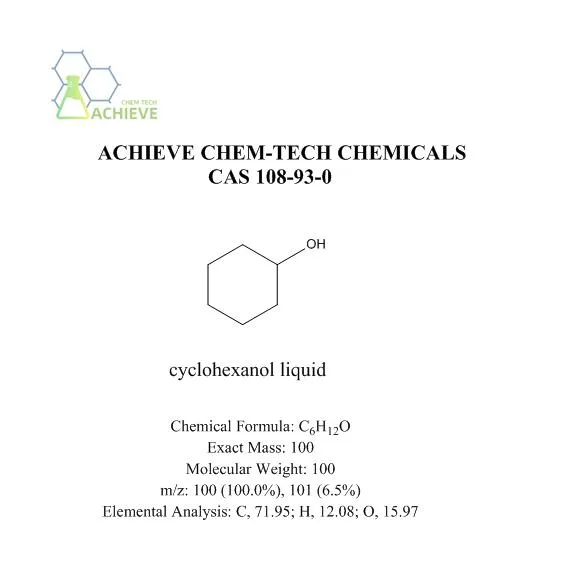


Cyclohexanol is an important organic compound with the chemical formula C6H12O. It appears as a colorless transparent oily liquid or white needle shaped crystals, with a camphor odor. It is slightly soluble in water, but can be mixed with various organic solvents such as ethanol, ether, and benzene. Due to its unique physical and chemical properties, cyclohexanol has a wide range of applications in various fields such as chemical, pharmaceutical, daily chemical, rubber, leather, textile, metal processing, petroleum processing, laboratory research, etc.
Nylon monomer production:
Cyclohexanol liquid is a key raw material for the production of nylon 6 and nylon 66. In the production of nylon 6, cyclohexanol is first oxidized to cyclohexanon, and then converted into caprolactam through Beckmann rearrangement reaction, which is the monomer of nylon 6. In the production of nylon 66, cyclohexanol is converted into adipic acid through oxidation, ammonification, and other steps, and then condensed with hexamethylenediamine to produce nylon 66. Nylon 6 and nylon 66 have excellent wear resistance, strength, and heat resistance, and are widely used in fields such as textiles, engineering plastics, and automotive parts.
Plasticizers and surfactants:
Cyclohexanol can be used to produce plasticizers such as cyclohexyl phthalate, which can significantly improve the flexibility and processability of plastics. It is widely used in PVC products, films, pipes, and other fields. In addition, cyclohexanol can also be used to synthesize surfactants for use in detergents, emulsifiers, and other products, improving their stain removal ability and stability.

Solvent and extractant

Coatings and paints:
Cyclohexanol, as a solvent in coatings and paints, can improve the flowability and film-forming properties of coatings, enhance the glossiness and adhesion of coatings. At the same time, cyclohexanol can also be used as a coating admixture to adjust the drying speed and hardness of the coating.
Rubber and resin:
Cyclohexanol is an important solvent in rubber and resin processing, which can dissolve various additives and promote the mixing and molding of rubber and resin. In addition, cyclohexanol can also be used as a rubber stabilizer to improve the strength and wear resistance of rubber products.
Metalworking:
In metal processing, cyclohexanol can be used as a component of metal detergents and polishing agents to remove oil and rust from metal surfaces, improve the smoothness and corrosion resistance of metal surfaces.
Laboratory study:
Cyclohexanol is commonly used as a solvent or extractant in organic synthesis reactions in the laboratory, and its solubility differences in different organic compounds are utilized to achieve the separation and purification of target compounds.

Leather processing

Leather degreasing
Cyclohexanol, as a degreaser in leather processing, can effectively remove oil and impurities from leather, making it softer and easier to process. Meanwhile, cyclohexanol can also improve the breathability and moisture absorption of leather, enhancing the comfort of leather products.
Leather delamination
During the leather peeling process, cyclohexanol can help the leather to smoothly detach from the mold without leaving any marks on the leather surface, maintaining the integrity and aesthetics of the leather.
Disinfectant soap and detergent emulsion:
Cyclohexanol has bactericidal and stain removing effects and can be used to manufacture disinfectant soap and detergent emulsion. In disinfectant soap, cyclohexanol can enhance the cleaning and disinfection effects of the soap; In descaling emulsions, cyclohexanol can help remove dirt and oil from the surface of the skin.
Cosmetics:
Cyclohexanol is used as a solvent, stabilizer and preservative in cosmetics to manufacture perfume, cosmetic water, lotion and other products. It can improve the stability and shelf life of cosmetics, while giving the product a good skin feel and aroma.
Pharmaceutical preparations:
In pharmaceutical formulations, cyclohexanol can be used as a solvent or co solvent to help the drug components dissolve and disperse better, improving the bioavailability and efficacy of the drug.

Textile industry

Fiber finishing agent:
Cyclohexanol can be used to produce fiber finishing agents and improve the performance of fibers. For example, using cyclohexanol based fiber finishing agent on pure cotton fabric can make the cotton fabric feel softer and smoother, less prone to wrinkling, and improve the comfort and durability of the fabric.
Dyes and additives:
Cyclohexanol can be used as a solvent or dispersant for dyes and auxiliaries in textile printing and dyeing, helping dyes better penetrate and adhere to fibers, improving dyeing effectiveness and color fastness.
Insecticide raw materials:
Cyclohexanol is an important raw material for the production of certain insecticides. Through chemical reactions, cyclohexanol can combine with other chemicals to produce pesticide products with insecticidal effects. These insecticides can effectively prevent and control pests on crops, protect crop growth, and improve crop yield and quality.
Adjuvants:
Cyclohexanol can also be used as a pesticide additive to improve the dispersibility, adhesion, and permeability of pesticides, enhancing their effectiveness and safety.

Petroleum processing

Crude oil distillation additive:
Adding an appropriate amount of cyclohexanol during crude oil distillation can improve distillation efficiency, enabling more effective separation of different components in crude oil and enhancing the quality and yield of petroleum products.
Oil Additive:
Cyclohexanol can be used to produce lubricant additives, improve the antioxidant, anti-wear, and extreme pressure properties of lubricants, and extend the service life of lubricants and mechanical equipment.
Metal ion determination:
In analytical chemistry, cyclohexanol can be used as a solvent or extractant for colorimetric methods. For example, in the determination of molybdenum and rhenium, cyclohexanol can be used as a solvent to react with thiocyanate to form colored complexes, and the content of metal ions can be determined by colorimetric method. In addition, cyclohexanol can also be used in experiments such as determining aluminum with phenylhydrazine and bismuth with 8-hydroxyquinoline or iodide.
Organic compound extraction:
In the extraction and separation experiments of organic compounds, cyclohexanol can utilize its solubility differences for different organic compounds to extract the target organic compound from the mixed system for further research and analysis.
Manufacturing of special materials

Celluloid plastic:
Cyclohexanol liquid is one of the important raw materials for manufacturing celluloid plastics. Celluloid has good plasticity and transparency, and has been widely used in fields such as photographic film and toys. Cyclohexanol plays a crucial role as a raw material in the synthesis of celluloid.
Other polymer materials:
Cyclohexanol can also be used to synthesize other polymer materials, such as polyurethane, epoxy resin, etc. These polymer materials have excellent physical and chemical properties and are widely used in fields such as construction, automotive, electronics, etc.

The main production methods of cyclohexanol are phenol hydrogenation and cyclohexane oxidation.
Phenol hydrogenation:
In 1906, Β.Н. Ipatiev prepared cyclohexanol through phenol hydrogenation, and was the first to realize industrialization in Baden Aniline Soda Ash Co., Ltd. in Germany. Nickel catalyst is generally used for phenol hydrogenation. The reaction temperature is 150 ℃, the pressure is 2.5MPa, the yield is close to the theoretical value, the product purity is high, and the reaction is stable. In the 1960s, in view of the price of raw materials, cyclohexane oxidation gradually replaced phenol hydrogenation.
Cyclohexanol liquid method:
Cyclohexane oxidation reaction is relatively complex. It first generates cyclohexyl hydrogen peroxide, and then decomposes into cyclohexanol and cyclohexanon. Rate constant ratio of each reaction process: k1/k2=3.7; k3/k4=1.4; k3/k1=24; k4/k2=66. These ratios are almost independent of temperature. It shows that: ① cyclohexanol and cyclohexanon are more easily oxidized than cyclohexane; ② Most cyclohexanon is oxidized by cyclohexanol, and cyclohexanon will generate various oxidation by-products. The reaction can be carried out in the presence of catalyst or without catalyst.
Common catalysts include cobalt salts (cobalt naphthenate, cobalt oleate, etc.) and boric acid. When cobalt salts are used as catalysts, the ketone alcohol ratio of the obtained ketone alcohol mixture (commonly known as ketone alcohol oil, i.e. KA oil) is 1:1~2, and when boric acid is used as catalyst, it is 1:9. However, boric acid recovery system needs to be added. For the process without catalyst, a catalytic decomposition system of cyclohexyl hydrogen peroxide is provided. Cobalt salt method is the most widely used in industry.
Fresh cyclohexane containing 100ppm cobalt naphthenate is mixed with circulating cyclohexane and oxidized with air in a three-stage series reactor. The temperature is 150~160 ℃, the pressure is 0.8~1.0MPa, the reaction time is 10~15min, and the one-way conversion rate is 4%~6%. The reaction tail gas is condensed to recover cyclohexane and high boiling substance, and then vented. After the liquid phase oxidation products are saponified by alkali washing and impurities are removed by water washing, more than 90% of the cyclohexane is recovered by distillation for recycling. After the light heavy components are further removed, an alcohol ketone mixture can be obtained, and cyclohexanol and cyclohexanon can be separated by distillation.
Environmental Impact
► Biodegradability
Cyclohexanol is biodegradable under aerobic conditions. Microorganisms in the environment can break down cyclohexanol into simpler compounds such as carbon dioxide and water. However, the rate of biodegradation can be affected by factors such as temperature, pH, and the presence of other substances in the environment.
► Toxicity to Aquatic Life
Cyclohexanol can be toxic to aquatic organisms at high concentrations. It can affect the growth, reproduction, and survival of fish, algae, and other aquatic species. Therefore, proper disposal and treatment of wastewater containing cyclohexanol are essential to minimize its impact on the aquatic environment.
► Air Emissions
During the production and use of cyclohexanol, volatile organic compounds (VOCs) may be emitted into the atmosphere. These VOCs can contribute to air pollution and the formation of ground - level ozone, which can have adverse effects on human health and the environment. Control measures such as the use of air pollution control devices are necessary to reduce these emissions.
Cyclohexanol liquid is a versatile organic compound with significant industrial importance. Its physical and chemical properties make it suitable for a wide range of applications, including the production of nylon, as a solvent, and in the fragrance industry. However, its production, use, and disposal also have environmental and safety implications. By implementing proper production processes, environmental control measures, and safety precautions, we can maximize the benefits of cyclohexanol liquid while minimizing its negative impacts on the environment and human health.
Hot Tags: cyclohexanol liquid cas 108-93-0, suppliers, manufacturers, factory, wholesale, buy, price, bulk, for sale, DBDMH, Solvent, Potassium Formate Powder, Dichloromethane Solution, 4 Hydroxyacetophenone CAS 99 93 4, Sodium Cyanoborohydride Solution CAS 25895 60 7