




Shaanxi BLOOM Tech Co., Ltd. is one of the most experienced manufacturers and suppliers of stannic oxide powder cas 18282-10-5 in China. Welcome to wholesale bulk high quality stannic oxide powder cas 18282-10-5 for sale here from our factory. Good service and reasonable price are available.
Stannic oxide powder is an inorganic substance with the chemical formula SnO2, CAS 18282-10-5, It is a white, light yellow or light gray powder with tetragonal, hexagonal or rhombohedral crystal system. Melting point 1630 ℃, boiling point 1800 ℃. Density of 6.95 g/mL at 25 ° C, it is also an excellent transparent conductive material. It is the first transparent conductive material to be put into commercial use. In order to improve its conductivity and stability, doping is often used, such as SnO2: Sb, SnO2: F, etc. It is an important semiconductor sensor material, and gas sensors prepared with it have high sensitivity. They are widely used for the detection and prediction of various combustible gases, environmental pollutants, industrial waste gases, and harmful gases. Humidity sensors prepared using SnO2 as the matrix material have applications in improving indoor environments, precision instrument and equipment rooms, as well as libraries, art galleries, museums, and other places. By doping a certain amount of CoO, Co2O3, Cr2O3, Nb2O5, Ta2O5, etc. into SnO2, varistors with different resistance values can be made, which are used in power systems, electronic circuits, household appliances, and other fields.

|
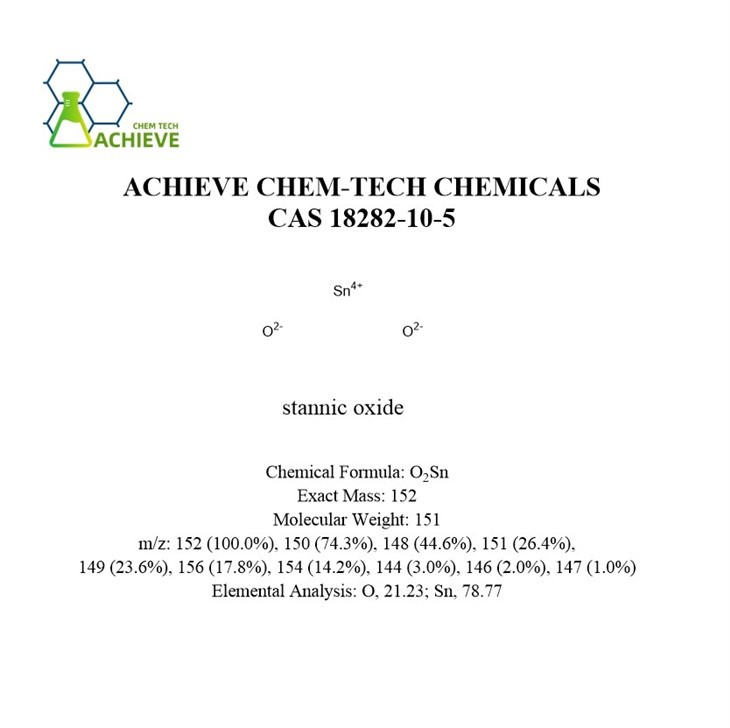
Chemical Formula |
O2Sn |
|
Exact Mass |
152 |
|
Molecular Weight |
151 |
|
m/z |
152 (100.0%), 150 (74.3%), 148 (44.6%), 151 (26.4%), 149 (23.6%), 156 (17.8%), 154 (14.2%), 144 (3.0%), 146 (2.0%), 147 (1.0%) |
|
Elemental Analysis |
O, 21.23; Sn, 78.77 |
|
|
|


Stannic oxide powder (SnO ₂), an important inorganic compound, plays an indispensable role in the electronics industry due to its unique physical and chemical properties. Its excellent electrical, optical, and chemical stability make it an ideal choice for various electronic devices and materials.
Gas sensor
The application in the field of gas sensors is particularly noteworthy. A gas sensor is a device capable of detecting specific gas components or concentrations in the air, widely used in environmental monitoring, industrial safety, medical health, and other fields. As a sensitive material for gas sensors, it has high sensitivity and selectivity towards multiple gases, and is therefore widely used in the preparation of various types of gas sensors.
1. Combustible gas sensor
Purpose: To detect combustible gases in the air, such as methane, hydrogen, carbon monoxide, etc., to prevent fire and explosion accidents.
Example: In coal mines, petrochemical plants, gas stations, and other places, using their base gas sensors to monitor the concentration of combustible gases in the air in real time to ensure production safety.
2. Environmental pollution gas sensor
Purpose: To detect environmental pollutants in the air, such as nitrogen dioxide, sulfur dioxide, ozone, etc., evaluate air quality, and provide data support for environmental protection.
Example: In urban environmental monitoring stations, traffic intersections, and other locations, gas sensors are used to monitor the concentration of environmental pollutants in the air, providing a basis for the government to formulate environmental policies.


3. Industrial waste gas sensors
Purpose: To detect harmful components in industrial waste gas, such as ammonia and hydrogen sulfide, to ensure that industrial emissions meet environmental standards.
Example: In industrial sites such as chemical plants, steel mills, paper mills, etc., their base gas sensors are used to monitor the concentration of harmful components in industrial waste gas, and timely detect and deal with excessive emissions.
4. Harmful gas sensors
Purpose: To detect harmful gases in the air, such as chlorine and phosgene, and prevent chemical accidents and poisoning incidents.
Example: In chemical plants, laboratories, and other places, using their gas sensors to monitor the concentration of harmful gases in the air in real time to ensure personnel safety.
Transparent conductive film
It is an excellent transparent conductive material with high transparency and good conductivity. This characteristic makes it an ideal choice for manufacturing transparent conductive films. Transparent conductive films have a wide range of applications in fields such as touch screens, liquid crystal displays (LCDs), and solar cells.
1. Touch screen
Purpose: As a conductive layer for touch screens, it enables touch operations.
Example: Transparent conductive films are widely used in the conductive layer of capacitive touch screens in electronic devices such as smartphones and tablets, allowing users to easily perform operations such as sliding and clicking.
2. Liquid Crystal Display (LCD)
Usage: As an electrode material for LCD, it enables image display.
Example: In liquid crystal displays, transparent conductive films are used as electrode materials to display images by controlling the voltage changes on the electrodes. This technology is widely used in electronic devices such as televisions, computer monitors, and mobile phones.


3. Solar cells
Usage: As an electrode material for solar cells, it improves the photoelectric conversion efficiency of the battery.
Example: In solar cells, transparent conductive films are used as electrode materials, and their high transparency and conductivity enable sunlight to be more effectively absorbed and converted into electrical energy. This technology has been widely applied in the field of photovoltaic power generation, making important contributions to the development of renewable energy.
Lithium ion battery
Stannic oxide powder has high lithium storage capacity and good cycling stability, and is therefore widely used in the field of lithium-ion batteries. Lithium ion batteries are currently one of the most commonly used battery technologies, with advantages such as high energy density, long cycle life, and no pollution. They are widely used in fields such as mobile electronic devices and new energy vehicles.
2. Quantum dot tin dioxide
Usage: As a new type of positive electrode material for lithium-ion batteries, it provides higher capacitance and energy density, improves the cycle life and safety performance of the battery.
Example: Quantum dot tin dioxide is a nanomaterial with a unique structure and controllable optoelectronic properties. By controlling factors such as the size, shape, and shell structure of quantum dots, the electrochemical performance of lithium-ion batteries can be improved. For example, by controlling the size of quantum dots to reduce the expansion rate and volume change of materials, the cycle life of lithium-ion batteries can be improved. In addition, quantum dot tin dioxide can reduce thermal runaway and internal short circuits in batteries, improving their safety performance. This technology provides a new direction for the development of lithium-ion batteries.


1. Negative electrode material
Usage: As a negative electrode material for lithium-ion batteries, it provides high energy density and long cycle life.
Example: In lithium-ion batteries, it is used as a negative electrode material to achieve charging and discharging of the battery through lithium insertion and removal processes. This technology is widely used in electronic devices such as smartphones, laptops, and electric vehicles, providing reliable energy support for their operation.
Humidity sensor
It also has excellent humidity sensitivity and is therefore used to prepare humidity sensors. A humidity sensor is a device that can detect changes in humidity in the air and is widely used in fields such as agriculture, food processing, and precision instruments and equipment.
1. Agricultural field
Purpose: To monitor soil moisture in farmland and guide irrigation and fertilization work.
Example: In farmland, using its moisture sensitive sensor to monitor soil moisture in real time, guiding irrigation work based on humidity data, improving water resource utilization efficiency, and promoting crop growth.
2. Food processing field
Purpose: To monitor humidity changes during the food production process, ensuring food quality and safety.
Example: In the process of food processing, using its base humidity sensor to monitor the humidity changes in the production environment in real time, timely detect and deal with problems of high or low humidity, and ensure food quality and safety.


3. Precision instrument and equipment field
Purpose: To monitor humidity changes in precision instrument equipment rooms and prevent equipment from being damaged by moisture.
Example: In the precision instrument equipment room, tin dioxide based humidity sensors are used to monitor the humidity changes in the room in real time, detect and deal with high humidity problems in a timely manner, prevent equipment from being damaged by moisture, and ensure the normal operation of the equipment.
Varistor
By doping a certain amount of other oxides (such as CoO, Co2O3, Cr2O3, Nb2O5, Ta2O5, etc.) into it, varistors with different resistance values can be made. Varistors are resistance devices with nonlinear volt ampere characteristics, widely used in power systems, electronic circuits, household appliances, and other fields.
1. Power system
Purpose: To protect electrical equipment in the power system from damage caused by overvoltage and overcurrent.
Example: In the power system, tin Stannic oxide powder based varistors are used as overvoltage protection devices. When the voltage in the power system exceeds the set value, the resistance of the varistors will rapidly decrease, absorbing and converting the overvoltage into heat energy to be released, thereby protecting electrical equipment from damage.
2. Electronic circuits
Purpose: To protect components in electronic circuits from damage caused by surge voltage and transient voltage.
Example: In electronic circuits, tin dioxide based varistors are used as surge voltage protection devices. When the voltage in the electronic circuit suddenly rises, the varistors quickly absorb and consume excess energy, thereby protecting the components in the circuit from damage.


3. Household appliances
Purpose: To protect household appliances from external interference such as lightning and static electricity.
Example: In household appliances, tin dioxide based varistors are used as lightning protection devices. When the household appliance is subjected to external interference such as lightning or static electricity, the varistor will quickly absorb and consume the interference energy, thereby protecting the household appliance from damage.
Other applications
In addition to the main applications mentioned above, there are also other applications in the electronics industry.
1. Production of electronic components
Usage: As a raw material or auxiliary material for electronic components, it improves the performance and stability of the components.
Example: In the production process of electronic components, using them as raw materials or auxiliary materials can produce electronic components with excellent performance, such as capacitors, resistors, etc. These components are widely used in various electronic devices and have made important contributions to the development of the electronics industry.
2. Enamel pigments
Usage: As one of the raw materials for enamel pigments, it provides rich colors and patterns for enamel products.
Example: In the production process of enamel products, using it as one of the raw materials for coloring can prepare enamel products with various colors and patterns. These products are not only beautiful and elegant, but also have excellent corrosion resistance and high temperature resistance, and are widely used in fields such as kitchen utensils and sanitary ware.


3. Photocatalytic materials
Usage: As one of the raw materials for photocatalytic materials, it is used for degrading organic pollutants, purifying air and water bodies, etc.
Example: In the process of photocatalytic degradation of organic pollutants, tin dioxide is used as one of the raw materials for photocatalytic materials. It can generate photo generated electron and hole pairs by absorbing sunlight, and then undergo redox reactions with organic pollutants to degrade them into harmless substances. This technology provides new ways and methods for environmental protection and pollution control.
4. Quantum dot luminescent materials
Usage: As one of the raw materials for quantum dot luminescent materials, it is used to prepare high-performance luminescent devices and displays.
Example: In the preparation process of quantum dot luminescent devices, using it as one of the raw materials for quantum dot luminescent materials can optimize the luminescent performance by adjusting parameters such as the size and shape of quantum dots. This technology provides new ideas and methods for the preparation of high-performance light-emitting devices and displays.


Tin oxide exists in the form of cassiterite in nature. Tin ore is generally reddish brown in color, in the form of particles or blocks, and is mostly dispersed in granite. It is the main ore for extracting tin. Tin oxide is stable to both air and heat, insoluble in water and difficult to dissolve in acid or alkali solutions, but soluble in hot concentrated sulfuric acid, molten caustic soda, and potassium hydroxide, and slightly soluble in alkali metal carbonate solutions. Not reacting with general chemical reagents, not reacting with nitric acid. It slowly dissolves into chloride by co heating with concentrated HCl. At high temperatures, it is reduced to metallic tin by reacting with hydrogen gas. Metal tin and CO2 are obtained by reacting with CO, and the reaction is reversible. Method: Tin oxide is obtained by burning tin in air, or by reacting tetravalent soluble tin salts with alkali, or by reacting metallic tin with concentrated HNO3 to form β - stannic acid precipitate, which is then heated and dehydrated.
Stannic oxide powder is also an excellent transparent conductive material. It is the first transparent conductive material to be put into commercial use. In order to improve its conductivity and stability, doping is often used, such as SnO2: Sb, SnO2: F, etc. SnO2 and its doping both have a tetragonal rutile structure, as shown in Figure 1. Red represents O, black represents Sn, SnO2 is composed of two Sn atoms and four O atoms, with a lattice constant of a=b=0.4737nm, c=0.3186nm,c/a=0.637. O2-=0.140nm,Sn4+=0.071nm. SnO2 is an n-type wide bandgap semiconductor with a bandgap of 3.5-4.0 eV, visible and infrared transmittance of 80%, plasma edge located at 3.2 μ m, refractive index>2, extinction coefficient tending towards 0. SnO2 has strong adhesion and can bond with glass and ceramics up to 20 MPa. Its Mohs hardness is 7-8, and it has good chemical stability and can withstand chemical etching. As a conductive film, SnO2's charge carriers mainly come from crystal defects, namely O vacancies and electrons provided by doping impurities.

Tin (Sn) is one of the earliest metals used by humans. As early as 3000 BC, Mesopotamia and ancient Egyptians had mastered the smelting technology of tin, mainly used to make bronze (copper tin alloy). However, tin mainly exists in the form of cassiterite (SnO ₂) in nature, so ancient craftsmen inevitably came into contact with tin oxide during the smelting process. In the 17th century, with the development of modern chemistry, scientists began to systematically study tin oxides:
Robert Boyle (1660s) mentioned in "The Doubtful Chemist" that tin forms a white powder (i.e. SnO ₂) when heated in air.
Carl Wilhelm Scheele (1770s): It was experimentally proven that heating tin in nitric acid can produce a white precipitate, known as tin oxide.
Joseph Louis Gay Lussac (early 19th century): Further studied the stoichiometric ratio of SnO ₂ and confirmed its molecular formula as SnO ₂.
Ren é Just Ha ü y (1801): First systematic description of the crystal structure of cassiterite, discovering that it belongs to the tetragonal crystal system.
Friedrich Mohs (1820s) classified the hardness of cassiterite as 6-7 on the Mohs scale, which became an important mineralogical reference.
After the Industrial Revolution in the 19th century, the demand for tin surged, and the preparation method of SnO ₂ gradually standardized:
Direct oxidation method: Tin metal is oxidized at high temperatures (>1000 ° C) to form SnO ₂ powder.
Wet chemical method: Tin salts (such as SnCl ₄) react with alkali to form Sn (OH) ₄, which is then calcined to obtain SnO ₂.
Hot Tags: stannic oxide powder cas 18282-10-5, suppliers, manufacturers, factory, wholesale, buy, price, bulk, for sale, 2 ETHYLHEXYL STEARATE, Hydroxylamine hydrochloride powder, Dodecylbenzene CAS 123 01 3, Solvent, cmit isothiazolinone, terephthalic acid powder