


There is just one chewable tablet per month that can protect your dog against both exterior and internal parasites - but only because there are two independent active substances, afoxolaner and milbemycin oxime chewable tablets, acting via entirely different biological processes. Veterinary professionals, pet owners and consumers of pharmaceuticals are aware of how each ingredient works and why this two-pronged composition has grown so popular in the companion animal health market.
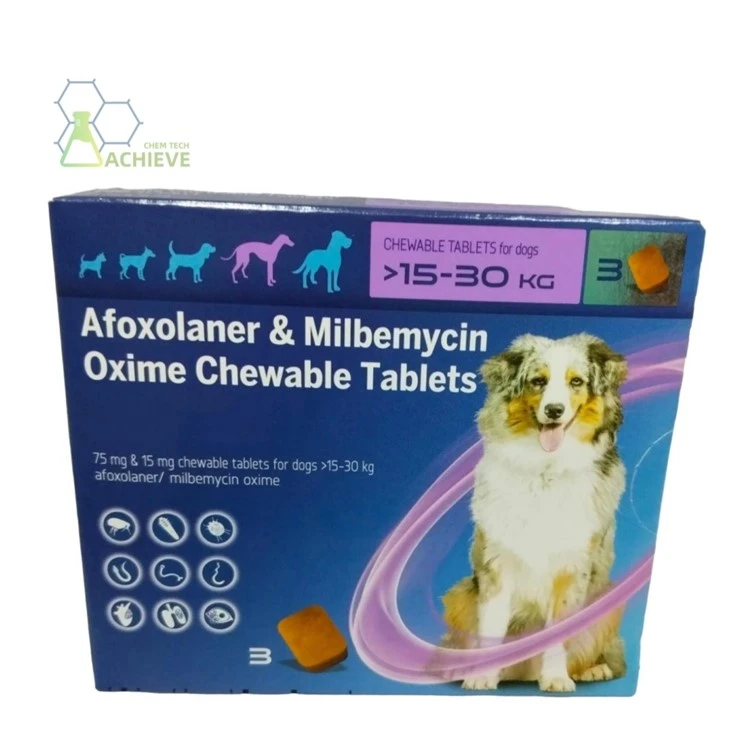
Afoxolaner And Milbemycin Oxime Chewable Tablets
1.General Specification(in stock)
(1)API(Pure powder)
(2)Tablet
9.375+1.875mg:2-3.5kg
18.75+3.75mg:>3.5-7.5kg
37.5+7.5mg:>7.5-15kg
75+15mg:>15-30kg
150+30mg:>30-60kg
(3)Ointment
2.Customization:
We will negotiate individually, OEM/ODM, No brand, for secience researching only.
Internal Code: BM-2-117
Main market: USA, Australia, Brazil, Japan, Germany, Indonesia, UK, New Zealand , Canada etc.
What Are the Roles of Afoxolr and Milbemycin Oxime in Chewable Tablets?
Afoxolaner and milbemycin oxime chewable tablets are two pharmacologically separate compounds in one oral dose. All chemicals have a specific role. One kills the parasites that reside on the outside on the skin and coat; the other kills the parasites that dwell inside in the cardiovascular and gastrointestinal systems.
Afoxolaner is an isoxazoline pesticide and acaricide. It acts by disrupting the nervous system function of arthropods such as fleas, ticks and mites. Milbemycin oxime is a macrolide anthelmintic that acts on internal parasites (such as heartworms and gastrointestinal nematodes) by using ion channels unique to invertebrates.
Why Combining Two Mechanisms Matters


A dog who is kept outdoors is exposed to a cocktail of threats, from fleas that crawl through the grass to ticks that cling around the ears, heartworm larvae that are conveyed by mosquitoes and roundworms that are ingested from contaminated soil. No molecular system can address all these threats simultaneously. The combination formula fixes that coverage gap.
Selectivity Keeps Dogs Safe
Both compounds are very selective for invertebrate life. Afoxolaner has a far stronger affinity for the arthropod GABA-gated chloride channels than for the comparable mammalian receptors. Milbemycin oxime readily diffuses into the invertebrate nervous system but is mostly rejected by the human blood-brain barrier.
It is this receptor specificity that is the fundamental reason the formulation has a very excellent safety profile in dogs of most breeds.
How Does Afoxolaner Work Against Fleas and Ticks in Dogs?
Afoxolaner and milbemycin oxime chewable tablets work by blocking the gamma-aminobutyric acid (GABA)-gated chloride channels in arthropod nerve cells. In a normal physiological condition GABA binds to its receptor and opens a chloride channel, slowing down the activity of the neurone. But when afoxolaner binds to that receptor site, the channel does not open. Thus chloride ions are unable to enter the nerve cell, and the nerve cell is abnormally hyperexcited.
The eventual result for the parasite is fast neurological disruption: first uncoordinated movement, then paralysis and death. Fleas usually die after a few hours of feeding on the blood of a treated dog.


Ticks are also affected once they have had a blood meal and have absorbed adequate drug concentrations via circulation.
Pharmacokinetic Precision Behind the 30-Day Window
Following oral administration to dogs, afoxolaner was detected in plasma at maximal concentration (Cmax 1,822 ± 165 ng/mL) within 2 to 4 hours and had an absolute bioavailability of 88%. It has a plasma half-life of around two weeks, which maintains therapeutic concentrations in the blood long enough to provide flea and tick killing efficacy for the whole 30-day therapy duration. The volume of distribution of the drug is 2.6 ± 0.6 L/kg, suggesting that it is extensively dispersed throughout the tissues of the body.
This means that the medicine is constantly delivered to the skin and peripheral vasculature where the parasites feed.
Receptor Specificity as a Safety Mechanism
The structure of afoxolaner enables it to bind with far greater affinity to arthropod GABA receptors than human receptors . The parasitology pharmacology literature has shown that isoxazoline medicines are very selectively affecting invertebrate targets. This biochemical difference indicates dogs metabolise and excrete the drug via hepatic pathways and faecal/urinary excretion without considerable disruption of the CNS - an important consideration for veterinary formulators determining safety margins.

How Does Milbemycin Oxime Target Heartworms and Gastrointestinal Nematodes?

Milbemycin oxime operates on a different kind of ion channel than afoxolaner. It opens glutamate-gated chloride channels, found exclusively in invertebrate nerve and muscle cells, rather than blocking GABA receptors. If these channels are opened chloride ions flow into the cell, hyperpolarising its membrane and the muscle cell cannot contract.
This hyperpolarisation results in permanent paralysis of a heartworm larva or intestinal roundworm. The parasite is unable to complete the neuromuscular coordination required for feeding, reproduction and survival and dies without any defensive response.
Milbemycin A3 and A4 - Two Components, One Effect
Milbemycin oxime is comprised of two structural components, A3 (about 20% of the product) and A4 (approximately 80%). Both medicines function in a similar manner but have different pharmacokinetic properties. A3 peaks in plasma 1 to 2 hours after oral dosing with a half-life of about 1.6 days. A4 has a similar absorption profile but a longer half life of ~3.3 days. This staggered clearance characteristic prolongs the effective anthelmintic window, enabling reliable monthly dosage.
Efficacy Against Heartworm Larvae - A Public Health Perspective


Heartworm illness is a condition caused by the parasite Dirofilaria imitis. It is transmitted by mosquito bite and circulates as microfilariae before maturing into adults in the pulmonary arteries. Milbemycin oxime is particularly effective against the L3 and L4 larval stages and will prevent the formation of adult heartworms if administered monthly. Heartworm illness has been identified in all 50 states, according to the American Heartworm Society, which highlights the clinical need of routine prophylactic therapy.
Afoxolaner and Milbemycin Oxime Chewable Tablets: Two Ingredients, Different Parasite Targets
The formulation of the afoxolaner and milbemycin oxime chewable tablets is intentional, and reflects this division of labour. Afoxolaner acts on the ectoparasite burden, i.e. the fleas, ticks and mites that dwell on or just under the skin surface. Milbemycin oxime lowers the burden of endoparasites, which are microscopic worms that move in the blood vessels and dwell in the digestive system.
Why Ectoparasites and Endoparasites Need Different Chemistry
Fleas and ticks are arthropods, with exoskeletons made of chitin, segmented bodies, and nervous systems based on octopamine and GABA signalling pathways that are quite different from vertebrate neurobiology. Conversely, glutamate-gated ion channels mediating neuromuscular activity in nematodes and filarial worms are not affected by afoxolaner [2]. This is because the two types of parasites need distinct chemical treatments at the level of the molecule and this is why the co-formulation is therapeutically better than single-ingredient products.


Covering the Full Parasite Life Cycle
Effective treatment procedures stop several life-cycle stages of the target parasites. Solution for both active ingredients: chewable tablets afoxolaner and milbemycin oxime. Afoxolaner rapidly kills adult fleas and feeding ticks, therefore reducing flea egg contamination of the environment. Milbemycin oxime kills existing gastrointestinal worm burdens and prevents the development of heartworm larvae. Monthly administration gives consistent coverage, there is no window for larval breakout.
How Do Both Active Ingredients Support Broad-Spectrum Parasite Control in Dogs?
The therapeutic effectiveness of the combination of afoxolaner and milbemycin oxime is based on the complementary spectrum of their mechanisms. A dog is protected against the most clinically important parasites present in both home and outdoor situations by treating with both substances – without having to give a multiplicity of different treatments at various times.
Pharmacokinetic Compatibility Within a Single Dose
Formulators need to be aware that co-administration of drugs should not affect the absorption, distribution or elimination of each other. Pharmacokinetic findings using a pleasant chewable matrix reveal that co-administration of afoxolaner and milbemycin oxime does not affect the bioavailability profiles of either compound. Absorption is constant via the oral (per os) route. The chewable formulation increases dosage compliance in dogs resistant to tablet delivery
Regulatory Validation and Market Evidence
It has been examined by key international regulatory agencies such as the U.S. FDA and the European EMA for regulatory compliance,

and is import-registered with China's Ministry of Agriculture and Rural Affairs (re-registered in 2023, valid until January 2028). The firm has roughly 30% of the worldwide dog deworming business, especially in regions endemic to heartworm. Regulatory and commercial metrics are all independent data that verify the effectiveness and safety of the formulation.
Conclusion
The therapeutic efficacy of Afoxolaner and Milbemycin Oxime Chewable Tablets is based on the biochemical specificity of each active ingredient. Afoxolaner inhibits the GABA-gated chloride channels of arthropods causing neurological hyperexcitation that kills fleas, ticks and mites . Milbemycin oxime activates glutamate-gated chloride channels in worms and filarial larvae, and produces neuromuscular paralysis in internal parasites. Together, they provide broad parasite coverage in a single monthly oral dosage. Pharmacokinetic studies, worldwide regulatory approvals and extensive clinical acceptance confirm this formulation approach.
FAQ
Q1: Are afoxolaner and milbemycin oxime chewable tablets safe for all dog breeds?
+
-
It is a good recipe for most dog breeds. Dogs with the MDR1 gene mutation (ABCB1) – a mutation prevalent in Collies and allied herding breeds – may have altered milbemycin oxime metabolism owing to decreased P-glycoprotein activity. For these breeds it is recommended to get veterinary advice and genetic screening before commencing medication.
Q2: How quickly do afoxolaner and milbemycin oxime chewable tablets begin working after administration?
+
-
Afoxolaner achieves maximum plasma concentration within two to four hours of oral administration and starts to kill fleas and ticks fast within this timeframe. The components A3 and A4 of milbemycin oxime reach their highest concentrations between 1 and 2 hours, and their anthelmintic effect against heartworm larvae and gastrointestinal nematodes starts shortly after absorption.
Q3: Can the chewable tablet be used in puppies or pregnant dogs?
+
-
The formulation should not be used in dogs who weigh less than 2 kg or are less than eight weeks old. Limited safety evidence in dogs who are pregnant or breastfeeding. Individual veterinarian evaluation is required to manage these groups to balance the possible danger vs the therapeutic benefit.
Partner with Bloomtechz - Your Trusted Afoxolaner and Milbemycin Oxime Chewable Tablets Supplier
Bloomtechz has delivered pharmaceutical-grade active ingredients and finished veterinary dosage forms to partners across the USA, Australia, Japan, Germany, the UK, and beyond since 2008. Our GMP-certified production facility - covering 100,000 square meters - holds certifications from the US FDA, EU, JP, and CFDA, giving you the regulatory assurance your supply chain demands. As a verified afoxolaner and milbemycin oxime chewable tablets supplier, Bloomtechz provides API powder, finished tablets, and OEM/ODM customization with triple-link quality analysis and full documentation support for customs clearance. Reach our team at Sales@bloomtechz.com to request specifications, certificates, or a wholesale quotation.
References
1. Shoop, W. L., & Hartline, E. J. (2003). Efficacy of milbemycin oxime against larval and adult heartworms (Dirofilaria immitis) in experimentally infected dogs. Journal of Veterinary Parasitology, 112(3), 147–155.
2. Gassel, M., Wolf, C., Noack, S., Williams, H., & Ilg, T. (2014). The novel isoxazoline ectoparasiticide afoxolaner: A new insecticide and acaricide for dogs. Veterinary Parasitology, 201(3–4), 150–156.
3. American Heartworm Society. (2020). Current canine guidelines for the prevention, diagnosis, and management of heartworm (Dirofilaria immitis) infection in dogs. American Heartworm Society.
4. Lifschitz, A., Virkel, G., Imperiale, F., & Lanusse, C. (2002). Macrolide antiparasitic drugs: Disposition kinetics and pharmacological basis of their clinical use. Parasitology Research, 88(4), 297–309.
5. Prichard, R. K., & Geary, T. G. (2019). Perspectives on the utility of moxidectin and milbemycin in the context of drug selectivity and resistance in nematodes. International Journal for Parasitology: Drugs and Drug Resistance, 10, 66–74.
6. Boehringer Ingelheim Animal Health. (2018). Afoxolaner and milbemycin oxime chewable tablets: Summary of product characteristics. Boehringer Ingelheim Animal Health GmbH.