




Shaanxi BLOOM Tech Co., Ltd. is one of the most experienced manufacturers and suppliers of alarelin 5mg in China. Welcome to wholesale bulk high quality alarelin 5mg for sale here from our factory. Good service and reasonable price are available.
Alarelin 5mg is a highly pure synthetic GnRH nonapeptide agonist, with approximately 15 times the activity of natural GnRH, mainly supplied for research and experimental purposes. In the initial stage, it can transiently stimulate the release of LH/FSH to trigger a short-term surge of gonadal hormones; continuous long-term administration downregulates pituitary GnRH receptors and rapidly reduces circulating estradiol, achieving stable and reversible endocrine suppression. It is suitable for studies on the mechanisms of endometriosis, reproductive regulation, hormone-dependent tumors, and other related fields, and also serves as a core tool compound for exploring gonadotropin signal transduction pathways in preclinical animal models.
Our Products Form



Alarelin COA
 |
||
| Certificate of Analysis | ||
| Compound name | Alarelin | |
| Grade | Pharmaceutical grade | |
| CAS No. | 79561-22-1 | |
| Quantity | 42g | |
| Packaging standard | PE bag+Al foil bag | |
| Manufacturer | Shaanxi BLOOM TECH Co., Ltd | |
| Lot No. | 202601090056 | |
| MFG | Jan 9th 2026 | |
| EXP | Jan 8th 2029 | |
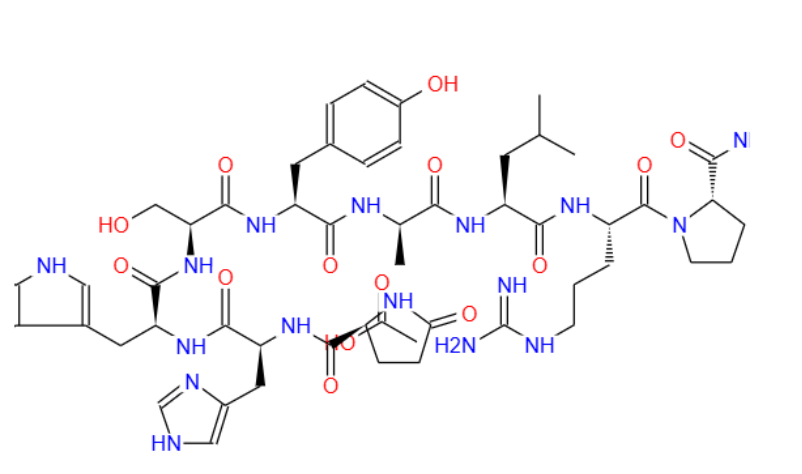
| Structure |
|
|
| Item | Enterprise standard | Analysis result |
| Appearance | White or almost white powder | Conformed |
| Water content | ≤5.0% | 1.11% |
| Loss on drying | ≤1.0% | 0.51% |
| Heavy Metals | Pb≤0.5ppm | N.D. |
| As≤0.5ppm | N.D. | |
| Hg≤0.5ppm | N.D. | |
| Cd≤0.5ppm | N.D. | |
| Purity (HPLC) | ≥99.0% | 99.90% |
| Single impurity | <0.8% | 0.47% |
| Total microbial count | ≤750cfu/g | 547 |
| E. Coli | ≤2MPN/g | N.D. |
| Salmonella | N.D. | N.D. |
| Ethanol (by GC) | ≤5000ppm | 712ppm |
| Storage | Store in a sealed, dark, and dry place below -20°C | |
|
|
||


Mechanism of Action in the Treatment of Endometriosis

(1) Biphasic Regulation of the HPO Axis and Medical Castration
Alarelin 5mg exerts a typical biphasic effect on the HPO axis. In the early stage of administration (1–2 weeks), its high activity enables strong binding to pituitary GnRH receptors, transiently stimulating massive release of luteinizing hormone (LH) and follicle-stimulating hormone (FSH), leading to a temporary elevation of ovarian steroid hormones. Some patients may experience a "flare-up" phenomenon with transient worsening of dysmenorrhea and pelvic pain.
Following continuous administration, sustained receptor activation triggers downregulation and desensitization, rendering the pituitary refractory. LH and FSH secretion is markedly inhibited, ovarian follicular development is arrested, and estradiol (E2) levels rapidly drop to postmenopausal castration levels (<20 pg/ml). This cuts off estrogen supply to ectopic endometrial lesions, achieving reversible "medical oophorectomy". The process is fully reversible: pituitary-ovarian function gradually recovers within 4–12 weeks after drug withdrawal, with no impact on long-term reproductive capacity.


(2) Multiple Inhibitory Effects on Ectopic Endometrial Lesions
Beyond core endocrine suppression, the product exerts direct and indirect multiple effects on ectopic lesions.First, it inhibits the proliferation of ectopic endometrial cells, induces apoptosis, downregulates the expression of estrogen receptors (ER) and progesterone receptors (PR) in lesions, and reduces lesion sensitivity to estrogen.
Second, it reduces local angiogenic factors such as vascular endothelial growth factor (VEGF) and basic fibroblast growth factor (bFGF) in lesions, inhibits neovascularization, blocks nutrient supply to lesions, and shrinks the volume of ectopic cysts and nodules.Third, it alleviates local inflammatory responses in lesions, lowers levels of inflammatory factors including prostaglandins and interleukin-6 (IL-6), relieves pelvic adhesions, pain and immune disorders, and improves the core pathological state of EMS.

(3) Advantages of the 5mg Dosage Form in Mechanistic Applications
The large 5mg dosage form offers flexibility for mechanistic research and clinical application.In scientific research, it allows precise preparation of solutions at varying concentrations for gradient administration in in vitro cell experiments (e.g., ectopic endometrial cell culture) and animal models (e.g., rat EMS models), clarifying dose-response relationships.
Information source: Hunan Pharmaceutical Affairs Service Network Alarelin Package Insert; Yaoyuan.com Alarelin for Injection Package Insert; Remetide Alarelin Product Pharmacological Specification; Benchchem Mechanism Analysis of Alarelin Acetate.
Clinical Applications in Endometriosis
Combination with it after laparoscopic conservative surgery (cyst enucleation, lesion resection) is a standard EMS treatment regimen.Administration starts 1 week postoperatively for 3–6 months, reducing the 2-year postoperative recurrence rate from 40%–50% to 10%–15%, especially beneficial for stage Ⅲ–Ⅳ severe EMS, patients with residual lesions or severe pelvic adhesions.


Endometriosis with Infertility
For EMS-related infertility, it improves the pelvic microenvironment, relieves inflammatory adhesions, and enhances endometrial receptivity.Natural conception or assisted reproductive technology may be pursued following recovery of ovarian function (1–2 cycles of menstrual resumption). The 6-month pregnancy rate after treatment reaches 45%–55%.
Special Types of EMS
Used for deep infiltrating endometriosis (DIE), ectopic lesions at cesarean section/perineal incisions, intestinal/bladder EMS, etc. It shrinks lesions, relieves pain, reduces surgical difficulty, and serves as palliative therapy for inoperable patients.

Information source: Weipu Journal Study on Alarelin Combined with Low-Dose Livial in the Treatment of EMS with Infertility; Weipu Journal Application of GnRHa and Add-Back Therapy in EMS Treatment.
Application in Basic EMS Research

(1) Tool for Disease Mechanism Research
As a standardized GnRH agonist, it is widely used in EMS mechanism research.In vitro: treatment of ectopic endometrial cells to observe changes in the expression of HPO axis-related genes (e.g., GnRH-R, ER, PR), inflammatory factors and angiogenic factors, elucidating the mechanisms of estrogen dependence and immune disorders in EMS.In vivo: establishment of rat/mouse EMS models with Alarelin intervention to study regulatory effects on lesion growth, apoptosis, and inflammatory pathways (e.g., NF-κB, TGF-β/Smads).
(2) New Drug Development and Efficacy Evaluation
Used as a positive control drug for in vitro/in vivo efficacy evaluation of novel EMS therapeutics (e.g., GnRH antagonists, selective estrogen receptor modulators).The effects of test compounds versus Alarelin on ectopic cell proliferation, apoptosis and hormone secretion are compared to assess new drug efficacy and advantages. It is also applied in combination therapy research to explore synergistic effects of Alarelin with traditional Chinese medicines and targeted drugs (e.g., anti-VEGF monoclonal antibodies), developing optimized treatment regimens.


(3) Scientific Research Value of the 5mg Dosage Form
Scientific experiments require high-dose, multi-batch dosing; the 5mg dosage form is cost-effective and economical.It enables precise preparation of stock solutions at varying concentrations to meet gradient requirements for cell experiments (nM–μM concentrations) and animal experiments (μg/kg dosages), ensuring stable and reproducible experimental data. It is a core tool drug in reproductive endocrinology and obstetrics and gynecology.
Information source: Benchchem Scientific Research Applications of Alarelin Acetate; Journal of Clinical Medicine Research on GnRH Antagonists in EMS Treatment.
Clinical Adjuvant Intervention Effect on Hormone-Dependent Breast Diseases
Core Pharmacological Mechanism of Action
Alarelin 5mg features targeted regulation of the pituitary-ovarian hormone axis as its core pharmacological property, blocking pathogenic factors at the source of hormone secretion to meet the therapeutic demands of premenopausal women with hormone-dependent breast diseases. As a long-acting GnRH agonist, the drug exerts a bidirectional effect of transient agonism followed by sustained suppression. After initial administration, it transiently activates anterior pituitary receptors to moderately boost the release of follicle-stimulating hormone (FSH) and luteinizing hormone (LH).


However, upon continuous and regular dosing, pituitary receptor desensitization and downregulation occur, completely blocking persistent gonadotropin synthesis and secretion. By suppressing ovarian gonadal function, the drug markedly reduces baseline peripheral blood levels of estrogen and progesterone, disrupting the hormonal microenvironment required for the survival of breast lesions.
Pathologically, abnormal tissue proliferation and invasive activity in hormone-dependent breast diseases are entirely reliant on continuous estrogen stimulation. Estrogen binds to receptors on breast lesions, driving aberrant cell division and proliferation and exacerbating mammary hyperplasia or tumor progression.
Via pharmacological ovarian suppression, it thoroughly cuts off the hormone supply pathway of lesions, effectively inhibiting excessive proliferation of abnormal breast tissue and enabling gradual atrophy of benign hyperplastic tissue. Meanwhile, it arrests the proliferation cycle of malignant tumor cells and restricts the invasion and dissemination of tiny lesions, controlling disease progression at the root and fully aligning with the core therapeutic concept of endocrine targeted intervention for such disorders.

Core Effects of Clinical Adjuvant Intervention

Management of Benign Hormone-Dependent Breast Lesions
Patients with severe hormone-dependent mammary hyperplasia, intractable adenosis of the breast and other benign lesions commonly present with severe premenstrual and postmenstrual breast distending pain and multiple breast nodules. Conventional symptomatic treatments including detumescence, analgesia and liver-soothing therapy only temporarily relieve discomfort without correcting endocrine disorders, leading to frequent disease recurrence. It steadily regulates the body's hormonal rhythm and rectifies estrogen-progesterone imbalance.
It eliminates pathological changes such as mammary duct dilatation and abnormal acinar hyperplasia induced by excessive hormone stimulation at the source, rapidly alleviating typical clinical manifestations including breast distending pain, indurated lumps and breast tenderness.In addition, it maintains a stable long-term endocrine milieu to prevent disease relapse triggered by repeated hormonal fluctuations, effectively lowering the risk of benign breast lesions progressing to atypical hyperplasia, and providing an efficient conservative intervention regimen for severe benign hormone-dependent breast diseases.


Adjuvant Intervention for Malignant Breast Tumors and Recurrence Prevention
For the intervention of malignant diseases, it serves as a core postoperative endocrine adjuvant agent for premenopausal patients with hormone receptor-positive breast cancer. Clinical studies have verified that ovarian function suppression is a pivotal strategy to reduce postoperative recurrence risk of this subtype of breast cancer.
The drug durably and stably inhibits ovarian estrogen synthesis and secretion, completely blocking the primary endogenous estrogen source and precisely severing the hormone-driven proliferation pathway of tumor cells to suppress the viability of residual tumor cells. Young premenopausal patients possess active ovarian function with volatile hormone levels, conferring a markedly elevated risk of tumor recurrence, and single-agent conventional endocrine therapy yields limited efficacy in this population.

Common Adverse Reactions
Early exacerbation of symptoms: pain, bleeding, etc., possibly caused by hormonal fluctuations.
Hypoestrogenic symptoms: hot flushes, sweating, vaginal dryness, decreased libido, dyspareunia.
Others: headache, asthenia, mood changes, rash; induration at the injection site may occur in individual patients.
Information source: Alarelin for Injection Package Insert; CNKI Adverse Reactions and Management of GnRH-a Drugs in Endometriosis Treatment.

I. API Synthetic Process
Alarelin 5mg API is produced via Fmoc solid-phase peptide synthesis, the mainstream industrial preparation technology.Proline-2-chloro-trityl chloride resin is used as the solid support.
After swelling in dichloromethane, Fmoc-protected amino acids are sequentially coupled from the C-terminus to the N-terminus following the drug sequence (pGlu-His-Trp-Ser-Tyr-D-Ala-Leu-Arg-Pro-NHEt).
Each step involves deprotection of the Fmoc group with piperidine in DMF, condensation using TBTU/HOBt/DIEA as coupling agents, and reaction completion monitored by the ninhydrin method.
After full peptide synthesis, cleavage and deprotection are performed with TFA/H₂O/Tis (95:2:3), followed by ether precipitation to obtain crude product with ~75.8% purity.
Further gradient purification by high-performance liquid chromatography (HPLC) and lyophilization yields a white crystalline powder with purity ≥98%, meeting pharmaceutical-grade standards.
II. 5mg Formulation Production & Molding Process
The product is a lyophilized powder for injection, manufactured in GMP clean rooms.Purified Alarelin API is mixed with excipients including mannitol and sodium acetate per the formulation, dissolved in water for injection to form a drug solution, and sterile-filtered through a 0.22 μm membrane.The solution is quantitatively filled into 7ml vials (5mg Alarelin per vial), partially stoppered, and transferred to a lyophilizer.Lyophilization process: pre-freezing at -45℃ for 6 hours, vacuum sublimation drying for 18 hours, and desorption drying for 5 hours, ensuring moisture ≤3.0%.Final products are fully stoppered, capped, inspected visually, labeled and packaged, with microbial and endotoxin control throughout (≤50 EU/mg).
III. Quality Control Standards & Key Indicators
Complies with the Chinese Pharmacopoeia 2020 Edition and enterprise in-house standards.Core QC indicators:
Assay: 95.0%–105.0%
Related substances: single impurity ≤2.0%, total impurities ≤5.0%
Moisture ≤3.0%
Acetic acid content ≤7.5%
Endotoxin <50 EU/mg
HPLC purity ≥98.0%
Key control points throughout production: raw material testing, synthetic coupling efficiency, cleavage and purification yield, content difference before/after lyophilization, sterility and pyrogen testing.
5mg finished products undergo full testing including content uniformity, clarity, pH (5.0–7.0), and stability (24 months storage at -20℃ protected from light).
Information source: ChemicalBook Preparation and Purification of Alarelin Acetate; NMPA Drug Database; Good Manufacturing Practice (GMP) Requirements for Lyophilized Powder for Injection.
FAQ
What is the drug alarelin used for?
+
-
Alarelin acetate, a synthetic gonadotropin-releasing hormone (GnRH) analogue, is widely used to manage endometriosis and hormone-sensitive malignancies. Although its safety profile is generally favorable, we report the first documented case of severe hepatotoxicity associated with alarelin acetate administration.
Hot Tags: alarelin 5mg, suppliers, manufacturers, factory, wholesale, buy, price, bulk, for sale