


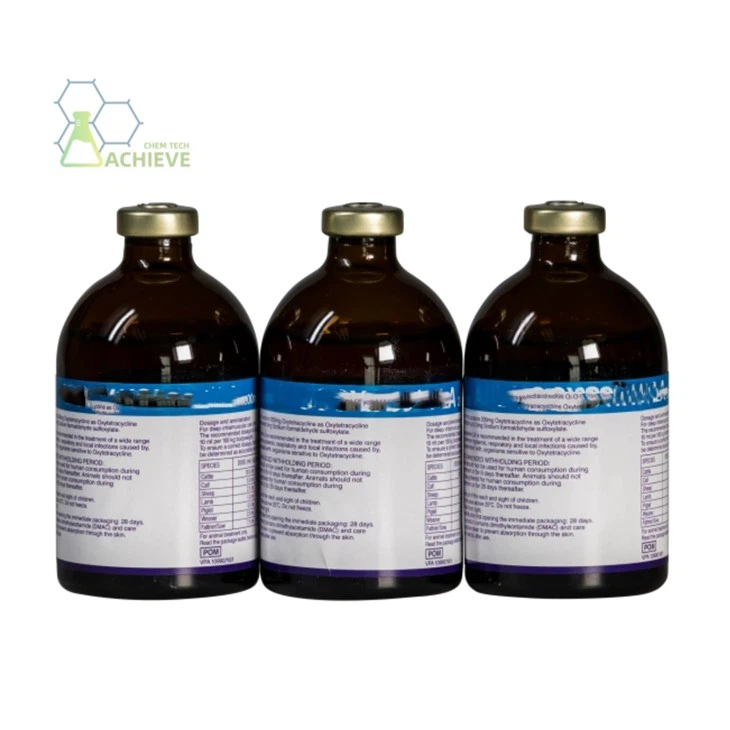



Shaanxi BLOOM Tech Co., Ltd. is one of the most experienced manufacturers and suppliers of chlortetracycline injection in China. Welcome to wholesale bulk high quality chlortetracycline injection for sale here from our factory. Good service and reasonable price are available.
Chlortetracycline injection, produced by the metabolism of Streptomyces coelicolor, has a yellow crystalline form. Its injection form exerts antibacterial effects by inhibiting bacteria protein synthesis. The specific mechanism is to specifically bind to the A site of the bacteria ribosome 30S subunit, block the binding of aminoacyl tRNA to mRNA, and thus inhibit peptide chain extension. As a foundational member of tetracycline antibiotics, its injectable form has played an important role in clinical and veterinary medicine since its fermentation and isolation by Streptomyces aureofaciens in the mid-20th century.
It covers Gram positive bacteria (such as penicillin resistant Staphylococcus aureus and Streptococcus), Gram negative bacteria (such as Pasteurella and Haemophilus influenzae), and atypical pathogens (such as Mycoplasm, Chlamydia, and Rickettsia). Clinically, it is mainly used to treat severe infections caused by sensitive bacteria, such as porcine respiratory diseas syndrome (PRDC), chronic respiratory diseas (CRD) in chickens, and diarrhea in weaned piglets. At the same time, it is used in aquaculture to prevent and treat fish vibriosis, streptococcal diseas, etc. Please note that Enterococcus is naturally resistant to this drug.


Additional information of chemical compound:

Our Product


Chlortetracycline COA


Chlortetracycline injection is a foundational member of tetracycline antibiotics, has played a key role in clinical and veterinary medicine since its isolation from Streptomyces aureofaciens in 1948 in its injectable form. Although the human drug market has significantly shrunk due to drug resistance issues and the rise of new antibiotics, it still remains irreplaceable in specific scenarios.
Chlortetracyclin specifically binds to the 30S subunit of bacteria ribosomes, blocking protein synthesis at multiple stages. Its mechanism of action can be divided into the following three stages:
1. Peptide chain elongation inhibition
The tetraphenylene nucleus structure (containing 4 conjugated benzene rings) in chlorotetracycline molecules tightly binds to the A site of the 30S subunit through hydrophobic interactions, forming a stable complex.


2. Peptide chain release blockade
Chlorotetracycline can bind to the end of synthesized peptide chains, inhibit peptidyl transferase activity, and prevent the release of peptide chains from the P site into the cytoplasm. This mechanism has a significant effect on Gram positiv bacteria, with a peptide chain release blocking rate of up to 95% for Staphylococcus aureus, and a blocking rate of about 60% -70% for Gram negative bacteria due to the outer membrane barrier effect.


3. Changes in cell membrane permeability
High concentrations of chlorotetracycline (≥ 10 μ g/mL) can induce disruption of the phospholipid bilayer structure of bacteria cell membranes, leading to leakage of small molecules such as ATP and nucleotides from the cell. Experiments have shown that after 2 hours of tratment with Escherichia coli, the extracellular ATP concentration increases by 300%, while the intracellular potassium ion concentration decreases by 50%, ultimately leading to bacteria lysis.
The antibacteria spectrum of chlorotetracycline covers Gram positiv bacteria, Gram negative bacteria, and atypical pathogens, and its selective advantages are reflected in the following aspects:
1. Gram positive bacteria
The minimum inhibitory concentration (MIC) for streptococci (such as Streptococcus pyogenes) and staphylococci (including penicillin resistant strains) is 0.1-0.5 μ g/mL.


Clinical data shows that the effective rate of tratment for Streptococcus suis infection in pigs is 82%, significantly higher than penicillin (65%).
2. Gram negative bacteria
The MIC for Haemophilus influenzae and Pasteurella is 0.5-2 μ g/mL, but it is naturally resistant to Pseudomonas aeruginosa.
In the tratment of Porcine Respiratory Diseas Syndrome (PRDC), the combination of chlorotetracycline and tetracycline can reduce the load of Blue Ear Virus (PRRSV) by 40% and increase the clearance rate of Mycoplasm pneumoniae to 75%.
3. Atypical pathogens
The MIC for Mycoplasm, Chlamydia, and Rickettsia is 0.05-0.2 μ g/mL. In the chronic respiratory diseas (CRD) model of chickens, monotherapy with chlorotetracycline can reduce the mortality rate from 30% to 15%, while the combination with tetracycline (3:1 ratio) further reduces the mortality rate to 5% and increases the cure rate to 90%.


The synergistic mechanism of the combination therapy of Chlortetracycline injection is mainly reflected in the synergistic effect with tetracycline and the efficacy expansion effect. Its core mechanism includes multi-target blockade, drug resistance reversal, and pharmacological complementarity. The specific analysis is as follows:
Synergistic mechanism: multi-target blockade and drug efficacy superposition
Target complementarity
It specifically binds to the A site of the 30S subunit of bacteria ribosomes, inhibiting the binding of aminoacyl tRNA to mRNA and blocking peptide chain elongation; Teramycin (a type of truncated pleurotoxin) binds to the peptidyl transferase center of the 50S subunit, inhibiting the release of peptide chains. The combination of the two forms a "30S-50S dual target blockade", which completely blocks the bacteria protein synthesis process.
Experimental data: The chessboard dilution method showed that the FIC index of the combination of Aureociclin and tetracycline on Mycoplasm galliseptica (MG) in chickens was 0.5-0.75 (FIC<0.5 was synergistic, 0.5-1 was additive), indicating a significant synergistic effect between the two. In the in vivo experiment, the mortality rate of the 200mg/L combination group was 40% lower than that of the monotherapy group, and the cure rate was increased by 35%.
Target complementarity
Reversal effect of drug resistance:Teramycin can inhibit the expression of bacteria efflux pumps (such as TetK and TetL), reduce the efflux of Aureociclin, and restore its sensitivity to drug-resistant bacteria.
Experimental data: The combination therapy can restore sensitivity of tetracycline resistant Staphylococcus aureus (MIC>32 μ g/mL) (MIC reduced to 2 μ g/mL) and increase the clearance rate of resistant bacteria by 60%.
Mechanism of drug efficacy expansion: expansion of antibacteria spectrum and shortening of tratment course
Complementary antibacteria spectrum

Chlorotetracycline:
Covers Gram positiv bacteria (such as Staphylococcus aureus and Streptococcus), Gram negative bacteria (such as Haemophilus influenzae and Pasteurella), and atypical pathogens (such as Mycoplasm, Chlamydia, and Rickettsia).
Taimiao Mycoplasm:
It has highly selective activity against Mycoplasm and certain Gram positiv bacteria (such as Mycoplasm hyopneumoniae and Streptococcus suis).
Combination effect:
The combination of the two can cover almost all pathogens in pig herds, including multidrug-resistant strains, except for viruses. For example, the tratment cycle for porcine proliferative enteritis can be shortened from 7 days for monotherapy to 3 days.

Drug resistance response strategy: molecular modification and optimization of medication regimen
Regarding the issue of resistance to chlorotetracycline, current research focuses on the following directions:
Derivative Development
Improve drug stability through structural modification. For example, the water solubility of chlorotetracycline bisulfate (CTC-HS) increased by 5 times, the bioavailability increased from 30% to 65%, and the MIC against tetracycline resistant strains decreased by 50%.
Pulse based dosing regimen
Adopting the "high-dose shock low-dose maintenance" mode can delay the development of drug resistance. In pig farm practice, adding 200g of chlorotetracycline per ton of feed (impact period of 3 days) and reducing it to 50g (maintenance period of 14 days) can reduce the detection rate of drug-resistant bacteria from 45% to 15%.
Standardization of combination therapy
The World Health Organization (WHO) recommends the combination of chlortetracycline injection and beta lactase inhibitors (such as clavulanic acid) to cover enzyme producing strains. Clinical data shows that the cure rate of this regimen for ampicillin resistant Haemophilus influenzae type B meningitis has increased from 60% to 85%.

Aureomycin is industrially produced by microbial fermentation. The process consists of four core stages: strain breeding, submerged fermentation, extraction and purification, and salt formation refining. It represents a classic large-scale manufacturing technology for tetracycline antibiotics.
I. Strain Breeding and Seed Preparation
The production strain is Streptomyces aureofaciens. High-yielding strains are obtained via mutagenesis and high-throughput screening.Seed preparation involves three stages: sand-spore tube → master slant → production slant, with activation at 28 °C for 4–5 days. The activated culture is then inoculated into a seed tank using a medium containing corn starch, peanut meal, and yeast powder, and cultivated at 30 °C under aeration for 24–30 h to obtain robust seed broth.
II. Submerged Fermentation (Core Stage)
Large-scale fermenters of 50–100 m³ are employed. The medium contains carbon sources (corn starch), nitrogen sources (soybean meal, peanut meal), and inorganic salts (potassium dihydrogen phosphate, zinc sulfate, ferric trichloride).Fermentation conditions: temperature 29–31 °C, aeration rate 1:0.8–1 (vvm), tank pressure 0.03 MPa, stirring speed 120–150 r/min. Sugar is fed after 12 h to maintain total sugar at 5.5%–1.5%, with pH controlled at 5.8±0.2. The fermentation cycle is approximately 5 days, and the fermentation titer reaches 15,000–20,000 U/mL.
III. Pretreatment and Extraction of Fermentation Broth
After fermentation, the broth is acidified to pH 1.2–1.4 with hydrochloric acid or oxalic acid, and sodium ferrocyanide and zinc sulfate are added for flocculation and impurity removal.The filtrate is obtained by plate-and-frame filtration. Calcium chloride or magnesium chloride is added to precipitate v calcium salt, and wet cake is collected by filtration.Traditionally, crude aureomycin is obtained by dissolving the cake in ethanol followed by acid precipitation. Modern processes adopt membrane separation and concentration to reduce solvent consumption and improve efficiency.
IV. Refining and Salt Formation
The crude product is dissolved in ethanol, and hydrochloric acid is added for salt conversion, with crystallization controlled at 0–5 °C.After washing with ethanol and vacuum drying below 60 °C, aureomycin hydrochloride is obtained with purity ≥95% and melting point 210–215 °C.Feed-grade product can be directly dried and pulverized. Pharmaceutical-grade product requires recrystallization and decolorization, with heavy metals controlled ≤10 ppm and moisture ≤1.0%.
V. Process Characteristics and Quality Control
Aseptic operation is implemented throughout the process, with online monitoring of dissolved oxygen, pH, and sugar content.Fermentation is energy-intensive, and raw material costs account for more than 50% of total production cost.Products are classified as API, premix, and soluble powder for medical and veterinary use, complying with the standards of the Chinese Pharmacopoeia and FDA.
Adverse reactions and contraindications
1. Adverse reactions of veterinary drugs
Pigs: Long term use of high doses (>100g/t) can cause disruption of gut microbiota, leading to diarrhea or constipation.
Poultry: Use during the egg laying period can cause a decrease in eggshell quality (thickness reduction of 10% -15%), and should be managed during the drug withdrawal period.
Aquatic animals: Soaking in high concentrations (>20mg/L) can cause gill congestion or epidermal shedding, and the dosage should be strictly controlled.
2. Contraindications
Veterinary drugs:Poultry during egg laying period (residual limit in eggs ≤ 100 μ g/kg).Lactating cows (residual limit in milk ≤ 100 μ g/kg).
FAQ
Is aureomycin the same as tetracycline?
+
-
It is a type of tetracycline that was the first of its kind, but is no longer used orally. It has similar pharmacokinetics, therapeutic uses, and adverse effects to other tetracyclines.
Is it natural or synthetic?
+
-
It is produced through a fermentation process using the bacterium Streptomyces aureofaciens, which naturally synthesises Aureociclin as a secondary metabolite.
What is the difference between oxytetracycline and chlortetracycline?
+
-
CTC is more lipid-soluble than OTC and protein binding for both drugs is clinically insignificant, so the volume of distribution of CTC is 24 per cent greater than that of OTC (CTC more readily distributes into body tissues).
Hot Tags: chlortetracycline injection, suppliers, manufacturers, factory, wholesale, buy, price, bulk, for sale