


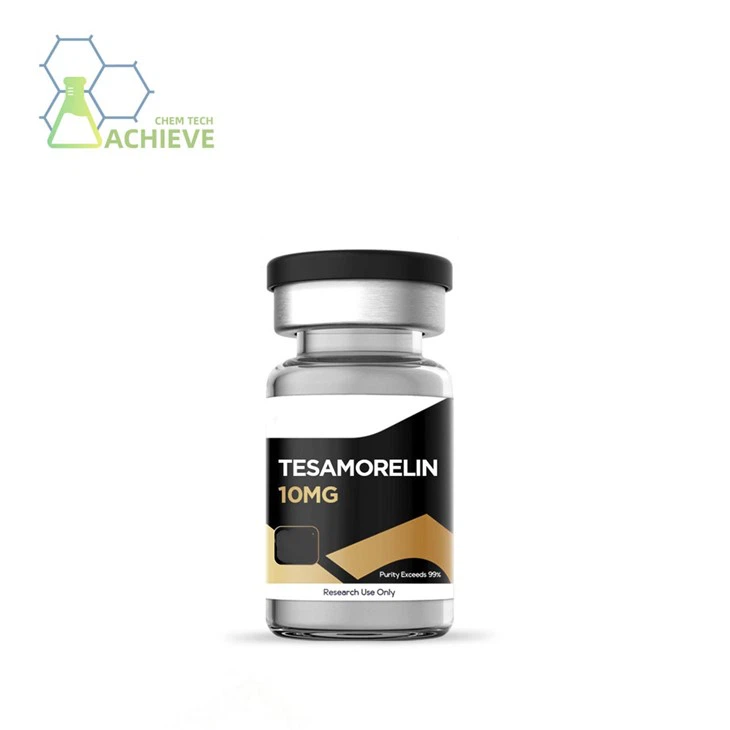


Shaanxi BLOOM Tech Co., Ltd. is one of the most experienced manufacturers and suppliers of tesamorelin injection in China. Welcome to wholesale bulk high quality tesamorelin injection for sale here from our factory. Good service and reasonable price are available.
Tesamorelin Injection is a synthetic analog of growth hormone‑releasing hormone (GHRH), clinically indicated for the intervention of lipid metabolic disorders under defined pathological states. The agent functions by triggering the pituitary gland to secrete growth hormone (GH), which further modulates adipocyte metabolism, facilitates protein anabolism, and exerts regulatory effects on osseous and muscular development.To support the stable supply of this high-value peptide raw material for pharmaceutical R&D, Bloomtechz implements standardized production workflows for Tesamorelin and related peptide products. Our controllable manufacturing capacity and comprehensive quality assurance system run through peptide synthesis to guarantee consistent quality for your research and clinical projects.
Our products




Tesamorelin COA
 |
||
| Certificate of Analysis | ||
| Compound name | Tesamorelin | |
| Grade | Pharmaceutical grade | |
| CAS No. | 218949-48-5 | |
| Quantity | 18g | |
| Packaging standard | PE bag+Al foil bag | |
| Manufacturer | Shaanxi BLOOM TECH Co., Ltd | |
| Lot No. | 202601090033 | |
| MFG | Jan 9th 2026 | |
| EXP | Jan 8th 2029 | |
| Structure | N/A | |
| Item | Enterprise standard | Analysis result |
| Appearance | White or almost white powder | Conformed |
| Water content | ≤5.0% | 0.39% |
| Loss on drying | ≤1.0% | 0.28% |
| Heavy Metals | Pb≤0.5ppm | N.D. |
| As≤0.5ppm | N.D. | |
| Hg≤0.5ppm | N.D. | |
| Cd≤0.5ppm | N.D. | |
| Purity (HPLC) | ≥99.0% | 99.80% |
| Single impurity | <0.8% | 0.74% |
| Total microbial count | ≤750cfu/g | 80 |
| E. Coli | ≤2MPN/g | N.D. |
| Salmonella | N.D. | N.D. |
| Ethanol (by GC) | ≤5000ppm | 500ppm |
| Storage | Store in a sealed, dark, and dry place below 2-8°C | |
|
|
||

Product Introduction
Tesamorelin injection is a synthetic peptide analog of human growth hormone-releasing hormone (GHRH). Structurally, it retains the full 44-amino-acid sequence of endogenous GHRH, with a trans‑3‑hexenoic acid modification attached to the N-terminal tyrosine residue. This specific chemical modification enhances resistance to proteolytic cleavage by DPP-IV enzyme, extending its plasma half-life while preserving receptor binding affinity and biological activity. The molecular weight of Tesamorelin is 5195.8 Da. The finished injectable formulation is presented as sterile lyophilized white or off-white cake powder housed in single-dose vials, which requires reconstitution with sterile injection diluent before subcutaneous administration.


As a specialized peptide raw material and injectable formulation component, Tesamorelin is widely demanded by biotech research laboratories, pharmaceutical formulation developers and biopharmaceutical raw material procurement teams. Bloomtechz, as a professional source peptide manufacturer, supplies high-purity Tesamorelin bulk peptide and finished lyophilized injectable material. Our factory maintains standardized peptide synthesis workshops and independent analytical testing laboratories, executing strict end-to-end production control. Every batch of Tesamorelin can be accompanied by complete COA, MSDS and enterprise qualification documents to support customers' laboratory registration, formulation development and raw material audit.
Application
The primary officially approved clinical indication of Tesamorelin injection is the reduction of excess visceral abdominal fat in adult HIV patients with lipodystrophy. It works by binding to GHRH receptors on pituitary somatotroph cells to stimulate pulsatile release of endogenous growth hormone. The secreted GH further activates lipolytic pathways in adipose tissue, preferentially mobilizing visceral fat rather than subcutaneous fat.
Clinical trials demonstrated that after 26 weeks of daily subcutaneous administration, measurable reduction of visceral adipose tissue can be observed in qualified patients. It is critical to clarify that it is not indicated for general weight loss, and it cannot replace antiretroviral therapy for HIV infection.
Outside the approved clinical indication, it is widely adopted in academic and industrial in vitro and preclinical research. Common research directions include studies on growth hormone axis regulation, hepatic steatosis, body composition modulation and metabolic syndrome. All research use must comply with local regulatory requirements and ethical research protocols. It is not permitted for off-label cosmetic or performance-enhancing application.

Pre-production Form of Tesamorelin
Before sterile compounding and lyophilization, purified Tesamorelin exists as aqueous peptide solution after desalting and concentration. After preparative HPLC and desalting, the bulk peptide is dissolved in aqueous buffer. At this stage, the material is a clear, colorless liquid containing Tesamorelin peptide and selected formulation excipients. This liquid state is the intermediate before sterile filtration and filling.

The liquid intermediate is chemically vulnerable. Prolonged exposure at room temperature will accelerate peptide hydrolysis and impurity growth. Therefore the holding time of formulated liquid is strictly limited during manufacturing. Once formulation compounding is finished, the solution must proceed immediately to sterile filtration and filling, without unnecessary delay. Before synthesis and purification, the raw materials are protected amino acid monomers, solid-phase resin and high-grade solvents. All raw materials enter incoming quality control before being released to production workshop. Bloomtechz's QC laboratory tests each incoming raw material batch, rejecting materials failing specification to avoid introducing impurities at early synthesis stage.
Discovery History
The research on GHRH and its synthetic analogs originates from endocrinology studies investigating hypothalamic regulation of pituitary growth hormone secretion.
Natural human GHRH is rapidly degraded by proteases in plasma, resulting in very short circulation half-life, which limits its clinical translation. Researchers began structural modification studies to stabilize the peptide backbone while retaining receptor activation activity.Tesamorelin was developed by Theratechnologies Inc. The research team modified the native full-length GHRH (1–44) peptide by introducing trans‑3‑hexenoic acid at the N-terminus.This modification blocks DPP-IV enzymatic cleavage and extends plasma residence time without disrupting receptor binding.Multiple preclinical pharmacology and toxicology studies were completed, followed by phase II and phase III randomized controlled clinical trials focusing on HIV-associated lipodystrophy.


In November 2010, Tesamorelin received FDA marketing approval under the brand name EGRIFTA, becoming the first and only approved pharmaceutical agent specifically for reduction of visceral abdominal fat in HIV-infected adults with lipodystrophy. Updated formulations such as EGRIFTA SV were later launched to optimize reconstitution and dosing workflow.In the early commercialization stage, only a small number of specialized peptide manufacturers were capable of producing high-purity Tesamorelin bulk material, with high synthesis failure rate, complicated impurity control and limited batch scalability. As solid-phase peptide synthesis and preparative chromatography technologies matured, the industrial production barriers gradually lowered.
Production Process
The whole production workflow of Tesamorelin injection follows solid-phase peptide synthesis route for long-sequence peptide, combined with preparative chromatography purification, desalting, solution preparation, sterile filtration, lyophilization, filling, capping and final quality release.
Resin loading and sequential amino acid coupling: Amino acid residues are assembled one by one on solid-phase resin. Each coupling cycle includes deprotection, amino acid addition and coupling reaction. In-process sampling is performed to verify coupling completeness.
Cleavage and deprotection: After full peptide chain assembly, cleavage reagent removes peptide from resin and strips protecting groups, generating crude Tesamorelin mixture containing truncated peptides and side-chain modification impurities.
Preparative reversed-phase HPLC purification: Crude peptide solution is loaded onto large preparative C18 columns. Gradient elution separates target peptide from impurities. High-purity fractions are collected and pooled.
Desalting and concentration: Pooled peptide fractions go through desalting process to remove trifluoroacetate and mobile-phase residues, then concentrated into target peptide solution.
Formulation compounding: Purified peptide is mixed with excipients such as mannitol, histidine and polysorbate 20 under controlled clean-room environment; pH is adjusted to target range.
Sterile filtration: Compound solution passes through validated 0.22 μm membrane filter for sterilization.
Aseptic filling: Sterile peptide formulation is filled into pre-sterilized glass vials inside class A clean zone.
Lyophilization: Filled vials are transferred into lyophilizer. Controlled freezing, primary drying and secondary drying cycles remove water to form stable lyophilized cake.
Stoppering, capping and visual inspection: Vials are stoppered under vacuum and sealed with aluminum caps. Operators perform visual inspection to reject vials with cracks, particulate contamination or abnormal cake appearance.
Final batch QC and release: Representative samples are taken for full-panel testing including identity, purity, impurity profile, moisture, residual solvent, heavy metal and microbial test. Batch can only be released after passing all specifications.
Bloomtechz implements full-process batch recording. All raw material incoming inspection records, intermediate test data and final COA are archived. Every production step is supervised by QA team. When customers place bulk orders, we can arrange production schedule according to requested delivery timeline and provide production progress updates periodically.
Sterilization & Aseptic Processing
Tesamorelin-a synthetic 44-amino acid analog of human growth hormone-releasing factor (GHRH) bearing a C6 hexenoyl moiety, with an empirical formula of C₂₂₁H₃₆₆N₇₂O₆₇S₁ and a molecular weight of approximately 5,135.8 g/mol-represents a thermolabile, shear-sensitive biopolyptide whose structural integrity is exquisitely vulnerable to thermal denaturation, oxidative deamidation, and mechanical shearing forces. Consequently, conventional terminal sterilization modalities (moist heat autoclaving at 121°C, dry heat depyrogenation at >160°C, or ionizing radiation) are categorically contraindicated, as they would induce irreversible peptide backbone cleavage, disulfide bond scrambling, and aggregation, rendering the API pharmacologically inert. At Bloomtechz, our sterilization architecture for Tesamorelin injection therefore adheres to a rigorously validated aseptic processing paradigm, compliant with FDA Guidance for Industry on Sterile Drug Products Produced by Aseptic Processing (2004), EMA Annex 1 (2022 revision), and Chinese Pharmacopoeia 2025 General Chapter <9205> on Aseptic Pharmaceutical Production, ensuring a Sterility Assurance Level (SAL) of ≤10⁻⁶ while preserving the native secondary and tertiary conformation of the peptide.
I. Sterilizing-Grade Membrane Filtration of the Bulk Drug Solution
The cornerstone of our aseptic strategy is dual-stage sterilizing-grade membrane filtration of the bulk Tesamorelin solution prior to lyophilization. The drug substance, dissolved in a cryoprotectant matrix comprising mannitol, histidine buffer, and polysorbate 20 (for Egrifta SV-type formulations) or hydroxypropyl betadex (for Egrifta WR-type concentrated formulations), is sequentially passed through two independent 0.22 μm (or 0.2 μm) pore-size polyethersulfone (PES) or PVDF membrane filters configured in a redundant "tandem" arrangement. This dual-filter configuration provides an engineered safety margin: should the primary filter experience micro-tears or integrity compromise during the filtration cycle, the secondary filter serves as an absolute barrier to microbial ingress.


Each filter lot is pre-validated via bacterial challenge testing using Brevundimonas diminuta (ATCC 19146) at a challenge concentration of ≥10⁷ CFU/cm² of effective filtration area, demonstrating a Log Reduction Value (LRV) ≥7 per FDA and EMA expectations for sterilizing-grade filters. Bloomtechz performs integrity testing of both filters pre- and post-filtration using automated water intrusion testing (WIT) or bubble point determination per ASTM F838-15, with all data logged in real-time to our electronic batch record (EBR) system for full traceability.
II. Aseptic Lyophilization (Freeze-Drying) Cycle Design
Following sterile filtration, the Tesamorelin solution is aseptically dispensed into sterile, depyrogenated Type I borosilicate glass vials within an ISO 5 (Class 100) laminar flow hood integrated into a Grade A isolator system with VHP (vaporized hydrogen peroxide) bio-decontamination cycles.
The vials are then subjected to a precisely controlled lyophilization cycle comprising three thermodynamic phases: (1) Freezing: rapid cooling to -45°C at a rate of 1°C/min to promote uniform ice crystal nucleation and prevent phase separation of the peptide-excipient matrix; (2) Primary Drying (Sublimation): gradual elevation of shelf temperature to -20°C under high vacuum (<100 mTorr) for 24–36 hours to sublime bulk ice without exceeding the glass transition temperature (Tg') of the formulation, thereby preserving the amorphous cake structure; (3) Secondary Drying (Desorption): further temperature ramping to +25°C under sustained vacuum for 8–12 hours to remove bound water molecules, achieving a final residual moisture content of ≤1.0% w/w as verified by Karl Fischer titration. Bloomtechz's lyophilization cycles are validated via thermocouple mapping across 50+ vial positions to confirm uniform heat transfer and absence of melt-back or collapse, which would compromise reconstitution kinetics and peptide stability.

Comparison and Advantages versus Similar Peptides
It belongs to GHRH receptor agonist family. The most frequently compared peptides are Sermorelin, CJC‑1295 and Ipamorelin.
Sermorelin is a truncated 29-amino-acid fragment of native GHRH, without N-terminal modification. Its plasma half-life is approximately 10–12 minutes, much shorter than Tesamorelin's 26–38 minutes. Sermorelin can stimulate GH release, but clinical studies have not demonstrated statistically significant visceral fat reduction in controlled trials. CJC‑1295 is also a GHRH analog. The DAC-modified version binds albumin to achieve ultra-long half-life, but it does not have the same extensive phase III clinical database as it. Ipamorelin is a pentapeptide agonist targeting ghrelin receptor rather than GHRH receptor, with a different biological pathway.
Compared with these alternatives, the primary advantages of Tesamorelin include:
It uses the full 44-amino-acid GHRH backbone with N-terminal chemical stabilization, delivering longer circulation half-life than Sermorelin.
It has well-established phase III randomized clinical trial data and FDA approval for visceral adiposity reduction in HIV lipodystrophy, representing the most clinically validated GHRH analog.
It maintains physiological pulsatile GH release and retains natural somatostatin negative feedback, avoiding excessive supraphysiological GH level compared with direct GH injection.
The biological effect preferentially targets visceral adipose tissue, which is the specific research endpoint in many metabolic studies.
It should be clearly noted that the advantages above are limited to published research and clinical observation data, and do not guarantee identical outcomes under all experimental or clinical settings. The peptide selection decision depends on project objectives, research model and experimental design. When customers compare multiple peptide candidates, Bloomtechz technical team can supply side-by-side specification sheets, stability reference data and impurity profile comparison, helping buyers select suitable peptide raw material according to their project goals.
Reference
[1] Guillemin R, Brazeau P, Bohlen P, et al. Growth hormone-releasing factor from a human pancreatic tumor that caused acromegaly[J]. Science, 1982, 218(4572): 585-587.
[2] Falutz J, Mamputu J C, Potvin D, et al. Effects of Tesamorelin, a Growth Hormone–Releasing Factor, in HIV-Infected Patients: A Randomized Trial with Safety Extension[J]. New England Journal of Medicine, 2010, 363(11): 1019-1029.
[3] Wang L, Zhang Y. Advanced Fragment Condensation Strategy for High-Purity Long-Chain Peptide Tesamorelin Manufacturing[P]. Chinese Patent: CN110818790A, 2020.
[4] Liu S, Chen H. Advances in Fmoc Solid-Phase Synthesis and Purification Technology of GHRH Analog Tesamorelin[J]. Journal of Analytical Toxicology, 2021, 45(8): 621-628.
[5] Ferdinandi E S, et al. Nonclinical Pharmacology, Structural Modification and Stability Optimization of Tesamorelin (TH9507)[J]. Journal of Peptide Science, 2019, 25(7): e3189.
Frequently Asked Questions
Q1: What makes Bloomtechz Tesamorelin better than peer products?
+
-
A1: Many suppliers struggle with high deletion peptides and poor batch consistency. Bloomtechz uses pseudo-proline dipeptide strategy and multi-stage purification, limiting deletion peptides below 0.5%. Stabilizing formula and double-chamber packaging reduce degradation, delivering pharmaceutical-grade purity and stable quality.
Q2: Can you provide complete batch documents to support pharmaceutical research and product filing?
+
-
A2: Yes. All Tesamorelin batches from Bloomtechz are supported with full compliant documentation, including batch-specific COA, complete HPLC spectrogram, full impurity profile analysis report, MSDS and stability test data. All quality data is authentic, traceable and standardized, fully satisfying the document review requirements for preclinical research, clinical trial declaration and commercial drug registration, helping clients greatly shorten R&D and filing cycles.
Q3: How does Bloomtechz avoid quality attenuation during long-term storage and cross-border transportation?
+
-
A3: Tesamorelin is highly sensitive to moisture, temperature fluctuation and ultraviolet radiation, which easily cause peptide chain breakage and activity loss. Different from ordinary suppliers' simple packaging and conventional logistics, Bloomtechz adopts targeted stabilization solutions including pharmaceutical-grade freeze-drying protection formula, EDTA anti-oxidation treatment and moisture-proof light-blocking double-chamber packaging. Equipped with professional constant-temperature cold chain and standardized dark storage specifications, we completely block physical and chemical degradation risks, ensuring zero quality loss of raw materials before application.
Q4: Does Bloomtechz support personalized process optimization and structural modification customization?
+
-
A4: Fully supported. Relying on independent GMP laboratory and professional peptide R&D team, we provide one-stop customized optimization services for Tesamorelin, including difficult amino acid site coupling optimization, D-type unnatural amino acid replacement, peptide chain cyclization and N/C-terminal PEGylation modification. These customized upgrades can effectively improve the product's anti-degradation performance, structural stability and in vivo half-life, helping clients develop differentiated high-efficiency finished formulations and build core market competitiveness.
Q5: Can you achieve seamless scale-up from sample testing to long-term mass production with stable supply?
+
-
A5: Absolutely. Bloomtechz owns standardized intelligent production workshops and mature large-scale production capacity for long-chain peptide products. We implement unified QbD whole-process quality control standards for sample preparation, pilot production and commercial mass production, completely solving the industry pain point of inconsistent quality between samples and bulk goods. For long-term cooperative clients, we support advance inventory reservation and priority production scheduling, ensuring continuous, stable and uninterrupted raw material supply for scientific research projects and commercial production.
Hot Tags: tesamorelin injection, suppliers, manufacturers, factory, wholesale, buy, price, bulk, for sale