




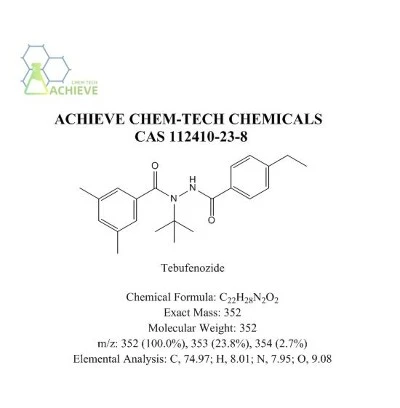
The main component of tebufenozide powder is imidacloprid. The pure product is a white solid with the molecular formula C22H28N2O2 and CAS 112410-23-8. It has a melting point of 191 ℃, good solubility in water (20 ℃), and little solubility in other solvents. It is stable after 7 days of storage at 94 ℃ and light stable in an aqueous solution with pH=7 at 25 ℃. The vapor pressure is 3 × 10⁻⁸mmHg (25 ℃). KOWlogP=4.25 (PH=7). Caryol hydrazide is a type of ecdysteroid insecticide that interferes with the normal development of insects, causing them to molt and die. Low toxicity, acute oral LD50 in rats is greater than 5000mg/kg, safe for humans, mammals, fish, earthworms, etc., and very safe for the environment. It is an ideal and safe insecticide for comprehensive prevention and control. It is a new type of non steroidal insect growth regulator and the latest insect hormone insecticide. It is an efficient and low toxicity insect growth regulating pesticide mainly used for controlling cabbage, beet armyworm, etc. Imidacloprid has high insecticidal activity and strong selectivity, and is effective against all Lepidoptera larvae. It is particularly effective against pests such as cotton bollworm, cabbage caterpillar, diamondback moth, and beet armyworm. Safer for non target organisms. Imidacloprid is non irritating to the eyes and skin, and has no teratogenic, carcinogenic, or mutagenic effects on higher animals. It is also very safe for mammals, birds, and natural enemies.

|
Chemical Formula |
C22H28N2O2 |
|
Exact Mass |
352 |
|
Molecular Weight |
352 |
|
m/z |
352 (100.0%), 353 (23.8%), 354 (2.7%) |
|
Elemental Analysis |
C, 74.97; H, 8.01; N, 7.95; O, 9.08 |
|
|
|


The preparation of tebufenozide powder requires two steps. First, the reagent n- (4-ethyl benzoyl) - n'- tert butyl hydrazine is synthesized, and then the reagent is used to synthesize tebufenozide.
Preparation of n- (4-ethyl benzoyl) - n'- tert butyl hydrazine:
Add 22.4 g of human tert butyl hydrazine hydrochloride (converted into hundreds), 50g of water, 120ml of solvent, 0.15g of self-made catalyst, control the reaction temperature to 0~5c, and protect it with nitrogen. Add 20% sodium hydroxide solution and 15% sodium carbonate solution successively for 0.5h. Then add solvent, and then add 28.8 g of 4-ethyl benzoyl chloride and 20% sodium hydroxide solution at the same time. The dropping time is 2 h, and then react for 1 h. Then raise the temperature to 60C, until all the solids are dissolved, and stand for layering. The organic layer was washed once with 80 g of 1% hydrochloric acid solution, stratified, and the solvent was removed to obtain 37.9 g of quasi white solid, with a content of 97.2% and a yield of 97.9%.

Preparation of tebufenozide:
Add the undissolved n- (4-ethyl benzoyl) - n'- tert butyl hydrazine solution prepared in 2.3.1 to a 500ml reaction flask, and control the kettle temperature at 60C. At the beginning, 3,5-dimethylbenzoyl chloride and base were added dropwise at the same time for 1 h, and then reacted for 3 h. Then add 50 g of water, raise the temperature to 92c until all the solids are dissolved, and let it stand for layering. The organic layer is washed once with 100g of 1% hydrochloric acid solution. The organic phase crystallizes at about 10C for 1h, and the white solid is filtered. The filter cake is the technical drug. Filtrate recycling. The average content of filter cake after drying is 96.3% by liquid chromatography.


As a non steroidal new type of insect growth regulator, imidacloprid has been widely used in the field of agricultural pest control since its development by the American company Rohm and Haas (now part of Dow Agrochemicals) in 1990, thanks to its unique molting hormone like mechanism of action and high efficiency and low toxicity.
Tebufenozide powder has a special effect on Lepidoptera insects and larvae, which is its most prominent advantage in prevention and control. There are many species of Lepidoptera pests, including many important agricultural vermin, and imidacloprid has good control effects on them.
Common Lepidoptera vermin, such as cotton bollworm, are the main vermin on cotton and other crops. Their larvae can burrow into cotton bolls, seriously affecting the yield and quality of cotton. Tebufenozide is sprayed to prevent and control the cotton bollworm from the peak period of egg hatching to the time of larvae boring.


Generally, 20% tebufenozide suspension or 200 g/L tebufenozide suspension 1500-2000 times liquid is used for uniform spray control, which can effectively control the harm of cotton bollworm. Cabbage caterpillar is a common pest on cruciferous vegetables, which feeds on leaves with larvae, causing leaves to be scratched or perforated, affecting the growth and quality of vegetables. Using 20% tebufenozide suspension 1000-2500 times liquid spray can effectively reduce the number of cabbage caterpillars. The diamondback moth is also an important pest of cruciferous vegetables, and its larvae have the ability to burrow and cause significant harm to vegetables.
Tebufenozide has special effect on Plutella xylostella, and the corresponding concentration of liquid medicine can be used for spray according to the insect situation. The beet armyworm is an omnivorous pest that can harm various crops. Its larvae have a tendency to cluster and overeat, and can quickly consume all the leaves of crops. Tebufenozide is used at the peak incubation period of beet armyworm, with an average of 67-100g tebufenozide suspension of 20% per mu, and spray with 30kg to 40kg water for control. The effect is remarkable.
Other pests: In addition to lepidopteran vermin, they also have a certain effect on selective dipteran and water flea insects. For example, in some orchards, the control of some dipteran vermin can also have a certain effect.

Applicable crops

The applicable crop range is wide, covering various common crops, fruit trees, vegetables, etc.
Fruit trees: can be used to prevent and control vermin such as leaf rollers, heart worms, various prickly moths, caterpillars, leaf boring moths, and inchworms on fruit trees such as dates, apples, pears, and peaches. For example, to control the apple leafroller, 20% suspension agent 1000-2000 times of liquid spray can effectively control the harm of vermin, protect the leaves and fruits of fruit trees, and improve the quality and yield of fruits. In grape cultivation, it can prevent and control vermin such as grape moths, ensuring the normal growth and development of grapes.
Vegetables: Suitable for various vegetables such as cabbage, melon, eggplant, etc. To control diamondback moth, beet armyworm, cabbage worm, melon borer, tomato yellow spot moth, bean borer and other vermin in cruciferous vegetables, beans and solanaceous vegetables, 20% suspending agent or 200g/L suspending agent 75-100mL, or 24% suspending agent 60-80mL per mu, mixed with 45-60kg water, can effectively reduce the density of vermin, reduce the degree of damage to vegetables, and ensure the yield and quality of vegetables.


Other crops: It can also be used for cotton, tobacco, grain and other crops to prevent and control cotton bollworm, diamondback moth, cabbage caterpillar, beet armyworm and other lepidopteran vermin. In cotton cultivation, imidacloprid can effectively control the harm of vermin such as cotton bollworms, reducing the problem of cotton yield reduction and quality decline caused by vermin. For pest control on tobacco, it can also play an important role in ensuring the normal growth and quality of tobacco. In addition, imidacloprid can also be used for crops such as potatoes, soybeans, sugar beets, tea, walnuts, flowers, etc. to prevent and control corresponding vermin and promote the healthy growth of these crops.
The main application method is spray. Select the appropriate concentration and spraying time according to different control objects and crops.
Concentration selection: Generally, 20% suspension agent is used, with a dilution ratio between 1000-2500 times. The dilution factor may vary for different pests and crops. For example, to control cotton bollworm, 20% tebufenozide suspension or 200 g/L tebufenozide suspension 1500-2000 times liquid spray is used; To control diamondback moth, cabbage worm and other vermin, use 20% tebufenozide suspension 1000-2500 times of liquid spray; For the control of beet armyworm, during its peak incubation period, an average of 67-100g tebufenozide suspension agent of 20% per mu was used, and 30kg to 40kg water was added to spray for control.


Spray time: Chlorpyriprole has poor effect on eggs, and attention should be paid to spraying during the late stage of egg development or early stage of larval development. After feeding on crop leaves sprayed with pesticides, larvae stop feeding within 6-8 hours and dehydrate and die within 2-3 days. Therefore, spraying pesticides during the early stages of larval development can timely control the harm of vermin and improve the effectiveness of prevention and control. For example, to control pine caterpillars, 24% tebufenozide suspension can be sprayed with 1200-2400 times of liquid spray at the initial stage of larval hatching, which can effectively reduce the number of pine caterpillars and protect forest resources.
It can be mixed with various insecticide ingredients to produce compound insecticides to enhance the control effect, expand the control spectrum, and delay the development of resistance.
Mixing with pyrethroid pesticides such as cypermethrin and high-efficiency cypermethrin: pyrethroid pesticides have contact and stomach toxicity effects, with a fast action rate. When mixed with imidacloprid, they can not only exert the stomach toxicity of imidacloprid and regulate insect growth, but also utilize the rapid contact killing effect of pyrethroid pesticides to improve the control effect on vermin. For example, to control some highly resistant Lepidoptera vermin, a mixture of imidacloprid and cypermethrin can be used to enhance the insecticidal effect.


Mixing with biological pesticides such as avermectin and emamectin benzoate: Biological pesticides have the characteristics of environmental protection and safety. When mixed with imidacloprid, tebufenozide powder can reduce the use of chemical pesticides, reduce environmental pollution, and improve prevention and control effectiveness. For example, when controlling the diamondback moth, the mixture of imidacloprid and avermectin can enhance the control effect on the diamondback moth, especially for diamondback moths with average efficacy of imidacloprid, the mixed effect is even better.
Mixing with Bacillus thuringiensis: Bacillus thuringiensis is a microbial insecticide that has a specific effect on Lepidoptera pests. When mixed with imidacloprid, the synergistic effect of both can be exerted to improve the control effect on vermin and delay the development of pest resistance.
faq
What is Tebufenozide used for?
Uses. Tebufenozide is an insect growth regulator that interferes with molting of Lepidopteran larvae. It is used on fruitworm, fireworms, false armyworm, gypsy moth, and spanworms, and is applied pre-harvest. Registered for use in EU countries.
What is the use of Teflubenzuron?
Hot Tags: tebufenozide powder cas 112410-23-8, suppliers, manufacturers, factory, wholesale, buy, price, bulk, for sale, Yeast Extract Powder CAS 8013 01 2, p Anisaldehyde liquid, spermidine powder, Sucrose Powder CAS 57 50 1, 5-hydroxymethylfurfural synthesis, Bis 4 hydroxyphenyl Sulfone CAS 80 09 1