


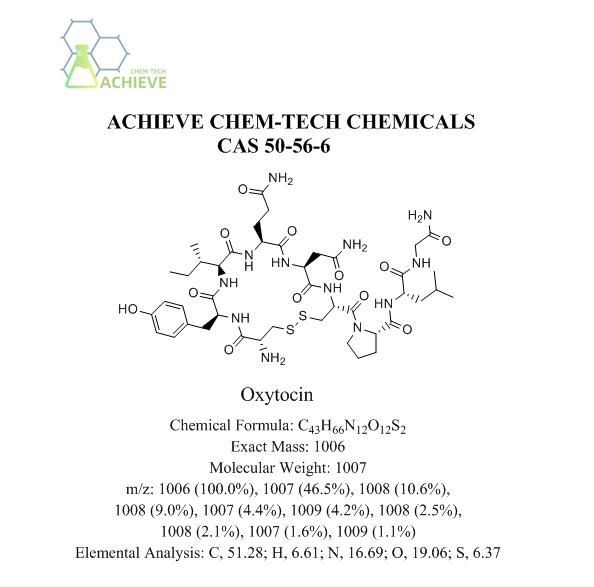


Shaanxi BLOOM Tech Co., Ltd. is one of the most experienced manufacturers and suppliers of oxytocin powder cas 50-56-6 in China. Welcome to wholesale bulk high quality oxytocin powder cas 50-56-6 for sale here from our factory. Good service and reasonable price are available.
Oxytocin powder is an important sex hormone and precursor of progesterone, which plays various physiological functions in the human body. Oxytocin exists in the form of white crystals or crystalline powders, with common physical states being solid, liquid, and gaseous. Has varying degrees of solubility. In common organic solvents such as alcohols, ethers, chlorinated hydrocarbons, etc., oxytocin has a high solubility. However, its solubility in water is relatively low. Relatively stable under conventional conditions, but decomposition may occur under strong acid, alkali, or high temperature conditions. Secreted by the posterior pituitary gland and synthesized by the paraventricular nucleus and supraoptic nucleus of the hypothalamus, it consists of 9 amino acids. It is delivered to the neurohypophysis for release at a rate of 2-3 millimeters per day. The cysteine (Cys) residues at positions "1" and "6" form a cyclic structure of a 6-peptide in the form of disulfide bonds. Oxytocin can stimulate the secretion of milk by the breast, promote the contraction of uterine smooth muscle during childbirth, and promote maternal love. In addition, it can also lower the levels of stress hormones such as adrenal ketone in the human body, thereby lowering blood pressure. It is not exclusive to women, both men and women can secrete it.

|
Chemical Formula |
C43H66N12O12S2 |
|
Exact Mass |
1006 |
|
Molecular Weight |
1007 |
|
m/z |
1006 (100.0%), 1007 (46.5%), 1008 (10.6%), 1008 (9.0%), 1007 (4.4%), 1009 (4.2%), 1008 (2.5%), 1008 (2.1%), 1007 (1.6%), 1009 (1.1%) |
|
Elemental Analysis |
C, 51.28; H, 6.61; N, 16.69; O, 19.06; S, 6.37 |
|
|
|



The following are detailed steps for a possible synthesis of Oxytocin powder:
1. Synthesis of 7-peptide amide (3-9 segments) from benzyloxycarbonyl leucine p-nitrophenyl ester
1> Using benzyloxycarbonyl leucine p-nitrophenyl ester (1) as the starting material, compound (2) is obtained by acid catalyzed release of benzyloxy groups.
2> Compound (2) was treated with chloroform and potassium carbonate to obtain a fully reacted compound (3).
3> Treat compound (3) with concentrated ammonia water, adjust the pH to 8-9, and hydrolyze p-nitrophenyl ester to obtain compound (4).
4> Dissolve compound (4) in dilute hydrochloric acid, add sodium hydroxide to raise the pH of the solution to 8-9, and hydrolyze compound (4) to obtain compound (5).
5> Dissolve compound (5) in a dilute NaOH solution, add hydrochloric acid to raise the pH of the solution to 8-9, and hydrolyze compound (5) to obtain compound (6).
6> Dissolve compound (6) in a dilute NaOH solution, add hydrochloric acid to raise the pH of the solution to 8-9, and hydrolyze compound (6) to obtain 7-peptide amide.
2. Synthesis of benzyloxycarbonyl-S benzylcysteine · tyroyl azide (1-2 stages)
1> Stir Cbz Se (t-Bu) - Gly Tyr (Alloc) - Gln (Trt) - Gly Gly He (NO2) - NHCH2CH2N3 (1) in a methanol solution of sodium methoxide at room temperature, allowing (S) -3-benzyloxycarbonylamino-4-phenylalanine methyl ester (2) to react with benzylmagnesium bromide to obtain the product (3).
2> Reflux in N, N-dimethylformamide containing triethylamine to react (R) - N - (2,5-dichlorophenyl) - L-alanine (4) with methanesulfonyl chloride to obtain (R) - N - (2,5-dichlorophenyl) - L-alanine methanesulfonate (5).
3> Reflux in N, N-dimethylformamide containing triethylamine to react (R) - N - (2,5-dichlorophenyl) - L-alanine (4) with benzyl magnesium bromide to obtain product (6).
4> Reflux in N, N-dimethylformamide containing triethylamine to react (R) - N - (2,5-dichlorophenyl) - L-alanine methanesulfonate (5) with benzyl magnesium bromide to obtain product (7).
5> Reflux in N, N-dimethylformamide containing triethylamine to react product (7) with trifluoroacetic acid to obtain product (8).
6> Reflux in N, N-dimethylformamide containing triethylamine to react product (8) with sodium azide to obtain product (9).
7> Reflux in N, N-dimethylformamide containing triethylamine to react product (9) with hydrazine hydrate to obtain product (10).
3. Synthetic oxytocin
Reflux the 7-peptide amide (3-9 segments) obtained from the above steps with benzyloxycarbonyl-S benzylcysteine · tyroyl azide (1-2 segments) in dichloromethane to generate oxytocin.
The above steps are only one possible method, not the only one. During the specific implementation process, adjustments may need to be made based on factors such as laboratory conditions, equipment, and reagent availability. In addition, some safety and risk assessments may need to be conducted during this process to ensure the safety of the experiment and the reliability of the results.

Application history:
Since 1911, oxytocin has been used in clinic to treat delayed labor.
In 1927, it was used to induce labor, but oxytocin from natural sources was small and expensive.
In 1953, the American biochemist Vincent duvinho synthesized it for the first time and won the Nobel Prize in 1955.
Chemical structure:
The chemical structure of oxytocin in humans and most mammals is as follows:
Cysteine tyrosine isoleucine glutamine aspartate cysteine proline leucine glycine NH2
The structure of oxytocin is very similar to that of antidiuretic hormone (cysteine tyrosine phenylalanine glutamine aspartate cysteine proline arginine glycine NH2).

Physiological effects:
(1) Effect on mammary gland: lactating mammary gland continuously secretes milk under the action of prolactin and stores it in mammary gland acini. Oxytocin powder can make the myoepithelial cells around the mammary gland acinus contract, and promote the mammary gland with lactation function to discharge milk.
(2) Effect on the uterus: oxytocin has a strong contractile promoting effect on the uterus, but the pregnant uterus is more sensitive. Estrogen can increase the sensitivity of the uterus to oxytocin, while progesterone is the opposite.
(3) Effect on social shyness and autism: oxytocin can help people who are neglected in social occasions to overcome social shyness. But oxytocin nasal spray does not work for people who are already very confident.
(4) When you feel cheerful or have a strong sense of belonging, the hypothalamus synthesizes oxytocin, and the pituitary secretes oxytocin, and the stress is also relieved. At the same time, the oxygen supply of tissues in the body increases greatly.
Special role:
Affect the relationship between the baby and the mother
Some experiments have shown that people who have established a close attachment relationship with them in infancy will become more caring and considerate after using oxytocin; However, for those who were relatively indifferent to their mothers in infancy, oxytocin deepened their bad memories.
Secretion regulation:
Oxytocin secretion is mainly regulated by neuroreflex. When the baby sucks the nipple, the stimulation information is transmitted to the supraoptic nucleus and paraventricular nucleus of the hypothalamus, which causes the secretion of oxytocin and causes the breast to ejaculate, which is called ejaculation reflex and belongs to neuroendocrine reflex. On this basis, a conditioned reflex can be formed, and the baby's crying or touching can cause milk ejection.
During labor, the cervix and vagina are pressed and pulled, which can reflexively cause oxytocin secretion, which is helpful for labor. Oxytocin can stimulate uterine contraction, but it is not the decisive factor to initiate uterine contraction during labor. In addition, emotional reactions such as panic and anxiety can inhibit oxytocin secretion.
The clinical significance of OXTR mutations
The mutations of the OXTR (oxytocin receptor) gene have significant clinical implications. By influencing the function of the oxytocin system, it is closely related to various neurological and psychiatric disorders as well as abnormal social behaviors. The following analysis is conducted from three aspects: disease association, behavioral manifestations, and treatment challenges.
Association between OXTR mutations and neuro-psychiatric disorders
Autism Spectrum Disorder (ASD)
Multiple studies have shown that OXTR gene mutations are important risk factors for autism. For instance, the polymorphisms at rs53576 and rs2254298 loci are associated with core symptoms such as social interaction deficits and repetitive behaviors in autistic patients. Animal experiments have demonstrated that OXTR knockout mice exhibit impaired social recognition and memory, while human studies have shown that the levels of oxytocin in the cerebrospinal fluid of autistic patients are generally lower, and the expression of OXTR in some brain regions is abnormal. These findings suggest that OXTR mutations may disrupt the oxytocin signaling pathway, affecting social cognition and reward mechanisms, thereby exacerbating autistic symptoms.
Schizophrenia and depression
OXTR mutations are also associated with negative symptoms of schizophrenia (such as apathy and social withdrawal) and the risk of depression. For example, certain OXTR single nucleotide polymorphisms (SNPs) may reduce the binding affinity of the receptor to oxytocin, leading to emotional regulation disorders. Additionally, the levels of oxytocin in the cerebrospinal fluid of depressed patients are significantly lower at night, further supporting the role of the OXTR system in emotional stability.
Anxiety disorders
Oxytocin exerts an anti-anxiety effect by inhibiting long-term potentiation (LTP) at the prefrontal anterior cingulate cortex (ACC) of the brain. OXTR mutations may weaken this mechanism, increasing the susceptibility to chronic pain-related anxiety or generalized anxiety disorder (GAD). Clinical studies have found that individuals with lower anxiety levels have higher cerebrospinal fluid oxytocin concentrations, while individuals with OXTR mutations may not be able to effectively relieve anxiety due to blocked oxytocin signaling.
Abnormal behaviors and social functions caused by OXTR mutations

Emotional fluctuations and social avoidance
OXTR mutations may lead to abnormal emotional regulation, manifested as intense emotional fluctuations, lack of affection and friendship, and extreme rejection of physical contact or intimate behaviors. For example, individuals carrying the A-allele gene may have abnormal OXTR expression, resulting in vigilance towards social behaviors such as hugs, accompanied by unease. This behavioral pattern may be manifested as extreme selfishness and disregard for others' feelings in marital or family relationships, even increasing the risk of domestic violence.
Interaction between gender and early life stress
Studies have shown that the interaction between OXTR mutations and early life stress (such as childhood abuse and neglect) may exacerbate behavioral problems. For instance, female OXTR mutation carriers may show higher risk of depression and anxiety in stressful environments, while males may be more prone to aggressive behaviors. This gender difference may be related to the regulatory role of oxytocin in gender-specific social behaviors.

Challenges and coping strategies in clinical treatment

Differences in oxytocin treatment response
Although nasal administration of oxytocin has been proven to alleviate symptoms in patients with autism, anxiety disorders, etc., OXTR mutations may lead to reduced sensitivity to oxytocin in individuals. For example, some autistic patients may not respond to oxytocin treatment due to their OXTR gene carrying pathogenic mutations, which affect the binding of the receptor to oxytocin or signal transduction. This suggests that genetic testing may become an important means of screening individuals who will benefit from oxytocin treatment.

Precision medicine and individualized administration
For individuals with OXTR mutations, precise medical strategies need to be developed. For example, through gene editing technology to correct the mutation site, or developing new OXTR agonists to enhance signal transduction. Additionally, combining OXTR expression profiles and functional imaging techniques can achieve individualized administration of oxytocin, improving treatment efficacy and reducing side effects.

Multimodal treatment intervention
For complex behavioral problems caused by OXTR mutations, single drug treatment may have limited effect. Comprehensive behavioral therapy, social skills training, and environmental intervention may be more effective in improving patients' social functions. For instance, regarding the OXTR mutation in individuals with autism, a combination of oxytocin therapy and cognitive behavioral therapy can be employed to significantly enhance their social skills.
Hot Tags: oxytocin powder cas 50-56-6, suppliers, manufacturers, factory, wholesale, buy, price, bulk, for sale, cholesterol powder, Procaine Hydrochloride, Medetomidine hydrochloride, levamisole hydrochloride powder, articaine hydrochloride powder, Sapropterin Hydrochloride