




Shaanxi BLOOM Tech Co., Ltd. is one of the most experienced manufacturers and suppliers of scopolamine powder cas 51-34-3 in China. Welcome to wholesale bulk high quality scopolamine powder cas 51-34-3 for sale here from our factory. Good service and reasonable price are available.
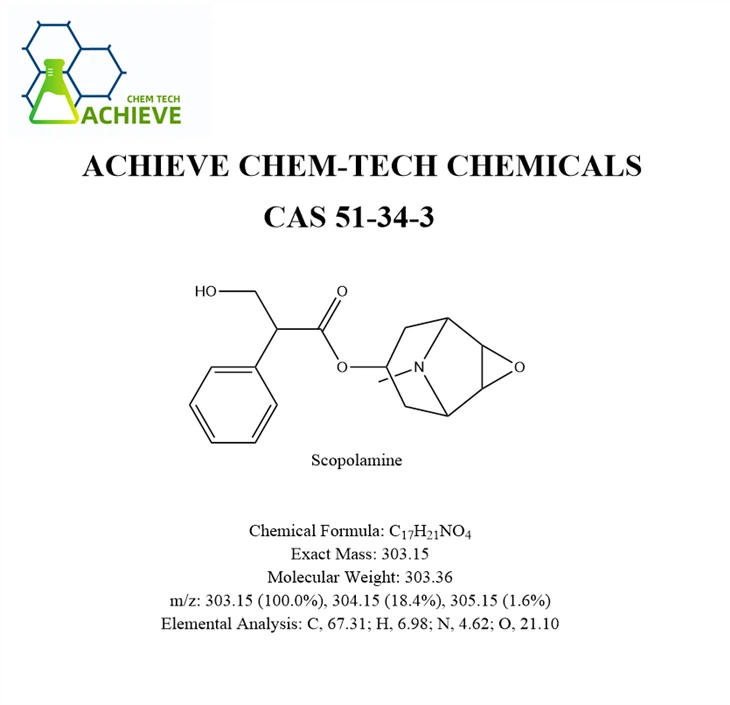
Scopolamine powder is a tropane alkaloid widely found in Solanaceae plants. It was first isolated from scopolamine by E. Schmidt in 1892. Its chemical formula is C17H21NO4 CAS 51-34-3 . It has multiple pharmacological effects and is widely used in the medical field. Scopolamine has a significant central sedative effect and can be used for pre-anesthesia administration to reduce tension and anxiety during surgery. As an M cholinergic receptor blocker, scopolamine can block M cholinergic receptors, reduce glandular secretion, make patients feel thirsty, and cause increased heart rate and pupil dilation. Scopolamine has a direct excitatory effect on the respiratory center and can accelerate breathing. Scopolamine can relieve peripheral vascular spasms, improve microcirculation, and help treat certain circulatory disorders. It has a good effect on motion sickness (such as motion sickness, seasickness, etc.) and is often used in combination with diphenhydramine to enhance the effect.

|
|
|


| Chemical Formula | C17H21NO4 |
| Molecular Weight | 303.35 |
| Exact Mass | 303.15 |
| m/z | 303.15 (100.0%), 304.15 (18.4%), 305.15 (1.6%) |
| Elemental Analysis | C, 67.31; H, 6.98; N, 4.62; O, 21.10 |
| Melting point | 59 ºC |
| Boiling point | 444.28°C |
| Flash point | 232.2℃ |
| Storage conditions | -20°C |
| Form | <55°C solid,>55°C liquid |
| Color | White to off-white |
| Solubility | Soluble in water, freely soluble in ethanol (96 per cent). |

Scopolamine powder has a wide range of main application areas, mainly involving medical and scientific research. The following are its main application areas:
Medication Before Anesthesia
Before surgery, Scopolamine is often used as a pre-anesthetic drug to reduce the patient's anxiety and tension, and at the same time reduce respiratory and digestive tract secretions, which is beneficial to the smooth progress of the surgery.
Anti-Motion Sickness Treatment
Scopolamine has a significant effect on motion sickness (such as motion sickness, seasickness, airsickness, etc.). It reduces the occurrence of motion sickness symptoms such as nausea and vomiting by acting on specific receptors in the central nervous system.
Psychiatric Treatment
In psychiatry, Scopolamine is used to treat certain mental illnesses, such as mania, by helping to control a patient's mood and behavior through its sedative effects.


Pain Management
Although Scopolamine itself is not used directly as an analgesic, it can play an auxiliary role in some pain management programs by indirectly improving pain perception by reducing patients' anxiety and tension.
Emergency And Intensive Care
In emergency and intensive care settings, Scopolamine can be used to treat emergencies such as septic shock and microcirculation disorders, improving the patient's physiological state through its anticholinergic effects.
Ophthalmic Applications
Although the direct application of Scopolamine in ophthalmology is limited, due to its ability to cause mydriasis, Scopolamine may be used as an adjunct drug during certain eye examinations or surgeries. However, due to its potential side effects, such as blurred vision and increased risk of glaucoma, caution is warranted in its ophthalmic use.
Scientific Research Fields
In scientific research fields such as neuroscience and pharmacology, Scopolamine is often used as a research tool to explore the mechanism of the cholinergic system in cognition, memory, behavior, etc.
Scopolamine powder main uses in the medical field are wide-ranging, covering many aspects such as pre-anesthetic medication, anti-motion sickness treatment, psychiatric treatment, and emergency and intensive care.

1. Main uses

Pre-Anesthetic Medication
Before surgery, Scopolamine is often used as a pre-anesthetic medication to reduce the patient's anxiety and tension, as well as reduce respiratory and digestive tract secretions, thereby facilitating the smooth progress of the surgery.
Anti-Motion Sickness Treatment
Scopolamine has a significant effect on motion sickness (such as motion sickness, seasickness, airsickness, etc.). It reduces the occurrence of motion sickness symptoms such as nausea and vomiting by acting on specific receptors in the central nervous system.
Psychiatric Treatment
In psychiatry, Scopolamine is used to treat certain mental illnesses, such as mania. Through its sedative effects, Scopolamine helps control patients' mood and behavior.
Emergency And Intensive Care
In emergency and intensive care settings, Scopolamine can be used to treat emergencies such as septic shock and microcirculation disorders. Through its anticholinergic effect, Scopolamine can improve patients' physiological status and improve survival rates.

2. Precautions

Adverse reactions: Large doses of Scopolamine may cause fatigue, dizziness, drowsiness, and sometimes excitement, delirium, and unconscious movements. Adverse reactions such as dry mouth, flushed skin, and blurred vision may also occur.
Contraindications: People with a history of allergies to this product, patients with glaucoma, and patients with severe heart disease should use it with caution or should not use it.
Drug Interactions: When using Scopolamine, care should be taken to avoid simultaneous use with other drugs that may interact.
Scopolamine has a wide range of uses in the medical field. In addition to the previously mentioned pre-anesthetic medication, anti-motion sickness treatment, psychiatric treatment, emergency and intensive care, there are also the following uses:
Improving excessive gastric acid secretion
Mechanism of action: Scopolamine reduces gastric acid secretion by blocking M cholinergic receptors, thereby helping to relieve the discomfort caused by excessive gastric acid.
Application scenario: In the Department of Gastroenterology, Scopolamine can be used to treat diseases such as gastritis and gastric ulcers caused by excessive gastric acid secretion.
Treatment of gastrointestinal, gallbladder and kidney smooth muscle spasm
Mechanism of action: Scopolamine has an antispasmodic effect and can relax smooth muscles, thereby relieving spasmodic pain in organs such as the gastrointestinal, gallbladder and kidney.


Application scenario: In internal medicine, Scopolamine can be used to treat smooth muscle spasm diseases such as biliary colic, renal colic, and gastrointestinal spasm.
Treatment of septic shock
Mechanism of action: Scopolamine can improve microcirculation and increase tissue perfusion, thereby helping to correct the low perfusion state of patients with septic shock.
Application scenarios: In emergency and critical care medicine, Scopolamine can be used to treat septic shock to improve patient outcomes.
Ophthalmology applications
Mechanism of action: Scopolamine has a mydriatic effect, which can dilate the pupil, thereby helping ophthalmologists perform fundus examinations or surgical operations.
Application scenarios: Although Scopolamine has limited direct applications in ophthalmology, it may be used as an adjuvant in certain specific ophthalmic examinations or surgeries. However, due to its potential side effects, such as blurred vision and increased risk of glaucoma, caution should be exercised when using it in ophthalmology.


Treatment of bronchial asthma and asthmatic bronchitis
Mechanism of action: Scopolamine can relax bronchial smooth muscles and reduce respiratory secretions, thereby helping to relieve symptoms in patients with bronchial asthma and asthmatic bronchitis.
Application scenarios: In respiratory medicine, Scopolamine can be used to treat acute attacks of bronchial asthma and asthmatic bronchitis.

The synthesis of Scopolamine is a complex process involving multiple steps and the transformation of intermediate products. The following is a generalized synthesis process:
I. Raw material acquisition
Plant extraction:
Scopolamine is widely found in Hyoscyamus niger and Datura stramonium of the Solanaceae family. Therefore, the raw materials of Scopolamine can be obtained by extracting from these plants.
Chemical synthesis:
In addition to plant extraction, the raw materials of Scopolamine can also be obtained by chemical synthesis. This usually involves a series of complex chemical reactions, including organic synthesis, enzyme cataly.
II. Synthesis steps
Preliminary synthesis:
According to the selected raw materials and synthetic routes, a preliminary synthesis reaction is carried out to obtain the preliminary product of Scopolamine.
Purification and refining:
The preliminary product is purified and refined to remove impurities and improve the purity and quality of the product. This usually includes steps such as crystallization, filtration, and drying.
Salting reaction:
Since Scopolamine is easy to racemize and difficult to preserve, its hydrobromide or hydrochloride salt form is mainly used clinically.
Therefore, the corresponding acid (such as hydrobromic acid or hydrochloric acid) is added to the purified Scopolamine to perform a salt-forming reaction to generate a stable salt compound.
III. Specific synthesis route
Preparation of scopolol:
Scopolamine is used as the starting material, and scopolol is prepared through hydrolysis, reduction and other steps.
01
Esterification reaction:
Scopolol is subjected to an esterification reaction with an acyl chloride compound to generate a corresponding ester compound.
02
Hydrolysis reaction:
The ester compound is subjected to a hydrolysis reaction under acidic conditions to obtain a preliminary product of Scopolamine.
03
Purification and refining:
The preliminary product is purified and refined.
04
Salting reaction:
The purified Scopolamine powder is subjected to a salt-forming reaction with hydrobromic acid to generate Scopolamine hydrobromide.
05
IV. Precautions
Safety:
Scopolamine and the chemicals involved in its synthesis process may be harmful to the human body, so the synthesis operation must be carried out under strict safety conditions.
Environmental protection:
Waste liquid, waste gas, etc. generated during the synthesis process must be properly handled to prevent pollution to the environment.
Quality control:
The reaction conditions and operating parameters of each step must be strictly controlled during the synthesis process to ensure that the quality and purity of the product meet the requirements.
Regulatory compliance:
The relevant laws, regulations and rules must be followed during the synthesis process to ensure the legality and compliance of the synthesis activities.
Hot Tags: scopolamine powder cas 51-34-3, suppliers, manufacturers, factory, wholesale, buy, price, bulk, for sale, Nitroso R salt, 1H Benzimidazole 1 4 bromophenyl 2 ethyl , 3 bromo 2 chloro 9 9 dimethyl 9H fluorene, CAS 89508 65 6, CAS 1252259 63 4, 4 benzo 4 5 imidazo 1 2 a benzo 4 5 thieno 2 3 c pyridin 6 yl phenyl trifluoromethanesulfonate