




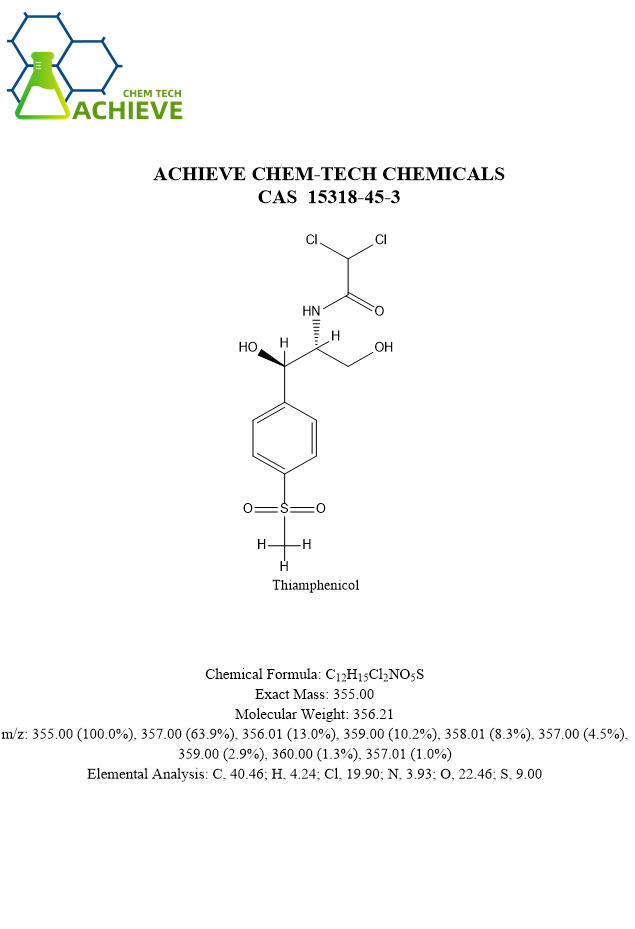


Shaanxi BLOOM Tech Co., Ltd. is one of the most experienced manufacturers and suppliers of thiamphenicol cas 15318-45-3 in China. Welcome to wholesale bulk high quality thiamphenicol cas 15318-45-3 for sale here from our factory. Good service and reasonable price are available.
Thiamphenicol (Thiophenicol) is a broad-spectrum bacteriostatic antibiotic belonging to the amphenicol class, structurally analogous to chloramphenicol but featuring a methylsulfonyl group that enhances stability and alters pharmacokinetic properties. This white to off-white crystalline powder demonstrates particular efficacy against Gram-positive and Gram-negative bacteria, including strains resistant to other antibiotics, through reversible inhibition of the 50S ribosomal subunit. Unlike chloramphenicol, thiophenicol lacks the nitro group responsible for aplastic anemia, offering a safer hematological profile while maintaining similar antimicrobial activity.
The compound exhibits excellent tissue penetration and prolonged half-life (5-8 hours), with about 90% oral bioavailability and negligible protein binding. Primarily used in veterinary medicine for respiratory and enteric infections, it also finds application in human medicine for sexually transmitted infections like chlamydia and gonorrhea in certain regions.

Additional information of chemical compound:
|
Chemical Formula |
C12H15Cl2NO5S |
|
Exact Mass |
355.00 |
|
Molecular Weight |
356.21 |
|
m/z |
355.00(100.0%),357.00(63.9%),356.01(13.0%),359.00(10.2%),358.01(8.3%), 357.00 (4.5%), 359.00 (2.9%), 360.00 (1.3%), 357.01 (1.0%) |
|
Elemental Analysis |
C, 40.46; H, 4.24; Cl, 19.90; N, 3.93; O, 22.46; S, 9.00 |
|
Melting point |
163-166℃ |
|
Density |
1.3281 (rough estimate) |
|
|
|


Respiratory and urinary system infections
Thiamphenicol can be used to treat respiratory infections caused by sensitive bacteria, such as pneumonia and bronchitis caused by Haemophilus influenzae, Streptococcus pneumoniae, etc. Its broad-spectrum antibacterial activity makes it one of the effective drugs for treating such infections. Urinary tract infection is one of the common bacterial infections, and Thiophenicol can be used to treat urethritis, cystitis, pyelonephritis, etc. caused by sensitive bacteria such as Escherichia coli and Proteus. It effectively kills or inhibits the growth of these pathogens by inhibiting bacterial protein synthesis, thereby alleviating the symptoms of patients.


Intestinal and Hepatobiliary System Infections
Intestinal infection is also one of the indications for Thiophenicol. It can be used to treat gastroenteritis, bacterial dysentery, etc. caused by sensitive bacteria such as Salmonella and Shigella. By inhibiting the growth of pathogens in the intestine, it helps restore the normal balance of gut microbiota and alleviate symptoms such as diarrhea and abdominal pain in patients.
Hepatobiliary system infection is one of the more serious infections in clinical practice, and Thiophenicol can be used to treat cholecystitis, cholangitis, and other infections caused by sensitive bacteria. Its antibacterial activity helps to kill or inhibit pathogens, alleviate inflammatory reactions, and thus improve patients' symptoms.
Obstetrics and Gynecology&Genital Infections
In the field of obstetrics and gynecology, Thiophenicol can also be used to treat infections caused by sensitive bacteria, such as pelvic inflammatory disease, endometritis, etc. These infections typically cause patients to experience symptoms such as abdominal pain, fever, and increased vaginal discharge.


The broad-spectrum antibacterial activity of Thiophenicol helps alleviate these symptoms and promote patient recovery. Genital infections are also one of the indications for Thiophenicol. It can be used to treat otitis media, sinusitis, and other conditions caused by sensitive bacteria. By inhibiting the growth of pathogens, Thiophenicol helps alleviate inflammatory reactions and alleviate symptoms such as ear pain, nasal congestion, and runny nose in patients.
thiophenicol's "SOS" response to bacteria and its mechanism and effects induced by bacteriophages
Thiamphenicol, as a methylsulfonyl derivative of chloramphenicol, exhibits broad-spectrum antibacterial activity by inhibiting the peptidyl transferase activity of the bacterial 70S ribosome 50S subunit, blocking protein synthesis. However, its antibacterial effect is not limited to directly inhibiting bacterial growth, but may also indirectly affect bacterial survival strategies and collective behavior by inducing the "SOS" response system and phage activation.
The triggering mechanism of thiophenicol on bacterial SOS response
Biological basis of SOS response system
SOS response is an emergency repair system activated by bacteria in the event of severe DNA damage, regulated by RecA protein and LexA inhibitors. When bacterial DNA is damaged by ultraviolet radiation, chemical mutagens, or antibiotics (such as quinolones), single stranded DNA (ssDNA) is exposed and activates the RecA protein, forming RecA fibers. Activated RecA cleaves LexA inhibitors through co protease activity, relieving their inhibition of SOS genes (such as recA, lexA, uvrA, sulA, etc.), initiating processes such as DNA repair, error prone repair, and cell cycle arrest.
Potential pathways of thiophenicol induced SOS response
Indirect correlation between protein synthesis inhibition and DNA damage
Thiophenicol blocks protein synthesis by inhibiting peptidyl transferase activity, which may lead to ribosome arrest on mRNA and the formation of untranslated ribosome mRNA complexes. This stagnation may trigger bacterial stress responses, including increased pressure on DNA replication. For example, when protein synthesis is blocked in Escherichia coli, DNA replication forks are prone to stagnate, leading to double stranded DNA breaks (DSBs) and activating SOS responses.


Analogical effect of mitochondrial protein synthesis inhibition
Thiophenicol not only inhibits bacterial ribosomes, but also suppresses eukaryotic mitochondrial protein synthesis (due to the similarity in structure between mitochondrial ribosomes and bacterial 70S ribosomes). Although mitochondrial dysfunction does not directly trigger bacterial SOS response, such cross inhibitory effects suggest that thiophenicol may indirectly cause DNA metabolism disorders by interfering with bacterial ribosome function, thereby activating the SOS system.
Indirect induction of oxidative stress
Inhibition of protein synthesis may lead to metabolic imbalance in bacteria, resulting in the accumulation of reactive oxygen species (ROS). ROS can damage DNA, form oxidized bases such as 8-oxoguanine, and activate SOS response. For example, fluoroquinolone antibiotics trigger SOS responses by inducing DNA double strand breaks, while thiophenicol may indirectly induce SOS through a similar pathway.

The effect of thiophenicol on phage induction

The infection cycle and induction mechanism of bacteriophages
Bacteriophages can be divided into lytic phages (directly cleaving the host) and mild phages (integrating into the host genome to form prophages) based on their infection strategies. Mild bacteriophages can be induced to enter the lysis cycle and release progeny bacteriophages under host stress, such as DNA damage or antibiotic exposure. SOS response is one of the main triggering factors induced by prophages, as the activation of SOS genes (such as recA) can cleave the prophage integrase and initiate the lysis program.
The dual effect of Thiophenicol on phage induction
If thiophenicol indirectly activates SOS response through DNA damage or metabolic stress, it may promote induced lysis of mild bacteriophages.
For example, in Staphylococcus aureus treated with thiophenicol, if the strain carries prophages (such as φ 11, φ 12), SOS activation may lead to phage genome cleavage, release of progeny phages, and lysis of the host. This effect may enhance the antibacterial effect of thiophenicol, but it may also lead to the spread of bacteriophages in bacterial populations. Phage replication relies on host ribosomes synthesizing viral proteins.Thiophenicol may inhibit the assembly of progeny phages by blocking the expression of late stage genes such as structural proteins and lytic enzymes by inhibiting the function of the 50S subunit.


For example, under chloramphenicol treatment, the production of progeny bacteriophages of T4 bacteriophage significantly decreased because the drug blocked the synthesis of bacteriophage capsid proteins.
Experimental cases and clinical significance
Phages often carry virulence genes (such as Shiga toxin and cholera toxin), and their induced lysis may enhance bacterial pathogenicity.For example, after the deletion of the prophage φ 458 of avian pathogenic Escherichia coli (APEC) strain DE458, biofilm formation decreased, adhesion and invasion ability decreased, and virulence significantly weakened.
If thiophenicol induces the lysis of such prophages, it may release virulence factors, and potential risks in clinical use should be monitored.
Bacteriophages can specifically lyse drug-resistant bacteria, while thiophenicol restricts bacterial growth by inhibiting protein synthesis. When used in combination, thiophenicol may reduce the number of bacteria and lower the host density threshold required for phage infection; At the same time, phage lysis can release bacterial contents (such as lipopolysaccharides), enhancing the immunomodulatory effect of thiophenicol. For example, in combination therapy for multidrug-resistant Pseudomonas aeruginosa, the combination of bacteriophages and aminoglycoside antibiotics can significantly reduce bacterial load.

SOS and phage regulatory network in antibacterial mechanism

The dynamic balance of bacterial stress response
Bacteria under Thiamphenicol stress may form complex stress networks through SOS response, phage induction, and quorum sensing (QS) systems. For example, SOS activation can upregulate error prone repair enzymes (such as DNA polymerase IV), leading to an increase in mutation rates and promoting the production of resistance genes; Meanwhile, phage lysis may release genomic fragments, accelerating the spread of drug resistance through horizontal gene transfer (HGT).
Evolutionary strategy of thiophenicol resistant bacteria
Bacteria exposed to thiophenicol for a long time may adapt to drug stress through the following mechanisms:
Overactivation of SOS response: Some bacteria may enhance SOS gene expression through mutations, improve DNA repair ability, and reduce the DNA damage effect of thiophenicol.
Acquisition of phage resistance: Bacteria may resist phage infection through CRISPR Cas system or restriction modification system (R-M), reducing thiophenicol induced lytic effects.
Reprogramming of metabolic pathways: Bacteria may upregulate alternative protein synthesis pathways (such as non ribosomal peptide synthesis), bypassing the inhibitory effect of thiophenicol.


I. Route Selection and Starting Materials
Thiophenicol is a chloramphenicol derivative, distinguished primarily by replacement of the para-nitro group on the benzene ring with a methanesulfonyl group. The dominant industrial route employs ethyl D-p-methylsulfonylphenylserinate (D-ethyl ester) as the chiral starting intermediate.
Compared with conventional racemic resolution routes, this strategy embeds chirality in the starting material, cutting racemate waste by half and suiting large-scale active pharmaceutical ingredient (API) manufacture.
Laboratory routes frequently begin with p-(methylthio)benzaldehyde or p-(methylthio)acetophenone, delivering the methanesulfonyl moiety through sequential functional-group transformations and oxidation. Asymmetric syntheses directly establish stereocenters via methods such as Sharpless epoxidation and hydroxynitrile lyase catalysis, reducing resolution costs.
II. Key Reaction Sequence
In the D-ethyl ester route, reduction of the ester group using potassium borohydride or similar reducing agents converts the ethyl ester into a 1,3-propanediol framework; careful temperature and pH control prevents racemization at the chiral center. Cyclization with dichloroacetonitrile then yields a dihydrooxazoline cyclic intermediate.
This ring protects the vicinal diol and amino group, mitigating side reactions during subsequent oxidation and acylation. The critical oxidation step selectively converts the aromatic methylthio group (–SMe) to methanesulfonyl (–SO₂Me). Oxidant strength must be precisely tuned to avoid overoxidation or oxidative cleavage of the diol. Final acidic hydrolysis opens the ring and removes the oxazoline protecting group to furnish the desired D-threo product.
III. Stereochemistry and Process Challenges
The molecule bears two contiguous chiral carbons, and the threo configuration must be preserved. Conventional racemic resolution sacrifices 50% of material, a major limitation of older processes.
Epimerization readily occurs during reduction, cyclization, and hydrolysis, making temperature, solvent composition, and acid/base strength the core process controls.
Selectivity in methylthio oxidation is equally important: strong oxidants can degrade the dichloroacetamide group and vicinal diol. Industrial practice favors mild, controllable oxidation systems that convert sulfide to sulfone in staged fashion.
IV. Purification and Emerging Synthetic Directions
Crude product purity is upgraded via aqueous precipitation followed by organic-solvent recrystallization to meet pharmacopoeial specifications for related substances and optical purity. Recent green-process research centers on asymmetric catalysis and enzymatic synthesis: hydroxynitrile lyases construct chiral cyanohydrins, while chiral catalytic epoxidation directly delivers chiral diols, eliminating resolution steps and lowering waste and energy consumption. Such routes exhibit excellent stereoselectivity at lab scale, yet catalyst cost and continuous-process scalability remain to be validated.
Hot Tags: thiamphenicol cas 15318-45-3, suppliers, manufacturers, factory, wholesale, buy, price, bulk, for sale, paracetamol powder, Atropine Sulfate Monohydrate CAS 5908 99 6, levamisole hydrochloride powder, eriodictyol powder, Baclofen Powder CAS 1134 47 0, 3 Dimethylaminophenol