




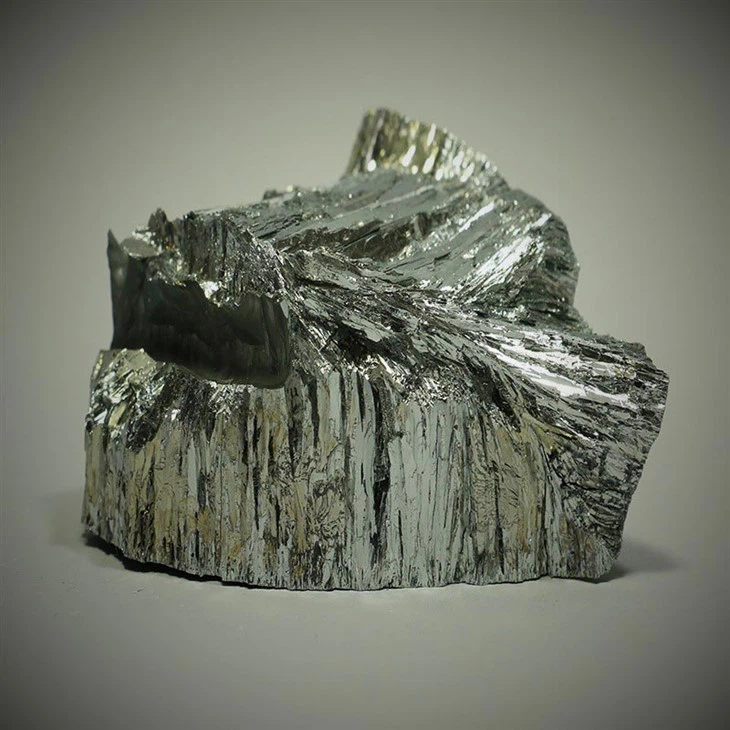

Shaanxi BLOOM Tech Co., Ltd. is one of the most experienced manufacturers and suppliers of bismuth sulfide cas 1345-07-9 in China. Welcome to wholesale bulk high quality bismuth sulfide cas 1345-07-9 for sale here from our factory. Good service and reasonable price are available.
Bismuth sulfide is a chemical substance with the molecular formula Bi₂S₃, dark brown powder. It is produced by direct combination of bismuth and sulfur, or by passing hydrogen sulfide into bismth salt solution. Insoluble in water, toxic, slightly radioactive, harmless to human body. it has the advantages of environmental friendliness, photoconductivity, and nonlinear optical response. It is widely used in solar cells, photodiode arrays, and infrared spectroscopy. It can also be used in the preparation of other bismth compounds, free-cutting steel additives, and microelectronics.

|
|
|

|
Chemical Formula |
Bi2S3 |
|
Exact Mass |
514 |
|
Molecular Weight |
514 |
|
m/z |
514 (100.0%), 516 (13.6%), 515 (2.4%) |
|
Elemental Analysis |
Bi, 81.29; S, 18.71 |

Bismuth sulfide (Bi2S3) is a common inorganic compound with a wide range of uses, the following is a detailed introduction:

Semiconductor materials
it is a stable material with important semiconducting properties, and has unique optical, electrical, thermal and other properties. It is widely used in the manufacture of optoelectronic devices, such as photosensitive devices, light-controlled switches, photoelectric sensors, photomultiplier tubes, etc.
Solid state laser
In semiconductor lasers, the optical properties of Bi2S3 have important applications in terms of device wavelength and energy density and laser wavelength stability. Bi2S3 doped yttrium aluminum garnet crystal is also an important material for manufacturing high-performance lasers.


Thermoelectric materials
Bi2S3 is a thermoelectric material widely used in thermoelectric field. Its thermoelectric properties have been extensively studied because of its not only strong thermoelectric properties but also low thermal conductivity and good chemical stability. Therefore, it is widely used in the preparation of thermoelectric devices, such as generators, coolers, etc.
Drugs for neuropathic pain
In recent years, Bi2S3 is being widely studied as a new drug for the treatment of neuropathic pain because of its remarkable therapeutic effect in the treatment of neuropathic pain with less toxic side effects.


Electrolytic production of bismuth
Bi2S3 is one of the main raw materials of metal bismth, and the extraction of bismth from Bi2S3 requires an electrolytic process, which is widely used in industrial production.
Costume jewelry
Bi2S3 crystal has a metallic luster and colorful appearance similar to natural chalcopyrite ore, therefore, it is widely used in the manufacture of costume jewelry.

Bismuth sulfide (Bi₂S₃) boasts a wide range of applications across multiple industries, leveraging its unique physical and chemical properties.

In the field of optoelectronics
Which stands out due to its semiconducting characteristics. It is widely used in solar cells, where it helps convert sunlight into electrical energy efficiently. Additionally, its nonlinear optical response makes it a valuable material for optoelectronic devices such as photodiode arrays and infrared spectroscopy instruments.
It also finds application in the production of other bismth compounds and as an additive in easy-to-cut steels, enhancing the machinability of these metals.
In the microelectronics industry
Its ability to improve the performance of electronic devices through doping and modification makes it a sought-after material for research and development.
Moreover, its potential in catalysis and environmental remediation is being actively explored. Its catalytic properties can be enhanced through modifications, making it a promising candidate for catalyzing chemical reactions and treating pollutants.

In summary, its versatility and unique properties position it as a key material in optoelectronics, materials science, and potentially other emerging fields, contributing to advancements in technology and sustainability.

Synthesis methods
- The chemical precipitation method involves the reaction between bismuth nitrate and sodium sulfide. The reaction takes place in an aqueous solution and results in the formation of product precipitate.
Bi(NO3)3 + 3 Na2S-> Bi2S3 + 6 NaNO3
- The reaction is carried out in several steps. First, bismth nitrate is dissolved in water to form a clear solution. Sodium sulfide is then added to the solution, and the mixture is stirred vigorously. The resulting product is a dark grey precipitate of it. The precipitate is then washed several times with deionized water and dried at a low temperature.
- The chemical precipitation method is a simple and cost-effective method of synthesizing it. However, the purity of the product is not guaranteed, and the reaction has to be carefully controlled to avoid the formation of impurities.
- The hydrothermal synthesis method involves the reaction between bismth salts and hydrogen sulfide in a high-pressure vessel. The reaction takes place at high temperatures and pressures, resulting in the formation of product crystals.
- The process involves dissolving bismth salts in water to form a solution. The solution is then transferred to a high-pressure vessel, where hydrogen sulfide gas is added. The mixture is then heated to a high temperature and pressure, and the reaction takes place. The resulting product is a crystalline form of it that can be harvested by filtration and washing.
- The hydrothermal synthesis method is a reliable method of synthesizing pure bismuth sulfide crystals. However, the process requires specialized equipment and is time-consuming.
- The solvothermal synthesis method involves the reaction between bismth salts and a solvent in a high-pressure vessel. The reaction takes place at high temperatures and pressures, resulting in the formation of product crystals.
- The process involves dissolving bismuth salts in a solvent such as ethylene glycol or dimethylformamide to form a solution. The solution is then transferred to a high-pressure vessel, where it is heated to a high temperature and pressure. The reaction takes place, and the resulting product is a crystalline form of it that can be harvested by filtration and washing.
- The solvothermal synthesis method is a reliable method of synthesizing pure product crystals. However, the process requires specialized equipment and is time-consuming.
- The spray pyrolysis method involves the reaction between bismth salts and a high-temperature gas stream. The reaction takes place in a specially designed spray nozzle, resulting in the formation of it particles.
- The process involves dissolving bismth salts in a solvent and then spraying the solution into a high-temperature gas stream. The temperature of the gas stream causes the solvent to evaporate, leaving behind it particles. The particles are then collected on a filter and washed with a solvent to remove impurities.
- The spray pyrolysis method is a simple and cost-effective method of synthesizing it particles. However, the process may require optimization to achieve the desired particle size and purity.
- The chemical vapor deposition method involves the reaction between bismth precursor molecules and sulfur vapor in a high-temperature reactor. The reaction takes place on a substrate, resulting in the formation of a thin film of it.
- The process involves heating bismth precursor molecules in a reaction chamber and introducing a flow of sulfur vapor. The sulfur vapor reacts with the precursor molecules on the substrate, forming a thin film of it. The film can be harvested by peeling it off the substrate or by using other techniques.
- The chemical vapor deposition method is a reliable method of synthesizing thin films of it with precise thickness and purity. However, the process requires specialized equipment and expertise.
In conclusion, it can be synthesized using several methods, each with its advantages and disadvantages. The choice of method depends on the desired purity, particle size, and application.

Bismuth sulfide, chemically denoted as Bi₂S₃, is an inorganic compound with distinct properties and applications in various fields. This compound belongs to the family of chalcogenides, specifically sulfides, where bismuth, a post-transition metal, forms bonds with sulfur, a nonmetal in the chalcogen group.
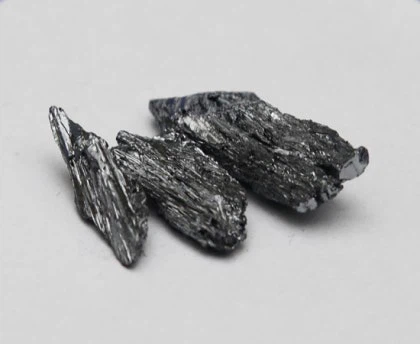
The most notable characteristic is its unique coloration. It commonly exists in a vibrant, iridescent black or dark brown form, which gives it a striking appearance in both powdered and crystalline states. This coloration arises from its crystalline structure and the way light interacts with the bismuth and sulfur atoms within the lattice.

The applications primarily in the field of pigments and optoelectronics. Due to its intense color and stability, it is used as a pigment in paints, coatings, and plastics, adding a distinct aesthetic quality to these materials. In optoelectronics, its semiconducting properties make it a potential candidate for use in photovoltaic cells and other devices that convert light into electricity. Research is ongoing to explore its full potential in these advanced technologies.
Furthermore, it has been studied for its potential catalytic properties. Certain modifications or doping with other elements can enhance its ability to catalyze chemical reactions, making it a target for applications in catalysis and environmental remediation.
From a synthesis perspective, it can be prepared through various methods, including precipitation reactions, solvothermal synthesis, and other chemical routes. These methods offer different degrees of control over the particle size, shape, and crystallinity of the resulting material, enabling the tailoring of properties for specific applications.

In summary, with its striking coloration and versatile properties, holds promise for diverse applications in pigments, optoelectronics, catalysis, and potentially other areas. As research continues, new uses and optimizations of this intriguing compound are likely to emerge.
FAQ
What is bismuth sulfide?
Bismuth sulfide (Bi2S3) is a direct bandgap semiconductor with a layered structure and a band gap of 1.3 eV. It has a high absorption coefficient, superior photocatalytic activity, and reasonable conversion efficiency. It is a potential material for thermoelectric research due to its low cost and low toxicity.
Is Bi2S3 a salt?
Bismuth sulfide (Bi2S3) is a binary salt also called bismuthinite and it is the most common form in which bismuth is found in nature.
How to get rid of bismuth sulfide?
Practice Good Oral Hygiene: Maintain a regular oral hygiene routine of brushing your teeth twice a day and flossing daily to help remove any residual bismuth sulfide from the surface of the tongue and prevent bacterial buildup.
Is bismuth toxic to humans?
Although bismuth is considered to be nontoxic and as much as 15 g can be tolerated by an adult, the long-term use of bismuth may result in side effects and even toxicity to human subjects.
Hot Tags: bismuth sulfide cas 1345-07-9, suppliers, manufacturers, factory, wholesale, buy, price, bulk, for sale